Best Coilovers for JDM Cars: A Buyer’s Guide for the 350Z, Skyline & S2000
If there’s one upgrade that transforms how a JDM car feels on the road, it’s coilovers. They lower your ride height, sharpen turn-in, and let you dial in the exact stance and handling balance you want. But with dozens of options on the market, picking the right kit for your Nissan 350Z, Skyline R32-R34 or Honda S2000 can be confusing. Here’s what actually matters.
What Coilovers Do (And Why They Beat Stock Suspension)
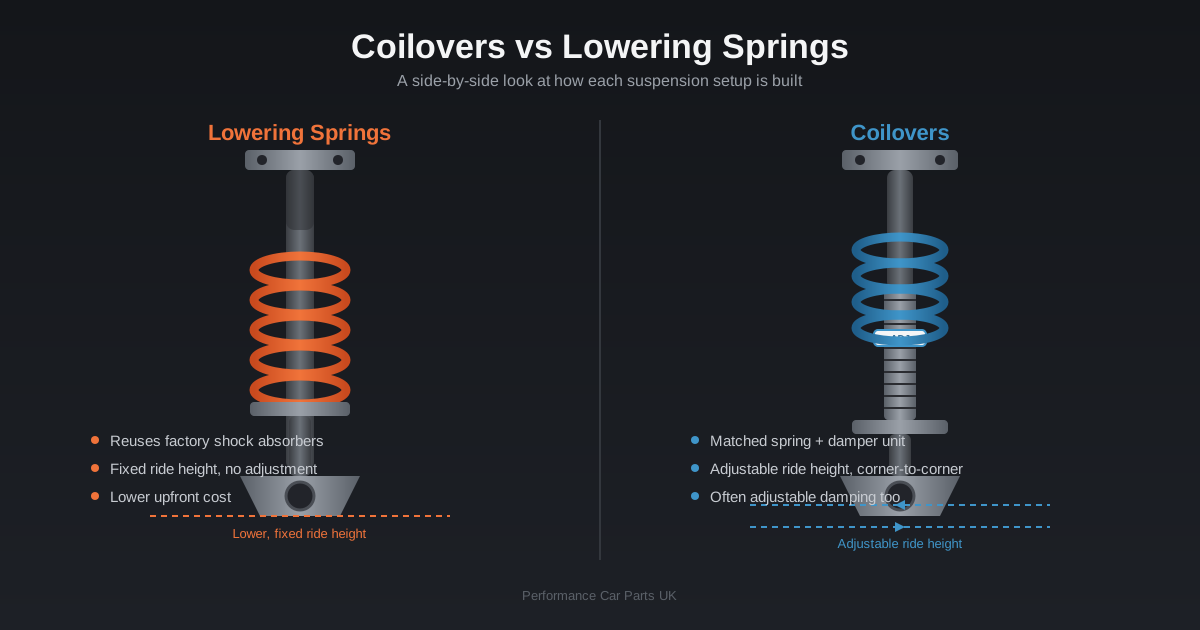
Standard suspension is built for comfort and cost, not performance. Coilovers combine the spring and damper into a single adjustable unit, letting you fine-tune ride height and, on better kits, damping stiffness too. That means less body roll in corners, a more planted feel under braking, and the ability to set your car up for exactly how you drive it — whether that’s a daily commute, spirited B-road driving, or track days.
Key Things to Check Before Buying
Ride height range. Some kits are designed purely for show-car stance, which can compromise handling and ground clearance. If you actually drive the car regularly, look for a kit with a sensible drop range (typically 25-45mm) rather than maximum slam.
Damping adjustability. Entry-level coilovers are often non-adjustable or single-way adjustable. Mid-range and above give you separate rebound and compression adjustment, which matters if you want to switch between comfortable street settings and firmer track settings.
Spring rates. Heavier cars (like the 350Z) need stiffer spring rates than lighter cars (like the S2000) to control body movement properly. A kit designed specifically for your chassis will have appropriate rates baked in — generic “universal” kits often don’t.
Pillow ball vs rubber top mounts. Pillow ball mounts reduce unwanted flex and improve steering feel and precision, at the cost of slightly more noise and vibration into the cabin. Rubber mounts are quieter but less precise. Track-focused drivers usually prefer pillow ball; daily drivers often prefer rubber.
Corrosion resistance. UK weather is brutal on suspension components. Look for coilovers with a zinc-plated or coated body, especially if the car is used year-round.
Matching Coilovers to Your Chassis
- Nissan 350Z/370Z — A heavier chassis benefits from a well-damped kit with stiffer rear spring rates to control the independent rear suspension properly.
- Skyline R32/R33/R34 — These respond exceptionally well to coilovers thanks to their already-capable multi-link suspension; a quality kit unlocks the chassis’s full potential for both grip and drift setups.
- Honda S2000 — Being front-mid-engined and lightweight, the S2000 needs less aggressive spring rates than heavier cars, but benefits massively from better damping control given how communicative the chassis already is.
Street vs Track Setup
If your car is mainly a daily driver, prioritise ride comfort and a moderate drop — an overly stiff, slammed setup will punish you on UK roads. If you’re building a track or drift car, prioritise adjustability, camber plate compatibility, and stiffer spring rates that can handle repeated hard cornering without excessive body movement.
Don’t Forget the Supporting Parts
Coilovers rarely work in isolation. Once you lower a car, factory bushings, top mounts, and alignment specs are often pushed outside their comfortable range. Budget for:
- A four-wheel alignment after fitting
- Camber arms or plates if you’re running a significant drop
- Fresh top mounts if you’re reusing an older coilover kit
Final Thoughts
Coilovers are one of the highest-impact upgrades you can make to a JDM chassis, but the “best” kit depends entirely on how you use the car. Match the spring rates and adjustability to your driving style rather than chasing the lowest ride height, and you’ll end up with a car that handles as good as it looks.
Browse our full range of coilovers fitted for 350Z, Skyline, S2000 and more.