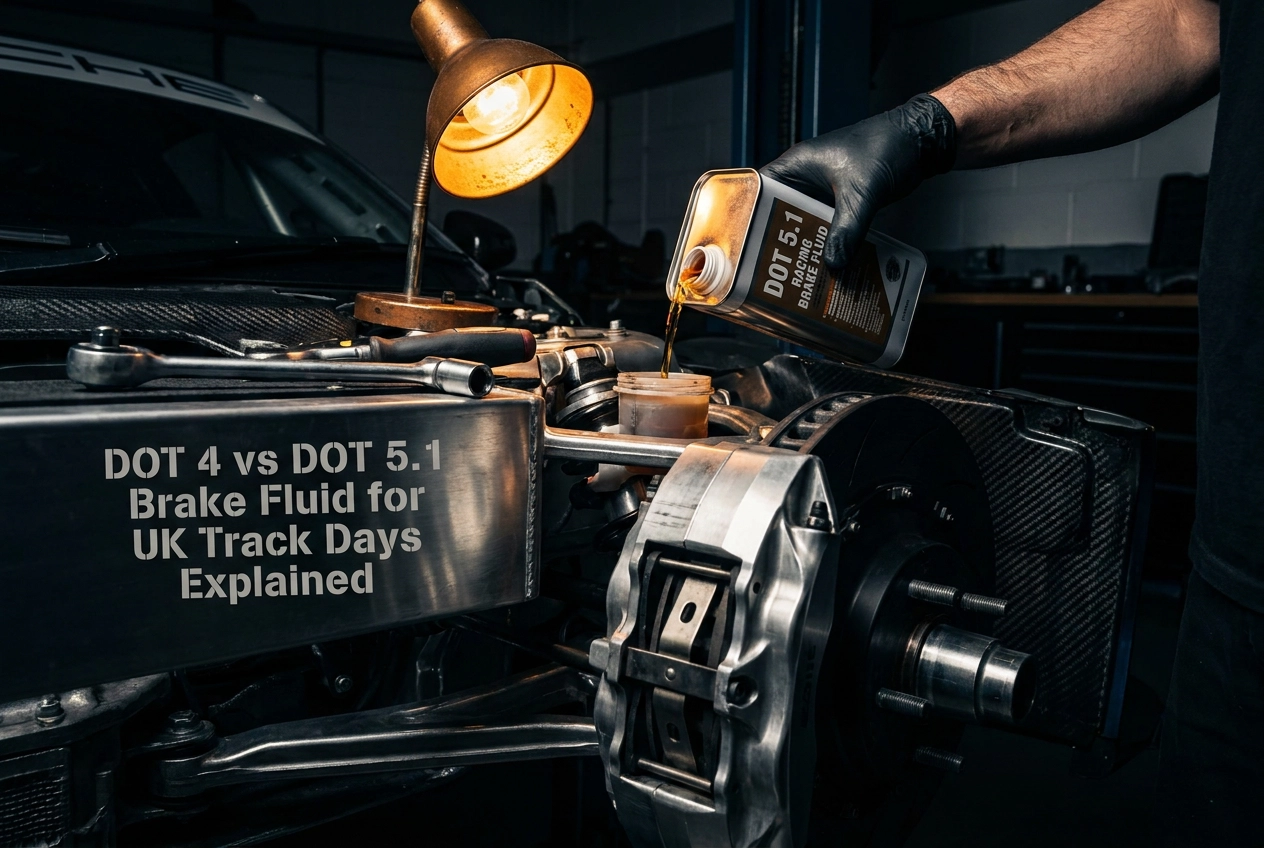
You are braking hard into a corner, the pedal is firm, and then it happens: the pedal goes long and soft, requiring a second pump to get the car slowed for the apex. It is a classic track day frustration. While it is tempting to blame the pads or the discs, the brake fluid is a prime suspect on a UK track day. Chasing the exotic, high dry-boiling-point fluid is often the wrong path, as it ignores the real enemy: moisture and the repeated heat cycling that track use puts the fluid through.
This tutorial will explain why fresh, high-quality DOT 4 fluid with a strong wet boiling point is usually the smarter choice for a typical track car than racing fluid with a flashy dry rating. We will break down what wet and dry boiling points actually measure, explain why DOT grades are minimum standards rather than a performance ladder, and clarify the real differences between DOT 4 and DOT 5.1. We will also examine why DOT 5.0 silicone fluid is a trap, cover the correct bleeding order, and provide a realistic replacement cadence to keep your pedal firm.
Why Long-Pedal Fade on UK Track Days Is Usually Fluid, Not Pads or Discs
A long or soft pedal that sinks and travels further for the same braking effort is a hydraulic symptom. In our experience pad fade feels different, with a firm pedal but weaker braking, so do not confuse the two.
Glycol-based fluids absorb atmospheric moisture over time, which is why wet boiling point is measured after defined moisture conditioning (DOT grades explained). That much is sourced. What follows is our practitioner view, not a measured finding: old, moisture-contaminated fluid is an often overlooked cause of soft-pedal fade on a typical UK track-day car, and a pedal that goes long after a few hard laps points first to the fluid rather than to the pads or discs.
Track use likely adds to this. Repeated heavy braking raises fluid temperature well above road driving, and fluid already near its wet boiling point has less margin than fresh fluid. We have no degradation rate to offer, so treat that as observation rather than measurement.
Practical consequence: before upgrading calipers, discs or pads, fit fresh correctly specified fluid and bleed the system properly. If the pedal firms, fluid was the fault. If it still fades with a firm pedal, investigate friction and cooling.
Dry vs Wet Boiling Point: What Those Numbers Actually Measure
The bottle presents two boiling points, and they measure different states. Dry ERBP is tested on new, unused fluid from a sealed container. It is the headline figure buyers compare, but it describes a condition the fluid begins leaving once it is opened and starts taking on moisture.
Wet ERBP is measured after the standard’s defined moisture-conditioning procedure. It is a laboratory result under controlled conditions, not a reading from your reservoir.
FMVSS 116 sets minimums, not guarantees: DOT 3 dry 205°C / wet 140°C; DOT 4 dry 230°C / wet 155°C; DOT 5 dry 260°C / wet 180°C. Real fluids may exceed these, so look for the wet figure on the product’s data sheet rather than relying on the headline number.
For DOT 4 that is a 75°C gap between regulatory minimums. A headline dry number therefore says little about behaviour after a year in a UK car. In our practitioner view, the wet figure is the better guide to whether the pedal stays firm on lap eight.
In a damp UK climate, with intermittent use and long periods at the wet end of the range, choose on wet boiling point and freshness. The dry number is a showroom specification; the wet number is the one your track day tests.
DOT Grades Are Minimum Standards, Not a Performance Ladder
The DOT number on the bottle is not a score. DOT grades are minimum-performance categories within a standard, not a quality ranking; treating DOT 5.1 as an automatic upgrade over DOT 4 starts many bad buying decisions.
FMVSS 116, the US federal requirement behind these labels, is a package of requirements rather than a single boiling figure. A fluid must satisfy the whole package, so one headline boiling figure is a poor comparison.
Vehicle documentation governs: use the fluid specified for the exact car in its current handbook or workshop information. A car that permits DOT 3 or DOT 4 is a vehicle-specific example; it does not create a general rule that any higher grade can be substituted anywhere. Check the handbook or reservoir cap and use the specification it names, not the number you prefer. The label is a specification to interpret, not a badge to upgrade.
DOT 4 LV is a separate category: low viscosity at low temperature, often tied to cars with electronic brake control systems. It is a distinct specification driven by system behaviour, not simply a better DOT 4, so do not substitute it into or out of a car that calls for it.
DOT 4 vs DOT 5.1: What Actually Changes
Treating DOT grades as minimum categories narrows the DOT 4 versus 5.1 question. Treat the two as close relatives rather than different technologies, confirm compatibility from the manufacturer’s data before mixing or switching, and never mix either with a fluid labelled DOT 5. The label difference is mostly about boiling-point figures. Check the specific product’s technical data sheet rather than assuming, because products within a grade can differ noticeably.
The catch, and this is our practitioner view rather than a measured finding: extra dry margin only helps while fluid is fresh. A two-year-old DOT 5.1 that has absorbed moisture can offer less usable margin than a fresh, well-specified DOT 4 in the same car. DOT 5.1 earns its premium where documentation specifies it, or where a driver does many hard sessions and refreshes fluid often enough to stay near the dry end. For a typical UK track-day car doing a handful of events a year, that premium is often money in the wrong place.
So choose on wet boiling point and freshness first, grade second, and keep the dry figure in its place, as above.
Why DOT 5.0 Silicone Fluid Is a Trap for Track Cars
DOT 5.0 is not simply the next step after DOT 5.1. It is generally sold as a silicone-based fluid, a different kind of product from the glycol grades, and, as the grades section showed, not a step up the same ladder. We cannot detail its behaviour here, so use the fluid manufacturer’s technical documentation for silicone specifics. Inside that limit, the practical rule is simple: silicone fluid does not belong in a hydraulic system built and specified for glycol fluid unless the vehicle documentation says so.
Topping up or swapping a DOT 4 system with it is not a shortcut to a higher boiling point. Its regulatory minimums of 260°C dry and 180°C wet look attractive on paper, but that is not a reason to use it. Never mix the two types and never top up one with the other. A conversion needs a full flush with the correct fluid and the vehicle documentation checked first.
If the car says DOT 4, buy the best fresh DOT 4 you can, not a silicone fluid. The high dry number on a silicone bottle answers a question your car is not asking. As elsewhere, fit what the system specifies.
Bleeding Order and a Practical Procedure
The bleed itself deserves care. Treat the order below as our practitioner view, then confirm it against the workshop information for your exact car. The principle is furthest caliper from the master cylinder first. For many cars that is a rear-first order such as rear left, rear right, front left, front right, but a UK right-hand-drive layout or diagonal hydraulic split can alter it. Label any list as typical, not universal.
A pressure bleeder is an alternative to the two-person pedal method and can make it easier to keep the reservoir from running low. Keep the reservoir topped up throughout; never let it drop far enough for air to enter the master cylinder. Use fluid from a sealed container, close bottles promptly, keep the reservoir and cap clean, and avoid reusing fluid that has been left open. Contamination during a bleed undoes the job.
Bleed each corner until clean, bubble-free fluid appears, then check pedal firmness before driving. Repeated top-ups between services are worth investigating, as they may point to a leak or another fault rather than normal consumption.
Realistic Replacement Cadence for a Track-Day Car
Fluid replacement is best planned around the calendar rather than the odometer. This cadence is our practitioner view built on moisture absorption, not an industry standard. The manufacturer’s schedule is the baseline and must be respected.
For a UK car doing several track days a year, replace fluid annually, ideally before the season, and consider a mid-season refresh if the calendar is busy. A lightly used road car with no track work can follow the manufacturer’s longer schedule. Annual changes make sense because absorption is continuous rather than mileage-based; heat cycling on track is likely to push fluid towards its wet range faster than road use; and usable capacity is dominated by the wet figure.
A fluid change is usually inexpensive next to pads or tyres, and it addresses a possible cause of a long pedal.
Override any calendar and bleed immediately if the pedal goes long under repeated braking, feels spongy or inconsistent, the reservoir fluid looks discoloured, the fluid age is unknown, or an event has involved unusually heavy braking.
UK Track-Day Brake Fluid Checklist
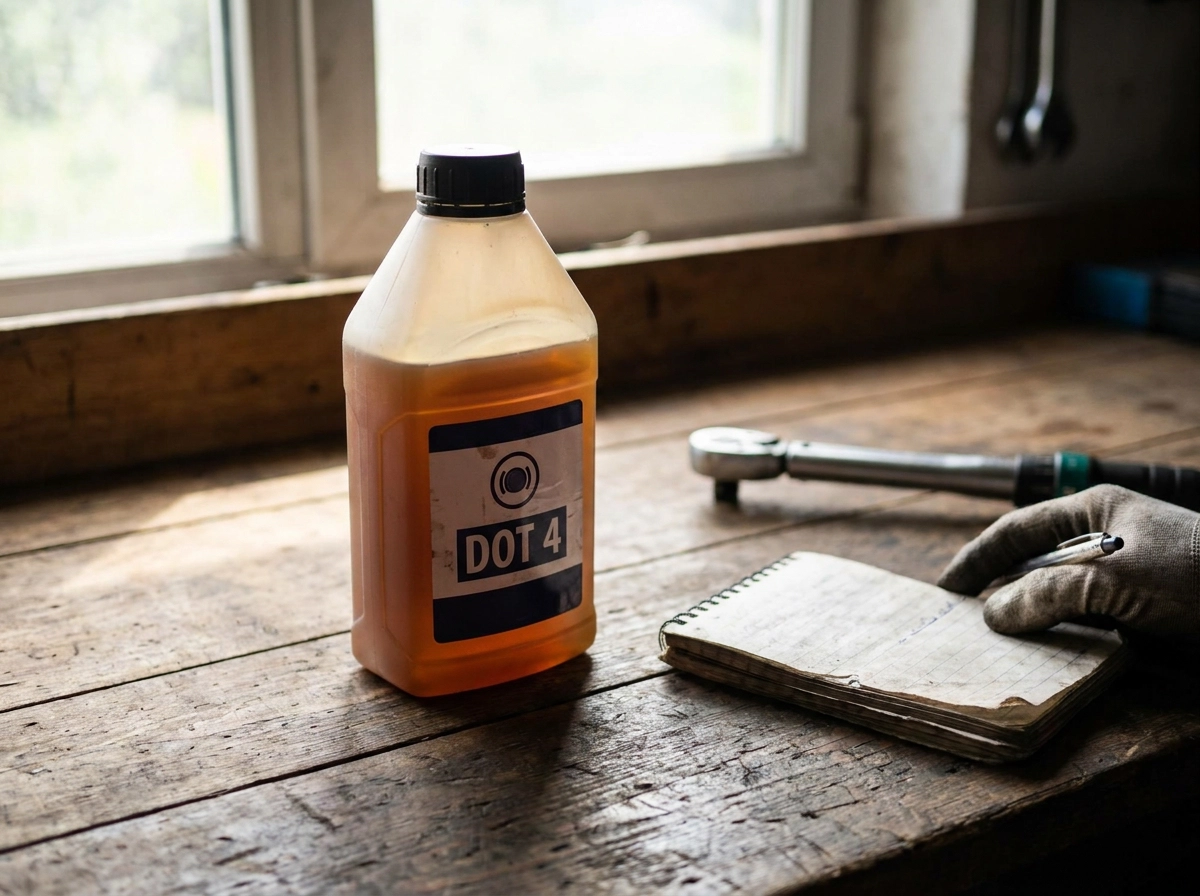
Use this as a checklist, not a shopping list.
- Check the vehicle’s own documentation first and note the exact specification it names, including whether it calls for DOT 4 LV. That check settles more arguments than any boiling-point comparison.
- Select on wet boiling point first, then freshness and correct specification; treat the headline dry figure as the least useful number. Buy brake fluid in a sealed container of known stock, not old shelf stock or an unmarked decanted bottle.
- Book the fluid change as its own job, not an add-on to a pad swap. Log the date on the reservoir cap or service record and keep a spare sealed bottle for pre-event top-ups.
- If the pedal stays long after a correct bleed with fresh fluid, look beyond the fluid, as covered earlier.
- For pads, discs or other brake parts, Performance Cars Parts is a UK-based, online-only retailer covering brakes and performance upgrades, with customer support by email and WhatsApp.
That sequence gives you a defensible baseline before the next event.
Key Takeaways Before Your Next Track Day
Before you book the next event, here is the short version. Old, moisture-loaded fluid is a prime suspect for long-pedal fade on UK track days, so refresh it before spending on bigger brakes. Fresh, correctly specified fluid with a strong wet boiling point beats an exotic dry figure that drifts into its wet range once the fluid has been in the car a while.
Check the vehicle documentation for the exact specification, including whether it calls for DOT 4 LV. DOT grades are minimum standards, not a ladder, and DOT 5.0 silicone is not a drop-in for a DOT 4 system.
Bleed furthest-to-nearest from the master cylinder, following the car’s own procedure, using sealed fresh fluid and keeping the reservoir clean and topped up. Replace fluid annually with regular track work, and immediately if the pedal goes long.
Shop related performance parts

Explore related products

Always check the individual product listing for your vehicle and engine before ordering.