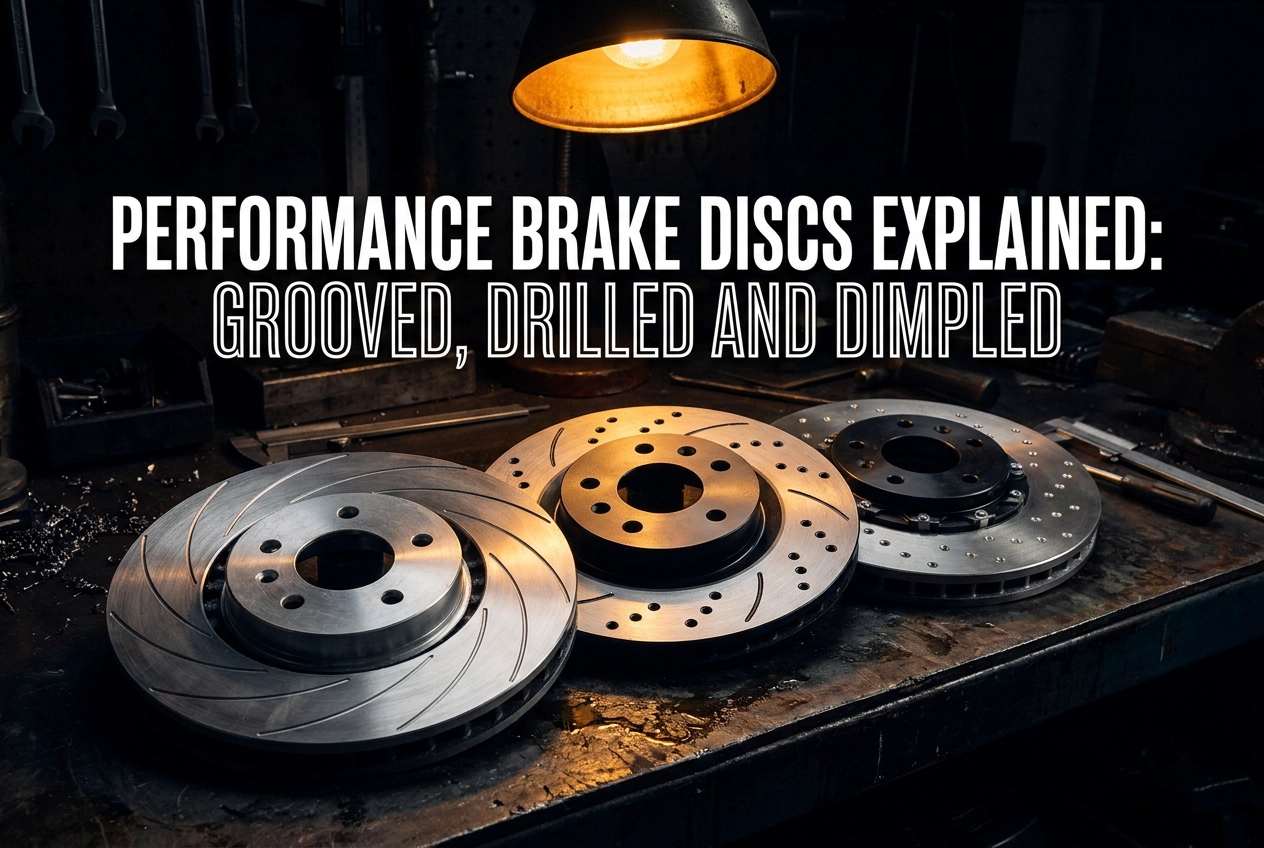
Most buyers shopping for performance brake discs encounter the same problem: a wall of marketing claims built around words like “improved bite,” “superior heat dissipation,” and “race-proven design,” with very little explanation of the engineering behind them. The result is that drivers routinely fit the wrong disc for their actual use case, accelerating wear, reducing consistency under load, and in some cases compromising safety.
Surface patterns are not cosmetic. Grooves, drill holes, and dimples each alter how a disc manages thermal energy, how gas escapes from beneath a heated pad, and how consistently friction is delivered across the disc face. Understanding those differences is the foundation of a sound buying decision.
This guide cuts through the noise. You will learn how each disc type behaves thermally, which pad compounds complement them, and how application demands should drive your choice. Whether your car is a daily driver that occasionally sees a track day, or a dedicated circuit machine, the sections that follow give you the technical framework to choose correctly, budget accurately for service intervals, and meet UK road legality requirements without compromise.
Why the Surface Pattern on a Brake Disc Actually Matters
A brake disc’s job is not simply to create friction. When you brake hard, the disc must absorb and shed the enormous thermal energy produced by converting the car’s kinetic energy into heat, and the surface pattern machined into its face is the primary mechanism controlling how that heat is managed between stops.
The temperature stakes are significant. Under a hard stop on a road car, rotor surface temperatures rise sharply. On a circuit car subjected to repeated heavy braking zones, temperatures climb significantly higher, with Formula SAE thermal modelling confirming disc temperatures can reach extreme levels under sustained racing loads. The surface pattern directly influences how quickly the rotor sheds that heat before the next braking event.
There is a second mechanism at work alongside heat. As the pad face presses against the rotor under load, gas released by the pad compound and fine debris accumulate at the contact interface, forming a thin low-friction layer. This is pad glazing and outgassing. Left uninterrupted, it progressively reduces bite and contributes to brake fade. Different disc surface patterns break up this layer at different rates, which is why two discs at identical temperatures can deliver noticeably different pedal response.
Much of the marketing language around performance brake discs conflates these three distinct functions: heat shedding, gas clearance, and pad bite consistency. The result is buyers choosing discs engineered for visual impact rather than their actual driving conditions.
The three dominant patterns available in the aftermarket, grooved, drilled, and dimpled, each address a specific problem within this thermal system. Understanding how disc type, pad compound, and your driving profile interact is the only reliable starting point for choosing correctly.
How Brake Discs Generate and Shed Heat: The Thermal Baseline
Every braking event is a heat conversion problem. The kinetic energy of a moving car is transformed almost entirely into thermal energy at the disc and pad interface, and the disc absorbs the majority of that heat. Because the disc has significantly greater thermal mass than the pad, it acts as the primary heat sink in the system, conducting energy away from the contact patch and radiating it into the surrounding airflow.
Grey cast iron, the standard material across most performance brake discs, has strong thermal conductivity, with graphite flake distribution influencing how efficiently heat moves through the disc body. The vulnerability of cast iron is not its conductivity but its sensitivity to uneven heat distribution. When temperature gradients develop between the disc surface and its interior, thermal stress can initiate micro-cracks that propagate under repeated cycling. This is a material behaviour issue, not a defect, and it is why surface pattern geometry matters beyond aesthetics.
The temperature ranges across different driving contexts are not incremental; they represent fundamentally different operating conditions.
- Street use: Even spirited road driving generates moderate temperatures at the rotor surface. At these temperatures, heat management is largely a secondary concern; consistent bite and a progressive pedal feel matter more than thermal shedding efficiency.
- Track day use: A single circuit session can push a road car’s discs to significantly higher temperatures. The same disc that performed adequately on public roads is now operating in a regime where shedding heat between braking zones becomes the limiting factor.
- Sustained racing: Dedicated circuit use compounds the problem further. The risk shifts from peak temperature generation to heat soak, where sustained heat accumulation during a racing stint builds faster than the disc can dissipate it, degrading friction consistency regardless of pad compound.
This three-tier thermal gap is the correct starting point for evaluating grooved, drilled, and dimpled disc designs. Each pattern was engineered to address a specific point on that temperature curve, which is why the choice of disc type must begin with an honest assessment of where and how the car is actually driven.
Grooved Brake Discs: How They Work and Who They Suit
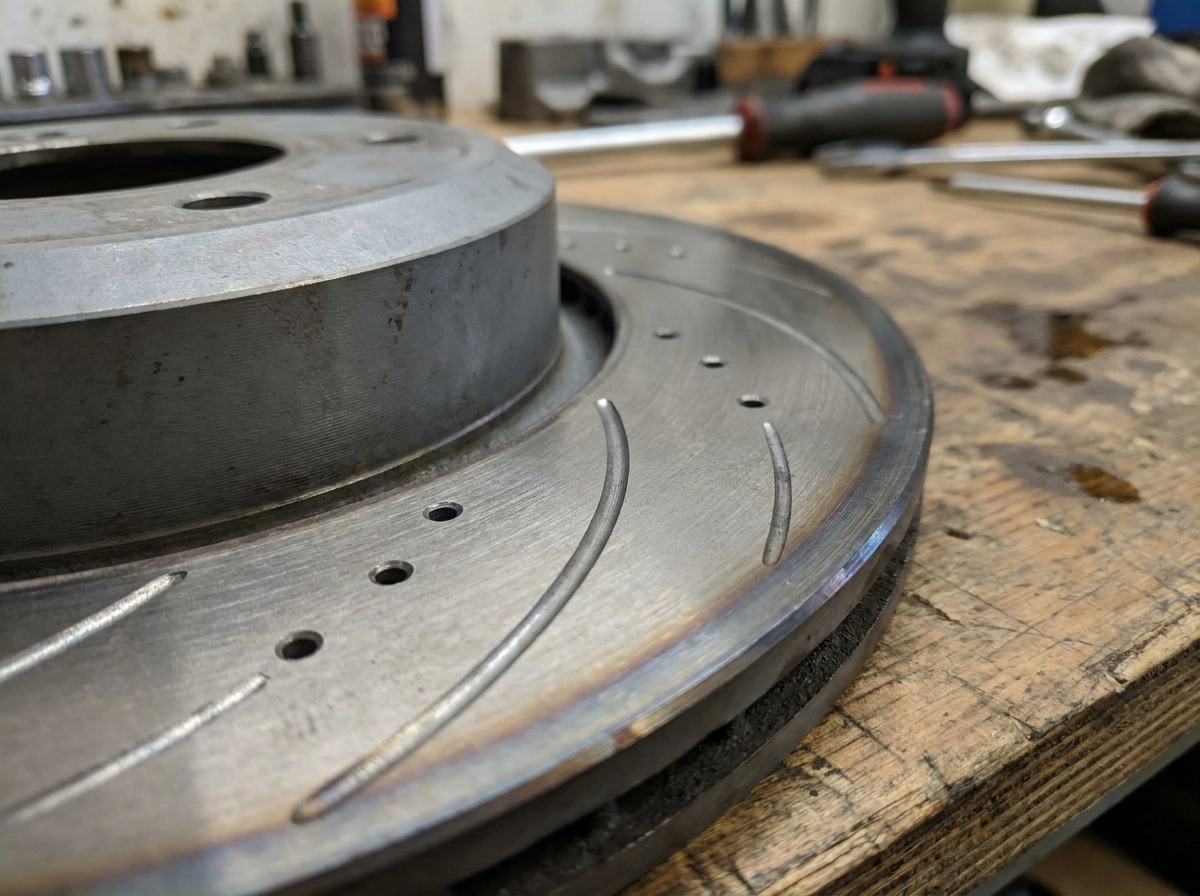
Grooves are machined channels cut into the disc face in radial, curved, or multi-directional patterns. As the pad sweeps across each channel, the groove edge shears away the glazed outer layer of friction material, continuously exposing fresh compound on every rotation. Simultaneously, gas, dust, and debris are channelled away from the contact patch and expelled at the disc’s outer edge, keeping the interface clean regardless of how hard the brakes are working.
The practical result is consistent bite throughout a braking event. On repeated heavy stops, where pad outgassing would otherwise build a compressible layer between pad and disc and cause progressive fade, the deglazed surface maintains friction without interruption. This is the defining performance advantage of grooved brake discs over a standard flat face.
Structurally, grooved discs are the most robust of the three pattern types. Because no material is removed from the disc body, the full cross-section of cast iron remains intact across the braking surface. This makes grooved discs significantly more resistant to the thermal cycling stresses that cause cracking in drilled variants, where each hole creates a stress concentration point.
The accepted trade-off is pad wear. Groove edges act as abrasive tools against the pad face, and pad life will be noticeably shorter than on a standard disc. Drivers running semi-metallic or sintered performance brake pads on circuit accept this as part of their running costs, not a product defect.
Grooved discs are the preferred choice for track day drivers and club motorsport competitors. They are fully road legal in the UK and require no modification, declaration, or exemption to pass an MOT, making them a practical dual-purpose upgrade for any driver splitting time between road and circuit.
Drilled Brake Discs: Performance Promise vs. Structural Reality
Where grooved discs preserve full structural material, drilled discs take the opposite approach: through-holes machined across the disc face remove material entirely. Drilled discs were developed for motorsport use, originally to address gas build-up under heat. Earlier pad formulations produced more outgassing than modern compounds, and that gas layer between pad and rotor reduced friction at the worst possible moment. Drilling gave it somewhere to escape.
The problem is that pad chemistry has moved on considerably. Modern pad chemistry has reduced outgassing substantially, though the gas-venting benefit of drilling is debated, which means the primary justification for drilling has diminished with current street and track pads. The holes remain, but the problem they solved is largely no longer the problem.
What does remain is the structural consequence. Each hole creates a stress concentration point in the cast iron, a notch effect that becomes critical under repeated thermal cycling. As the disc heats and cools through successive braking events, micro-cracks initiate at hole edges and propagate outward through the disc face. This is not an edge case; it is a predictable failure mode inherent to the geometry. Cast iron offers limited warning before fracture progresses, which on a circuit is a safety-critical outcome.
For road-only use on a car that never sees a track, the picture is more balanced. Some drivers report a marginally fresher initial bite in wet conditions, though comparative braking data on this is limited. Thermal stresses on the road remain modest enough that cracking typically develops slowly within a normal service interval, making drilled discs an acceptable, if not optimal, choice for the street.
The verdict is clear once track use enters the equation. If the car forms part of a broader performance parts upgrade that includes circuit driving, drilled discs carry structural risks that grooved or dimpled alternatives do not. The next section covers exactly that alternative.
Dimpled Brake Discs: The Compromise That Earns Its Place
Where drilled discs create a through-hole and introduce a structural liability, dimpled discs machine a shallow blind recess into the disc face. The material beneath each dimple remains intact, which preserves the continuous cast iron cross-section that drilling compromises.
That geometry still disrupts the boundary layer of gas and vaporised resin that builds between pad and rotor under heat. As the pad face passes over each recess, localised pressure drops briefly and the boundary layer breaks up, maintaining consistent contact and reducing the progressive fade that builds across repeated heavy stops.
Because the disc is not perforated, there is no stress-concentration notch for thermal cycling to exploit. Repeated heat cycles initiate micro-cracks at sharp discontinuities in the material; a blind recess presents a far lower stress riser than a through-hole. This makes dimpled discs a genuinely usable option for track day driving, where drilled discs carry a measurable cracking risk.
The pad wear trade-off is more favourable than with grooved discs. Deep groove edges act as cutting tools against the pad face on every revolution. Dimple edges are shallower and shorter in contact length, producing noticeably less abrasive wear. Drivers running a road car to occasional track days can use one set of pads across a full season without the accelerated consumption that a fully grooved setup demands. Matching the right compound matters here; the guide to brake pad compounds covers which friction materials suit this dual-purpose use case.
Gas venting efficiency sits between a flat disc and a grooved disc. Dimples do not channel gases outward the way a radial groove does, but they create enough local pressure variation to reduce gas film build-up compared to a standard face under sustained heat.
For a road car covering two to five track days per year, dimpled discs represent the most coherent choice: better bite consistency than standard, lower structural risk than drilled, and lower pad wear than grooved.
Grooved and Drilled Combined: When More Is Not Better
Where dimpled discs represent a structural compromise that earns its place, combination drilled-and-grooved discs represent one that rarely does. They are among the most heavily marketed options in the performance brake disc category, positioned as the logical culmination of both technologies. The reality is more troubling.
The structural problem is one of compounding vulnerabilities. Each drilled hole already creates a stress concentration point in the cast iron, where cyclic thermal loading initiates micro-cracks at the hole edge. Adding machined grooves introduces further discontinuities adjacent to those existing stress risers. Crack propagation pathways multiply not because grooves are inherently dangerous in isolation, but because placing them near through-holes removes the uninterrupted material that would otherwise arrest crack growth. Thermal fatigue research supports this: cyclic tensile and compressive stresses during braking and cooling repeatedly load these weak points until cracks extend radially outward.
At street temperatures (covered in the thermal baseline section), cracking risk is modest. Combination discs can perform adequately here, and their improved wet-weather bite is genuine.
The calculation changes with track exposure. A driver completing three or more track days per year should treat combination discs as a cosmetic product carrying a structural penalty, not a performance upgrade. Grooved-only or dimpled discs are the lower-risk choice at that usage frequency.
Before purchasing, check the manufacturer’s stated application carefully. Most reputable suppliers specify combination discs for road and light performance use only. If that caveat is absent from the listing, that absence is itself informative. The principle of matching specification to actual use case is covered in the aftermarket wheels buyer’s guide for UK performance cars.
Matching Performance Brake Pads to Your Disc Type
Disc selection and pad compound selection are not separate decisions. The friction interface is a system; fitting an incompatible pad to a performance disc degrades bite consistency and accelerates wear on both components simultaneously.
Organic and NAO pads are the softest option. Their relatively compliant friction material conforms across groove and dimple edges without excessive edge wear, making them a workable choice for road use on grooved or dimpled discs. The limitation is thermal: organic compounds reach their performance ceiling at relatively modest temperatures, making them unsuitable for circuit use regardless of the disc pattern beneath them.
Semi-metallic pads are the most practical compound for a road-to-track-day application. Their metallic content raises the effective operating temperature range while preserving enough compliance for daily driving. On grooved or dimpled discs, they deliver the friction consistency needed to take advantage of the continuously deglazed contact surface the pattern creates. For drivers attending one to four track days per year, a quality set of brake pads in a semi-metallic compound paired with grooved or dimpled discs is the most sensible specification.
Sintered or fully metallic pads are designed for sustained high-temperature circuit use and pair well with grooved discs in dedicated track and racing applications. The trade-off is a mandatory warm-up period; sintered compounds require a proper warm-up period before they generate adequate friction, creating a real cold-road hazard for daily driving.
A pre-matched disc-and-pad set beds in faster and removes compatibility uncertainty.
Always verify the pad manufacturer’s stated temperature ceiling against your realistic brake temperatures. A pad rated to 450 degrees Celsius will fade rapidly on circuit, regardless of how well the disc manages heat beneath it.
Which Disc Type Should You Actually Buy: A Use-Case Guide
With disc type and pad compound matched, the remaining decision is which combination suits your actual driving profile.
Road-only drivers seeking better wet-weather bite and a cleaner pedal feel should choose dimpled or lightly grooved discs paired with a semi-metallic pad. The performance gain over standard discs is meaningful; the pad wear penalty is modest and manageable within normal service intervals.
Road drivers attending one or two track days per year should choose grooved or dimpled discs. Grooved discs prioritise track bite; dimpled discs reduce total running costs, both suit this profile. Both are structurally sound choices for this frequency of track exposure.
Regular track day drivers running five or more sessions per year should treat grooved discs paired with a dedicated track pad as the minimum acceptable specification. At this frequency, the structural advantage of grooved over drilled becomes financially significant: a cracked disc cannot be skimmed or resurfaced and must be replaced immediately, turning a budget decision into an unplanned expense.
Club motorsport and circuit racing drivers are in a different product category entirely. Racing brake discs with deep grooves, high-carbon cast iron or composite construction, and sintered pads are the correct specification. These should be sourced as a matched system, not assembled piecemeal from road-performance components.
Drivers drawn to drilled discs for aesthetic reasons should be honest about whether the car will see track time. Drilled discs are road-legal and visually distinctive; on a road-only car they perform adequately. If the car will be tracked, factor the cost of early replacement into the decision from the start.
One upgrade that applies across every category: check your brake fluid. Standard DOT 4 has a relatively modest dry boiling point, check the fluid manufacturer’s specification, and under sustained track use that threshold is reachable, and vapour lock fade will occur regardless of how well the discs and pads perform.
UK Road Legality, MOT Compliance and Insurance Considerations
Once you have settled on the right disc type for your application, the regulatory picture is straightforward but worth understanding precisely before you buy.
All three disc types, grooved, drilled, and dimpled, are road legal in the UK provided they satisfy the minimum thickness and structural integrity requirements set out in the Road Vehicles (Construction and Use) Regulations 1986. The regulations do not prohibit surface patterns; they require that brake components meet a defined structural standard.
The MOT test enforces this in two ways: inspectors measure disc thickness against the manufacturer’s minimum specification, and they conduct a visual check for cracking. A drilled disc that has developed radial cracks propagating from hole edges will fail on structural grounds. The failure is not triggered by the drilling itself but by the crack, which is why a freshly fitted drilled disc passes without issue and a thermally fatigued one does not.
On insurance, aftermarket performance brake discs do not automatically void your policy, but they constitute a declared modification. Fitting them without notifying your insurer creates a material non-disclosure that can void a claim, particularly where the modification is relevant to risk. Declare the change in writing and keep the confirmation.
Track day insurance operates separately. Many specialist policies require that the vehicle’s braking system meets the circuit’s own minimum specification, which is defined in that venue’s Standing Regulations and differs between circuits. Check the specific venue requirements before each event, not just at the start of the season.
Motorsport competitors licenced under Motorsport UK must consult the Technical Regulations for their specific series. Some classes restrict disc pattern type or pad compound; non-compliance results in exclusion, not a warning.
Retain the manufacturer’s product documentation, including part number and specification sheet, for every set of performance brake discs you fit. This evidence simplifies insurance declarations and resolves any queries at circuit safety or noise checks without delay.
Wear Rates, Service Intervals and Total Cost of Ownership
Beyond the regulatory considerations, the practical cost of ownership deserves equal attention before you commit to a disc type.
Pad wear is the most significant ongoing variable. Grooved discs accelerate pad wear noticeably more than standard discs; the groove edges continuously shear the pad face, which is precisely what delivers consistent bite, but the material cost is real. Dimpled discs are more moderate, producing moderately more pad wear than standard, sitting between the milder wear of drilled discs and the more aggressive consumption of deeply grooved variants. Budget accordingly when calculating your total upgrade cost.
Disc longevity depends heavily on how the car is used. A road-specification grooved disc on a car that never sees a circuit can last considerably longer on a road-only car. The same disc on a car attending monthly track days may need replacement significantly shorter on a car attending regular track days, depending on pad compound and driving intensity. Drilled discs introduce a separate cost risk on any tracked car: radial cracking from hole edges is a known failure mode under repeated thermal cycling. A cracked drilled disc must be replaced immediately, an unplanned expense that can exceed the initial saving.
Purchasing a brake discs and pads set as a matched unit typically reduces total cost compared to sourcing components separately. Matched sets bed in faster because the compound and surface pattern are calibrated together, shortening the mileage during which friction performance is suboptimal.
One cost that consistently goes unbudgeted is brake fluid. A high-specification DOT 4 or DOT 5.1 fluid should be replaced at each track event, as absorbed moisture lowers the boiling point significantly. That recurring cost belongs in any honest total-cost calculation alongside pads and discs.
How to Bed In Performance Brake Discs Correctly
Getting maximum performance from your new discs and pads depends on one step that cost calculations alone cannot capture: proper bedding-in.
When you fit a new disc and pad combination, the pad compound must deposit a thin, even transfer film across the entire disc face. That transfer layer is the actual friction interface during braking; the disc and pad surface are secondary. Skip or rush this stage and you get patchy deposits instead, which create the uneven contact that causes vibration, judder, and inconsistent pedal bite from the first hard stop.
The standard road bedding sequence involves 8 to 10 progressively harder stops from 40 to 60 mph, reducing speed to around 5 to 10 mph rather than stopping completely. Allow 5 to 10 minutes of gentle driving between each stop to dissipate heat before loading the brakes again. The full sequence takes less than an hour on a quiet road but establishes the transfer layer correctly across the whole disc face.
Surface pattern does not change the procedure, follow the same sequence regardless of disc type.
Critical point: do not come to a complete standstill immediately after a hard stop during the bedding sequence. Holding stationary pads against a hot disc concentrates pad material at a single contact patch. Those hotspots are the primary cause of brake judder on new performance discs, and they appear within the first few stops if you ignore this.
After road bedding, treat the opening 10 to 15 minutes of your first track session as an extended warm-up, using progressively harder braking zones rather than immediately driving at full pace. Road temperatures alone cannot complete the high-temperature transfer layer; this final phase, at circuit-level heat, seals it properly.
Choosing the Right Performance Brake Disc: Key Takeaways
Once the discs are bedded and the system is ready, the choice that matters most has already been made.
No single disc pattern is universally superior. Grooved, drilled, and dimpled designs each address a specific problem, and the correct selection is determined entirely by how and where the car is driven.
- Grooved discs deliver the most consistent bite on track through continuous pad deglazation and strong structural integrity under repeated thermal cycling. The trade-off is noticeably accelerated pad wear; budget for more frequent pad replacements.
- Drilled discs are best suited to road-only use, where their wet-weather bite improvement and appearance are genuine benefits. Drilled discs are not suitable for regular track use; thermal cycling initiates radial cracking at hole edges, and a cracked disc must be replaced without warning.
- Dimpled discs offer the most practical solution for a road car that sees occasional track days. They improve gas clearance and bite consistency over a standard disc, resist the cracking risk associated with drilling, and produce less pad wear than a deeply grooved setup.
Pad matching is not optional. Performance brake pads must be selected for the disc type and the expected operating temperature range. A pre-matched disc-and-pad set shortens bedding and removes compatibility risk.
Two compliance checks apply before fitting. Declare any brake modification to your insurer; failing to do so risks voiding a claim. Then confirm legality against the relevant track day venue regulations or motorsport series technical regulations, because road-legal and competition-legal are separate standards that may each apply depending on how the car is used.