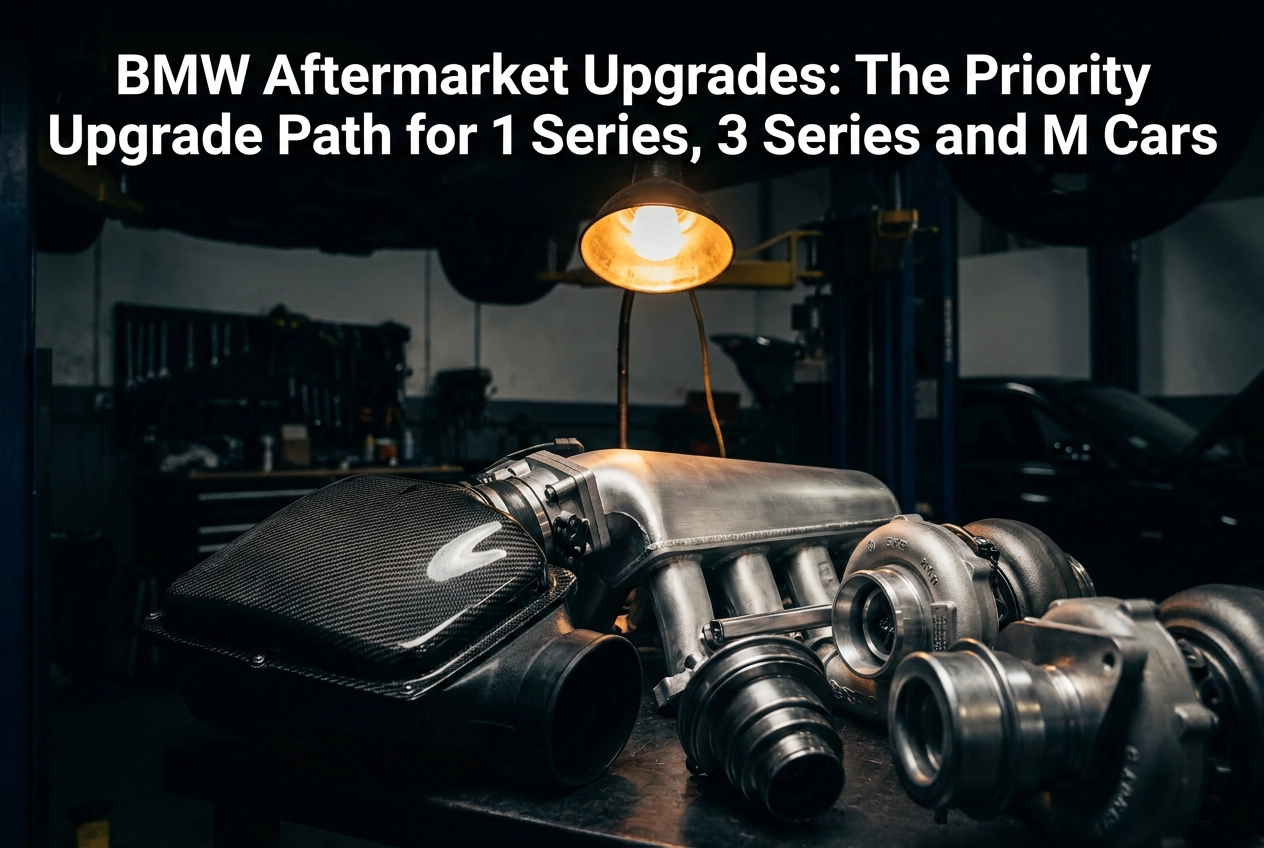
Spending money on BMW aftermarket upgrades in the wrong order is one of the most common and costly mistakes enthusiasts make. A stage 3 turbo kit on an engine with marginal oil system health, or a power-focused remap on suspension that cannot handle the load, produces results that disappoint and components that wear prematurely.
BMW’s turbocharged platforms, particularly the N55, B58 and S55, respond exceptionally well to aftermarket work. These engines are genuinely capable of reaching 400hp, 500hp and beyond 800hp with the right modifications applied in the right sequence. That last part is what separates enthusiasts who get consistent, reliable performance gains from those who chase peak numbers and end up with an expensive, unreliable car.
This guide structures BMW aftermarket upgrades as a prioritised path, from the foundational work that protects your investment through to forced induction changes and stage 3 builds. You will learn which platform you are actually working with, where your budget delivers the strongest returns, and exactly why sequence determines results. Whether you own a 1 Series, 3 Series or an M car, this is the order that makes every pound count.
Why Upgrade Sequence Determines Results on BMW Platforms
BMW’s N55 and B58 inline-six engines are widely regarded among enthusiasts as highly modification-receptive turbocharged platforms. That receptiveness, however, cuts both ways. Push forced induction changes onto a weak oil or intake foundation and you accelerate wear rather than performance, turning what should be a reliable power gain into an expensive engine repair.
The sequencing mistakes that cost enthusiasts the most money are rarely dramatic. Fitting a Stage 2 map before addressing blow-by with a catch can allows crankcase vapours to carbon-load the intake tract under elevated boost, compounding the problem with every subsequent modification. Chasing peak power figures without first addressing suspension compliance means a track-day car that is faster on paper but slower and less safe in practice.
Experienced tuners structure BMW aftermarket upgrades into a defined hierarchy: Stage 1, Stage 2, Stage 2 Plus, and Stage 3. Each tier is not simply a power level; it is a set of reliability and airflow margins that the next tier depends on. Understanding what separates each stage from the next is the foundation of a build that delivers results without expensive rework.
The budget case for sequencing is concrete. A disciplined staged build can bring an N55 F30 to 400hp for a fraction of the cost of recovering from a poorly sequenced Stage 3 attempt that fails mid-build due to skipped foundations.
Know Your Platform Before Spending: N55, B58 and S55 Differences
That sequencing logic only works if you know exactly which engine sits under your bonnet, because the N55, B58 Gen 1, and S55 follow meaningfully different upgrade paths with different ceilings and different budget implications. This guide covers the full priority path across the F20/F21 1 Series, F30/G20 3 Series, and M Car variants including the F87 M2 and S55-powered M3/M4. Where platforms diverge in compatibility or upgrade logic, those differences are called out directly.
The Three Platforms at a Glance
N55 (F20 1 Series, F30 3 Series pre-2016, F87 M2): single twin-scroll turbo, port injection only. On a stock block with the correct supporting modifications in place, there is a meaningful power ceiling on stock internals. Beyond Stage 2, the risk profile rises sharply without internal engine work; the port-only fuelling system and factory internals become the limiting factors.
B58 Gen 1 (G20 330i/M340i, F87 M2 Competition): dual injection combining direct and port delivery, stronger factory internals, and a more capable high-pressure fuel pump as standard. A cast turbo upgrade such as the Pure 600 pushes the Stage 3 ceiling beyond 600hp. The B58 Gen 1 arrives from the factory closer to its own limits than the N55, which is precisely why it tolerates more aggressive staged investment. For a thorough overview of what Stage 3 tuning realistically involves across these platforms, the linked guide sets the right expectations before you commit budget.
S55 (F80 M3, F82 M4): twin-turbo architecture that follows entirely separate upgrade logic. The S55 follows separate upgrade logic and its aftermarket has matured in ways that make single turbo conversions an increasingly discussed high-power route.
Why This Affects Your Budget Directly
B58 Gen 1 justifies higher spend at each stage because the factory floor is higher. Pushing an N55 past Stage 2 without addressing internals carries measurably greater risk of bearing and bottom-end stress under sustained boost.
There is also a fitment dimension that matters specifically for UK buyers. UK buyers should verify RHD fitment compatibility for any turbo system before purchasing, as packaging constraints can vary by chassis generation.
Before purchasing any BMW aftermarket upgrade, confirm your exact engine code. The same model year and nameplate can carry different engines depending on market and trim level, and a part listed for the F30 335i does not automatically fit every F30 with a six-cylinder badge.
Priority 1: BMW Engine Oil and Oil System Foundations
With your platform identified, the first money you spend should not touch a turbo, a map, or an intake. It should go on oil.
Both the N55 and B58 run tight bearing clearances and sustain high oil temperatures under boost. On a stock car driven hard, or any modified example running elevated boost pressure, oil grade and change interval are the primary defence against premature bearing wear. No subsequent modification is protected unless this foundation is correct.
Minimum specification for any turbocharged BMW is BMW LL-04 or LL-01 FE approved full-synthetic oil. For a modified or track-used engine, step up to a 5W-40 or 10W-60 motorsport-grade oil. The higher viscosity grade maintains a thicker protective film at elevated temperatures, where a 0W-30 long-life oil designed for fuel economy begins to shear under sustained boost loads.
On the N55 specifically, fit an oil catch can before adding any other modification. The N55 uses port injection only, which means crankcase vapours recirculating through the PCV system deposit carbon directly onto intake valves. There is no fuel wash to clear it. Each stage of tuning adds boost pressure, which increases blow-by volume and accelerates carbon accumulation. A catch can intercepts those vapours before they reach the intake tract. Addressing this at Priority 1 prevents a problem that compounds invisibly across every subsequent stage.
For any car driven on track, an oil cooler belongs on the list before Stage 2 tuning. Elevated oil temperatures under sustained boost degrade film strength, and both the N55 and B58 can reach those temperatures under circuit conditions. An oil cooler keeps temperatures in a manageable range and protects turbo bearings during cool-down.
Oil analysis kits, available as part of a broader range of performance upgrades that transform how your car drives, allow you to extend or shorten change intervals based on actual oil condition rather than fixed mileage. Serious enthusiasts increasingly use them to protect engines that have already had significant money spent on them.
Performancecarsparts.co.uk stocks performance engine oils and oil system components suited to modified BMW platforms, making this the most accessible and highest-value starting point on the entire upgrade path.
Priority 2: Intake Upgrades and Induction System Optimisation
With the oil system secured, intake upgrades become the logical next step, and the one that directly determines how much performance a subsequent remap can actually deliver.
On both the N55 and B58, a cold air or behind-the-grill intake reduces intake air temperature, sharpens turbo spool responsiveness, and creates the airflow headroom a Stage 1 map needs to hit its full gain figure. Fitting a remap before addressing intake flow is working backwards; the map will be calibrated against an airflow ceiling that the factory intake imposes.
Choosing between Stage 1 and Stage 2 intake systems
Stage 1 panel filter replacements are the lowest-risk entry point. They improve filtration flow with no structural changes to the airbox and no additional fault codes. Gains are modest, but the modification is reversible and carries zero fitment risk.
Stage 2 behind-the-grill intakes are a more meaningful upgrade. By drawing air from in front of the radiator rather than from the warm engine bay, they provide genuine heat separation and measurably better flow. These systems are available across the N55, N20, F10, F15, F25, and F26 platforms, making them one of the more universally applicable intake and induction upgrades in the BMW aftermarket.
On the B58, inlet manifold upgrades do not enter the picture until Stage 2 Plus and beyond, when higher boost pressures and increased fuel delivery rates expose the factory manifold as a restriction. Below that threshold, the standard manifold is not a limiting factor.
Two mistakes that regularly cost money
First: fitting a high-flow intake on the N55 without a supporting remap. On some N55 configurations this triggers lean fault codes, masking any performance benefit and creating a diagnostic problem that requires a map revision to resolve properly.
Second: assuming platform interchangeability. A part listed for the F30 N55 is not guaranteed to fit the G20 B58. The engine bays, airbox locations, and MAF sensor positions differ. Incorrect induction fitment affects both measured performance and long-term reliability, so verify the exact engine and chassis code before purchasing.
The induction noise improvement is worth noting as a secondary benefit. Many 1 Series and 3 Series owners find the factory intake undersells the inline-six acoustically; a Stage 2 system changes that noticeably.
Priority 3: Stage 1 ECU Remap, the Performance Multiplier
With the intake system in place, the foundations are set for the highest-value modification in the entire sequence.
A Stage 1 ECU remap works within the tolerances of stock hardware, requiring no further physical changes beyond the intake already fitted. That simplicity is precisely what makes it the best performance-per-pound modification available, but it also means the map is only as reliable as what sits beneath it. Oil system health and intake airflow come first for a reason: the remap will exploit every weakness in those foundations.
The gains are substantial across both platforms. Stage 1 maps on the B58 M340i deliver meaningful gains over the factory baseline, with typical Stage 1 results in the +40-60 hp range. The N55 responds even more dramatically: gains of 50-70bhp are realistic depending on the baseline variant.
Tuner selection matters more than the headline figure. Platform-specific calibration experience is the critical variable, not claimed peak power numbers. Platform-specific calibration matters; a map not tailored to the N55’s tolerances risks placing excessive load on engine internals under sustained high-RPM use, a risk that a reputable tuner avoids by operating within safe margins. Before committing, it is worth reading through Stage 1, Stage 2 or Stage 3? to understand what each tier actually involves before purchasing.
Treat a Stage 1 map as a commitment, not a conclusion. Increased boost and revised timing raise thermal and mechanical loads across the drivetrain. Supporting modifications at subsequent stages become more urgent as a direct result, making brakes and suspension the logical next priority rather than an optional addition.
Priority 4: Brakes and Suspension Before Any Further Power Upgrades
With Stage 1 in place, the next limiting factor is chassis control, not engine output.
This is the stage most commonly skipped. Enthusiasts eager for Stage 2 power figures bypass brakes and suspension entirely, then discover that more power into the same corners produces slower lap times and higher risk, not faster ones. Adding output to a car that already struggles under braking or through corner entry does not solve the underlying handling deficit; it magnifies it.
Suspension first, for track use
On both the F30 and F87 chassis, load transfer and corner-entry stability are the primary limiters of fast lap times at club motorsport level, not peak power. Coilovers, uprated anti-roll bars, and adjustable top mounts address these directly by reducing body roll, improving weight transfer predictability, and sharpening front-end response. The F87 M2 has a specific case for prioritising the anti-roll bar upgrade: the chassis carries a tendency toward front-axle understeer under power, a characteristic that worsens as output climbs. Stiffer ARB rates correct this before it becomes a handling liability on track.
Brakes must keep pace with power
A 400hp F30 on standard brake components will overheat rotors under sustained track use. OEM-spec brake fluid has a lower dry boiling point than dedicated high-temperature fluids, and repeated hard braking generates vapour that compresses in the lines, causing fade precisely when the car demands the most stopping force. Uprated pads, braided stainless lines, high-temperature brake fluid, and larger discs where the caliper bracket allows are the minimum required configuration for any modified BMW used on circuit.
For road-only builds, this stage can run in parallel with Stage 2 tuning rather than strictly preceding it. For any car attending a track day, it is a non-negotiable prerequisite.
Keeping the build consolidated
Splitting suspension and brake orders across multiple suppliers adds complexity and delays the build. The brakes and suspension range at performancecarsparts.co.uk covers uprated pads and high-temperature fluid for modified BMW platforms, addressing both upgrade categories from a single source.
Priority 5: Stage 2 Tuning, Intercooler Upgrades and Cooling System Work
With chassis and braking capability addressed, Stage 2 is where the hardware investment begins in earnest.
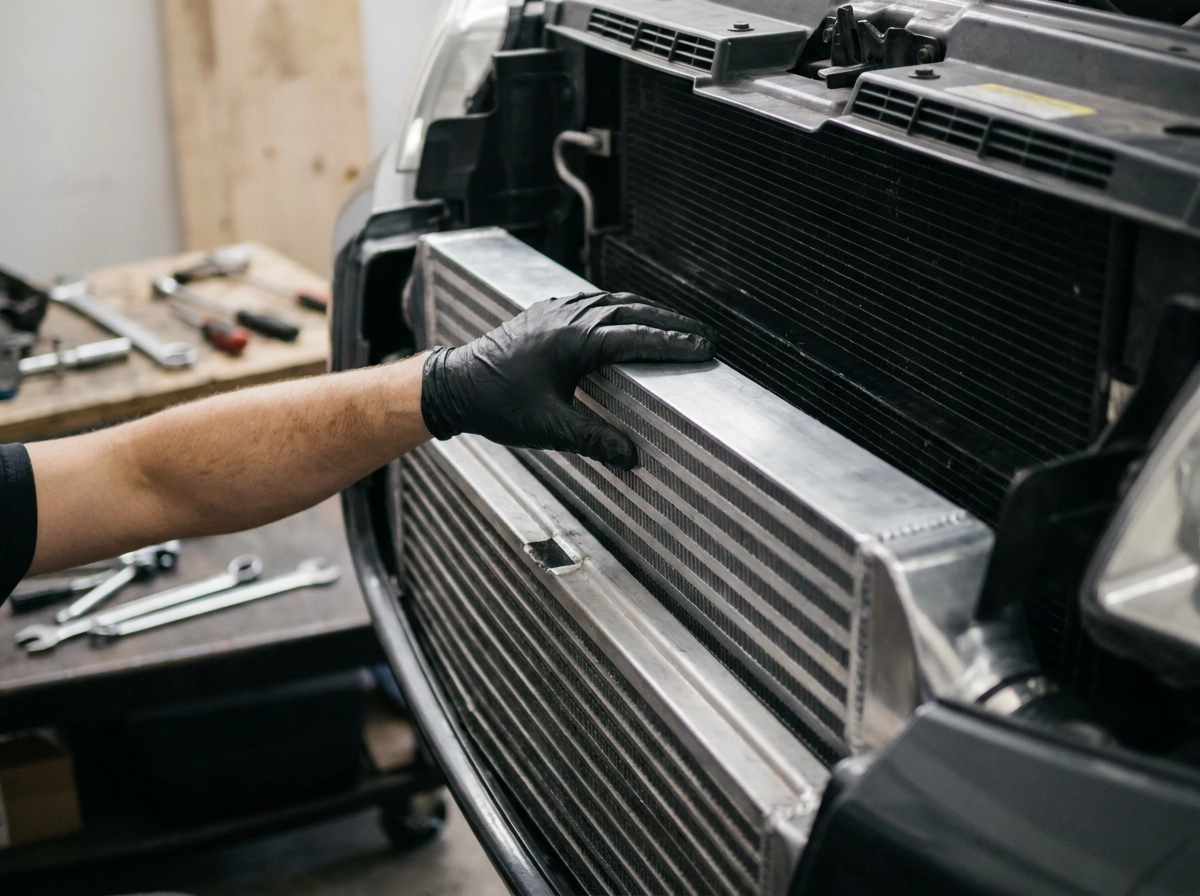
Stage 2 tuning moves beyond software adjustments and into physical modifications that unlock higher boost thresholds. On the N55, the core component list is a larger front-mount intercooler, a high-flow downpipe, and a supporting remap calibrated for the new hardware. Together, these unlock meaningfully higher output than Stage 1 alone.
Why the intercooler comes first on the list
Increased boost pressure generates significantly more heat in the charge air. The factory N55 intercooler is sized for stock boost levels; under sustained load at Stage 2 pressures, it heat-soaks rapidly and intake air temperatures climb. When that happens, the ECU pulls timing to protect the engine, and power drops off precisely when it is most needed. An uprated intercooler core resolves this by restoring charge air density under repeated boost cycles. You can find options suited to the N55 and B58 platforms in the Level 3 Stage 2 intercooler upgrades range.
Downpipe selection and turbo protection
A high-flow downpipe, either catted for road use or decat for track-only builds, reduces exhaust backpressure. Lower backpressure directly improves turbo spool speed and reduces turbine inlet temperatures across repeated boost cycles, reducing thermal stress on the turbo bearing. This is not a marginal gain; it is protective as much as it is performance-oriented.
Cooling system maintenance on the N55
Any N55 with significant mileage should have thermostat condition verified, coolant refreshed, and the water pump inspected before Stage 2 tuning is applied. N55 owners and tuners widely report water pump reliability concerns under elevated thermal loads. Fitting a Stage 2 map onto a marginal water pump accelerates that failure.
B58 Gen 1 adds a fuel system dimension
Tuners commonly recommend a high-pressure fuel pump upgrade for B58 Gen 1 at Stage 2 Plus, as the factory unit is considered a limiting factor at elevated fuel demand. Address this alongside the intercooler and downpipe rather than as an afterthought.
Before purchasing any single Stage 2 component, map out the complete hardware list. Stage 2 changes affect adjacent systems, and buying parts individually without a confirmed full specification leads to incompatibility and costly rework.
Priority 6: Stage 3 and Beyond, Turbo Upgrades and Forced Induction Changes
With the fuelling infrastructure from Stage 2 Plus in place, Stage 3 is where it gets tested against a fundamentally different turbocharger.
On the B58 Gen 1, the clearest Stage 3 entry point is a cast turbo upgrade such as the Pure 600, which targets 600hp+ on the crank. That figure is only achievable with a complete supporting system: a high-pressure fuel pump upgrade, a flex fuel kit running E30 or E85 blends, and a custom fuelling map calibrated for the new turbo’s flow characteristics. The stock B58 bottom end, with its forged crankshaft and closed-deck block, safely holds 600 to 650 bhp on factory internals, but this is a hard ceiling, not a comfortable operating range.
The N55 Stage 3 path splits into two distinct options. A hybrid turbo upgrade retains the stock manifold and offers a more accessible route to 450hp+. A full single turbo conversion delivers more linear power across the rev range, but requires a custom manifold, revised charge piping, and comprehensive ECU tuning. This is a project build in the truest sense: budget three to four weeks minimum, not a weekend.
The trend toward single turbo conversions on high-power B58 and M-platform builds reflects a specific engineering reality. The stock twin-scroll B58 housing creates significant backpressure and thermal load at high RPM, causing the ECU to retard ignition timing as intake air temperatures climb. A single turbo conversion eliminates that constraint rather than working around it.
Fuelling failure is the most common Stage 3 failure mode. Flex fuel kits improve knock resistance meaningfully, but only if fuel quality is managed consistently and sensors are recalibrated after every significant fuel blend change.
For UK buyers, fitment verification is non-negotiable at this stage. RHD packaging constraints affect several high-boost turbo systems designed for LHD markets, and bottom-mount versus top-mount configurations are chassis-specific. If you are researching forced induction builds on other platforms, the principles covered in a buyer’s guide to performance Audi parts in the UK illustrate how fitment complexity scales with power level across different architectures.
The cost-per-horsepower ratio at Stage 3 is significantly worse than at any earlier stage. Total system costs at Stage 3 on the B58 are substantial once turbo, fuelling, mapping, and ancillaries are combined. Reserve this stage for dedicated track or competition builds where daily drivability is a secondary concern.
Platform-Specific Notes: 1 Series, 3 Series and M Car Upgrade Differences
The stage upgrades above apply differently depending on which chassis you are actually running. Treating these platforms as interchangeable is one of the most common purchasing mistakes on the BMW aftermarket.
F20/F21 1 Series (N55, N20): The lighter kerb weight means Stage 1 and Stage 2 power gains translate into a more immediate power-to-weight improvement than the same modifications deliver on the heavier F30. That is a genuine advantage, but it cuts both ways: the chassis is more sensitive to tuning, and coilover selection must be specific to the F20/F21 geometry. Suspension components listed for the F30 are not interchangeable, and fitting incorrect spring rates or damper valving for the platform undermines both handling and safety.
F30 3 Series (N55) vs G20 3 Series (B58): These are not the same car for tuning purposes. The F30 N55 and the G20 B58 have diverging component compatibility and different power ceilings. The G20 M340i runs the B58 Gen 1, which justifies deeper staged investment owing to its stronger factory internals and higher aftermarket ceiling. Purchasing staged components for one platform and fitting them to the other is a reliable route to wasted expenditure.
F87 M2 (N55): The factory chassis, brakes, and limited-slip differential already meet track-day requirements, so the suspension-before-power sequencing is less urgent here than on a standard 1 or 3 Series. Oil system foundations and intake work remain equally critical regardless.
F80 M3 / F82 M4 (S55): The twin-turbo S55 follows different staged logic from the outset. Single turbo conversion has become a widely discussed high-power route for the S55.
Budget Allocation and the Diminishing Returns Curve
Once you have identified your exact platform and confirmed component compatibility, the question becomes where to direct each pound for maximum return. The diminishing returns curve on BMW aftermarket upgrades is steep, and understanding it before committing budget prevents the most common and costly sequencing errors.
Stage 1 delivers the best cost-per-horsepower ratio of any modification tier. Stage 1 spend, covering oil system work, intake, and a platform-calibrated remap, delivers the best cost-per-horsepower ratio of any modification tier.
Stage 2 hardware shifts the economics significantly. Stage 2 hardware investment is substantially higher than Stage 1. The result is 70 to 100bhp over stock, which is genuinely transformative, but each pound spent delivers fewer horsepower than at Stage 1. The curve has already begun to flatten.
Stage 3 on the B58 involves significant total outlay across turbo, fuel system, mapping, and supporting components. The gain of 150 to 200bhp over Stage 2 comes with exponentially higher complexity, greater maintenance overhead, and real daily drivability trade-offs.
For the community-validated sweet spot for a daily-driven modified BMW, Stage 2 remains the most balanced choice. It delivers transformative performance, preserves reasonable reliability, and avoids the fuel management demands and fitment constraints of Stage 3.
For track-focused builds, the allocation priority is equally clear: a meaningful portion of total budget, ideally the largest single allocation, should go to brakes, suspension, and tyres before power upgrades beyond Stage 1. At club motorsport level, this consistently produces better lap times than equivalent spend on power alone.
The Right Order Makes Every Pound Work Harder
The sequence is fixed: oil and oil system first, then intake and remap, then brakes and suspension for any car that sees circuit use, then Stage 2 hardware, then Stage 3 only when the build justifies it. Each step earns the next. Buying out of order costs more to fix than it would have cost to sequence correctly from the start.
performancecarsparts.co.uk stocks engine oil, oil system components, intake parts, suspension, brakes, and BMW motorsport accessories across 1 Series, 3 Series, and M Car applications. Use the staged path covered in this guide to build a purchase sequence from that catalogue and avoid the costly rework that comes from buying out of order.
Conclusion
The difference between a BMW that performs and one that simply costs money comes down to sequence. Get the foundations right first: oil system integrity, then intake and induction, then calibration through a platform-specific remap. From there, let power gains earn the next stage rather than chasing hardware before the car is ready to use it.
Every pound spent in the correct order compounds. Every pound spent out of order creates rework.
Whether you are building a 1 Series daily, a 3 Series track weapon, or developing an M Car to its ceiling, the path is the same. Follow the priority sequence, understand your specific platform, and allocate budget where it returns the most.
Visit performancecarsparts.co.uk to source the components that match your current stage, and build the BMW you intended from the first purchase, not the third attempt.