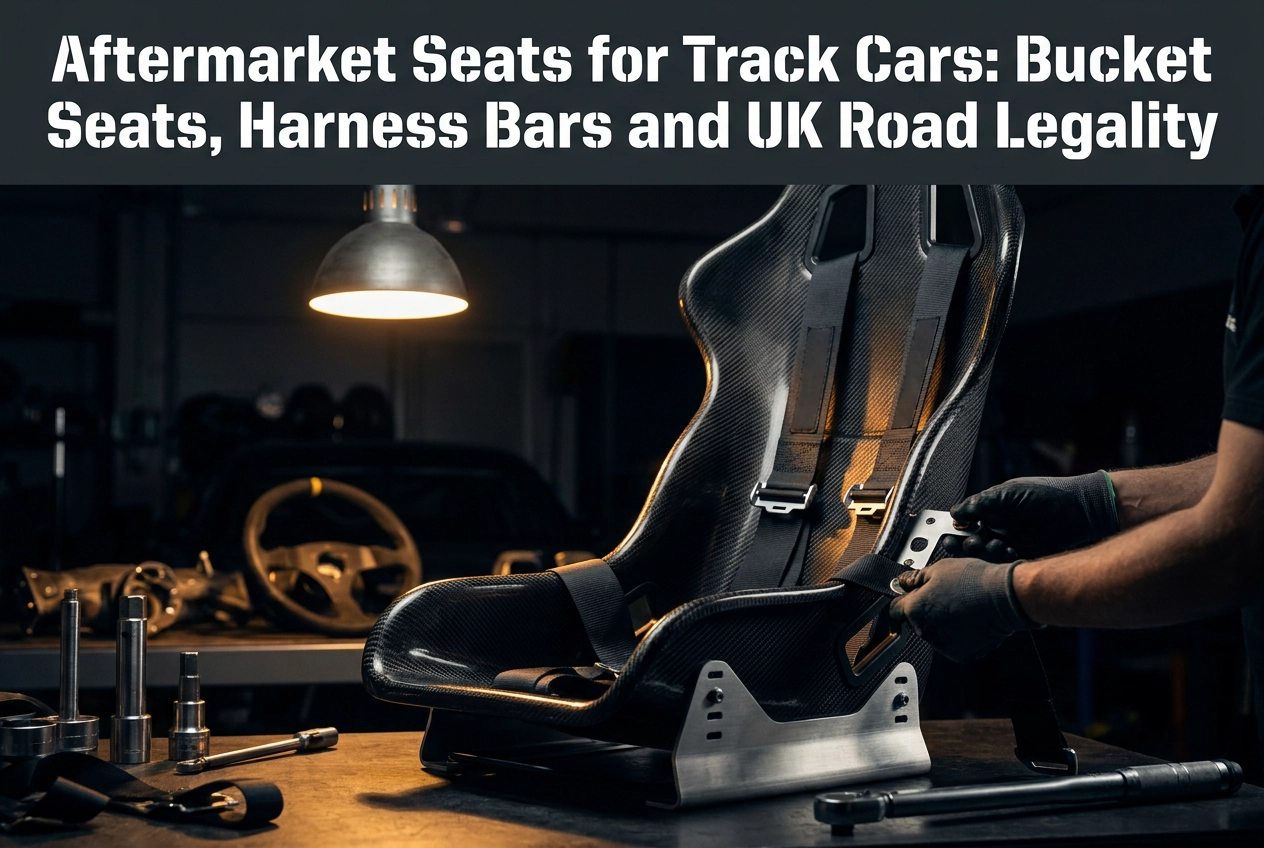
Most performance drivers reach the same point eventually. You find a seat you want, start measuring up the interior, then hit a wall of unanswered questions about MOT compliance, airbag deletion and whether a racing harness is even legal on public roads. Product pages rarely help. Forum threads contradict each other. And the cost of getting it wrong, whether that means an MOT failure, a voided insurance policy or a genuinely unsafe installation, is too high to guess.
Aftermarket seats are one of the most rewarding upgrades you can make to a track car, but they come with real compliance obligations that most buyers only discover after purchasing. This guide cuts through the confusion. You will learn exactly how UK road legality applies to bucket seats and harnesses, why airbag removal is a serious MOT concern, how to get rail and subframe fitment right, and why a multi-point racing harness cannot legally replace your standard three-point seatbelt on public roads. Whether you are building a dedicated track car or a road and circuit dual-purpose machine, what follows gives you everything you need to buy correctly and stay compliant.
What Are Aftermarket Bucket Seats and Why Do Performance Drivers Use Them?
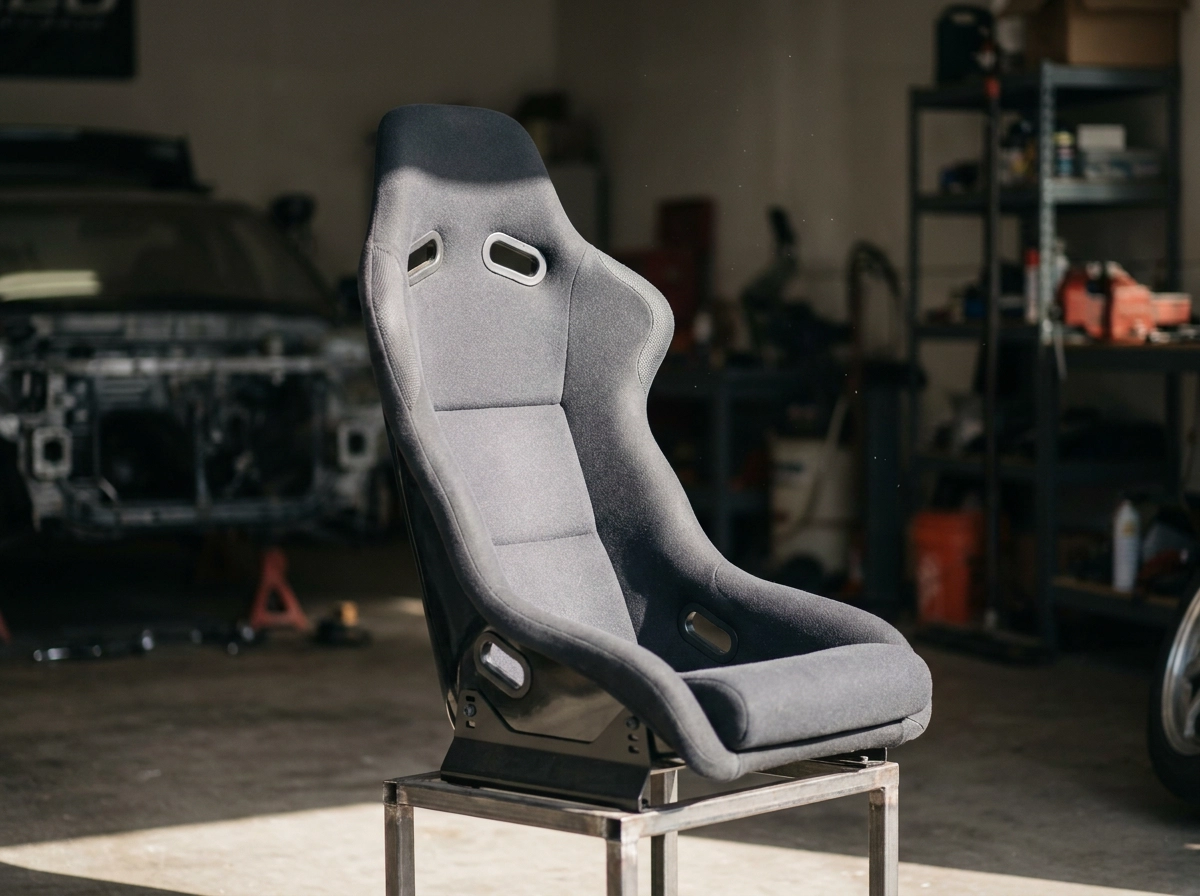
Aftermarket bucket seats are purpose-built replacements for the padded, adjustable seats fitted to road cars as standard. OEM seats are designed around comfort, compliance and cost, which means they offer limited lateral support and carry significant weight. Aftermarket designs strip those priorities back considerably.
The fundamental split is between fixed-back and reclining bucket seats. A fixed-back shell is moulded as a single rigid piece, offering maximum structural integrity and the tightest lateral support; it is the correct choice for harness use on track. A reclining bucket retains an adjustable backrest, making it more practical for daily road use whilst still improving the support and driver positioning that a standard seat cannot match.
The performance case for either design rests on three factors. First, deep side bolsters brace the driver’s torso through corners, reducing the muscular effort needed to hold position and keeping the driver’s inputs precise under lateral load. Second, most aftermarket seats weigh substantially less than the OEM equivalent, contributing to the overall weight reduction that track day drivers pursue across every component. Third, a well-chosen shell positions the driver lower and more centrally, improving feel through the controls and reducing fatigue over a session.
Some aftermarket seats are developed primarily for one regulatory market, a seat designed for Japanese domestic competition, for example, does not automatically align with UK road regulations.
That tension sits at the heart of this guide. The performance benefits are genuine, but three compliance barriers create real risk for buyers who skip the research. Fitting the wrong seat can interfere with factory airbag systems, compromise seatbelt function, or create an incompatible harness setup. Each of those outcomes carries MOT, legal or safety consequences.
This guide addresses each barrier in sequence, in plain terms, so you can make an informed decision before purchasing. If you are also considering complementary upgrades, the exhaust replacement guide for UK performance drivers covers a similarly compliance-relevant modification in the same practical detail.
Are Aftermarket Bucket Seats Legal on UK Roads?
The short answer is yes: fitting an aftermarket bucket seat to a UK road car is legal, provided the seat is mounted correctly through a dedicated seat rail and appropriate subframe. That single condition carries most of the weight. An improvised bracket, a mismatched rail, or any mounting arrangement that cannot withstand a crash load is where a straightforward upgrade becomes a legal and safety problem.
The seat itself is not a direct MOT test item, but its mounting interacts with areas that are tested. Section 6 of the MOT Inspection Manual covers body structure and attachments including the floor and interior; a poorly fitted seat can compromise floor metal and belt anchorage geometry, generating failures in those areas.
The three-point seatbelt rule is non-negotiable. The original factory belt must remain fully functional and unobstructed by the aftermarket seat. A bucket seat that prevents the belt from routing correctly, or that makes wearing it impractical, fails this requirement regardless of any other credentials the seat carries.
That brings in a distinction buyers regularly miss. A seat being described as motorsport-specification does not make it road-legal for your car. Some aftermarket seats are manufactured exclusively for closed-circuit use and their documentation states this explicitly. Others are designed for dual road and track use. The product listing rarely resolves this question on its own; you need to check the manufacturer’s homologation documents and confirm the specific model suits road use.
FIA homologation certifies a seat meets motorsport competition standards; it is a different framework from UK road-use compliance, and buyers should not treat one as evidence of the other, verify the manufacturer’s road-legal designation separately.
Getting this right before purchase protects your MOT, your insurance position, and the structural integrity of the installation. The same principle applies across your build: just as not all brake compounds suit road use (see this guide to brake pad compounds for road and track), not all motorsport seats are cleared for the road.
Seat Rails, Subframes and Getting the Fitment Right
Secure mounting is a legal requirement, but getting there is more technically involved than most product pages suggest. The most common practical barrier is rail compatibility.
Aftermarket seats, including Bride bucket seats and similar motorsport-derived designs, use either a brand-specific or universal base pattern. That base must be bridged to your car’s OEM floor mounting points via a dedicated seat rail kit. If no vehicle-specific rail exists for your model, a universal bracket becomes necessary, and that is where problems begin.
Side-mount and low-mount rail systems serve different purposes beyond simply securing the seat. A standard rail raises the seat height, which is tolerable in a tall cabin but genuinely problematic in a low-roofline car like a Honda Civic Type R or a Mk5 Golf GTI. A low-mount or side-mount rail reduces the stack height between the floor and the seat shell, keeping your head clear of the roofline and preserving the driving position the bucket seat is meant to create.
Subframe adapters and universal brackets exist to fill the gap when no direct-fit rail is available. The critical point is that physical fitment is not structural fitment. A seat can appear solid and correctly positioned while the load path through the floor is compromised. In a crash, seat anchorage systems must distribute substantial forces through the vehicle’s structure. An incompatible or non-engineered bracket cannot guarantee that load transfer, regardless of how the installation looks.
Floor pan condition is equally important. Corrosion around the OEM seat mounting threads is common on older track cars, and weakened metal at those four points undermines the entire installation. Before fitting any aftermarket seat, inspect the floor pan properly. If there is meaningful corrosion, it must be addressed first.
Before purchasing, cross-reference the seat manufacturer’s fitment guide against your specific vehicle model and year. Rail kits are not universal across facelifts or body variants, even within the same nameplate. If the fitment picture is unclear, have the installation assessed by a competent fabricator before you commit. This applies equally to other structural modifications; the same discipline required here carries through to changes like exhaust routing, as explored in our guide to choosing exhaust pipes for performance cars.
Airbag Deletion, MOT Failures and the Compliance Problem No One Warns You About
Fitment is only part of the problem. Once a bucket seat is in place, a second and less obvious compliance risk emerges: what the seat does to your car’s airbag system.
Many performance bucket seats have a narrower shell, a different bolster profile, or a fixed-back geometry that physically conflicts with factory side airbags mounted in the OEM seat bolster. Some cars also carry door-card airbags that deploy toward the seat. When the seat no longer sits where the system expects, sensors misread, wiring gets disturbed, and warning lights illuminate.
The DVSA MOT Inspection Manual (updated 1 June 2026) covers supplementary restraint systems under Section 7 (Other Equipment). An illuminated airbag warning lamp is an assessable item under that section; buyers should check the current manual text directly at gov.uk to confirm defect classification before proceeding.
The regulatory position has not shifted to accommodate aftermarket safety equipment. A UK Parliament petition that specifically sought legislative provision to permit airbag deletion where bucket seats and harnesses are fitted closed in August 2023 with just 32 signatures, well short of the 10,000 required to trigger a government response. No regulatory change followed. As of the time of writing, no legislative provision exists to permit airbag deletion on a road-registered vehicle in place of alternative restraint systems, as confirmed by the absence of any government response to the 2023 petition.
Some buyers look to airbag simulators or warning-light bypass devices as a workaround. These exist in the market, but fitting a device specifically to defeat a tested safety system on a road car introduces its own risks. An insurer that discovers a bypass device following a claim has grounds to treat the modification as undisclosed and material; it may also attract attention under the Road Traffic Act where a vehicle is presented in a condition that is unsafe for road use. It is not a recommended route.
The practical takeaway for a dual-use road and track build is straightforward: if your intended seat requires airbag deletion to fit, it is a track-only seat on that vehicle. The same MOT thinking applies across other modifications too; if you are researching this area, the Aftermarket Exhaust Systems: The Complete UK Buyer’s Guide covers how exhaust upgrades intersect with MOT requirements and is worth reading alongside this one.
Multi-Point Harnesses on the Road: Why a Racing Harness Is Not a Seatbelt Replacement
Airbag compliance is only one part of the legal picture. The harness system raises a separate and equally important set of requirements.
A four-point, five-point or six-point racing harness is not a legal substitute for the factory three-point seatbelt on a UK public road. The Road Vehicles (Construction and Use) Regulations 1986 require that the original type-approved restraint remains installed and fully operable. Fitting a harness alongside it does not satisfy that requirement unless the factory belt is also wearable and in working order.
The reason this rule exists is biomechanical, not bureaucratic. A multi-point harness is engineered as part of a system: it works correctly only when paired with a fixed-back seat and a rearward anchor structure such as a harness bar or roll cage. Those shoulder straps need somewhere solid behind the occupant to pull against. Without that rearward support, the harness cannot manage the load paths in a frontal impact correctly, and submarining or spinal compression becomes a genuine injury risk rather than a theoretical one.
Fitting a harness to a standard reclining OEM seat compounds that risk significantly. The reclining seat mechanism and its mounting were never designed to absorb the force vectors a multi-point harness generates in a crash. The result is that the combination of harness and standard seat can be more dangerous than the original belt-and-seat system it was meant to improve upon. The factory setup is type-approved as an integrated unit; a bolt-on harness retrofit carries no equivalent road-use certification.
The compliant positions for road use are straightforward. Either the harness is fitted and the original three-point belt is also worn where practicable, making both systems operational simultaneously, or the harness is reserved exclusively for track use and the factory belt is used on the road. Many dual-use builds treat the harness as a track-day fitting and reconnect the standard belt before the car returns to public roads.
For those working through a broader upgrade plan, the 10 performance upgrades that genuinely transform how a car drives provides useful context on where safety and performance modifications sit alongside other improvements.
Harness Bars and Roll Cages: What Structure Do You Actually Need?
A multi-point harness requires a fixed anchor point behind the seat, that structure is the subject of this section.
What a harness bar does
A harness bar is a bolt-in transverse tube spanning the rear of the cabin, providing dedicated mounting points for shoulder straps at the correct angle. It is the most accessible structural solution for a road car or occasional track-day vehicle where a full roll cage is impractical or unnecessary. Cost and installation complexity are both significantly lower than a cage, which is why it suits the majority of dual-use builds.
Where a harness bar falls short
A harness bar is an anchor point, not a safety structure. It provides no rollover protection whatsoever. For serious circuit work with a fixed-back seat, a full roll cage is the correct solution; Motorsport UK defines a safety cage specifically as a framework designed to prevent serious bodyshell deformation in a collision or rollover. A harness bar cannot perform that function, and treating it as equivalent is a genuine safety risk at track.
Roll cages on road-registered cars
Fitting a roll cage introduces its own compliance consideration. Bare steel tubes positioned near occupants must be padded; unpadded metalwork presents a clear head-strike hazard in any incident, and this is reflected in the padding requirements applied to road-registered vehicles with cage modifications. Purpose-made FIA-grade cage padding is the appropriate material; improvised foam is not an acceptable substitute.
Mounting integrity
Whichever structure you fit, the mounting points must connect to structural chassis members, not to boot floor sheet metal alone. Unreinforced floor panels will not hold under crash loads. Motorsport UK specifies reinforcement plates beneath mounting feet to spread load into the bodyshell properly. This is the same principle that governs secure subframe mounting for aftermarket seats, and the same logic that applies to anti-roll bars and other chassis-attached components. A bar that pulls through the floor in a crash offers no protection at all.
Track-Only Versus Road-Legal Seats: How to Tell the Difference Before You Buy
The same care you applied to harness anchorage points applies equally to the seat itself: not every aftermarket bucket seat is cleared for public road use, and the product listing often will not tell you that unprompted.
The aftermarket seat market divides into two distinct categories. Track-only seats are manufactured and homologated exclusively for closed-circuit motorsport; their documentation explicitly prohibits road use. Road-legal seats are designed to function within the constraints of a road-registered vehicle, including compatibility with a standard three-point belt. These two categories look nearly identical on a product page, which is where buyers run into trouble.
What to look for in a product listing
An FIA homologation number confirms the seat meets a motorsport safety standard. It does not confirm the seat is road-legal. To confirm road use suitability, look for three things: an explicit road-legal designation in the manufacturer’s documentation, confirmation that the seat shell accommodates standard three-point belt routing through the correct apertures, and any relevant compliance markings for your market. If a listing only cites an FIA number and nothing else, treat the seat as track-only until you can verify otherwise.
Japanese-market seats and UK road use
Bride bucket seats and comparable Japanese-market motorsport seats are widely used in UK performance builds and are genuinely well-regarded products. However, the Bride range includes both road-legal and circuit-only variants, and they are not always clearly distinguished in third-party listings. Verify the specific model number against the manufacturer’s own homologation documentation before purchasing, particularly if the car is road-registered.
How geometry creates a compliance problem
A seat with an extreme fixed-back recline angle, or a shell so tightly bolstered that it physically blocks the three-point belt’s travel path, will fail the belt-functionality requirement regardless of its other credentials. Geometry is not a secondary consideration; it is a direct legal variable.
Before committing to any seat, confirm both the manufacturer’s stated usage classification and your own intended use. If the car sees road miles between track days, a circuit-only seat creates compliance problems that no amount of safety pedigree resolves.
Declaring Aftermarket Seats and Harnesses to Your Insurer
Once you have confirmed a seat is road-legal for your build, the next step most buyers skip is telling their insurer before anything is bolted in.
Aftermarket seats, multi-point harnesses, and harness bars or roll cages are all material modifications under UK motor insurance principles. A material modification is any change that affects the risk the insurer has priced. All three categories qualify, and all three must be declared.
The consequence of not declaring is severe. UK insurance law on consumer disclosure means non-declaration of a material modification can give an insurer grounds to void a claim or reduce a payout, even where the modification was unrelated to the incident. Check your policy wording and seek specialist advice if in doubt. A non-declared bucket seat fitting discovered after a rear-end collision is enough to trigger it.
Airbag deletion carries additional risk at the insurance stage. Suppressing the warning light does not conceal the change; it remains a material alteration to the vehicle’s safety specification. Some insurers will decline to cover a vehicle with airbags deleted regardless of the premium offered. Declaring it early tells you where you stand before committing to the modification.
Contact your insurer before fitting, not after. This single step lets you understand any premium change, confirm coverage conditions, and avoid a gap in cover between installation and acknowledgement. Fitting first and notifying afterwards leaves a window where a claim could be disputed.
Standard insurers often apply broad loadings or blanket exclusions to modified vehicles because their underwriting models are not calibrated for motorsport equipment. Specialist motorsport and modified car insurers understand the difference between a track-prepared road car and a standard vehicle; they price accordingly and are less likely to exclude or void on technical grounds. If your build involves multiple modifications, including suspension upgrades covered in guides like coilovers and performance suspension, a specialist policy is usually the more cost-effective and legally sound route.
What to Check Before You Buy Aftermarket Seats for Your Car
With insurer notification handled, run through this checklist before placing any order.
1. Define your use case before you browse. If the car is road-registered and must pass MOT, eliminate any seat that requires airbag deletion or blocks the original three-point belt from routing correctly. Those seats are not compatible with road-legal use under current UK regulations, regardless of build quality or brand reputation.
2. Confirm rail compatibility for your specific vehicle. Do not assume a popular seat fits your car. Verify that a dedicated rail kit exists for your make, model and year, then check that the combined seat-plus-rail stack height clears your roofline. A rail that raises the seating position by 30 mm can be the difference between a compliant fit and a car you cannot safely drive.
3. Check homologation documentation before purchasing. Confirm whether the seat is explicitly road-legal or circuit-only. If it carries FIA homologation, check whether the seat carries an expiry on its homologation; many track venues and insurers will ask for valid documentation. An FIA stamp alone does not confirm UK road compliance.
4. Buy the harness only when the supporting structure is confirmed. A multi-point harness requires a fixed-back seat and a structurally sound harness bar or roll cage. Purchasing the harness first and solving the anchorage problem later is the wrong order. Confirm both components are compatible and correctly mounted before the harness goes anywhere near the car.
5. Keep documentation from day one. Retain product certificates, homologation sheets, fitment receipts and any written confirmation from your insurer. If a claim arises, this paperwork demonstrates the modification was compliant and declared at the time of fitting. Undocumented modifications are far harder to defend.
For buyers sourcing harness and safety equipment through performancecarsparts.co.uk, the motorsport accessories range covers options suited to both track day preparation and road-legal builds. Apply this checklist to any product in that range exactly as you would elsewhere; the compliance requirements are the same regardless of where the parts are purchased.
The Bottom Line on Aftermarket Seats, Harnesses and UK Road Legality
Once you have worked through that checklist, the decision comes down to three non-negotiable compliance pillars. The seat must be mounted securely through correct, vehicle-specific rails. The original factory three-point belt must remain installed and fully functional. No manufacturer-fitted airbag system may be removed or disabled on a road-registered vehicle without serious MOT consequences.
A multi-point racing harness is track equipment, not a road seatbelt replacement; the original three-point belt must remain in use on public roads.
On airbag deletion specifically, the position is unchanged. The MOT Inspection Manual, updated 1 June 2026, covers supplementary restraint systems under Section 7, buyers should verify the current defect classification at gov.uk. The petition seeking a legislative carve-out for motorsport-modified vehicles, noted in the airbag section above, drew no government response and no regulatory change followed. Buyers planning a dual-use road and track build must work within that constraint, not around it.
The preceding sections cover each of these points in full detail.
Before any seat, harness or cage is fitted, contact your insurer. Non-declaration of a material modification can void a claim entirely, regardless of whether the modification caused the incident. Treating compliance as part of the purchase decision protects both your cover and your MOT status.
For harness equipment, safety products and performance parts suited to track day preparation, the motorsport accessories range at performancecarsparts.co.uk is a practical starting point for building a setup that is both capable on circuit and correctly specified for your intended use.
Conclusion
Aftermarket bucket seats and harnesses can transform a track car’s performance and safety, but only when specified, fitted and declared correctly. The key points are covered in detail above: choose a road-legal seat, keep the original three-point belt operable, leave the airbag system intact for road use, anchor any harness to proper structure, and declare everything to your insurer before fitting.
Getting this right is not complicated, but it does require doing the groundwork before you buy rather than after. Research your fitment, understand the legal position, and choose components that match your actual use case.
For equipment that meets the demands of both circuit and compliance, explore the motorsport accessories range at performancecarsparts.co.uk and build your setup with confidence from the start.