
Blow-off valve vs diverter valve: which should you fit? The choice changes how your turbocharged car sounds, how it behaves when you lift off and come back on the throttle, and how happily it runs after a remap. Whether you drive a VW Golf GTI, Audi S3, Hyundai i30 N or BMW 335i, the right valve depends on how your engine measures air, how much boost it runs and what you want from the car.
A recirculating diverter valve sends the released boost back into the intake, which is why it is the usual choice for road cars and for engines that meter air with a MAF sensor. An atmospheric blow-off valve, often called a dump valve in the UK, releases that air outside the intake and makes the familiar turbo “whoosh”.
Neither type adds power on its own, but swapping a split or leaking factory valve for a suitable upgrade can restore boost that was being lost. Below we compare blow-off, diverter and dual-port valves, explain what changes after a remap, and help you pick the right upgrade for your car.
Looking for a compatible upgrade? Shop blow-off valves and dump valves, or contact Performance Car Parts UK on WhatsApp or by email for fitment advice before you order.
Quick Answer: Blow-Off Valve vs Diverter Valve, Which Should You Choose?
In the blow-off valve vs diverter valve decision, for most remapped road cars that also see the odd track day, an uprated recirculating valve is the sensible starting point: it fixes the common factory weak spot without upsetting the engine’s air metering. A vent-to-atmosphere blow-off valve makes most sense on builds that have been calibrated for it, or where the owner accepts the noise and the tuning work that can come with it. This guide covers turbocharged petrol engines only.
| Your car and driving | Recommended starting point | Main compromise |
|---|---|---|
| Standard or Stage 1 road car, factory valve healthy | Keep the OEM valve, or fit an uprated recirculating valve when it is due for replacement | Little or no change in sound |
| Remapped car with a split or leaking factory diaphragm valve | Uprated piston-type recirculating (diverter) valve | Costs more than a basic OEM replacement; spring choice matters |
| Road car where the owner wants some audible “whoosh” | Dual-port or hybrid valve that recirculates part of the air, set up with your tuner’s advice | Some noise and possible running quirks if not set up correctly |
| Higher-boost or track-focused build mapped for it | Atmospheric blow-off valve | Noise at circuits with limits, mapping required, possible warning lights |
Final choice depends on the valve manufacturer’s application list, your engine’s air metering and the fitment for your exact model. Browse our blow-off and dump valves to see vehicle-specific options.
What a Blow-Off or Diverter Valve Actually Does
Under boost, the turbo’s compressor is pushing pressurised air through the intercooler and into the inlet manifold. When you snap the throttle shut for a gearchange or a corner, that air suddenly has nowhere to go. Pressure builds against the throttle plate and the airflow through the compressor can stall and reverse in rapid cycles. This is known as compressor surge, and it produces the fluttering sound many people associate with turbo cars. Repeated surge puts extra stress on the turbo’s bearings and compressor wheel, which is why a correctly working valve matters.
The valve’s job is to open the moment the throttle closes and give that trapped air an escape route. Most designs are referenced to manifold pressure: under boost, pressure on both sides helps hold the valve shut along with its spring, and when the throttle closes the manifold drops into vacuum, which pulls the valve open. Some newer engines use an electronically controlled valve that the ECU opens instead.
Where the escaping air goes is the key difference in the blow-off valve vs diverter valve comparison:
- Recirculating valve (diverter or bypass valve): routes the air back into the intake ahead of the turbo. It is quiet, and it is what most manufacturers fit from the factory.
- Atmospheric blow-off valve (dump valve): vents the air into the engine bay or out through a trumpet, creating the characteristic sound.
- Dual-port or hybrid valve: splits the flow between recirculating and venting, aiming for some sound with fewer side-effects.
If you are planning a wider boost-system build, our turbo and intercooler upgrade guide explains how the valve fits alongside the turbo, intercooler and pipework.
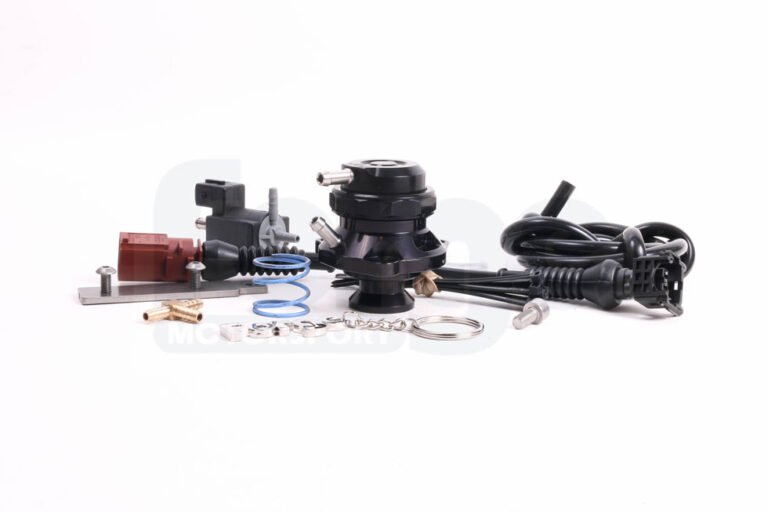
Recirculating Diverter Valves: The Factory Choice and Why They Fail
Manufacturers fit recirculating valves for good reasons. They are quiet, they keep the measured air inside the system, and they suit emissions and refinement targets. The weakness on many cars is the construction rather than the concept. A lot of factory valves use a rubber diaphragm and plastic body, and those parts live in a hot engine bay while cycling every time you lift off.
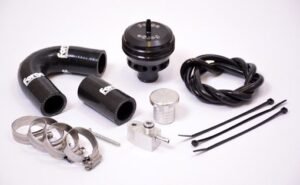
UK manufacturer Forge Motorsport, for example, says on its replacement for the common 25mm Bosch diverter valve that the original is prone to the internal rubber diaphragm failing, which causes a boost leak. Its replacement is a piston-type design with Viton O-rings and a choice of springs, and can be serviced with a rebuild kit. That design approach is typical of the uprated recirculating valves on the market, though materials and features vary by brand.
Signs your diverter valve may be leaking
- Boost that builds more slowly, or falls short of what it used to reach, especially after a remap.
- Hesitation or a flat spot when you get back on the throttle after a gearchange.
- Boost-related fault codes or a reduced-power mode on some cars.
- A visible split or tear when the valve is removed and the diaphragm inspected.
These symptoms can also come from split hoses, loose clamps, intercooler leaks or a faulty boost-control solenoid, so a smoke test or boost-leak test is worth doing before blaming the valve. Intercooler hoses, couplers and clamps often get replaced at the same time on tuned cars for exactly this reason.
Atmospheric Blow-Off Valves: Sound, Air Metering and Running Rich
The appeal of an atmospheric dump valve is obvious: it sounds like a turbo car. The catch depends on how your engine works out how much air it is getting.
Mass airflow (MAF) metered engines
On engines that measure incoming air with a MAF sensor ahead of the turbo, the ECU has already counted the air by the time the valve opens. If that air is vented to atmosphere rather than returned to the intake, the ECU still fuels for air that never reaches the cylinders. The result can be a brief rich condition each time the valve opens, which may show up as hesitation when you get back on the throttle, a stumble at idle, or in some cases stalling. Over time, running rich repeatedly is not good for spark plugs or the catalytic converter. Turbo manufacturer Garrett’s turbo system optimisation guide sums it up simply: use a recirculating (bypass) valve on MAF engines for the best drivability, while MAP-based engines can use either a vent-to-atmosphere or a recirculating valve. EngineLabs’ explanation of blow-off and bypass valves notes that tuning is normally how this is resolved on cars that keep a vent-to-atmosphere valve.
MAP (speed-density) engines
Engines that calculate airflow from manifold pressure and other inputs, rather than measuring it upstream with a MAF, are generally less sensitive to where the valve vents. That is one reason competition cars on standalone ECUs often run fully atmospheric valves. However, many modern road cars use a blend of sensors and models, so do not assume your car is unaffected. Ask your tuner how your specific engine meters air before choosing a fully venting valve.
Hybrid and dual-port valves
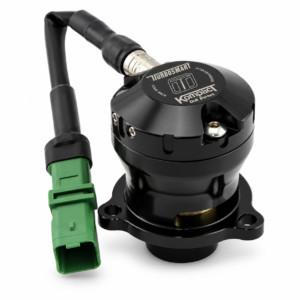
Dual-port valves try to split the difference. Turbosmart, for instance, describes its Kompact Dual Port as a 50-50 vent-to-atmosphere and recirculating design, with staged operation that recirculates at lower boost to keep the ECU content, and the option to blank the vent to make it fully recirculating. Other brands use adjustable or partially venting designs. Behaviour differs between products, so check the manufacturer’s notes for your engine.
Piston vs Diaphragm Valves and Choosing the Right Spring
Aftermarket valves broadly use either a piston or an uprated diaphragm. Piston designs are popular for durability and serviceability, while some diaphragm designs are praised for sensitivity at low pressure. There is no single “best” type; what matters is that the valve is designed for your boost level, mounts correctly and is from a manufacturer that lists your application.
Spring choice affects how readily the valve opens. Too soft and the valve can leak or crack open under boost, especially with the high vacuum some engines pull at idle. Too stiff and it may not open fully when you lift off, which can bring back the surge you were trying to avoid. Many uprated valves come with a set of springs and guidance on which to use for standard, remapped or higher-boost setups. There is no universal spring rate, so follow the valve maker’s recommendation for your engine and boost level and adjust only if you see symptoms.
- Fluttering on lift-off at low boost: may suggest the spring is too stiff for that situation.
- Boost leak, hissing at idle or a lumpy idle: may suggest the spring is too soft or the valve is not sealing.
- Valve noise when cruising off-boost: can be normal on some atmospheric designs but worth discussing with your tuner.
Blow-Off Valve vs Diverter Valve: Do You Need an Upgrade After a Remap?
Not always. Plenty of Stage 1 cars run happily on a healthy factory valve. Whether an upgrade is worthwhile depends on several things at once: how much boost the map adds, how well the factory valve copes on your engine, its age and condition, and how hard the car is used. Higher boost increases the load on a weak diaphragm, so a remap is a common time to check the valve or replace it pre-emptively on engines with a known history of failures.
As builds go further, the valve becomes part of a wider set of supporting mods. Our explainer on Stage 1, Stage 2 and Stage 3 tuning covers what typically changes at each step, and many Stage 2 setups also involve the exhaust side, including the sports cat vs decat choice for tuned cars covered in our downpipe guide. If your tuner recommends changing the valve, ask whether they want it recirculating, whether the map needs adjusting, and which spring they prefer.
Dump Valve Upgrades for Popular UK Tuned Cars
The blow-off valve vs diverter valve choice also depends on the car itself. Every engine has its own valve location, fitting and air-metering strategy, so use these notes as a list of checks rather than a guarantee of what fits. Always confirm the product listing covers your engine code and model year.
VW Golf GTI / Golf R, Audi S3, SEAT Leon Cupra (1.8 and 2.0 TSI)
Check which generation of engine you have, as valve fitments differ between generations, and inspect the condition of the factory valve. Ask your tuner whether they prefer a recirculating valve for your map.
From our range: Recirculation Valve and Kit for Audi and VW 1.8 and 2.0 TSI/TFSI
From our range: Recirculation Valve for VW, Audi, Skoda and Cupra 2.0 (2021 onwards)
Hyundai i30 N, Kona N and Veloster N
Decide whether you want a fully recirculating or partially venting setup, watch for warning lights after fitting, and ask your tuner about calibration.
From our range: Atmospheric and Recirculating Valve for Hyundai i30N, Kona N and Veloster N
BMW 135i, 335i and 1M (N54)
This twin-turbo engine uses two factory diverter valves. Check both, along with the charge pipe, as the two are often upgraded together.
From our range: Hard Pipe and Blow Off Kit for BMW 135i, 335i and 1M (N54)
Renault Megane RS 280 and 300 (Mk4)
Confirm the correct valve for your generation and engine, and whether the car is standard or mapped.
From our range: Recirculating Valve for Renault Megane RS 280 and 300 Mk4
Ford Fiesta ST (Mk8) and Puma ST
Check the model year and engine against the listing, and whether you want the factory-style quiet operation or some audible venting.
From our range: Ford Fiesta Mk8 ST and Puma ST Dump Valve
MINI Cooper S and related 1.6 turbo models
Check the engine type and year, as early and later engines differ, and whether the factory valve on your car is electronically controlled.
From our range: Replacement Recirculation Valve and Kit for MINI Cooper S and Peugeot Turbo
Fitting a Blow-Off or Diverter Valve: What to Expect
On many cars, swapping a factory diverter valve for a direct-fit uprated unit is a straightforward job for a competent home mechanic, often just a few bolts or clips and a vacuum hose. Others need adaptor plates, new pipework or a relocation kit, and some valves are buried behind other components. The difficulty varies so much between cars that it is worth reading the fitting instructions before you order.
- Use new O-rings or gaskets where supplied and make sure mating faces are clean.
- Tighten fasteners to the figure given by the valve or vehicle manufacturer; there is no universal torque setting.
- Check the vacuum or signal line is routed to the correct port and is not kinked or split.
- On electronically controlled valves, make sure any wiring or control module is connected as the instructions describe.
- After fitting, check for boost leaks, warning lights and idle quality before driving hard.
If the job involves new charge pipes or turbo-side hoses, you can browse turbo performance parts, including actuators and inlet pipes.
Blow-Off Valves, the UK MOT and Insurance
Whichever way you go on blow-off valve vs diverter valve, there is no MOT item that specifically tests either one. However, the knock-on effects of the wrong setup can matter. The MOT inspection manual’s nuisance section treats an engine malfunction indicator lamp (MIL) that is on, or indicating a malfunction, as a major defect on petrol cars first used from 1 July 2003. Petrol cars are also tested for exhaust emissions, and excessive exhaust noise compared with a similar standard vehicle is a major defect. A valve that causes a persistent warning light or poor running could therefore lead to problems at test time, even though the valve itself is not checked.
Insurance is the other point to consider. Consumer group Which? advises that you should tell your insurer about modifications, including engine and performance changes, because not doing so could invalidate your cover. Insurers differ on how they treat a recirculating valve swap compared with a vent-to-atmosphere dump valve, so declare the change and let them decide rather than assuming it is too minor to mention.
For track days, many UK circuits run static and drive-by noise limits. A loud atmospheric valve is usually less of a factor than the exhaust, but it is one more reason to check the organiser’s noise rules before you go.
Common Blow-Off Valve Myths
- “A dump valve adds power.” A valve does not add power on its own. An uprated valve that stops a boost leak can restore performance that was being lost, which is a different thing.
- “Louder means better.” The sound comes from where the air is released, not from how well the turbo is protected. A quiet recirculating valve can do the job just as well.
- “Any valve fits any turbo car.” Mounting, port sizes, signal source and control method vary widely between engines. Vehicle-specific kits exist for a reason.
- “Flutter is always harmless.” Occasional flutter is common on modified cars, but sustained surge adds stress to the turbo, as noted earlier. If it concerns you, ask your tuner.
Dump Valve Upgrade Checklist: Before You Buy and Fit
- Confirm your engine code, model year and whether the factory valve is vacuum or electronically controlled.
- Rule out other boost leaks with a smoke or pressure test before blaming the valve.
- Decide whether you want quiet recirculation, a hybrid setup or full venting.
- Ask your tuner how your engine meters air and whether the map needs adjusting.
- Check which spring the manufacturer recommends for your boost level.
- Make sure the product listing covers your exact car, and that any adaptors or hoses needed are included.
- Check for warning lights and smooth running after fitting, well before your MOT.
- Tell your insurer about the modification.
Blow-Off Valve vs Diverter Valve FAQs
Is a blow-off valve better than a diverter valve?
Neither is better in every case. A recirculating diverter valve generally suits road cars whose engines measure intake air with a MAF sensor, while an atmospheric blow-off valve suits engines and maps set up to cope with venting. The right choice depends on your car and how it is tuned.
Does a blow-off valve increase horsepower?
Not directly. The valve releases pressure when the throttle closes. Replacing a leaking factory valve can bring back boost that was being lost, but fitting an atmospheric valve on its own will not add power.
Can you fit a dump valve to a standard turbo car?
Many standard turbo petrol cars can take a vehicle-specific dump valve kit. However, venting to atmosphere can cause running problems on some air-metering systems, so check the manufacturer’s compatibility information first.
Do I need a stronger diverter valve after a Stage 1 remap?
Not necessarily. A healthy factory valve is often fine at Stage 1. An upgrade makes more sense if the original valve is leaking, has failed, or is known to struggle at the boost your map runs.
Why does my turbo flutter when I lift off the throttle?
Flutter usually comes from compressor surge, when pressurised air is not released quickly enough. Spring choice, valve design and the boost pipework all affect it. Persistent or heavy surge is worth investigating.
Is an atmospheric blow-off valve legal in the UK?
The MOT has no specific check for blow-off valves. However, the car must still pass the emissions and warning light checks, and noise limits still apply. You should also tell your insurer about the modification.
What is the difference between a dual-port valve and a recirculating valve?
A recirculating valve sends all the released air back into the intake. A dual-port valve vents some of it to atmosphere and recirculates the rest, depending on its design. You still need to check it suits your engine management.
Which dump valve fits my car?
Fitment depends on make, model, model year, engine code, turbo layout and how the valve is controlled. Check these against the manufacturer’s application list, or contact Performance Car Parts UK and we will help you find a suitable part.
Shop Blow-Off Valves and Dump Valves
Conclusion
The blow-off valve vs diverter valve choice comes down to what you want from the car. If the goal is reliable boost on a remapped road car, an uprated recirculating valve is usually the tidy, low-drama option. If you want the sound, a hybrid or fully atmospheric valve can work well, but only when the engine’s air metering and the map are set up for it. Either way, the valve protects the turbo; the difference is how the released air is handled and what that means for running, MOT and insurance.
Ready to upgrade? Browse our blow-off valves and dump valves or explore the full range at performancecarsparts.co.uk. Not sure which valve or spring suits your car? Contact our team on WhatsApp or by email with your make, model, engine and current modifications, and we will help you check fitment before you order.
Shop related performance parts

Explore related products

Always check the individual product listing for your vehicle and engine before ordering.