Every time you press the brake pedal, a carefully engineered friction material is doing the hard work of converting kinetic energy into heat. Yet most drivers never give a second thought to what those brake pads are actually made of, or whether the compound under their calipers is even suited for their driving style.
Choosing the wrong brake pad compound can mean premature rotor wear, excessive brake dust, poor cold bite, or dangerously inconsistent stopping power under high-heat conditions. Choosing the right one, however, can meaningfully improve both safety and performance.
In this guide, we break down the four primary brake pad compounds: organic, semi-metallic, fully metallic, and ceramic. You will learn how each compound behaves across different temperature ranges, how they interact with rotor material, and what trade-offs come with each option. Whether you are upgrading a daily driver, maintaining a tow vehicle, or looking for a street-friendly performance upgrade, understanding the material science behind brake pads will help you make a more informed, confident decision at the parts counter.
Why Brake Pad Choice Matters More Than You Think
Brake pads represent the single most consequential contact point in your entire braking system, yet they remain one of the most frequently underspecified components on performance vehicles. According to automotive brake friction market analysis, brake pads now account for 47.9% of all automotive brake friction product sales globally in 2026, commanding the largest share of any component category in the braking aftermarket. The global brake pads segment is forecast to grow at a CAGR of 8.5% between 2026 and 2033, driven by rising consumer awareness around vehicle safety and accelerating demand for performance-specification friction compounds. These are not abstract market trends; they reflect a genuine shift in how drivers, engineers, and regulators understand braking performance.
For performance car owners and track day drivers, compound selection directly governs four critical variables: stopping distance, pedal feel, rotor wear rate, and thermal stability under sustained braking loads. Standard OEM-grade organic pads are engineered for comfort and low noise across typical road use. Under repeated hard braking, heat builds rapidly within the pad material, causing friction coefficient degradation, known as heat fade, which lengthens stopping distances precisely when consistent braking performance matters most. Selecting a compound matched to your vehicle’s thermal demands and usage profile is a functional engineering decision, not a preference.
The UK context adds further urgency. Britain’s aging vehicle fleet drives higher replacement frequency across the aftermarket, but each replacement represents an upgrade opportunity. Choosing a higher-specification compound rather than a like-for-like swap can meaningfully improve both safety margins and driving confidence. Compounding this, UK and EU regulatory frameworks are actively tightening standards around brake dust particulate emissions, pushing the market toward advanced ceramic and semi-metallic formulations. Per 2026 global brake pads market analysis, ceramic compounds are projected to hold a 42.6% material type share within friction products in 2026, reflecting their growing acceptance as the performance benchmark. Understanding what separates a standard replacement pad from a genuine performance upgrade has never been more relevant.
The Three Brake Pad Compound Types
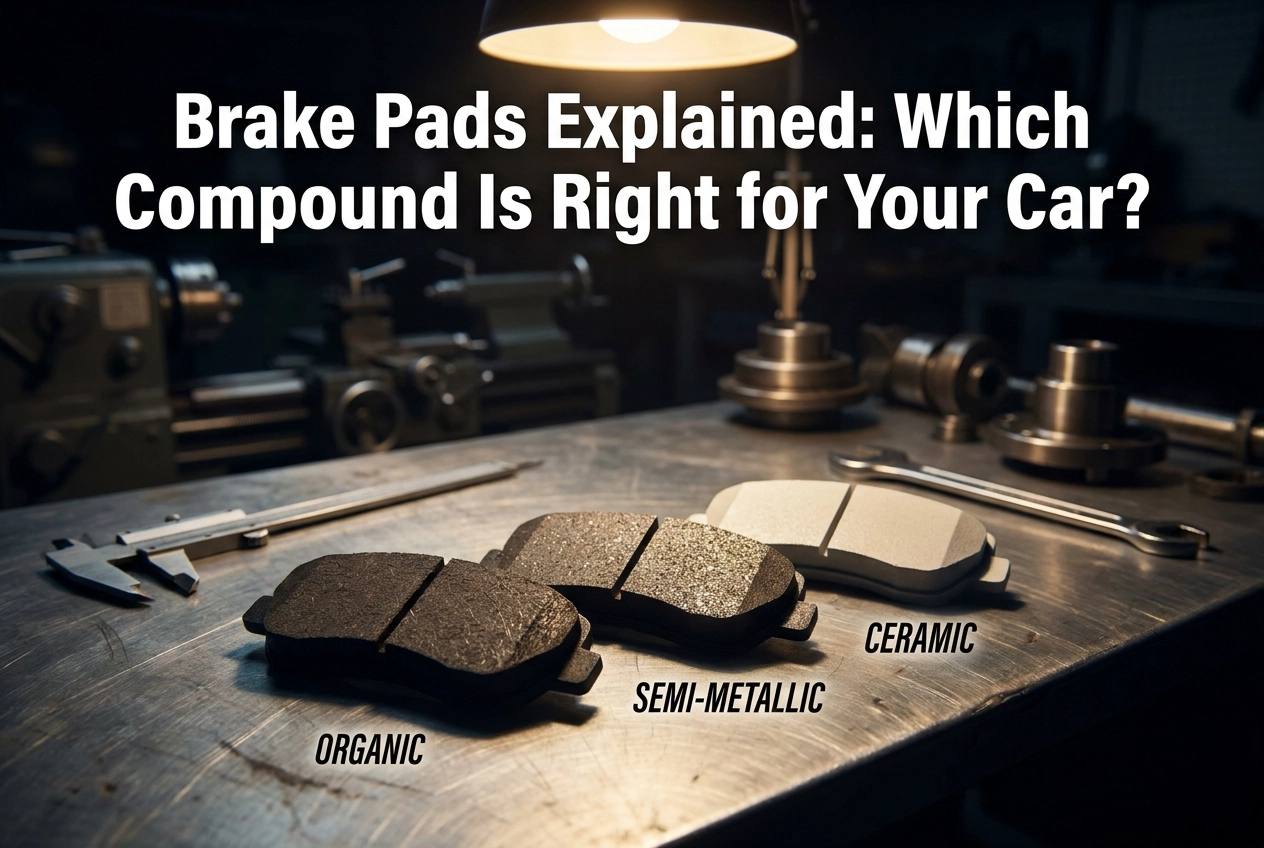
The brake pad market organises itself around three principal compound types: organic (NAO), semi-metallic, and ceramic. Each is engineered with a distinct set of trade-offs across friction coefficient, operating temperature range, noise, dust output, and service life. Understanding these differences is not academic; it directly determines whether your brakes perform safely under your specific driving conditions.
Organic pads, composed of rubber, glass, carbon, and binding resins, are the softest and most affordable option. They operate quietly and cause minimal rotor wear, but their low thermal threshold makes them susceptible to fade and glazing under sustained braking loads, ruling them out for any track or spirited road application.
Semi-metallic pads incorporate ferrous metal fibres bonded with graphite and carbon. They deliver the highest stopping power and outlast organic compounds considerably, but they run noisier, wear rotors faster, and produce heavy, difficult-to-clean dust.
Ceramic pads are dense ceramic compounds blended with small amounts of metallic fibre, engineered specifically for quiet operation, low dust output, and extended service life. Their performance characteristics across road and light performance applications explain why ceramics are projected to hold a 42.6% share of the overall friction products market in 2026. The key limitation is reduced cold-bite; ceramic compounds require heat to reach optimal friction levels, which creates a measurable stopping power deficit from a cold start.
Compound mismatch is arguably the most common and costly error in brake specification. An organic or comfort-oriented ceramic pad subjected to repeated high-speed braking will experience thermal fade, a condition where friction drops sharply as the pad material overheats, resulting in a dangerously long stopping distance. Conversely, a competition semi-metallic pad used on a cold morning commute may deliver inconsistent bite until it reaches its narrow operating temperature window, precisely the conditions when emergency braking is most likely needed.
Organic Brake Pads
Organic pads, formally classified as NAO (non-asbestos organic) compounds, are constructed from a blend of fibrous materials including glass, rubber, carbon compounds, and Kevlar fibres, all bound together using a resin matrix. This composition makes them the softest of the three principal compound types, which directly influences every performance characteristic they exhibit, both positive and negative. The manufacturing inputs are relatively inexpensive compared to ceramic or semi-metallic alternatives, which is the primary reason organic pads remain the default factory fitment on a significant proportion of new vehicles globally.
Performance characteristics skew toward refinement over capability. Organic pads operate quietly, generate minimal brake dust, and are gentle on rotor surfaces due to their low hardness. They also engage effectively from cold, requiring no heat build-up to generate adequate friction, which suits short urban trips and stop-start commuting where brakes rarely reach elevated temperatures. For older vehicles with standard cast iron rotors, the softer friction interface is particularly beneficial, reducing wear on components that may already have accumulated significant service hours.
The critical limitation is thermal threshold. Organic pads begin to fade beyond approximately 300 to 400 degrees Celsius, at which point the resin binder degrades and the coefficient of friction drops sharply. This makes them fundamentally unsuitable for track driving, sustained motorway braking, or towing applications where repeated high-load stops generate heat that organic compounds cannot dissipate or withstand. A further handling consequence of the softer compound is increased pedal compressibility, which can produce a less precise, slightly spongy pedal feel under heavier braking loads.
Wear rate is the other key trade-off. The same softness that protects rotors accelerates pad material wear, meaning replacement intervals arrive sooner compared to ceramic or semi-metallic alternatives, partially offsetting the lower upfront cost. For a full breakdown of brake pad types and their material differences, understanding this wear relationship is essential before making a purchasing decision.
Organic pads are best suited to standard road cars used primarily in urban or light commuting conditions, where braking demands are modest and heat resistance is not a requirement.
Semi-Metallic Brake Pads
Semi-metallic brake pads are constructed from a compound containing 30 to 65% metal content by weight, typically comprising steel wool, iron powder, and copper fibres, all bonded within a resin matrix alongside friction modifiers and graphite lubricants. This metallic loading is what fundamentally separates them from organic alternatives; the higher thermal conductivity of the metal particles allows the pad to absorb and dissipate heat far more effectively, pushing the operating threshold well above what an organic compound can tolerate before friction performance begins to degrade.
That heat tolerance translates directly into more consistent bite across a wider temperature range. Where organic pads can exhibit noticeable fade under prolonged or repeated braking loads, semi-metallics maintain more predictable friction coefficients as temperatures climb. This reliability is a primary reason why many OEM fitments on performance-oriented road cars specify semi-metallic compounds; they offer a meaningful level of stopping authority while still keeping noise and dust output within acceptable limits for everyday use. For a driver in a hot hatch or a heavier performance saloon who regularly uses the full capability of the car, this balance is genuinely useful.
The trade-offs are worth understanding clearly before specifying semi-metallics. The abrasive nature of metallic particles means rotor wear rates are higher compared with ceramic compounds, and the harder friction material can generate audible noise, particularly during the first few applications after a cold start on a damp morning. Brake dust output is also elevated relative to ceramics, and it tends to be darker and more adhesive, accumulating on alloy wheel faces more visibly. These are known characteristics of the compound type rather than defects, but they do influence day-to-day ownership experience. For a detailed breakdown of how semi-metallics compare against ceramics on these specific attributes, the AAA’s ceramic vs semi-metallic brake pad guide provides a useful reference.
For occasional track days or spirited B-road driving, semi-metallics perform competently. Under sustained circuit conditions involving repeated hard braking from high speed, however, the compound will eventually approach its thermal limits more quickly than a purpose-built motorsport pad. Typical service life under average mixed driving sits in the region of 25,000 to 45,000 miles, though aggressive use will compress this significantly.
Semi-metallic pads are best suited for fast road use, heavier vehicles, towing applications, and drivers seeking a tangible performance step above organic pads without the cost or operational constraints of full motorsport-specification compounds.
Ceramic Brake Pads
Ceramic brake pads represent a significant engineering departure from metallic compounds. Rather than relying on metal content for friction generation, ceramic pads use dense ceramic fibres combined with filler materials such as copper to create a compound that achieves high friction coefficients through material density and consistency rather than raw metallic abrasion. The result is a pad that operates quietly across a wide temperature range, produces very fine and light-coloured dust that is far less corrosive to alloy wheel surfaces, and maintains predictable friction behaviour through repeated thermal cycling.
From a market perspective, ceramic compounds are projected to hold a 42.6% share of the overall friction products market in 2026, a figure that underlines their growing dominance across both OEM fitment and the performance aftermarket. A key driver of this growth has been the resolution of a longstanding weakness: cold bite performance. Earlier ceramic formulations struggled to generate adequate friction before reaching operating temperature, limiting their appeal to warmer climates or drivers willing to accept a brief warm-up period. Modern ceramic compounds have largely addressed this limitation, making them a viable choice year-round in the UK’s variable climate conditions.
Heat resistance remains the standout performance attribute for ceramic compounds. Quality performance-spec ceramic pads are capable of operating effectively at temperatures well beyond 600 degrees Celsius, a threshold that covers the demands of fast road driving and occasional track day use comfortably. Where semi-metallic pads rely on metal content to conduct and dissipate heat, ceramic compounds resist heat fade through the inherent thermal stability of their fibrous matrix, maintaining consistent friction output even as brake temperatures climb through repeated hard stops.
Rotor wear is another area where ceramics demonstrate a measurable advantage. Because the compound is harder and more dimensionally consistent than semi-metallic alternatives, friction behaviour remains uniform across the rotor surface, reducing the uneven wear patterns that can lead to rotor lip formation or surface degradation over time. For drivers who want to protect a quality set of rotors while extracting real braking performance, this characteristic is practically significant.
Ceramic pads are best suited to performance road cars, drivers who prioritise clean wheels and low noise alongside genuine braking capability, and anyone seeking a high-specification daily-driver upgrade with genuine track-day potential. For a deeper look at ceramic vs metallic brake pad trade-offs, the compound selection logic becomes clear: ceramics offer the most balanced profile across noise, dust, rotor wear, and heat resistance for road-biased performance use. Those pushing into dedicated circuit work may eventually require a more aggressive semi-metallic or sintered compound, but for the majority of performance-oriented road drivers, ceramic pads represent the most capable all-round choice currently available.
Compound Comparison at a Glance
The table below consolidates the key trade-offs across all three primary compound types into a single decision framework, mapping each against five attributes that matter most for performance applications.
Reading across the table, organic compounds win on noise and entry-level cost but carry a meaningful thermal ceiling, typically fading above approximately 300°C under sustained load. Semi-metallic pads occupy the balanced middle ground, tolerating temperatures well in excess of 500°C while remaining accessible on price. Ceramic compounds lead on heat resistance, dust output, and rotor wear impact simultaneously, but the premium cost tier reflects that advantage.
One attribute absent from most standard comparisons is cold bite performance. Organic and semi-metallic compounds reach effective friction output at lower operating temperatures, making them more consistent during the first braking events of a cold start. Historically, ceramic pads required additional heat input before delivering peak friction. At the performance tier, modern ceramic formulations have substantially closed this gap through refined fibre geometry and improved binder chemistry, though it remains a variable worth verifying against a specific pad’s datasheet before committing to a fitment.
For a deeper breakdown of how each compound behaves across these attributes in practice, the ceramic vs semi-metallic comparison from FCP Euro provides useful real-world context on where each compound delivers and where it falls short.
Matching Your Brake Pads to How You Actually Drive
The compound type you select is only half the equation. The other half is whether that compound matches the conditions you actually subject your brakes to. A pad that delivers outstanding fade resistance at 700°C becomes a liability on a cold morning commute; a pad optimised for quiet, dust-free daily use will begin to fade before you reach the end of a long track straight. Use-case alignment is the single principle that overrides every other selection criterion, and the four profiles below map directly to the audience this guide addresses.
Daily Road Driving
For performance car owners using their vehicle as primary transport, a premium ceramic compound represents the most rational choice across all realistic operating parameters. The advantages covered in the previous section translate directly to daily-use priorities: minimal brake dust on alloy wheels, near-silent operation, consistent pedal feel from the first cold stop of the morning, and a working temperature range that spans the modest heat cycles typical of road use. Critically, a quality ceramic pad retains sufficient heat reserve to manage genuine emergency stops without fade, which matters more than many owners appreciate until they need it. The important qualification here is compound grade: premium ceramics engineered for performance vehicles are a substantially different product from entry-level OE-replacement ceramics, and the distinction becomes clear in both cold-bite response and structural durability under hard repeated use.
Fast Road and Spirited B-Road Driving
This profile occupies the most technically interesting position in the selection matrix. Drivers who use their car enthusiastically on public roads, including fast A-roads and twisting B-roads, need sharper initial bite and meaningfully better fade resistance than a standard ceramic provides, but they cannot accept the cold-bite penalty or elevated wear rate of a purpose-built track compound. Semi-metallic compounds and performance-oriented ceramics fill this gap precisely. Products such as EBC Yellowstuff and Ferodo DS2500 equivalents are specifically engineered for this application: they offer a firmer, more progressive pedal response under hard use, resist fade at temperatures that would begin to stress a daily-driver pad, and still perform acceptably from cold on a normal road. As this in-depth analysis of performance brake pad selection explains, semi-metallic compounds provide significant bite during initial braking phases alongside superior heat management versus organic alternatives, which is exactly the characteristic profile this driving style demands.
Track Day Use
Moving onto a circuit changes the operational demands on your brakes in ways that cannot be adequately addressed by even the best fast-road compound. Sustained braking from high speeds into tight corners, lap after lap, generates heat accumulation that takes brake temperatures well beyond what public roads produce. Purpose-built track compounds such as Ferodo DS3000 and EBC Bluestuff NDX are engineered specifically for this environment, delivering stable, consistent friction coefficients through repeated heavy braking zones rather than progressively fading as temperatures climb. Two important trade-offs come with this capability. First, these compounds wear considerably faster on the road and will degrade your rotors more aggressively in everyday conditions. Second, they may feel noticeably wooden or unresponsive when cold, which creates a brief but real safety window at the start of any drive. Bedding-in protocol is also non-negotiable at this level: new track pads must be heat-cycled through a structured series of progressive stops before their full performance characteristics are available, and skipping this step risks uneven transfer layer deposition on the rotor surface.
Full Motorsport and Competition
Race-specification brake pads are system components, not direct upgrades. They operate within a narrow, very high temperature window and will deliver dangerously unpredictable performance on the road, where they will rarely reach proper operating temperature. Before full friction performance is available, several warm-up laps are required to bring compounds to their effective range. Beyond temperature requirements, race pads are engineered as part of an integrated braking system that includes uprated rotors with higher thermal mass and surface specifications suited to the transfer layer these compounds deposit, alongside high-specification brake fluid rated for dry boiling points well above standard DOT 4. Running race pads on standard components introduces thermal stress concentrations that can compromise rotor integrity. As Edge Autosport’s brake pad selection guide makes clear, matching brake pad choice to the specific use case is critical rather than optional at this level of performance driving. For anyone using a vehicle exclusively in competition, race-spec pads represent the correct solution; for everyone else, they introduce more risk than benefit.
Understanding Heat Fade and Why It Can Catch You Out on Track
Heat fade is one of the most dangerous and misunderstood failure modes a driver can encounter on track, precisely because it can develop gradually and then deteriorate rapidly with very little warning. The mechanism begins at the molecular level: as brake pad temperatures climb beyond the compound’s designed operating threshold, the resin binders within the friction material begin to vaporise. This outgassing process creates a thin layer of compressible gas between the pad face and the rotor surface, effectively lubricating the interface that is supposed to generate friction. The result is a dramatic and sudden reduction in braking force that no amount of pedal pressure can fully recover in the moment.
Pad Fade vs. Fluid Fade: Two Failure Modes, One Braking Event
It is critical to understand that heat fade is not a single phenomenon. Two distinct failure modes can occur independently or simultaneously, and distinguishing between them is essential for both diagnosis and prevention.
Pad fade occurs when the friction compound itself overheats and loses its coefficient of friction through outgassing. The insidious characteristic of pad fade is that the pedal remains firm; the car simply does not decelerate as expected. Because the pedal feels normal, many drivers instinctively apply more force, which increases heat generation at an already-compromised surface and accelerates the failure further. Symptoms to recognise before full pad fade onset include progressively longer stopping distances despite consistent pedal pressure, a chemical or acrid burning smell emanating from the wheel area during or immediately after a braking session, and a faint glaze developing on the rotor surface. For a detailed breakdown of brake fade causes, these early warning signs are worth understanding before you reach a track environment.
Fluid fade operates through a different mechanism. Heat conducts from the pad and rotor interface through the backing plate and into the caliper body. Brake fluid, being hygroscopic, absorbs atmospheric moisture over time, which progressively lowers its effective boiling point. Standard DOT 5.1 fluid boils at approximately 190 to 270 degrees Celsius depending on age and moisture content. Once the fluid reaches that threshold inside the caliper, it produces compressible gas bubbles within the hydraulic circuit. The pedal travel increases noticeably and the pedal feels spongy rather than firm; in severe cases, braking force can drop away almost entirely. As explored in this discussion of brake fade and its causes, fluid fade is considered the more dangerous of the two failure modes because of how rapidly it can progress.
On track, both failure modes can occur within the same session if the braking system is not correctly specified for the thermal load being applied. A driver running standard road pads on a performance vehicle through repeated late, hard braking zones will typically encounter pad fade first, followed by fluid fade as residual heat soaks into the caliper.
The Correct Response to Fade and How to Prevent It
Pressing harder at the onset of fade is the wrong response, but it is the instinctive one. Increased pedal force at this stage adds heat to a system that is already thermally saturated and produces diminishing braking returns. The correct response is to temporarily reduce braking aggression and allow the system to cool, giving temperatures a lap or two to drop before returning to full-commitment braking zones.
Prevention, however, is always preferable to management. For track use, the compound selection should be treated as a minimum specification exercise rather than an upgrade decision. Pads rated to a continuous operating temperature of at least 650 to 800 degrees Celsius represent the appropriate starting point for repeated circuit use; compounds below this threshold will fade progressively through a standard track session. This specification should be addressed in parallel with an uprated brake fluid, since running a high-temperature pad compound through a system still filled with standard road fluid leaves fluid fade fully unaddressed.
Performance Cars Parts stocks uprated brake fluid alongside its range of performance pad compounds, which means both failure modes can be resolved within a single order rather than treating each as a separate problem. Addressing the complete thermal system, rather than the pad compound in isolation, is how a correctly specced track braking setup is built.
How to Bed In Brake Pads Correctly
Bedding-in, also referred to as burnishing, is not an optional finishing step. It is a fundamental part of the installation process for any new set of brake pads. The procedure works by transferring a thin, uniform layer of friction material from the pad face onto the rotor surface. This transfer layer creates the optimal interface between pad and disc, improving bite, stabilising friction output, and ensuring the system delivers consistent pedal feel from the first serious application onwards. Without it, you are effectively asking a cold, unmatched pad-to-rotor pairing to perform under significant thermal and mechanical stress.
Skipping the bed-in process is one of the most common errors made after a pad change, particularly among drivers who assume new parts are immediately ready for hard use. When material transfer happens unevenly, the consequences are compounding: vibration through the pedal and steering wheel, audible noise under braking, inconsistent stopping distances, and accelerated wear on both the pads and rotors. In severe cases, uneven deposits can create hard spots on the rotor face that no amount of repeated braking will fully resolve, forcing premature rotor replacement alongside the pads.
Road Bed-In Procedure
For standard road use, find a quiet stretch where you can brake without traffic pressure. From approximately 50 mph, apply moderate, progressive brake pressure to reduce speed to around 10 mph. Do not come to a complete stop, as bringing the vehicle to a standstill with hot pads stationary on the rotor concentrates heat in a single contact zone and encourages uneven deposit formation. Allow at least 60 seconds of gentle rolling between each cycle to permit heat dissipation. Repeat this sequence 6 to 8 times, deliberately increasing braking force on later cycles to build temperature progressively rather than shocking the system. The disc pad break-in guidance from Wagner Brake reinforces this graduated approach, emphasising that the goal is controlled, incremental heat cycling rather than a single aggressive stop. Note that recommended cycle counts vary between pad manufacturers; always cross-reference the specific instructions supplied with your pads.
Track and Performance Bed-In Procedure
For track or high-performance applications, the procedure demands more structure. Begin with 2 to 3 warm-up laps using only light braking to bring the entire system, pads, rotors, callipers, and fluid, up to operating temperature. Once warm, perform 3 to 4 progressively harder braking events from speed, allowing adequate cooling distance between each. Critically, never bring the vehicle to a complete standstill immediately following a hard braking event during this phase; stationary contact between a heavily loaded pad and a hot rotor is a primary cause of the uneven material deposits that bed-in is specifically designed to prevent. The procedure must be repeated if either pads or rotors are subsequently changed.
Inspecting the Results
After completing the bed-in sequence, allow the brakes to cool fully before inspecting the rotor surface. A successful process produces an even, slightly glazed appearance across the full swept face of the disc, indicating uniform material transfer. Discolouration confined to isolated patches, visible hot spots, or a mottled appearance are indicators that the procedure was incomplete or that stopping the vehicle prematurely occurred during the process. In these cases, the bed-in should be repeated from the beginning rather than simply continuing to use the pads in service.
Brake Pad Brands Worth Knowing for Performance and Motorsport Use
With compound selection principles covered, understanding which manufacturers produce the most credible performance and motorsport-grade brake pads will help you match the right product to your application with confidence.
EBC Brakes
EBC Brakes is one of the most widely recognised performance brake pad manufacturers among UK enthusiasts, and their tiered product range is deliberately structured to map compound capability against use case. The Greenstuff compound sits at the entry level, offering a meaningful improvement over OEM pads for road use with better bite and reduced dust, but it operates within a relatively modest temperature window unsuited to sustained track use. Moving up, the Yellowstuff compound is formulated for fast road driving and occasional track days, offering higher initial bite and improved fade resistance compared to Greenstuff while remaining usable on cold public roads. The Bluestuff NDX steps further into track and light motorsport territory, with a compound designed to build temperature quickly and maintain consistent friction coefficients through extended braking zones. At the top of the range, the RP-1 compound is engineered for competitive motorsport where sustained high temperatures are the norm rather than the exception. The hierarchy is logical and well-documented, making EBC a practical choice for enthusiasts who want a clear upgrade path as their usage evolves.
Ferodo
Ferodo is a heritage UK brand with motorsport credentials that predate modern circuit racing, and their DS compound range reflects decades of friction material development at the highest levels of competition. The DS2500 is the accessible entry point into the DS family, offering improved fade resistance over standard pads while retaining acceptable cold-bite characteristics for fast road and light track use. The DS3000 moves decisively into circuit territory, delivering consistent friction output at temperatures where most road-oriented compounds begin to fade, and it is a popular choice for club racing and track day drivers who prioritise reliability across a full session. Ferodo pads have appeared in national and international motorsport series across multiple disciplines, and that race-proven heritage translates into genuine confidence at the performance end of their range.
Brembo and Pagid
Brembo is primarily associated with high-performance caliper and rotor systems, but their compound-matched brake pad range is engineered to complement their caliper geometry specifically. For vehicles already running Brembo caliper upgrades, using matched Brembo pads ensures the friction material is optimised for the thermal and mechanical characteristics of that specific system. Pagid, operating as the motorsport performance division of TMD Friction, brings over 35 years of motorsport experience to its RS compound range. Their pads recorded more than 1,149 race victories in 2025 alone, with the RS compounds widely regarded as benchmarks for high-temperature stability and consistent friction coefficients across endurance-length sessions.
Prioritise Temperature Range Over Brand Loyalty
The most important principle when selecting between these brands is straightforward: cross-reference the compound’s operating temperature range against your actual use case before any other consideration. A Ferodo DS2500 will consistently outperform a full race compound on a cold public road, because race pads require substantial heat to reach their working friction window. Conversely, a road-optimised pad will fade decisively on circuit. Brand reputation matters, but compound specification must always take priority.
Do Uprated Brake Pads Affect Your MOT or Road Legality?
Uprated brake pads are legal for road use in the UK, provided two conditions are satisfied. First, pads must be fitted in matched pairs across the same axle; fitting different compounds to the left and right wheels of an axle violates the performance balance requirements established under the Road Vehicles (Construction and Use) Regulations 1986. Second, the vehicle’s overall braking system must continue to meet the performance standards prescribed by those regulations. Crucially, the regulations specify braking performance thresholds, not the compound type or brand of pad fitted. This means a genuinely uprated pad is not inherently unlawful, provided the system as a whole continues to function correctly and consistently.
What the MOT Actually Tests
The MOT brake test, as set out in the DVSA Inspection Manual (updated June 2026), measures braking efficiency and axle balance, not pad specification. A vehicle fitted with performance-grade brake pads in good condition, properly bedded in following installation, will typically pass the roller brake test without issue. The test does not interrogate what compound is fitted; it records the force applied and the balance between wheels on the same axle. Where problems can arise is with full race-spec compounds that require significant heat to reach their operating friction coefficient. On a cold roller brake test, these pads may generate inconsistent or asymmetric readings, potentially triggering an advisory or failure on brake balance grounds. For road-registered vehicles, a high-quality fast road compound is the more reliable and practical choice; it delivers meaningfully improved performance over OEM pads while remaining predictable across the cold-start conditions the MOT test replicates.
Insurance and Regulatory Considerations
Insurance implications are frequently overlooked in this conversation. While uprated brake pads are broadly regarded as a safety enhancement, at least one documented case shows an insurer classifying non-OEM pads as a declarable modification, with a £32 annual premium adjustment applied. The practical takeaway is straightforward: disclose the change to your insurer, particularly if your vehicle sees any track use alongside regular road driving. Failure to declare a modification that is later identified following a serious claim could provide grounds for a policy to be voided.
Looking further ahead, UK regulatory trends are worth monitoring. The Road Vehicles (Construction and Use) Regulations 1986 have been progressively amended, with recent changes addressing emissions and environmental factors. The EU and several US states have already introduced restrictions on copper content in brake dust, and the UK market is expected to align with those standards over time. For buyers specifying brake pads with long-term use in mind, compound reformulations driven by these restrictions are a realistic consideration when choosing between current product lines.
Brake Pads for EVs and Hybrids: What Performance Owners Need to Know
Regenerative braking systems recover a significant proportion of kinetic energy during deceleration, but this capability does not eliminate the need for conventional friction brake pads. Emergency stops from high speed, situations where the regenerative system reaches its torque limits, and low-speed final stopping all demand full friction braking engagement. For performance EV and hybrid owners, this means brake pads remain safety-critical components regardless of how sophisticated the vehicle’s energy recovery strategy is.
The defining challenge for EV and hybrid brake pads is not wear, but inactivity. Because regenerative braking handles the majority of routine deceleration, friction pads on these vehicles can sit dormant for extended periods between activation events. Without the continuous self-cleaning action that regular friction contact provides, rotor surfaces accumulate corrosion and pitting. In the UK, where persistent damp conditions and road salt exposure are seasonal realities, this process accelerates considerably. Glazing presents a secondary risk: pad friction surfaces harden and lose bite when not regularly worked through their normal operating cycle, which increases stopping distances precisely when full performance is needed most.
Cold-bite performance becomes disproportionately important in this context. A performance hybrid or electric car capable of significant speeds may go many miles relying entirely on regenerative deceleration, meaning the first friction brake activation could be an emergency stop. Pad compounds with strong cold-bite characteristics, capable of generating effective friction before reaching thermal operating range, are therefore a priority specification for this application. Pairing those compounds with zinc-coated or corrosion-resistant rotors directly addresses the inactivity corrosion problem that standard cast iron surfaces cannot withstand under low-use conditions.
The market is responding to these demands. The EV brake pads segment is projected to grow at approximately 17.5% CAGR through 2035, reaching USD 26.90 billion, reflecting significant manufacturer investment in EV-specific friction material formulations. Several established aftermarket suppliers have already launched dedicated hybrid and fully electric brake pad ranges designed to combine corrosion resistance with the friction performance required for emergency stops from speed.
For performance-oriented buyers making upgrade decisions now, manufacturer commitment to active EV product development should factor into compound selection. As the post-2030 transition increases the proportion of electrified vehicles on UK roads, braking software blend strategies will continue evolving. Choosing compounds from manufacturers actively developing EV-compatible formulations provides the best long-term assurance of friction performance, corrosion management, and compatibility with changing regenerative braking control strategies.
When Should You Replace Your Brake Pads?
Replacement intervals vary considerably depending on compound type and driving environment. Organic pads fitted to a vehicle used predominantly in urban stop-start conditions may require replacement as early as 25,000 miles, where repeated low-speed braking cycles generate consistent thermal load without allowing pads to cool fully. At the opposite end of the spectrum, high-quality ceramic compounds on a fast road car driven under moderate conditions can comfortably reach 70,000 miles before friction material is depleted to a replacement threshold. Semi-metallic compounds typically fall between these two points, offering a practical middle ground of 30,000 to 50,000 miles depending on application demands.
Track use presents an entirely different set of demands. Road-specification pads can be fully consumed within a single circuit session under sustained hard braking, particularly on longer configurations where braking zones are repeated at high approach speeds without adequate cooling intervals. This is precisely why fitting a dedicated track compound before each circuit session is the operationally correct approach; returning to road pads after track exposure also risks running thermally degraded material on public roads.
Physical wear thresholds provide the most objective measure of pad condition. A practical minimum of 2 to 3mm of friction material above the backing plate is the widely accepted guideline for scheduling replacement, with 1.5mm representing the legal minimum in UK fitment guidance. Many OEM and aftermarket pads incorporate electronic wear sensors that trigger a dashboard warning as the pad approaches this threshold, providing an additional layer of monitoring alongside manual inspection.
Audible indicators should never be dismissed. A persistent high-pitched squeal during braking indicates the wear indicator tab is contacting the rotor, which is a deliberate early-warning mechanism built into the pad. A grinding or metallic scraping sound means the friction material is fully consumed and the backing plate is contacting the rotor directly, causing accelerating rotor damage that transforms a straightforward pad replacement into a significantly more costly rotor job. A pulsing or vibrating pedal typically points to an uneven rotor surface, often the consequence of inadequate bedding-in or repeated heat cycling without proper cool-down.
The single most reliable early detection method remains a brief visual inspection through the wheel spokes at every tyre change or scheduled service interval. With the caliper and pad stack clearly visible on most fitments, assessing remaining pad thickness takes under a minute and provides early warning before rotor damage compounds the cost of repair.
Find the Right Brake Pads at Performance Car Parts
Performance Car Parts stocks a curated range of performance and motorsport brake pads covering the full application spectrum, from daily fast road driving through to full competition use. The catalogue is sourced from established friction material manufacturers, giving buyers access to properly tiered compound options rather than a generic selection of OEM-replacement products. This range depth matters because, as the preceding sections make clear, no single compound suits every vehicle, driving style, or use case simultaneously.
Operating exclusively online allows Performance Car Parts to keep pricing competitive without reducing product breadth. The brake system category extends well beyond pads alone: matched uprated rotors, performance brake fluid, and caliper hardware are all available, making it straightforward to complete a full friction system upgrade in a single order. For track and competition applications specifically, sourcing all system components together is not merely convenient; it is the most reliable way to ensure thermal ratings and specifications are correctly aligned across every component.
Buyers who need guidance on compound selection for a specific vehicle or use case can reach the team directly via email or WhatsApp. Application-specific advice of this kind is something generic catalogue sites are structurally unable to provide, and for a decision with genuine safety implications, access to that level of support carries real weight.
Browsing the brake pad category alongside the complementary rotor and brake fluid listings at performancecarsparts.co.uk is the recommended starting point for any performance or motorsport upgrade.
Conclusion
Compound selection remains the single most impactful decision in any brake pad purchase. Matching organic, semi-metallic, or ceramic compounds to your actual driving profile, rather than defaulting to the cheapest or most popular option, determines whether your brakes perform safely across every condition you encounter. Regardless of which compound you choose, always complete a proper bed-in procedure; skipping this step compromises both performance and service life from the very first application.
Treat any pad upgrade as a system-level decision. Uprating pads without addressing brake fluid heat tolerance or rotor specification creates a bottleneck elsewhere in the system, limiting the gains you actually see. Inspect pad thickness visually at every service interval and replace before the wear indicators contact the rotor; waiting until audible warnings appear risks rotor damage and significantly increases replacement costs.
For personalised compound recommendations tailored to your specific vehicle and use case, contact the Performance Car Parts team directly via WhatsApp or email before ordering. Expert guidance at the selection stage prevents costly mismatches and ensures your brake system is correctly specified from the outset.