Coilovers vs Lowering Springs: Which Is Better for Your Car?
If you want to lower your car, improve handling and achieve a more aggressive stance, two of the first suspension upgrades you’re likely to encounter are coilovers and lowering springs.
Both can reduce ride height and change how a car behaves through corners, but they work differently.
So which should you buy?
Coilovers or lowering springs?
The answer depends on your:
- Budget
- Vehicle
- Desired ride height
- Driving style
- Comfort requirements
- Future modifications
- Road or track use
For a daily-driven car requiring a modest drop, a quality set of lowering springs can be an excellent solution.
For enthusiasts wanting adjustable ride height, greater suspension control or a setup suitable for more serious performance driving, coilovers may be the better investment.
This complete guide from Performance Cars Parts UK explains the differences so you can choose the right suspension upgrade for your vehicle.
What Are Lowering Springs?
Lowering springs replace your vehicle’s standard suspension springs with shorter springs designed to reduce the car’s ride height.
Unlike coilovers, the original dampers or shock absorbers are usually retained unless upgraded separately.
The amount the car is lowered is predetermined by the spring manufacturer.
For example, a manufacturer might design a spring kit to lower a particular vehicle approximately:
20 mm
25 mm
30 mm
35 mm
40 mm
The exact drop varies according to the car and spring kit.
This makes lowering springs one of the simplest ways of improving a car’s stance without replacing the entire suspension system.
Lowering springs generally provide a fixed reduction in ride height, whereas coilovers allow the height to be adjusted after installation.
What Are Coilovers?
A coilover combines a coil spring and damper into a suspension assembly.
The name effectively comes from:
Coil spring + over the damper = coilover
Performance coilover kits are usually designed as a matched spring-and-damper package.
One of their biggest advantages is ride-height adjustment.
Rather than accepting one predetermined lowering amount, the threaded adjustment mechanism allows the vehicle’s height to be changed within the manufacturer’s specified adjustment range.
Depending on the coilover system, additional adjustments can include:
- Damping
- Rebound
- Compression
- Spring preload
- Camber
- Top-mount position
Not every coilover offers every adjustment.
Entry-level systems may provide only height adjustment, while advanced track-focused systems can provide significantly more setup control.
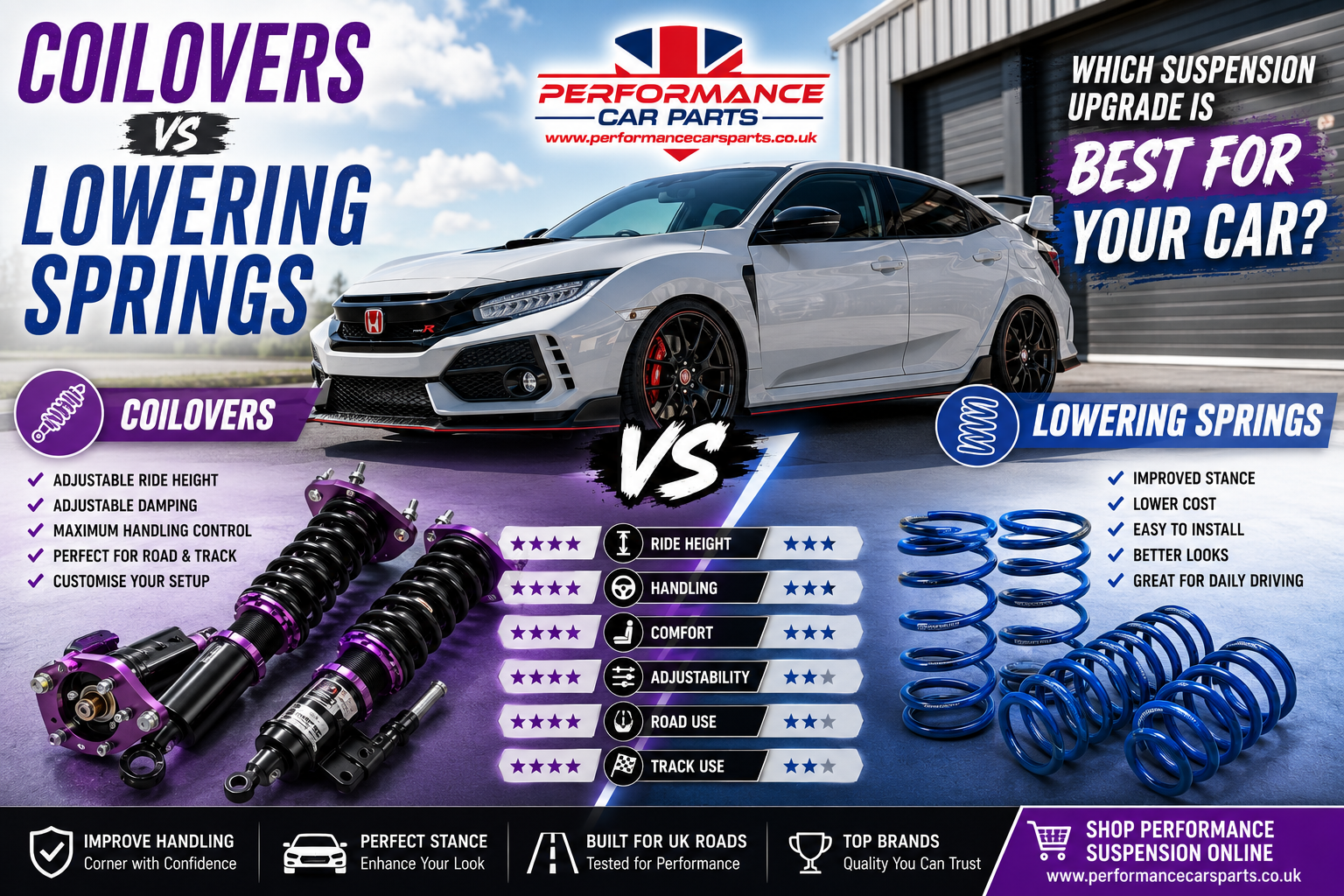
Coilovers vs Lowering Springs – Quick Comparison
| Feature | Lowering Springs | Coilovers |
|---|---|---|
| Lower ride height | Yes | Yes |
| Adjustable ride height | No – usually fixed | Yes |
| Replaces springs | Yes | Yes |
| Replaces dampers | Usually no | Usually yes |
| Adjustable damping | No | Available on many kits |
| Lower initial cost | Usually yes | Usually no |
| Simple road-car upgrade | Excellent | Excellent with correct setup |
| Track adjustment | Limited | Much greater |
| Corner weighting | No | Possible with suitable setup |
| Stance adjustment | Fixed | Adjustable |
| Setup complexity | Lower | Higher |
| Best for budget build | Often | Depends on budget |
| Best for serious suspension tuning | Limited | Usually |
The fundamental distinction is straightforward: lowering springs normally provide a predetermined drop, while coilovers provide considerably greater setup flexibility.
Benefits of Lowering Springs
Lowering springs remain extremely popular because they provide several advantages without the cost of replacing the complete suspension.
1. Lower Cost
Lowering springs generally cost significantly less than a complete quality coilover system.
That makes them attractive for enthusiasts who want:
- Improved stance
- Moderate lowering
- Sportier handling
- A straightforward suspension modification
without investing in a complete adjustable suspension system.
2. Improved Appearance
One of the most obvious benefits is appearance.
Many factory cars have a noticeable gap between the wheel and wheel arch.
Lowering the vehicle can reduce this gap and create a more purposeful stance.
This can be particularly effective when combined with suitable:
Alloy wheels
Performance tyres
Wheel spacers
or correctly chosen wheel offsets.
3. Lower Centre of Gravity
Reducing vehicle ride height can lower the centre of gravity.
Within sensible limits and with correct suspension geometry, this can contribute to reduced body movement and improved cornering behaviour.
However, lower does not automatically mean better handling.
Excessive lowering can adversely affect suspension geometry, available suspension travel and roll-centre behaviour.
The objective for a performance car should therefore be an effective suspension setup, not simply the lowest possible ride height.
4. Reduced Body Roll
Quality performance lowering springs are typically designed to provide a sportier suspension response.
This can help reduce excessive body movement during cornering.
The car may consequently feel:
Sharper
More responsive
More controlled
and more confidence-inspiring during spirited driving.
5. Straightforward Upgrade
For many cars, lowering springs provide a relatively simple route into suspension modification.
If you don’t need adjustable ride height or adjustable damping, there may be little reason to pay for features you will never use.
Disadvantages of Lowering Springs
Lowering springs aren’t perfect.
There are several considerations before buying them.
Fixed Ride Height
This is the biggest difference compared with coilovers.
Once the springs are fitted, the ride height is largely determined by the spring design.
If the resulting drop is:
too low
or
not low enough
you can’t simply adjust it.
Changing height generally means changing springs.
Factory Damper Compatibility
Lowering springs are often fitted to factory dampers.
The issue is that those dampers were originally designed around the standard springs, suspension travel and ride height.
A modest, vehicle-specific lowering spring can work acceptably with suitable factory dampers on many applications, but aggressive lowering or worn dampers can create a poor match.
If the original dampers are already worn, fitting new lowering springs won’t restore their damping ability.
This is why the condition and compatibility of the dampers should always be considered.
What Are the Benefits of Coilovers?
Coilovers offer considerably more control over suspension setup.
This makes them particularly attractive to enthusiasts who want more than simply lowering the vehicle.
1. Adjustable Ride Height
This is probably the biggest reason people buy coilovers.
A quality coilover kit allows you to alter ride height within its designed adjustment range.
This lets you fine-tune:
- Wheel-to-arch gap
- Vehicle stance
- Ground clearance
- Track setup
- Wheel fitment
- Suspension setup
rather than being locked into a single fixed drop.
2. Matched Springs and Dampers
A major advantage of a complete coilover kit is that the spring and damper can be designed to work together.
The damper can therefore be calibrated around the spring rate used in the kit rather than relying on a standard damper designed for the original factory spring.
This can provide better-controlled suspension behaviour when the system is correctly designed and set up.
3. Adjustable Damping
Many performance coilovers offer adjustable damping.
This can allow the driver or suspension specialist to alter how the suspension responds.
Depending on the system, you may be able to choose between:
Softer road settings
and
Firmer performance settings
or positions between them.
More sophisticated suspension systems may offer separate compression and rebound adjustment.
4. Better Performance Setup
For track use or serious fast-road driving, adjustability becomes particularly useful.
A coilover setup can potentially be configured around:
- Vehicle weight
- Tyres
- Driving conditions
- Circuit
- Driver preference
- Aerodynamics
- Suspension geometry
A suitable coilover system can also allow professional corner weighting, helping optimise how the car’s weight is distributed across its four tyres.
5. Future Adjustability
Your car may change over time.
You might later install:
- Different wheels
- Wider tyres
- Aero components
- Additional chassis modifications
- Different alignment settings
With coilovers, you have more flexibility to adjust the suspension as the build develops.
Are Coilovers Better Than Lowering Springs?
Not automatically.
It depends on what you’re trying to achieve.
A high-quality lowering spring can be a better choice for a daily road car than a poorly designed budget coilover.
Similarly, a correctly designed and professionally set-up coilover can offer significantly greater adjustability for a serious performance build.
The question shouldn’t simply be:
“Are coilovers better?”
Instead ask:
“Which suspension system is better for how I use my car?”
Coilovers vs Lowering Springs for Daily Driving
For a normal daily-driven road car, lowering springs can make a lot of sense.
You may want:
- Slightly reduced ride height
- Better stance
- Sportier handling
- Reasonable comfort
- Lower cost
- Minimal adjustment
In this situation, a quality lowering spring kit can provide exactly what you need.
A recent UK suspension guide similarly positions lowering springs as a cost-effective road-focused option where owners want improved looks and handling without needing extensive adjustment.
However, quality road-focused coilovers can also work very well on daily drivers.
The important factors are:
Spring rate
Damper quality
Ride height
and
Correct setup
Performance does not automatically require an excessively harsh ride.
Coilovers vs Lowering Springs for Fast-Road Driving
For a fast-road car, either can work.
Lowering Springs
Best when you want:
- Moderate lowering
- Predictable fixed setup
- Lower cost
- Mostly road driving
Coilovers
Better suited when you want:
- Precise ride-height adjustment
- Greater control
- Adjustable damping
- Future setup changes
- Occasional track use
For a serious fast-road build, a quality matched spring-and-damper kit is another option worth considering.
Coilovers vs Lowering Springs for Track Days
For regular track use, coilovers generally provide more useful adjustment.
Why?
Because track driving places different demands on suspension compared with normal road driving.
You may want to adjust:
- Ride height
- Damping
- Alignment
- Corner weights
- Camber
- Overall chassis balance
A fixed lowering spring provides much less flexibility.
This doesn’t mean every track car needs the stiffest coilover available.
In fact, excessive spring stiffness or insufficient suspension travel can reduce grip.
The objective is controlled tyre contact with the road or track, not simply maximum stiffness.
Do Coilovers Make Your Car Handle Better?
They can.
But simply installing coilovers doesn’t guarantee improved handling.
The result depends on:
- Coilover quality
- Spring rates
- Damper calibration
- Ride height
- Tyres
- Wheel alignment
- Suspension geometry
- Vehicle weight
- Driver requirements
A badly adjusted expensive coilover can perform worse than a properly designed standard suspension system.
Correct setup matters.
Do Lowering Springs Improve Handling?
Quality lowering springs can improve the feel of a car by reducing ride height and changing spring characteristics.
Potential benefits include:
- Reduced body movement
- More responsive cornering
- Sportier feel
- Lower centre of gravity
But again, the complete suspension system matters.
The springs have to work effectively with the dampers.
Do Coilovers Make the Ride Uncomfortable?
Not necessarily.
This is one of the biggest misconceptions surrounding coilovers.
Ride comfort depends heavily on spring rate, damping, suspension travel and setup.
Setting a car extremely low reduces available suspension travel and can create a harsh ride even with expensive components.
A road-focused coilover with appropriate spring rates and damping can be significantly more usable than an extremely stiff track-oriented setup.
Choose suspension for how you actually drive the car.
How Low Should You Lower Your Car?
There is no universal number.
The correct ride height depends on the vehicle.
Consider:
- Suspension travel
- Wheel clearance
- Tyre clearance
- Ground clearance
- Speed bumps
- Driveways
- UK road surfaces
- Suspension geometry
- Alignment
- Intended use
For a road car, retaining sufficient suspension travel and ground clearance is extremely important.
A car that looks fantastic but constantly hits speed bumps or bottoms out on rough roads isn’t necessarily a good performance setup.
What Happens If You Lower a Car Too Much?
Excessive lowering can create several problems.
These can include:
- Reduced suspension travel
- Bottoming out
- Poor ride quality
- Tyre rubbing
- Ground-clearance problems
- Exhaust clearance issues
- Altered suspension geometry
- Unwanted alignment changes
As evo notes, lowering the centre of gravity can aid cornering only up to a point; excessive lowering can negatively alter suspension geometry and roll-centre behaviour.
Therefore:
Lower ≠ automatically faster.
Do You Need Wheel Alignment After Fitting Coilovers?
Yes, a professional wheel alignment is strongly recommended after significant suspension changes.
Changing ride height can alter alignment settings.
Depending on the vehicle, these can include:
- Camber
- Toe
- Caster
Incorrect alignment can cause:
Uneven tyre wear
Poor handling
Reduced stability
and
Unpredictable steering behaviour
After fitting coilovers, the suspension should be properly set up and aligned.
The same principle applies after fitting lowering springs.
What Is Camber?
Camber describes the inward or outward angle of the wheel when viewed from the front of the car.
Performance cars often use some negative camber.
However, excessive negative camber can contribute to uneven tyre wear and may not provide an advantage for a road-driven vehicle.
Some performance coilovers include adjustable top mounts that can provide additional camber adjustment on compatible suspension designs.
What Is Corner Weighting?
Corner weighting involves measuring and adjusting the weight carried by each wheel.
On suitable coilover-equipped performance cars, a specialist can use scales and suspension adjustment to optimise the vehicle’s balance.
This is particularly useful for:
- Track cars
- Race cars
- Competition cars
- Serious fast-road builds
For an ordinary road car, it may not be necessary.
Best Coilovers for UK Roads
The “best coilovers” aren’t necessarily the stiffest or most expensive.
For a UK road car, look for a system offering:
- Appropriate spring rates
- Good damper control
- Sensible lowering range
- Corrosion-resistant construction
- Vehicle-specific fitment
- Replacement-parts availability
- Reputable manufacturer support
British roads can be rough.
A suspension system designed only around smooth circuits may not be ideal for everyday road use.
Popular Coilover Brands
Depending on vehicle application, performance enthusiasts may consider brands including:
TEIN
BC Racing
KW Suspension
Bilstein
HKS
Öhlins
Eibach
H&R
ST Suspensions
D2 Racing
MeisterR
Different brands and product ranges are aimed at different budgets and applications.
Don’t select suspension based on brand name alone.
Check the exact kit specification for your vehicle.
Popular Lowering Spring Brands
Well-known performance lowering-spring manufacturers include:
Eibach
H&R
TEIN
Whiteline
ST Suspensions
Vogtland
and other vehicle-specific performance manufacturers.
Again, check the exact application and expected lowering amount before purchasing.
Best Suspension Upgrades for Toyota GR Yaris
The Toyota GR Yaris has become one of the UK’s most popular modern performance platforms.
Owners frequently look for:
GR Yaris coilovers
GR Yaris lowering springs
GR Yaris suspension upgrades
GR Yaris anti-roll bars
GR Yaris control arms
A road-focused GR Yaris owner may prefer a moderate lowering spring or road coilover setup.
A car regularly used on circuit may benefit from more advanced suspension adjustment.
Best Suspension Upgrades for Honda Civic Type R
Popular searches include:
Civic Type R coilovers
FK8 coilovers
FL5 coilovers
EP3 coilovers
FN2 coilovers
Civic Type R lowering springs
Different generations of Civic Type R use different suspension designs, so always select components for the exact chassis and model year.
Suspension Upgrades for BMW Performance Cars
BMW performance models have an enormous suspension aftermarket.
Popular searches include:
BMW M140i coilovers
BMW M135i lowering springs
BMW M2 coilovers
BMW M3 coilovers
BMW M4 lowering springs
Cars equipped with adaptive or electronically controlled dampers may require additional consideration when changing suspension components.
Always verify compatibility before ordering.
Suspension Upgrades for Volkswagen Golf GTI & Golf R
Popular VW suspension searches include:
Golf R coilovers
Golf GTI coilovers
Golf R lowering springs
Golf GTI lowering springs
MK7 Golf R suspension
MK8 Golf R suspension
As with BMW applications, vehicles equipped with electronically controlled damping may require compatible suspension components or additional modules depending on the chosen setup.
Japanese Performance Car Suspension
Performance Cars Parts UK caters for enthusiasts modifying many Japanese performance platforms, including:
Toyota
GR Yaris
GT86
GR86
Supra
Honda
Civic Type R
Integra Type R
S2000
Nissan
Skyline GT-R
GT-R R35
350Z
370Z
Silvia
Subaru
Impreza WRX
WRX STI
BRZ
Mitsubishi
Lancer Evolution
These cars have extensive aftermarket suspension support and can benefit from carefully selected chassis upgrades.
What Other Suspension Parts Should You Upgrade?
Coilovers and springs aren’t the only suspension modifications available.
A complete performance suspension setup may also include:
Anti-Roll Bars
Designed to influence body roll and chassis balance during cornering.
Performance Bushes
Can replace softer or worn factory bushes to provide more precise suspension movement.
Adjustable Control Arms
Useful where additional alignment adjustment is required.
Strut Braces
Designed to increase rigidity between suspension mounting areas on suitable applications.
Camber Arms
Can provide additional alignment adjustment after lowering.
Drop Links
Performance or adjustable drop links may be useful when changing ride height or anti-roll-bar configuration.
Top Mounts
Performance top mounts can change steering response and, on some systems, provide camber adjustment.
The ideal combination depends on the vehicle and intended use.
Lowering Springs vs Coilovers – Which Should You Buy?
Choose Lowering Springs If:
You want a modest drop.
You primarily drive on the road.
You don’t need ride-height adjustment.
You want to keep costs lower.
You’re happy with a predetermined ride height.
Your existing dampers are suitable and in good condition.
You want a relatively simple suspension upgrade.
Choose Coilovers If:
You want adjustable ride height.
You want greater suspension control.
You may want adjustable damping.
You’re building a serious fast-road car.
You attend track days.
You want to fine-tune wheel fitment.
You expect the build to develop further.
You want the spring and damper supplied as a matched performance package.
Coilovers vs Lowering Springs: Final Verdict
So, which is better: coilovers or lowering springs?
For a typical road car where the owner wants improved stance and a modest handling upgrade without spending heavily, quality lowering springs can be an excellent choice.
For enthusiasts who want adjustable ride height, greater tuning potential and a suspension package suited to fast-road or track development, quality coilovers generally provide greater flexibility.
But there is one rule that applies to both:
Buy suspension based on your vehicle and intended use – not simply on how low it can go.
Correctly selected suspension should help the tyres maintain effective contact with the road while providing predictable handling and appropriate suspension travel.
Buy Coilovers & Lowering Springs in the UK
Looking for performance suspension parts in the UK?
At Performance Cars Parts UK, you can find suspension and chassis upgrades for a wide range of Japanese and European performance cars.
Shop for:
Coilovers
Lowering Springs
Performance Suspension
Control Arms
Bushes
Anti-Roll Bars
Strut Braces
Suspension Accessories
and other performance components.
We stock products for popular platforms including:
Toyota GR Yaris
Toyota GT86 / GR86
Toyota Supra
Honda Civic Type R
Nissan GT-R
Nissan 350Z / 370Z
Subaru WRX STI
Mitsubishi Evo
BMW M Cars
Volkswagen Golf GTI / Golf R
and many more.
Visit:
www.performancecarsparts.co.uk
and search by your vehicle or part number to find the right performance suspension upgrade.
Frequently Asked Questions
Are coilovers better than lowering springs?
Coilovers generally provide more adjustment, while lowering springs provide a simpler fixed-height solution. The better option depends on budget, vehicle and intended use.
Are lowering springs good for daily driving?
Quality vehicle-specific lowering springs can be a good choice for a daily-driven car where a moderate drop and sportier handling are desired.
Are coilovers good for daily driving?
Yes, provided the coilovers are designed for road use and correctly set up. Spring rate, damping and ride height all influence comfort.
Do coilovers improve handling?
A quality, correctly configured coilover system can improve suspension control and provide additional setup options. Poor setup, however, can make a vehicle handle worse.
How much should I lower my car?
There is no universal ideal drop. It depends on suspension design, wheel and tyre fitment, available suspension travel, road conditions and intended use.
Do I need an alignment after fitting lowering springs?
A professional wheel alignment is recommended after changing suspension ride height.
Do I need an alignment after installing coilovers?
Yes. Ride-height changes can affect suspension geometry and alignment.
Can lowering springs damage standard shocks?
Compatibility depends on the amount of lowering, spring rate, damper design and damper condition. Aggressive springs combined with worn or unsuitable factory dampers can produce poor suspension control.
Are cheap coilovers worth buying?
Suspension is safety-critical, so price should not be the only consideration. Look at damper quality, spring rates, corrosion protection, manufacturer support, fitment and suitability for your intended use.
What are the best coilovers for road use?
The best road coilovers are vehicle-specific systems with sensible spring rates, good damper control and an appropriate ride-height range rather than simply the stiffest or lowest kit available.