
Cold Air Intake & Induction Kits UK – Complete Performance Intake Guide
A cold air intake or performance induction kit is one of the most popular first modifications for performance-car owners.
They’re relatively straightforward to install on many vehicles, can significantly change the induction sound and may improve airflow compared with a restrictive standard intake.
But there is one question almost every enthusiast asks:
Does a cold air intake actually increase horsepower?
The answer is:
It can – but the results depend heavily on the vehicle, intake design and other modifications.
Installing an aftermarket air filter alone isn’t going to transform a 250 bhp car into a 300 bhp car.
However, on the right engine—particularly a modified turbocharged engine—improving intake airflow can become an important part of a complete performance package.
In this guide, Performance Cars Parts UK explains cold air intakes, induction kits, panel filters, intake pipes, turbo inlets and other popular intake modifications.
What Does a Car Air Intake Do?
Before discussing upgrades, it’s useful to understand the standard system.
An internal-combustion engine needs air.
The intake system delivers that air from outside the vehicle towards the engine.
Depending on the vehicle, a standard intake can include:
- Air intake duct
- Airbox
- Air filter
- Intake pipework
- Air-flow sensors
- Turbo inlet
- Resonators
- Associated hoses
Manufacturers design these systems around many requirements.
These can include:
Noise
Emissions
Packaging
Manufacturing cost
Fuel economy
Water protection
Reliability
Passenger comfort
A performance enthusiast may place greater priority on airflow, throttle response and induction sound.
What Is a Performance Air Intake?
A performance air intake is an aftermarket intake system designed to replace some or all of the factory intake.
Depending on the application, a complete system can include:
- High-flow air filter
- Larger intake pipe
- Heat shield
- Airbox
- Air duct
- Silicone hose
- Turbo inlet pipe
- Mounting hardware
Different manufacturers use different designs.
Some retain an enclosed airbox.
Others use an exposed cone filter with a heat shield.
Some systems completely replace the factory intake from the air filter to the turbocharger or throttle body.
What Is a Cold Air Intake?
A cold air intake is designed to draw air from a cooler area away from excessive engine-bay heat.
Why does this matter?
Cooler air is denser than hotter air.
In principle, denser intake air means more oxygen is available within a given volume of air.
However, real-world results depend on the intake design, engine management and vehicle.
A properly engineered cold air intake therefore needs to consider both:
Airflow
and
Air temperature
Simply fitting the largest possible open filter inside a hot engine bay doesn’t automatically create the best intake system.
Cold Air Intake vs Induction Kit
You’ll often see the terms used interchangeably, particularly in the UK.
However, there can be a difference.
Induction Kit
“Induction kit” is a broad term for an aftermarket air-intake system.
It may use:
- Open cone filter
- Enclosed filter
- Heat shield
- Replacement intake pipe
Cold Air Intake
A cold air intake specifically aims to position or feed the intake so that it receives cooler outside air.
Therefore:
Every cold air intake is a type of induction system, but not every induction kit necessarily provides an effective cold-air feed.
What Is a Performance Panel Filter?
A performance panel filter replaces the standard air-filter element inside the original airbox.
This is often the simplest intake upgrade.
Instead of replacing the entire system, you retain:
Factory airbox + Factory intake pipework
and install a higher-flow replacement filter.
Benefits of a Performance Panel Filter
A panel filter can be a good choice for owners wanting:
- Simple installation
- Factory appearance
- Minimal modification
- Potentially improved airflow
- Reusable filter options
- Subtle induction changes
For a standard or lightly modified road car, a quality panel filter can be a sensible first step.
Panel Filter vs Induction Kit
Which is better?
It depends on your goals.
Performance Panel Filter
Best for:
- Standard cars
- Daily drivers
- Subtle modifications
- OEM-style engine bays
- Lower budgets
Complete Induction Kit
Best for:
- More noticeable induction sound
- Modified cars
- Improved intake pipework
- Greater airflow requirements
- Owners planning additional tuning
A complete system may offer more potential because it can address restrictions elsewhere in the intake rather than changing only the filter.
Does a Cold Air Intake Increase Horsepower?
This is the most important question.
Yes – but don’t expect the same gain on every car.
Potential power gains depend on:
- Factory intake efficiency
- Engine type
- Turbocharged or naturally aspirated engine
- Intake restriction
- Air temperature
- ECU calibration
- Other performance modifications
Some modern factory intake systems are already efficient.
In these cases, replacing the intake on an otherwise standard vehicle may produce only a relatively small power increase.
On a modified turbocharged car flowing significantly more air than standard, an upgraded intake can become much more important.
How Much Horsepower Does an Induction Kit Add?
There is no honest universal number.
Claims such as:
“An induction kit adds 20 bhp”
without specifying the exact engine and test conditions should be treated cautiously.
One car might show only a small measurable increase.
Another modified turbocharged engine may benefit considerably more when the factory intake has become restrictive.
Think of an intake as part of the overall airflow system.
Can an Intake Improve Throttle Response?
Potentially.
Reducing intake restriction and changing intake volume can influence how an engine responds.
Drivers may notice:
- Sharper throttle response
- More immediate induction noise
- Increased turbo sound
- Different engine character
However, results vary by vehicle.
Why Does an Induction Kit Make a Car Sound Better?
For many enthusiasts, sound is one of the biggest reasons to install an induction kit.
Factory intake systems often contain resonators and enclosed airboxes designed to reduce intake noise.
Replacing these components can make induction sound much more noticeable.
On a naturally aspirated engine, this can produce a deeper intake roar under acceleration.
On a turbocharged engine, you may hear more:
Turbo spool
Airflow
Compressor sound
and, depending on the system, other induction noises.
For many road cars, the sound transformation can actually be more noticeable than the power increase.
Open Air Intake vs Closed Air Intake
Performance intakes generally fall into two broad categories.
Open Intake
An exposed performance filter is located within the engine bay, usually with some form of heat shield.
Advantages
- Strong induction sound
- Simple design
- Attractive engine-bay appearance
- Potentially high airflow
Considerations
- Heat management becomes important
- Filter location matters
- Air-feed design matters
Closed Intake
A closed intake encloses the filter inside an airbox or sealed housing.
Fresh air is normally supplied through dedicated ducting.
Advantages
- Better isolation from engine-bay heat
- More OEM-style appearance
- Controlled air supply
- Can still provide excellent airflow
Considerations
- Often more expensive
- Sound may be less aggressive than a completely exposed filter
Neither design is automatically superior.
The engineering of the complete system matters more.
What Is Heat Soak?
Heat soak occurs when components absorb heat from their surroundings.
An engine bay becomes extremely hot during operation.
If an intake draws excessive hot air from around the engine, intake temperatures can increase.
This is why heat shields, sealed airboxes and cold-air feeds are important considerations.
A performance intake should ideally balance:
High airflow + Controlled intake temperatures
rather than focusing only on filter size.
What Is a Turbo Inlet Pipe?
On a turbocharged engine, the turbo inlet carries air towards the turbocharger compressor.
As power and airflow requirements increase, the standard turbo inlet can potentially become restrictive.
Performance turbo inlet pipes may use:
- Larger internal diameter
- Smoother transitions
- Improved bends
- Silicone or aluminium construction
They are frequently combined with a performance intake on tuned turbocharged vehicles.
What Is an Intake Hose?
Factory intake hoses can sometimes use convoluted or flexible designs.
Performance intake hoses are often manufactured from:
Silicone
or rigid performance materials.
Potential benefits include:
- Improved durability
- Smoother airflow path
- Improved appearance
- Compatibility with tuned applications
Performance silicone hoses are particularly popular in modified Japanese and European vehicles.
Silicone Intake Hose vs Standard Rubber Hose
Quality silicone hoses are commonly used in performance applications because they can provide:
- Good temperature resistance
- Strong construction
- Attractive engine-bay appearance
- Multiple colour options
- Vehicle-specific fitment
For many vehicles, a silicone intake hose can be a useful supporting modification without replacing the entire intake system.
Performance Intake for Turbo Cars
Turbocharged engines can respond particularly well to airflow modifications when tuning increases their airflow requirements.
Popular turbocharged performance platforms include:
- Toyota GR Yaris
- Honda Civic Type R FK2
- Honda Civic Type R FK8
- Honda Civic Type R FL5
- Volkswagen Golf GTI
- Volkswagen Golf R
- Hyundai i20 N
- Hyundai i30 N
- Ford Focus ST
- Ford Focus RS
- BMW M135i
- BMW M140i
- BMW M2
- BMW M3
- BMW M4
- Subaru WRX STI
- Mitsubishi Evo
- Nissan GT-R
A tuned turbo build may combine:
Performance Intake + Turbo Inlet + Intercooler + Exhaust + ECU Calibration
to improve the complete airflow system.
Performance Intake for Naturally Aspirated Cars
Naturally aspirated engines don’t use a turbocharger to force additional air into the engine.
Instead, intake design can influence engine breathing and throttle response.
Popular naturally aspirated platforms include:
- Honda Civic Type R EP3
- Honda Civic Type R FN2
- Honda Integra Type R
- Honda S2000
- Toyota GT86
- Subaru BRZ
- Nissan 350Z
- Nissan 370Z
- Mazda MX-5
For these vehicles, intake upgrades are often combined with:
Headers + Exhaust + ECU Calibration
as part of a complete naturally aspirated tuning package.
Do You Need a Remap After Fitting an Induction Kit?
Not always.
Many vehicle-specific intake systems are designed to work on an otherwise standard vehicle without ECU calibration.
However, this depends on the application.
More substantial airflow changes can affect how certain engines measure incoming air.
A remap may also be beneficial when combining an intake with:
- Exhaust upgrades
- Intercooler
- Turbo inlet
- Larger turbo
- Fuelling upgrades
Always follow the intake manufacturer’s recommendations and speak to an experienced tuner where appropriate.
Can an Induction Kit Cause an Engine Warning Light?
A correctly designed vehicle-specific intake should account for sensors used by the original system.
However, an engine warning light can potentially occur if:
- Sensor positioning changes incorrectly
- Air leaks are present
- MAF scaling is affected
- Components aren’t installed correctly
- The intake isn’t suitable for the vehicle
This is another reason to buy a properly engineered kit rather than simply fitting a generic filter.
What Is a MAF Sensor?
MAF stands for Mass Air Flow.
A MAF sensor measures the amount of air entering the engine.
The ECU uses this information when calculating fuelling and engine operation.
Some vehicles are particularly sensitive to changes around the MAF housing.
A performance intake therefore needs to maintain appropriate airflow characteristics around the sensor.
Dry vs Oiled Performance Air Filters
Performance air filters can use different filtration technologies.
Two common types are:
Dry filters
and
Oiled filters
Dry Filter
Uses filtration media without additional filter oil.
Advantages can include simple maintenance.
Oiled Filter
Uses specially designed oil on the filtration material.
These can offer reusable performance filtration when correctly maintained.
Always follow the manufacturer’s cleaning and re-oiling instructions.
Using excessive filter oil can cause problems on some sensor-equipped vehicles.
Washable vs Disposable Air Filters
Some performance filters are washable and reusable.
This can make them attractive for long-term ownership.
However, reusable does not mean maintenance-free.
The filter still needs to be:
Inspected
Cleaned
and, where applicable,
Re-oiled
according to the manufacturer’s recommendations.
Best Intake Brands
The performance intake market includes many established manufacturers.
Depending on vehicle fitment, popular brands include:
HKS
Mishimoto
GruppeM
K&N
Pipercross
Ramair
Eventuri
AEM
Injen
Forge Motorsport
RacingLine
Different manufacturers take different approaches to intake design.
Some focus heavily on enclosed carbon-fibre systems.
Others provide open induction systems, replacement panel filters or complete intake pipework.
Choose according to the exact vehicle and intended modifications.
Carbon Fibre Intake Systems
Carbon-fibre intakes have become increasingly popular on premium performance cars.
They can offer:
- Low weight
- Excellent appearance
- Heat-management properties depending on design
- Carefully engineered airflow paths
Carbon intake systems can look particularly impressive in the engine bays of:
BMW M cars
Toyota GR models
Honda Civic Type R
Audi RS models
and other modern performance vehicles.
Best Cold Air Intake for Toyota GR Yaris
The Toyota GR Yaris has a strong performance aftermarket.
Popular searches include:
GR Yaris cold air intake
GR Yaris induction kit
GR Yaris air filter
GR Yaris performance intake
GR Yaris turbo inlet
A GR Yaris intake upgrade is frequently combined with:
- Performance exhaust
- Intercooler
- Turbo inlet
- ECU tuning
as owners increase performance beyond standard specification.
Best Intake for Honda Civic Type R FK8 & FL5
Honda’s turbocharged Civic Type R models are extremely popular with UK enthusiasts.
Common searches include:
FK8 induction kit
FK8 cold air intake
FK8 performance air filter
FL5 intake
FL5 induction kit
Civic Type R intake
A performance intake can increase induction and turbo sound while supporting additional airflow requirements on tuned cars.
Honda K20 & K24 Performance Intake
Naturally aspirated Honda K-Series engines are also extremely popular tuning platforms.
Owners frequently search for:
K20 induction kit
K20 cold air intake
K24 performance intake
EP3 induction kit
FN2 induction kit
Honda K-Series intake
A well-designed intake can form part of a naturally aspirated build alongside exhaust, header and ECU modifications.
Best Intake for Volkswagen Golf R & GTI
Popular searches include:
Golf R intake
Golf R induction kit
MK7 Golf R intake
MK8 Golf R intake
Golf GTI intake
EA888 performance intake
Turbo inlet and intake upgrades are especially common on tuned EA888-powered cars.
BMW Performance Air Intakes
BMW turbo engines have an enormous aftermarket.
Popular searches include:
BMW M140i intake
M140i induction kit
BMW M135i intake
BMW M2 intake
BMW M3 intake
BMW M4 intake
B58 intake
N55 intake
S55 intake
These applications often have both open-filter and enclosed carbon-fibre options.
Nissan GT-R R35 Intake Upgrades
The Nissan GT-R can move enormous quantities of air when power levels increase.
Popular searches include:
GT-R intake
R35 induction kit
GT-R air filters
R35 performance intake
For high-output GT-R builds, intake sizing needs to be matched to turbocharger and power requirements.
Nissan 350Z & 370Z Cold Air Intake
The naturally aspirated Nissan VQ platform also has extensive intake support.
Popular searches include:
350Z cold air intake
350Z induction kit
370Z cold air intake
370Z performance intake
VQ35 intake
VQ37 intake
Owners commonly combine intake and exhaust modifications before ECU tuning.
Subaru WRX STI & Mitsubishi Evo Intake Upgrades
Both platforms have a long history in the tuning scene.
Popular searches include:
Subaru STI induction kit
WRX cold air intake
Evo induction kit
Evo X intake
Mitsubishi Evo air filter
Turbocharged engines can become sensitive to airflow measurement and ECU calibration, so correct vehicle-specific components are particularly important.
Is a Cold Air Intake Worth It?
For many performance-car owners, yes—but your expectations should match your vehicle.
An intake can be worthwhile if you want:
- Improved induction sound
- Potentially reduced airflow restriction
- Better-looking engine bay
- Supporting hardware for tuning
- Reusable filter options
- Improved turbo sound
If your only goal is a huge horsepower increase on an otherwise standard car, an intake alone may not deliver what you expect.
Performance modifications generally work best as a system.
What Intake Should I Buy?
Ask yourself these questions:
Is My Car Standard?
A panel filter or simple vehicle-specific induction kit may be enough.
Is My Car Tuned?
Consider a complete intake and possibly upgraded turbo inlet.
Do I Want More Sound?
An open induction kit often produces a more noticeable intake sound.
Do I Want an OEM-Style Appearance?
Consider an enclosed intake or performance panel filter.
Am I Planning a Bigger Turbo?
Choose an intake capable of supporting your future airflow requirements.
Do I Drive in All UK Weather?
Filter positioning and water protection should form part of the decision.
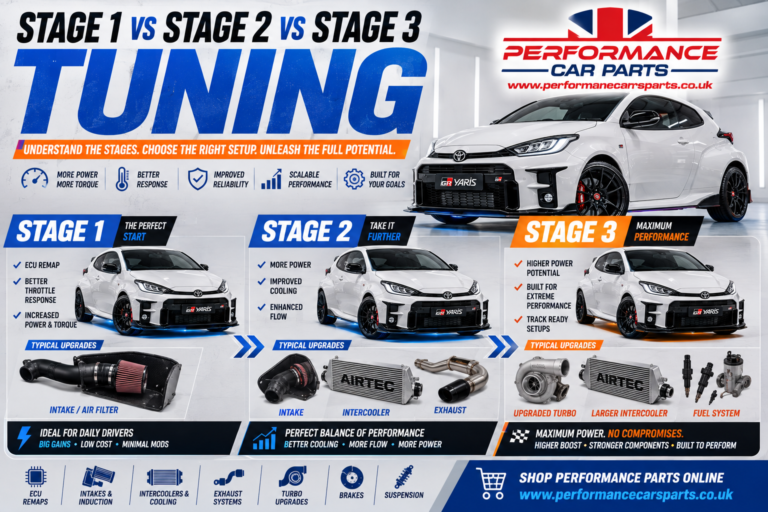
Performance Intake Upgrade Path
For many enthusiasts, the following progression makes sense:
Level 1 – Standard Road Car
Performance panel filter
Level 2 – Modified Road Car
Performance induction kit
Intake hose
Level 3 – Tuned Turbo Car
Complete intake
Turbo inlet
Intercooler
ECU calibration
Level 4 – High-Power Build
Large-diameter intake
High-flow turbo inlet
Upgraded turbocharger
Fuel-system upgrades
Intercooler
Performance exhaust
Custom ECU calibration
The exact requirements depend on the vehicle.
Buy Cold Air Intakes & Induction Kits in the UK
Looking for a cold air intake, induction kit or performance air filter in the UK?
At Performance Cars Parts UK, you can find intake and engine-airflow upgrades for a wide range of Japanese and European performance cars.
Shop for:
Cold Air Intakes
Induction Kits
Performance Air Filters
Panel Filters
Intake Pipes
Turbo Inlets
Silicone Intake Hoses
Airboxes
and other performance components.
Find performance parts for:
Toyota GR Yaris
Toyota Supra
Toyota GT86 / GR86
Honda Civic Type R
Honda S2000
Nissan GT-R
Nissan 350Z / 370Z
Subaru WRX STI
Mitsubishi Evo
BMW Performance Models
Volkswagen Golf GTI / Golf R
Hyundai N Models
and many more.
Visit www.performancecarsparts.co.uk and search by your vehicle or part number to find compatible performance intake upgrades.
Frequently Asked Questions
Does a cold air intake increase horsepower?
It can improve airflow and potentially increase power, but results vary considerably according to engine design, the original intake, ECU calibration and other modifications.
How much bhp does an induction kit add?
There is no universal figure. On some standard vehicles the increase may be small, while an intake can become more important on tuned engines with higher airflow requirements.
Does an induction kit make the car louder?
Usually, yes. Many aftermarket intakes make induction, turbo and engine sounds more noticeable because they remove some of the factory sound suppression.
Is an induction kit better than a panel filter?
A complete induction kit can replace more restrictive components and produce more intake sound. A performance panel filter is cheaper, simpler and retains the factory airbox.
Do I need a remap with a cold air intake?
Not always. It depends on the vehicle and intake system. More extensive airflow modifications may benefit from or require ECU calibration.
Is an open air filter bad for performance?
Not automatically. However, filter positioning and heat management matter. An exposed filter drawing excessive hot engine-bay air may not be optimal.
Is a closed air intake better?
A well-designed enclosed intake can help isolate the filter from engine-bay heat while maintaining strong airflow. The quality of the complete design matters more than simply whether it is open or closed.
Can an induction kit cause an engine-management light?
An incorrectly designed or installed system can cause problems on some vehicles, particularly where MAF readings are affected. Use a vehicle-specific intake and follow the manufacturer’s installation instructions.
Are performance air filters reusable?
Some are. Check the manufacturer’s specifications and cleaning procedure for the exact filter.
What is the best first performance modification?
There isn’t one universal answer. Intake upgrades are popular because they’re relatively straightforward, but tyres, brakes, suspension and vehicle maintenance should also be considered when planning a balanced performance build.