
Stage 1 vs Stage 2 vs Stage 3 Tuning – Complete UK Guide
If you’ve started researching ways to make your car faster, you’ve probably come across phrases such as:
Stage 1 remap
Stage 2 tuning
Stage 3 upgrade
Stage 1+
Stage 2+
But what do these tuning stages actually mean?
Does Stage 2 always require an exhaust?
Does Stage 1 need an upgraded air intake?
And how much horsepower can you expect from Stage 3?
The answer isn’t as simple as many people think.
There is no universal definition of Stage 1, Stage 2 or Stage 3 tuning. Different tuners and manufacturers can use these terms differently, and hardware requirements vary between vehicles. Current performance programmes such as RacingLine’s OEM+ offer separate Stage 1 through Stage 3 calibrations, with supporting performance components developed around different stages.
This guide from Performance Cars Parts UK explains what tuning stages generally mean and what performance parts you may need when modifying your car.
What Is Performance Tuning?
Performance tuning involves modifying a vehicle to change or improve characteristics such as:
- Horsepower
- Torque
- Throttle response
- Turbo response
- Cooling
- Exhaust flow
- Intake airflow
- Handling
- Braking performance
On a modern turbocharged car, one of the most common modifications is an ECU remap.
But as power increases, additional hardware may be needed to support that increased performance.
That’s where the concept of tuning stages comes from.
What Is an ECU Remap?
Your car’s Engine Control Unit (ECU) controls numerous engine functions.
Depending on the vehicle, these can include:
- Boost pressure
- Ignition timing
- Fuel delivery
- Throttle behaviour
- Torque management
- Rev limits
- Engine protection strategies
An ECU remap modifies the calibration to change how the engine operates.
Turbocharged engines are particularly popular for remapping because boost pressure and torque delivery can often be altered through software while retaining the original turbocharger.
What Is Stage 1 Tuning?
Stage 1 tuning generally refers to the first significant level of ECU performance tuning.
On many vehicles, Stage 1 is designed to work with a largely standard car.
A typical Stage 1 setup might consist of:
ECU Remap
plus optional supporting upgrades such as:
Performance air filter
Cold air intake
Turbo inlet
Depending on the application, these supporting modifications may not be mandatory.
For example, one current COBB Stage 1 application specifies the stock airbox, intercooler and exhaust as acceptable hardware, while allowing its intake as an option.
That demonstrates why you should always follow the hardware requirements for your exact tune, rather than assuming all Stage 1 setups are identical.
What Are the Benefits of Stage 1?
Stage 1 is popular because it can offer a noticeable improvement without requiring extensive mechanical modification.
Potential benefits include:
More horsepower
More torque
Improved throttle response
Stronger acceleration
Improved turbo response
Relatively low modification cost
For many daily-driven turbocharged cars, Stage 1 can provide an excellent balance between additional performance and retaining a relatively standard vehicle.
Do I Need an Intake for Stage 1?
Not necessarily.
Some Stage 1 calibrations work perfectly well with the factory intake.
Others may recommend a:
High-flow panel filter
or
Performance induction kit.
For example, COBB has offered Stage 1 packages pairing ECU software with a high-flow panel filter, while its Stage 1+ packages on some applications add a complete cold-air intake.
Even when an intake isn’t required, enthusiasts often install one because it can provide:
- Increased induction sound
- More turbo noise
- Improved airflow potential
- Preparation for later modifications
- Improved engine-bay appearance
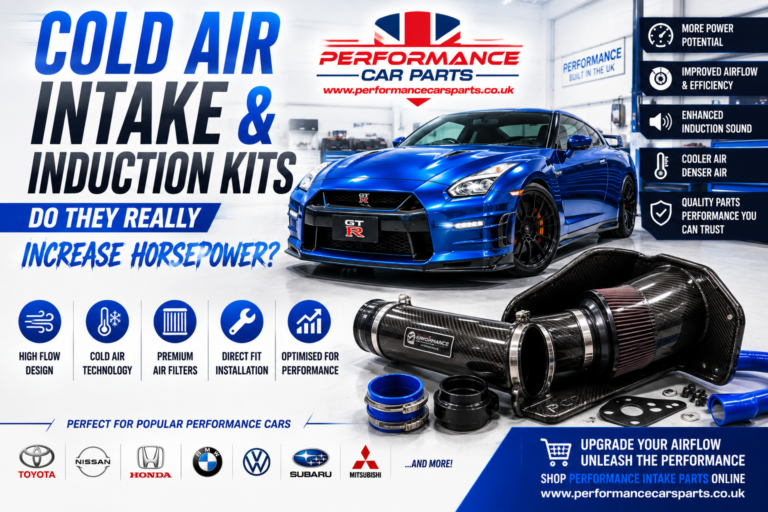
You can read our Cold Air Intake & Induction Kit Guide for more information.
Do I Need an Intercooler for Stage 1?
Again, not always.
Some Stage 1 calibrations are designed around the original intercooler.
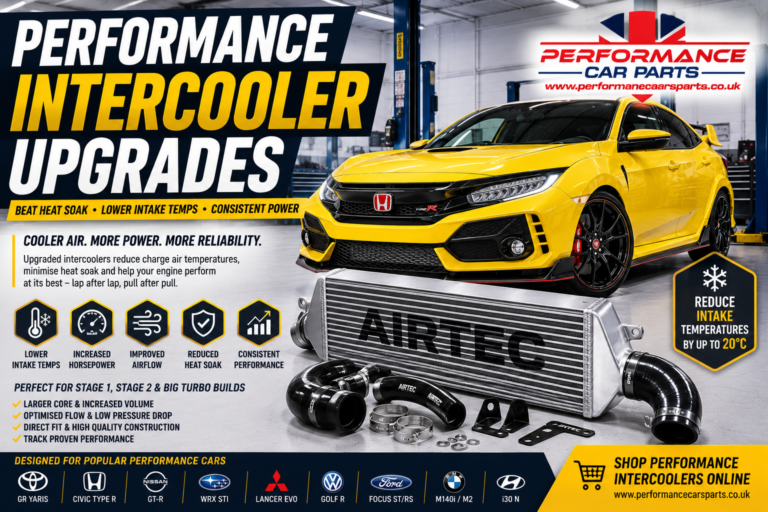
However, an upgraded intercooler can still be beneficial on cars that suffer from high intake temperatures or heat soak.
This becomes especially relevant if you:
- Drive aggressively
- Perform repeated acceleration runs
- Attend track days
- Drive during hot weather
- Plan to progress to Stage 2
An intercooler may therefore be a worthwhile supporting modification even where it isn’t mandatory.
What Is Stage 2 Tuning?
Stage 2 tuning generally means combining a more aggressive ECU calibration with supporting performance hardware.
This is where modification becomes more vehicle-specific.
Depending on the platform, Stage 2 hardware might include:
Performance air intake
Upgraded intercooler
Turbo inlet
Performance exhaust components
Charge pipes
Spark plugs
and other supporting upgrades.
But don’t assume every Stage 2 car needs exactly this list.
For example, COBB specifies an upgraded intercooler for Stage 2 on one Ford application while retaining the factory exhaust.
That is why buying parts according to generic “Stage 2” lists can be a mistake.
Stage 1 vs Stage 2 – What’s the Difference?
A simplified comparison looks like this:
| Feature | Stage 1 | Stage 2 |
|---|---|---|
| ECU Remap | Yes | Yes |
| Standard Turbo | Usually | Usually |
| Performance Intake | Optional/Recommended | Common |
| Intercooler Upgrade | Optional | Common |
| Exhaust Upgrades | Usually optional | Application dependent |
| Turbo Inlet | Optional | Common on some cars |
| Supporting Hardware | Limited | More extensive |
| Power Potential | Increased | Higher |
| Cost | Lower | Higher |
| Installation Complexity | Lower | Higher |
This table is a general guide, not a universal specification.
Why Does Stage 2 Need Supporting Modifications?
As you demand more performance from an engine, you can encounter restrictions.
Imagine increasing turbo boost while retaining components that cannot efficiently handle the additional airflow or heat.
Potential limitations can include:
- Intake restriction
- High intake temperatures
- Intercooler heat soak
- Exhaust restriction
- Fuel-system limits
- Turbocharger efficiency
- Engine temperature
Stage 2 supporting modifications aim to address some of these restrictions.
Why Is an Intercooler Important for Stage 2?
Increasing turbocharger output generally increases thermal demand.
A larger performance intercooler can help control charge-air temperature and maintain more consistent performance.
This is why intercoolers appear frequently in Stage 2 packages.
COBB, for example, has described heat rather than airflow as the major limitation it found when developing Stage 2 for certain EcoBoost applications, leading it to pair Stage 2 calibration with a larger front-mount intercooler.
You can internally link this section to:
Blog #7 – Performance Intercooler Upgrades UK
Why Upgrade the Intake?
A tuned turbocharged engine may need to move more air than the standard engine.
Performance intake modifications can include:
- High-flow air filter
- Cold air intake
- Larger intake pipe
- Turbo inlet
- Silicone intake hose
As power increases, reducing unnecessary airflow restrictions can become more important.
This section should internally link to:
Blog #6 – Cold Air Intake & Induction Kits UK
Why Upgrade the Exhaust?
The exhaust system carries gases away from the engine.
Performance exhaust modifications can alter:
- Exhaust flow
- Sound
- Weight
- Back pressure characteristics
- Appearance
Depending on the vehicle and calibration, exhaust upgrades can form part of a more extensive tuning package.
This section should link back to:
Blog #3 – Best Performance Exhaust Systems UK
What Is Stage 2+?
You may also encounter terms such as:
Stage 1+
Stage 2+
These aren’t universal specifications either.
A tuner may use “+” to distinguish a setup requiring additional hardware or providing another calibration level between its standard stages.
Another manufacturer may define it completely differently.
Therefore, never buy a part simply because the listing says:
“Suitable for Stage 2+.”
Check what your specific tuner requires.
What Is Stage 3 Tuning?
Stage 3 generally represents a more substantial performance build.
The biggest difference is often the turbocharger.
Where Stage 1 and Stage 2 frequently retain the original turbo, Stage 3 may involve:
Upgraded Turbocharger
along with supporting components.
A typical higher-output build might include:
- Larger/hybrid turbo
- Performance intake
- Larger intercooler
- Performance exhaust
- Upgraded fuelling
- Charge pipes
- Turbo inlet
- ECU calibration
- Transmission tuning
- Improved cooling
Depending on the power level, internal engine and drivetrain upgrades may also become necessary.
Again, the exact meaning of Stage 3 varies. RacingLine, for example, currently advertises tuning programmes extending from Stage 1 through Stage 3 on several VW/Audi platforms.
Stage 2 vs Stage 3
A general comparison:
| Upgrade | Stage 2 | Stage 3 |
|---|---|---|
| ECU Remap | Yes | Yes |
| Intake | Common | Common |
| Intercooler | Common | Usually |
| Exhaust Upgrades | Application dependent | Common |
| Original Turbo | Usually | Often upgraded |
| Fuel-System Upgrade | Sometimes | Often |
| Transmission Tuning | Sometimes | Frequently considered |
| Engine Internals | Usually standard | Depends on power |
| Cooling Upgrades | Recommended | Increasingly important |
| Cost | Medium | High |
| Power Potential | High | Much higher |
What Is a Hybrid Turbo?
A hybrid turbo typically uses a factory-style turbocharger housing or installation arrangement with upgraded internal components.
Depending on the turbo, modifications can include:
- Larger compressor wheel
- Upgraded turbine
- Improved bearings
- Modified housing
- Increased airflow capability
Hybrid turbos are popular because they can provide substantially more airflow while sometimes retaining relatively straightforward vehicle fitment.
Do You Need a Fuel-System Upgrade for Stage 3?
Potentially.
More power requires more fuel.
Eventually, factory components such as:
- Fuel pump
- High-pressure fuel pump
- Injectors
may reach their flow limits.
At this point, fuel-system upgrades become necessary.
This is especially important because inadequate fuel delivery under high load can be dangerous for an engine.
Fuel requirements should always be determined by the tuner building and calibrating the vehicle.
What Is TCU / DSG Tuning?
Engine tuning isn’t the only software modification available.
Automatic and dual-clutch transmissions have their own control systems.
These may be referred to as:
TCU tuning
DSG tuning
Gearbox remap
Transmission software can modify characteristics such as:
- Shift strategy
- Clutch pressure
- Torque limits
- Launch behaviour
- Shift speed
This can become increasingly relevant as engine torque rises.
RacingLine, for example, describes TCU calibration as controlling clutch pressure to match increased engine torque on applicable DSG vehicles.
Do You Need a DSG Tune for Stage 1?
It depends on the car and calibration.
Some vehicles can run Stage 1 engine software without gearbox tuning.
Others may benefit from or require TCU software as torque increases.
Always check the ECU and TCU requirements together.
Stage 1 Tuning for Daily Driving
For many owners, Stage 1 is the sweet spot.
Why?
Because it can offer significantly stronger performance without requiring a complete vehicle build.
A Stage 1 daily driver may retain:
- Standard turbo
- Standard intercooler
- Standard exhaust
- Standard engine internals
while receiving an appropriate ECU calibration.
Optional upgrades can then be added gradually.
Stage 2 for Fast-Road Cars
Stage 2 is popular among enthusiasts who want a more complete modified-car experience.
A typical fast-road build might combine:
Stage 2 ECU calibration
Performance intake
Upgraded intercooler
Exhaust upgrades where appropriate
Performance tyres
Brake upgrade
Suspension upgrade
The last three are extremely important.
More horsepower isn’t useful if the chassis cannot deploy or control it effectively.
Don’t Forget Your Brakes
If your car is considerably faster than standard, evaluate the braking system.
You may consider:
- Performance pads
- Performance discs
- High-temperature brake fluid
- Braided lines
- Big brake kit
Link this section to:
Blog #5 – Performance Brake Upgrades UK
A balanced performance build should be capable of accelerating, cornering and stopping effectively.
Don’t Forget Suspension
More power can also expose limitations in chassis setup.
Potential upgrades include:
- Coilovers
- Lowering springs
- Anti-roll bars
- Bushes
- Control arms
- Alignment components
Link this section to:
Blog #4 – Coilovers vs Lowering Springs
Stage 3 for Track & High-Power Builds
Stage 3 is where planning becomes extremely important.
Rather than simply buying random performance components, treat the car as a complete system.
Consider:
Engine
Turbocharger
Fuel system
Intake
Intercooler
Exhaust
Cooling
Gearbox
Clutch
Differential
Tyres
Brakes
Suspension
The weakest component can become the limiting factor.
Stage 1 vs Stage 2 vs Stage 3 Power Gains
There is no accurate universal horsepower figure for each stage.
Avoid claims such as:
Stage 1 = +50 bhp
Stage 2 = +100 bhp
Stage 3 = +200 bhp
without specifying a vehicle.
Power gains depend on:
- Engine
- Turbocharger
- Fuel
- Factory power
- ECU
- Hardware
- Ambient conditions
- Dyno
- Calibration
COBB’s published figures demonstrate this platform dependence: its historical WRX maps showed different percentage gains between Stage 1 and Stage 2 on one specific vehicle and fuel configuration. Those figures should not be applied to unrelated cars.
Stage 1 Toyota GR Yaris
The Toyota GR Yaris is one of the UK’s most popular modern tuning platforms.
Common searches include:
GR Yaris Stage 1
GR Yaris remap
GR Yaris Stage 2
GR Yaris performance parts
GR Yaris tuning
Potential supporting upgrades include:
- Performance intake
- Intercooler
- Exhaust
- Turbo inlet
- Cooling upgrades
- Brakes
- Suspension
As power increases, always follow the requirements of the chosen calibration.
Honda Civic Type R Stage 1 & Stage 2
Popular searches include:
FK8 Stage 1
FK8 Stage 2
FL5 Stage 1
Civic Type R remap
Civic Type R tuning
The turbocharged FK8 and FL5 have extensive performance aftermarket support.
Owners commonly upgrade:
Intake
Intercooler
Exhaust
Cooling
and chassis components as performance increases.
Golf R Stage 1 & Stage 2
The Volkswagen Golf R is one of the biggest UK remapping platforms.
Popular searches include:
Golf R Stage 1
Golf R Stage 2
MK7 Golf R Stage 2
MK8 Golf R tuning
Golf R remap
RacingLine currently offers staged software and extensive supporting hardware across VW/Audi platforms, illustrating how software and hardware can be developed as a package.
Common upgrades include:
- Intake
- Turbo inlet
- Intercooler
- ECU software
- TCU software
- Exhaust components
- Brakes
- Suspension
BMW M140i Stage 1 & Stage 2
The B58-powered BMW M140i is extremely popular in the UK tuning scene.
Search terms include:
M140i Stage 1
M140i Stage 2
B58 Stage 2
M140i remap
B58 tuning
Supporting modifications depend on power target and tuner requirements.
As torque rises, drivetrain and transmission considerations become increasingly important.
BMW M3 & M4 Tuning
Popular searches include:
BMW M3 Stage 2
BMW M4 Stage 2
S55 tuning
BMW M3 remap
BMW M4 performance parts
Potential modifications include:
- Intakes
- Chargecooler upgrades
- Exhaust
- Turbo upgrades
- Fuelling
- ECU software
- TCU software
Hyundai i30 N & i20 N Tuning
Hyundai’s N cars have developed a large UK enthusiast following.
Popular searches include:
i30 N Stage 1
i30 N Stage 2
i20 N tuning
Hyundai i30 N remap
Supporting upgrades can include:
- Intake
- Intercooler
- Exhaust
- Engine mounts
- Suspension
- Brakes
Ford Focus ST & RS Tuning
Popular searches include:
Focus ST Stage 1
Focus ST Stage 2
Focus RS Stage 2
Focus ST remap
Focus RS tuning
Intercooler upgrades are particularly common on tuned turbocharged Ford applications because thermal management becomes increasingly important as output rises.
Subaru WRX STI Tuning
Popular searches include:
WRX STI Stage 1
Subaru Stage 2
STI remap
Subaru performance parts
Subaru tuning needs particular care because the correct calibration must match the installed hardware.
Never install airflow-changing components and assume an existing tune will automatically compensate.
Which Tuning Stage Is Best?
Choose Stage 1 if:
You want a noticeable performance improvement.
The car is primarily a daily driver.
You want to retain most factory hardware.
You have a moderate budget.
Consider Stage 2 if:
You want greater performance.
You’re prepared to install supporting modifications.
You’ve upgraded cooling and airflow.
The car is used for fast-road driving.
Consider Stage 3 if:
You’re pursuing substantially higher power.
You’re installing a larger or hybrid turbo.
You’re prepared to upgrade fuelling and supporting systems.
You understand that costs and complexity rise considerably.
Is Stage 2 Worth It Over Stage 1?
For many enthusiasts, yes—but it depends on your goals.
Stage 1 often provides the largest improvement relative to cost because relatively little hardware may be required.
Stage 2 becomes attractive when you want to continue developing the car and are willing to invest in supporting modifications.
Stage 3 is generally a much bigger commitment.
Reliability: Is Stage 1 Safe?
No modification can be described as universally risk-free.
Reliability depends on:
- Quality of calibration
- Engine condition
- Fuel quality
- Maintenance
- Driving style
- Hardware
- Temperature management
- Power level
A poorly maintained vehicle shouldn’t be tuned simply because a remap is available.
Before tuning, ensure the car is mechanically healthy.
Service Your Car Before Tuning
Before increasing performance, check:
Engine oil
Filters
Spark plugs
Coolant
Gearbox oil where applicable
Brake condition
Tyres
Fault codes
Boost leaks
Ignition system
Starting with a healthy car is far more sensible than trying to solve maintenance problems with performance parts.
Performance Parts for Stage 1, Stage 2 & Stage 3 Builds
At Performance Cars Parts UK, you can find supporting performance components for tuned Japanese and European cars.
Shop for:
Cold Air Intakes
Induction Kits
Performance Air Filters
Performance Intercoolers
Chargecoolers
Turbo Inlets
Performance Exhausts
Downpipes and exhaust components
Turbochargers
Cooling Upgrades
Engine Components
Performance Brake Pads
Brake Discs
Big Brake Kits
Coilovers
Lowering Springs
Suspension Components
and other performance parts.
We supply parts for popular platforms including:
Toyota GR Yaris
Toyota Supra
Honda Civic Type R
Nissan GT-R
Nissan 350Z / 370Z
Subaru WRX STI
Mitsubishi Evo
Volkswagen Golf GTI / Golf R
BMW M140i / M2 / M3 / M4
Ford Focus ST / RS
Hyundai i20 N / i30 N
and many more.
Visit Performance Cars Parts UK to find performance components for your build.
Frequently Asked Questions
What is the difference between Stage 1 and Stage 2 tuning?
Stage 1 generally refers to ECU tuning with limited hardware changes, while Stage 2 commonly combines software with supporting airflow or cooling modifications. Exact definitions vary by tuner and vehicle.
Does Stage 1 need an intercooler?
Not always. Some Stage 1 tunes are specifically designed for the factory intercooler.
Does Stage 2 need an intercooler?
Many Stage 2 packages specify or strongly recommend an upgraded intercooler, particularly where increased boost creates additional heat.
Does Stage 2 need an exhaust?
Not universally. Requirements vary by tune. Some Stage 2 calibrations retain the factory exhaust.
Does Stage 1 require an intake?
Not necessarily. Some tunes allow the factory airbox, while others offer an upgraded intake as optional or required hardware.
What does Stage 3 mean?
Stage 3 generally describes a higher-level build, often involving an upgraded turbocharger and additional supporting hardware. There is no universal Stage 3 standard.
Is Stage 2 faster than Stage 1?
On the same platform and with appropriately matched hardware/software, Stage 2 will generally target greater performance than Stage 1. Actual gains depend on the vehicle and calibration.
Is Stage 1 good for daily driving?
Stage 1 is popular for daily-driven performance cars because many calibrations retain substantial factory hardware. Suitability depends on the specific tune and condition of the vehicle.
Do I need better brakes after a remap?
Not automatically, but braking, tyres and suspension should be assessed whenever vehicle performance is significantly increased.
Which is better: Stage 1, Stage 2 or Stage 3?
There is no universal best stage. The best option depends on your budget, vehicle, intended use and performance target.