Cold Air Intake vs Short Ram Intake: Which Induction Kit Actually Gains Power on a UK Road Car?
Fitting a cold air intake is one of the most popular first modifications on a UK road car, yet most buyers make the decision based on peak horsepower claims rather than how the kit will actually perform on a morning commute or a B-road blast. The result is often disappointment, or worse, a setup that loses power under the exact conditions it was supposed to improve.
This guide cuts through the marketing noise and treats the intake decision as what it really is: a practical trade-off between peak performance potential and real-world consistency. You will learn exactly how cold air intakes and short ram intakes differ in design and intent, why heat soak is the variable that makes or breaks a cold air system, and how dyno figures can flatter setups that underdeliver on the street. More importantly, you will see how your car’s engine bay layout, your typical driving conditions, and UK MOT requirements should all shape the choice before you spend a penny. By the end, you will have a clear, evidence-based answer rather than a spec-sheet comparison that leaves you guessing.
What Actually Separates a Cold Air Intake from a Short Ram Intake
Both induction kit types replace the OEM airbox and paper filter, but they approach the same goal from opposite ends of the engineering trade-off.
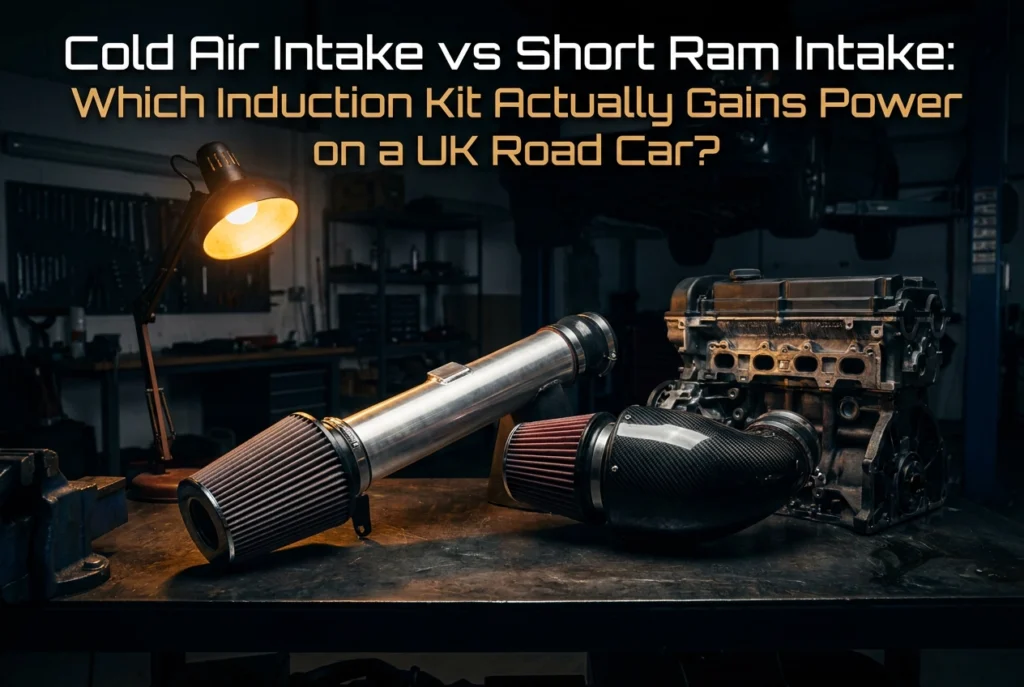
Cold air inductions route the intake pipe away from the engine bay entirely, typically down toward the front bumper or wheel arch. The objective is simple: source ambient air that hasn’t been heated by the engine, radiator, or exhaust manifold sitting inches away. Underbonnet temperatures on a warm engine can rise significantly above ambient, so putting physical distance between the filter and those heat sources is the primary design priority.
Short ram intakes take the opposite approach. A short pipe and cone filter replace the OEM airbox but remain positioned close to the engine. The priority here is minimising flow restriction and keeping the installation compact, not controlling intake air temperature.
The physics that separates their performance potential is straightforward: cooler air is denser, meaning each intake stroke draws in more oxygen molecules. More oxygen supports more fuel burn, which translates to more power. A cold air intake therefore has the potential to deliver stronger peak gains than a short ram unit fitted to the same car, provided the routing genuinely keeps the filter away from heat sources.
Short ram kits trade that thermal advantage for packaging practicality. On turbocharged engines and tightly packaged engine bays, routing a long intake pipe to a cooler location is often impractical without fabrication work. In those scenarios, a short ram kit delivers a real reduction in intake restriction without the routing complexity.
The critical distinction: these aren’t two versions of the same solution. They solve different problems and suit different cars.
Heat Soak Is Where Cold Air Intakes Win or Lose
That thermal advantage only holds if the intake is actually drawing cold air. Heat soak is where that assumption breaks down.
Underbonnet temperatures on a warm UK summer day rise substantially above ambient, particularly during stop-start commuting when airflow drops to near zero. A filter sitting close to the engine, rather than routed to a cool source near the bumper or wheel arch, can pull in air meaningfully hotter than outside ambient. At that point, the “cold air” label becomes misleading.
The effect is cumulative. A system that performs well on a cold early-morning motorway run will progressively lose that advantage as underbonnet temperatures build. After extended stop-start urban driving, a poorly routed cold air setup may offer little measurable benefit over a well-designed short ram kit in the same bay. The ECU compensates for rising intake air temperatures by pulling timing and adjusting fuelling, directly eroding the gain the intake was fitted to deliver. If you want to understand does a cold air intake actually increase horsepower, heat soak is the variable most marketing materials quietly ignore.
UK ambient temperatures are relatively moderate, which means the raw temperature differential a cold air system exploits is narrower than in hotter climates, worth bearing in mind when evaluating headline gain figures.
Routing quality is therefore decisive. A universal cold air intake fitted without careful attention to heat sources can perform worse than a short ram kit with a quality heat shield. Heat shields and insulated tubing reduce soak meaningfully for short ram setups, but they do not replicate the sustained advantage of a cold air system genuinely drawing from a cool, isolated source. Alongside other performance upgrades that transform how your car drives, the intake decision comes down to whether your specific installation can actually deliver on the cold air promise.
Dyno Numbers vs Street Pull: Why the Test Conditions Matter
Beyond real-world heat soak, the test conditions used to generate headline figures add a second layer of distortion. Dyno runs that produce headline power figures are typically performed after a cold start or an extended cool-down period, with the engine pulled hard through to its rev limiter in a single sweep. That scenario describes a dyno cell far more accurately than it describes a B-road commute.
On public roads, at the everyday engine speeds used in normal road driving, short ram intakes can deliver more consistent throttle response than their cold air counterparts, because reduced inlet restriction contributes meaningfully to throttle response at those speeds.
Credible technical commentary, including Engineering Explained’s analysis of cold air versus short ram systems, notes that the conditions favouring peak gains on a dyno rarely replicate everyday road use. The ECU trims fuelling to match available airflow, which blunts the headline numbers further. If you are researching whether a cold air intake genuinely increases horsepower, the honest answer for a naturally aspirated road car is that the gains are typically modest under optimal conditions, not the double-digit figures common in promotional materials.
Turbocharged cars shift this calculus entirely. On a turbocharged platform, the compressor and intercooler significantly influence final charge temperature, reducing the relative impact of pre-turbo inlet conditions.
Your Car’s Layout Should Drive the Decision
Those dyno conditions tell you what a system can do; your engine bay tells you what it will do on your actual car.
Transversely mounted FWD engines create the tightest constraints. Compact front-wheel-drive cars with transversely mounted engines leave little room to route intake piping down toward a cool air source without custom fabrication. On these platforms, a short ram kit is frequently the more realistic fitment.
Longitudinal layouts offer genuine routing flexibility. Rear-wheel-drive cars with longitudinally mounted front engines typically provide a more natural pipe run toward the bumper or front arch. These platforms are the better candidates for a properly positioned cold air intake and induction kit that actually reaches cooler ambient air.
Turbocharged engines shift the priority further. On turbocharged engines, intercooler efficiency governs charge temperature far more than what happens upstream of the compressor, as covered above.
Universal kits demand accurate sizing. A universal cold air intake that does not match your MAF housing or throttle body diameter precisely will introduce airflow measurement errors, and on a sealed forced-induction system, fitment gaps become boost leaks. Either scenario costs more power than any intake gain recovers.
Before purchasing, physically map your bay: locate the stock airbox, identify the nearest unobstructed cool air source, and trace whether any routing path clears belts, pulleys, and exhaust components without cutting or relocating parts.
Daily Driver or Weekend Car: The Use Case That Decides It
Layout tells you what fits. How you drive tells you what works.
For urban commuting and stop-start town driving, a short ram intake with a quality cone filter and heat shield delivers more consistent performance than a cold air system. A cold air intake that lacks proper routing will heat-soak in traffic, as detailed earlier. A well-shielded short ram kit sidesteps that problem by managing heat locally rather than relying on routing distance.
Cold air intakes earn their place on cars used predominantly for motorway runs, track days, or open-road driving. At sustained speeds, airflow through the engine bay remains high, underbonnet temperatures stabilise, and a properly routed cold air system can consistently draw cooler ambient air. That is the scenario where its peak power advantage over a short ram unit is most clearly felt.
Sound is worth factoring in honestly. Short ram intakes place the cone filter close to the throttle body, which produces a more pronounced induction roar from low to mid RPM. That constant pull under everyday acceleration is something many drivers actively prefer. Cold air systems produce a deeper, more dramatic intake note, but it is most audible at full throttle near the top of the rev range, a reward that rarely arrives on a daily commute.
If your car covers both roles, a short ram kit with a well-designed heat shield is the pragmatic choice. Browsing performance air intakes and induction kits by vehicle type rather than headline spec will steer you toward options matched to your platform, particularly on compact cars where cold air routing would require cutting or relocating components.
MOT Compliance and Emissions: What UK Buyers Must Check

Whichever intake type suits your driving style, there are practical compliance checks to complete before fitting either system.
Aftermarket induction kits are a common bolt-on upgrade, but always confirm current DVSA and VCA guidance on notification requirements, as the regulatory position is not definitively stated in publicly available MOT manuals. The MOT inspection manual makes clear that any modification causing excessive emissions or triggering a malfunction indicator lamp is a failure point. The MOT emissions test covers exhaust output, so the intake must not compromise combustion quality.
The most common compliance risk is a poorly sealed intake pipe or degraded cone filter on a MAF-equipped car. Unmetered air entering downstream of the sensor creates a lean mixture; the ECU cannot fully compensate, HC readings rise, and the car can fail emissions. Inspect all joints and clamps at every service interval, not just when symptoms appear.
On older, higher-mileage engines, particularly direct-injection units susceptible to intake valve carbon build-up, confirm that your chosen filter medium meets an equivalent filtration standard to the OEM element.
Oiled filters carry an additional maintenance requirement. Cotton gauze and foam elements need periodic re-oiling. Apply too much oil and the excess migrates onto the MAF sensor, corrupting airflow readings and triggering fault codes that cause rough running until the sensor is cleaned or replaced.
On the insurance side, an aftermarket induction kit is likely to be treated as a performance modification by many UK insurers, check your policy wording and disclose proactively, as failing to declare modifications can affect your cover. The same disclosure obligation applies to exhaust upgrades; the Aftermarket Exhaust Systems: The Complete UK Buyer’s Guide covers the legality and MOT considerations for that modification in full.
How to Choose the Right Induction Kit for Your Car
With compliance and insurance considerations addressed, the next step is translating all of that into a clear purchase decision.
Start with layout and use case. If your underbonnet space permits proper cold air routing away from heat sources, and the car regularly sees motorway runs or track days, a cold air intake justifies the additional installation complexity. For reference, Performance Cars Parts lists intake and induction upgrades by vehicle type, which helps narrow choices based on platform rather than guesswork.
If the engine bay is tight, the car is turbocharged, or your driving is predominantly urban, a short ram intake with a quality heat shield will deliver more consistent real-world results and install more cleanly. The thermal advantage of cold air routing shrinks on forced-induction engines for reasons covered in earlier sections.
Universal cold air intake kits require precise sizing. Verify that the inlet diameter matches your throttle body or MAF housing exactly before purchasing. A mismatch disrupts airflow calibration on MAF-based systems and can introduce rough idling, hesitation, or fault codes that outweigh any power benefit.
Finally, consider pairing any intake upgrade with a complementary modification. A performance exhaust or ECU remap can help the engine better exploit improved airflow, as fuelling and ignition timing are then calibrated to match the freer-breathing intake. The two modifications are often recommended together by tuners, though gains will vary by platform.
The Verdict: Which Intake Kit Is Right for Your UK Road Car?
Neither intake type wins outright. The decision comes down to honest self-assessment of your car and how you actually drive it.
Cold air intakes offer stronger peak power potential, but that potential only materialises when the pipework is properly routed away from heat sources and the car is driven in conditions, such as motorway runs or open-road work, where heat soak does not accumulate. In stop-start UK commuting, that advantage shrinks considerably.
Short ram intakes are the more practical choice for most UK road cars. Compact engine bays, turbocharged platforms, and daily-driven vehicles all favour the simplicity and consistent mid-range delivery of a short ram kit over the conditional gains of a cold air system.
Whichever route you choose, fit accuracy matters more than headline figures. A correctly sized, properly sealed kit on a modest engine will outperform an ill-fitted universal cold air intake on a more powerful one. Match the inlet diameter precisely, confirm the routing clears heat sources, and set realistic expectations about the gains involved.
Insurer declaration and MOT emissions compliance, covered fully above, are non-negotiable final checks. A well-chosen induction kit, installed correctly and declared properly, is a worthwhile upgrade. Prioritise those fundamentals over promotional power claims, and the decision becomes straightforward.
Conclusion
Choosing between a cold air intake and a short ram intake is less about brand reputation and more about understanding your specific car, engine bay layout, and driving habits. The verdict above sets out why short ram kits suit most UK road cars, while cold air intakes earn their place with clear routing and regular open-road use.
Fit quality, correct sizing, and proper sealing will always matter more than the intake type itself.
Ready to make your decision? Use the criteria covered in this guide, measure your engine bay, and match the kit to how you actually drive. A well-chosen induction kit, installed and declared correctly, delivers real-world results you will notice every time you pull onto a fast road.