Your owner’s manual says 10,000 miles. Maybe even 15,000. And if you drive a sensible commuter car on mostly highway roads in moderate weather, that interval might be perfectly reasonable. But you don’t do that. You track your car on weekends, run elevated boost, push your engine into sustained high-RPM territory, or some combination of all three. The rules written for average drivers were never written for you.
Here’s the problem: engine oil life degrades differently under performance conditions than it does under the controlled assumptions built into OEM service intervals. Those factory schedules are calibrated for specific, almost ideal driving scenarios, and research suggests fewer than 20% of vehicles actually qualify for them. The rest of us are operating under what manufacturers classify as severe service, whether we realize it or not.
This analysis breaks down why the standard mileage-based interval is the wrong framework for performance-oriented drivers. You will learn how to identify where your driving actually falls on the severity spectrum, how to select the right oil, and how to build a change schedule that reflects the actual demands you place on your engine.
OEM Oil Change Intervals Are Conditional, Not Universal
Modern OEM oil change intervals, which typically fall between 7,500 and 15,000 miles depending on manufacturer and model, are not blanket recommendations. They are conditional figures, calculated around a precise and optimistic driver profile: predominantly motorway miles, moderate ambient temperatures, no towing, and journeys long enough for the engine to reach and sustain full operating temperature on every run. Deviate from those conditions and the interval’s validity quietly degrades alongside the oil.
The problem is that these assumptions are rarely stated plainly. They exist in the small print of service schedules, not in the conversation at the dealership or the reminder sticker on the windscreen. Most owners treat the figure on the sticker as universal. It is not.
The scale of that mismatch is significant. The Filter Manufacturers Council’s technical guidance states directly that “normal” driving conditions are, in reality, very uncommon, and that the majority of vehicles operate under conditions warranting severe-service intervals. Their research indicates approximately 80% of vehicles fall into the severe category, with only 20% genuinely meeting the criteria for standard intervals.
The perception gap is just as striking. An AAA Automobile Club of Southern California study found that only 6% of motorists believed they drove under severe conditions, yet 62% acknowledged driving behaviours that technically qualify as severe service. The disconnect between what drivers assume and how they actually use their vehicles is substantial, and it exists across the general population before performance driving enters the picture at all.
For a performance driver, that gap widens considerably. Choosing the right consumables matters too: even factors like selecting an appropriate oil filter for your car become load-bearing decisions when the engine is running harder than OEM schedules ever anticipated.
Standard severe-service categories were defined with taxis, urban commuters, and light commercial vehicles in mind. A turbocharged road car used for track days does not fit neatly into any of those boxes. It exceeds them. The sections that follow examine exactly why, and what a more accurate interval actually looks like for a driver in that position.
What Qualifies as Severe Service and Why You Almost Certainly Meet It
So what exactly triggers severe service classification? Manufacturers are consistent across the industry: repeated short trips under 5 to 10 miles, sustained stop-and-go urban traffic, extended idling, towing or hauling loads, and operation in extreme temperatures, hot or cold. These are not edge cases. They describe ordinary British driving conditions for a significant portion of the population.
When manufacturers acknowledge severe service, the interval response is uniform. Ford reduces its F-150 recommendation to 5,000 miles as the upper ceiling for severe-duty operation, a threshold mirrored by Hyundai, Kia, and General Motors for certain engines. That is roughly half the standard interval, which is a meaningful admission about how quickly conditions degrade oil outside of ideal circumstances.
For a performance car owner, the picture compounds quickly. A weekday commute through city traffic already ticks the stop-and-go and short-trip boxes. Add a track day on Saturday and the same car has, within seven days, met multiple severe service triggers simultaneously, including sustained high engine loads and extreme thermal stress that no standard severe-service table was ever designed to model. Urban commuting and circuit use are not two separate service scenarios; for many enthusiasts, they describe the same car in the same week.
Knowing how to check your car oil the right way gives you a basic diagnostic tool, but visual checks cannot detect shear-thinned oil or depleted additives. That is why interval decisions for performance drivers need to be anchored to use conditions, not mileage compliance alone.
Why Performance Engines Operate Beyond Standard Severe-Service Assumptions
Even the severe-service category has a ceiling, and performance driving punches straight through it.
Severe-service categories were built around fleet and taxi use cases, a turbocharged engine running elevated boost on a circuit, or even an aggressive B-road stint, operates in a thermal and mechanical environment that those definitions simply never anticipated.
Turbocharger bearing lubrication is where the gap becomes most consequential. The turbo has no independent lubrication system; it depends entirely on engine oil circulating through its centre bearing housing. Turbine shaft speeds routinely exceed 100,000 rpm, generating localised heat at the bearing journal that is categorically different from anything a naturally aspirated commuter engine produces. The oil film holding that shaft is thin, working hard, and degrading faster than any OEM severe-service table was built to account for.
The situation worsens the moment the engine is switched off after sustained high-load running. Oil circulation stops, but the turbo housing retains intense heat with nowhere to go. Oil trapped in the housing continues to cook without flow, accelerating oxidation and promoting coking, the baked-on carbon deposits that restrict oil passages and eventually destroy turbo bearings. This heat soak problem is particularly acute in forced induction engines, which retain far more heat in the exhaust housing than a naturally aspirated equivalent.
Higher boost pressures raise cylinder temperatures and crankcase contamination loads, accelerating the depletion of the oil’s alkaline additive package. A remapped engine accumulates these acid contaminants faster than a stock-tune equivalent, raising the oil’s total acid number and depleting the alkaline additive package that neutralises them. The result is oil that is chemically spent well before it looks or smells different.
Forced induction vehicles run hotter oil than naturally aspirated engines at baseline, before any track use or aggressive street driving is factored in. Managing that additional thermal load is part of why cooling receives so much attention in performance builds. When track use or hard road driving is layered on top of that elevated baseline, oil degradation compounds in ways that no OEM interval model, severe-service or otherwise, was ever designed to address.
How Engine Oil Deteriorates Under Performance Use
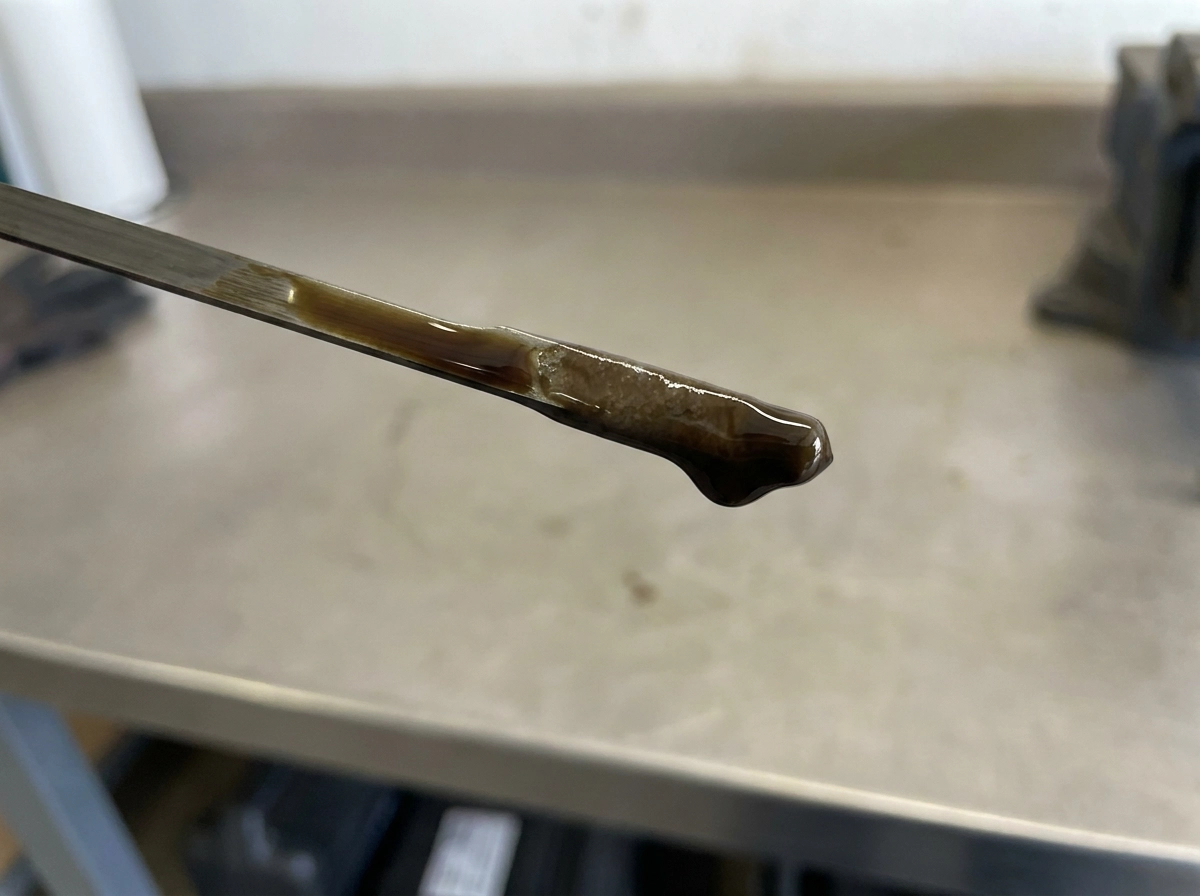
Those elevated thermal and mechanical stresses translate into four distinct degradation mechanisms working simultaneously against your oil’s protective capacity.
Viscosity breakdown through mechanical shear is the most immediate. Multi-grade oils contain viscosity index improvers: long-chain polymer molecules that allow the oil to flow freely when cold and maintain film strength at operating temperature. Under sustained high-rpm loads, the oil thins progressively and cannot fully recover its film strength. This is permanent degradation, not something that reverses when the engine cools.
Oxidation accelerates at the sustained high temperatures common in performance use. When oil molecules react with oxygen under heat, the reaction produces acidic compounds and sludge precursors. These acidic by-products attack seals, gradually clog oil galleries, and restrict flow to components that depend on a consistent clean supply, including turbocharger bearings and piston cooling jets.
Contamination enters through two routes: combustion blow-by pushing acidic gases past the piston rings into the crankcase, and fuel dilution from incomplete combustion events. Both lower the oil’s effective viscosity and degrade its additive package faster than heat alone would. Heavily modified engines running aggressive tunes generate more blow-by than standard units, accelerating this process considerably.
Additive depletion is the fourth mechanism and often the least visible. The anti-wear additives (zinc dialkyldithiophosphate, for example) and detergent packages that protect metal surfaces and keep combustion deposits in suspension are consumed over time. Once depleted, the base oil provides substantially less protection regardless of its remaining viscosity.
Does old engine oil affect performance? The effects are measurable and progressive: increased bearing wear, elevated friction across valvetrain components, reduced heat-transfer capacity, and higher combustion temperatures as the protective film thins. By the time any of these are detectable through symptoms, meaningful wear has already accumulated. If your engine oil warning light activates, degradation has almost certainly been building long before the sensor registered it.
Track driving compresses this degradation timeline dramatically, mileage alone cannot capture what a sustained session at high loads actually costs your oil.
Synthetic Oil Viscosity Selection for Performance and Track Use
Knowing how oil degrades is only useful if you select an oil capable of resisting that degradation in the first place. For turbocharged and track-used engines, that conversation starts with oil type, then moves to viscosity.
Full synthetic is the non-negotiable baseline. Conventional and semi-synthetic oils cannot match full synthetics for high-temperature stability, shear resistance, or oxidation resistance. The base oil molecules in a full synthetic are uniform in size and engineered for consistency under stress, which is precisely why they hold their viscosity longer under sustained load. If your engine is turbocharged, remapped, or sees any track use, treating full synthetic as optional is a false economy.
Viscosity grade is where selection becomes specific to your use case. The “W” rating describes cold-start behaviour; the second number describes viscosity at operating temperature, and that second number is what matters when your engine is working hard. A naturally aspirated car used for occasional track days will generally be well served by 5W-40, which provides strong film strength without the cold-start penalties of a thicker grade. A highly boosted or heavily modified engine sustaining high loads for extended periods is a different problem entirely: 10W-60 is frequently the appropriate choice, offering a substantially thicker oil film at peak operating temperature where bearing and valvetrain protection is most critical.
Do not treat the sticker under your bonnet as the final word. OEM viscosity specifications are set around standard road use and may not account for the sustained high-load conditions a modified or track-used engine faces. Those priorities are directly in tension with protecting a modified engine under track loads. Deviating from the OEM grade is not reckless; for a modified engine, it is often the more informed decision. The same logic applies across performance parts upgrades that change your engine’s thermal and mechanical environment, from uprated turbos to remapped ECUs.
Look for specifications that go beyond the standard road-oil baseline, dedicated motorsport-grade oils are formulated for the sustained high-temperature and high-shear conditions a track-driven engine faces.
Performance Cars Parts stocks a range of performance and motorsport engine oils covering turbocharged and track-use applications, including higher viscosity grades suited to modified engines that have moved beyond what standard OEM recommendations were designed for.
Building an Oil Change Schedule Based on Use Case, Not Mileage
Choosing the right oil grade matters, but it counts for little if the change interval is wrong. The best full synthetic in the sump will still degrade under sustained performance use; the question is how quickly, and how that maps to a schedule you can actually follow.
The most practical starting point is to categorise your driving each month into one of three profiles: pure road use, mixed road and occasional hard driving, or active track use. Each profile carries a different maximum interval ceiling, and a month that crosses categories defaults to the stricter of the two.
For a turbocharged car used only on the road but driven hard, a 5,000-mile or six-month ceiling, whichever arrives first, aligns with manufacturer severe-service thresholds. This is not a conservative estimate; it is where the OEM schedule already lands once severe conditions are acknowledged.
For any car completing track days, road mileage becomes a secondary metric. The interval should be anchored to events. A widely followed club-level practice is to change oil before every track day. Where that is impractical, a maximum of one to two events per change is a reasonable ceiling, provided session lengths are moderate and the engine is not running sustained maximum loads throughout. A heavily boosted engine doing back-to-back sessions warrants a fresh change before each event without exception.
Many experienced track day participants and club-level competitors treat a pre-event oil change as standard preparation; confirm any specific servicing expectations with your event organiser or championship regulations. If you are planning your season, the date of your next track day belongs in your service calendar now, not the week before you leave. Track preparation also extends to other components; if your brakes need attention at the same time, the Brake Pads Explained guide covers compound selection for both road and circuit use.
Finally, any engine modification resets the interval baseline entirely. An ECU remap, uprated turbo, or other forced induction upgrade changes the thermal and mechanical environment the oil operates in. Whatever schedule applied before the modification no longer reflects the engine’s actual demands. Start from a shorter ceiling and adjust from there.
Oil Analysis: The Data-Driven Way to Validate Your Interval
A use-based interval schedule tells you when to change; oil analysis tells you whether that decision was right. These two approaches work best together, and for a modified or track-used engine, the combination is hard to argue against.
Third-party oil analysis services work simply: drain a small sample from the sump at the point of your chosen interval, send it to the laboratory, and receive a detailed report covering wear metals including iron, copper, and chromium, viscosity measured at operating temperature, contamination levels from fuel dilution or coolant ingress, and remaining additive concentration. The data is specific to your oil, your engine, and your use pattern.
The value compounds across consecutive changes. Running an analysis programme over two or three consecutive intervals builds a trend picture rather than a single data point. As wear analysis research confirms, trends over time are far more diagnostic than absolute figures measured in isolation, because contamination and wear debris levels depend on too many variables for any single threshold to be universally meaningful. For a performance driver, that means two or three cycles of analysis can empirically confirm when your oil, in your engine, under your specific conditions, actually reaches the end of its useful life.
The practical outcome is a validated interval. If analysis consistently shows acceptable wear metal levels and stable viscosity at 4,000 miles after a track day, that figure becomes your confirmed ceiling rather than a cautious guess. If the data shows degradation arriving earlier, you tighten the schedule accordingly. The guesswork is replaced with evidence.
Oil analysis also functions as an early warning system that operates independently of audible or driveable symptoms. Laboratory wear metals testing is among the most effective methods of detecting potential failures before they become serious; elevated iron or chromium in a sample can indicate bearing, liner, or piston wear long before any knock or pressure drop alerts you. For an engine with significant modification investment, that lead time is genuinely valuable.
For owners building heavily modified platforms, whether an uprated turbo setup or a complete engine build, this level of rigour is proportionate to the financial stakes involved. Audi platform owners undertaking serious upgrades can find relevant context in this guide to sourcing Audi performance parts in the UK, where the same principle applies: informed decisions protect the investment. Pairing regular oil analysis with a quality full synthetic and a use-based interval schedule is the most defensible approach available to any performance driver running a high-value or heavily modified engine.
The Real Cost of Running Engine Oil Too Long in a Performance Car
Data tells you when oil is failing. What it cannot undo is the damage that accumulates when an interval is stretched too far.
The most immediate financial risk in a forced induction engine is the turbocharger. As established above, turbo bearings depend entirely on that oil film, once engine oil has sheared past its viscosity threshold or oxidised to the point where its additive package is depleted, that film weakens. Bearing wear accelerates rapidly from that point, often without any audible warning until clearances have opened beyond recovery. Replacement turbochargers on performance cars represent a significant repair bill, far exceeding the cost of preventive oil changes.
Main and big-end bearing wear follows a slower but equally destructive pattern. Degraded oil provides insufficient hydrodynamic film between the bearing shells and the crankshaft journals, and metal-to-metal contact begins to erode both surfaces. This process is entirely silent in its early stages. By the time it registers as an audible knock, the damage is substantial. A full bottom-end rebuild on a high-performance engine is among the most expensive mechanical repairs a performance car owner will face, and in some cases surpasses the market value of the car itself. Consistent, appropriately short oil change intervals are the cheapest form of insurance available against that outcome.
Deteriorated engine oil also carries a direct performance penalty. As oil thins through shear and contamination, friction increases across the valvetrain and cylinder bores, and the engine’s protective margins narrow, a measurable performance penalty. Piston cooling jets lose effectiveness as the oil’s heat-transfer capacity drops, raising combustion temperatures further.
Resale value is a less obvious but equally real cost. Informed buyers in the performance car market scrutinise service histories. A documented pattern of use-appropriate, shortened oil changes on a turbocharged or modified engine signals that the drivetrain has been maintained above OEM minimum. That record commands a premium. Its absence raises questions that typically resolve in the buyer’s favour, not the seller’s.
The economics are straightforward. One additional full synthetic oil change per year on a performance car costs a small fraction of what a single major mechanical failure demands. Set against the cost of a turbo replacement, a bearing rebuild, or a depreciated sale price, the case for more frequent changes is not a matter of preference. It is simple arithmetic.
The Performance Driver’s Oil Change Checklist
The case has been made; now apply it. Five principles should govern your oil change schedule from this point forward.
Discard the OEM interval as your reference point. Using that schedule on a turbocharged, remapped, or track-driven car is not conservative maintenance; it is deferred damage.
Set a 5,000-mile or 6-month ceiling, whichever arrives first, as your minimum starting point for any turbocharged road car driven hard. This aligns with the severe-service thresholds that manufacturers such as Ford, Hyundai, and GM already publish for high-stress applications. It is not aggressive; it is the floor. If you are completing track sessions, that ceiling drops further still.
Change your oil before every track day, without exception, if your car is turbocharged, heavily modified, or particularly valuable. Road mileage accumulated since the last change is irrelevant the morning before a track session. A single track stint stresses oil in ways no mileage figure alone can represent. The track session is the interval reset, not a footnote to it.
Match your viscosity grade to your actual modification level, not just the sticker under the bonnet.
Run at least one oil analysis cycle per season to replace guesswork with data on wear metals, viscosity, and remaining additive life.
Conclusion
The 10,000-mile rule was never written with your car in mind. Performance engines, turbocharged powertrains, and track use create conditions that standard OEM intervals simply do not account for. Mileage alone is a poor proxy for oil degradation; heat cycles, boost pressure, and driving intensity tell a far more accurate story.
The practical takeaways are straightforward: treat every track event as an interval reset, select a synthetic oil matched to your actual operating conditions, and use oil analysis to replace guesswork with hard data. These habits protect an engine that is difficult and expensive to replace.
Your oil change schedule is one of the cheapest forms of performance insurance available. Review your current interval against everything covered here, order a test kit if you have not already, and build a schedule your engine actually deserves.