A failing exhaust joint does not just create an annoying drone at highway speeds; it allows toxic gases to migrate toward the cabin and accelerates corrosion across surrounding components. The component standing between a tight, leak-free system and that kind of headache is often nothing more than a properly selected exhaust clamp.
Choosing the right clamp, however, is not as straightforward as grabbing the nearest U-bolt off the shelf. Diameter tolerances, pipe material, joint configuration, and operating temperatures all influence which clamp will actually hold under real-world thermal cycling and vibration loads.
This guide breaks down everything an intermediate-level mechanic or fabricator needs to make a confident decision. You will learn about the most common clamp types and where each one performs best, how to size a clamp correctly for your specific pipe diameter, which materials stand up to heat and moisture over the long term, and how to fit and torque a clamp so it seals properly without crushing the pipe. Whether you are repairing a factory exhaust or building a custom system from scratch, the following sections have you covered.
Types of Exhaust Clamps Explained
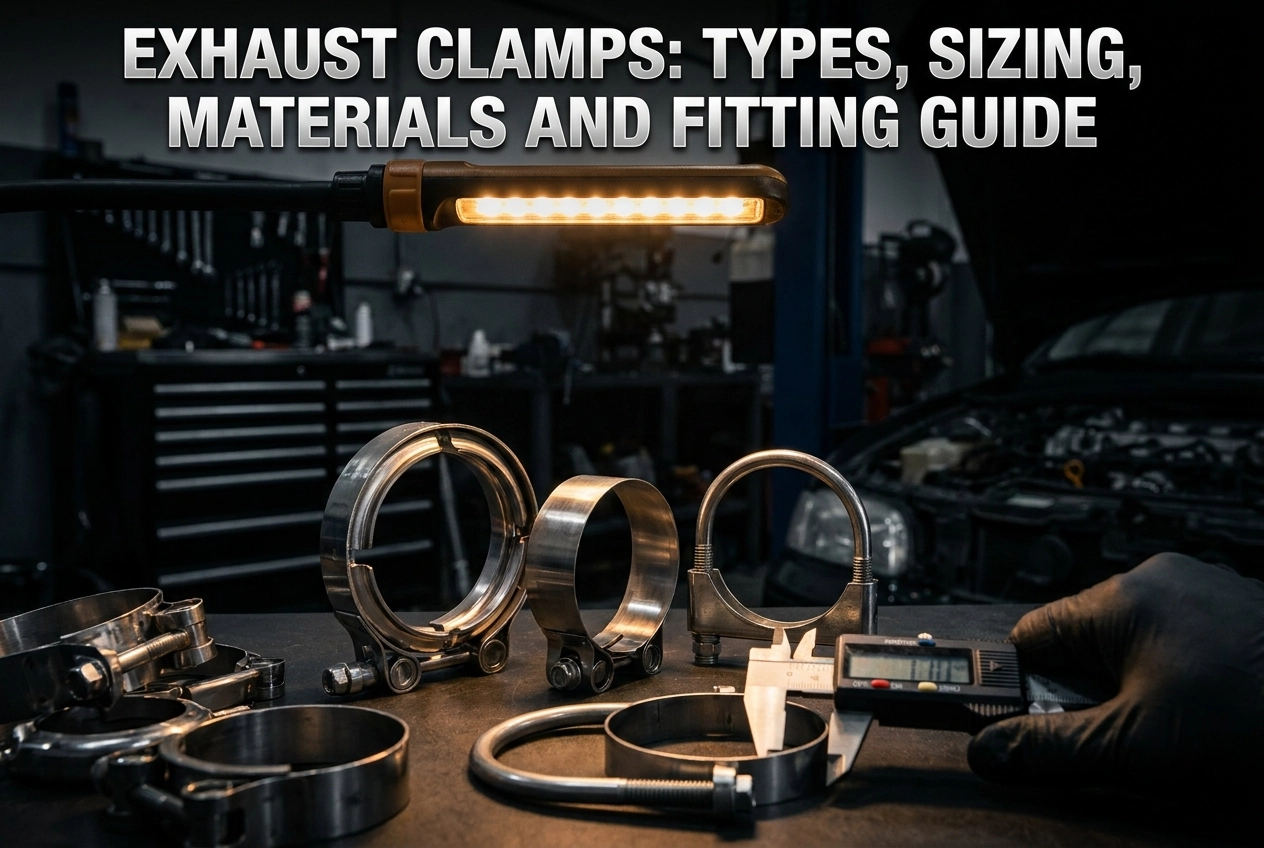
Not all exhaust clamps are built for the same job, and selecting the wrong type for your application can result in exhaust leaks, distorted pipework, or joints that are nearly impossible to disassemble without cutting. Here is a breakdown of the four main types and where each one belongs in your build.
1. U-Bolt Clamps
U-bolt clamps are the most widely seen type on standard OEM replacement exhaust systems. They consist of a U-shaped bolt that wraps around the pipe and compresses it against a saddle plate when tightened. While they are cost-effective and straightforward to fit, their clamping action is fundamentally uneven: the saddle applies concentrated pressure at two points rather than distributing load around the full pipe circumference. This can physically deform softer mild steel pipework over time, making future removal difficult without cutting the joint free. Mild steel variants are also highly susceptible to corrosion, particularly in the UK’s salt-heavy winter road conditions. For a straightforward OEM-spec repair on a standard system, they are adequate; for anything beyond that, they represent a compromise.
2. Band Clamps (Lap-Joint Clamps)
Band clamps improve considerably on the U-bolt design by wrapping a continuous band around the full pipe circumference, producing a genuine 360-degree seal without the crushing effect. Lap-joint band clamps are engineered for slip-fit connections where one pipe slides over another, making them well suited to standard aftermarket cat-back systems and mild performance builds. SS304 stainless steel band clamps are widely regarded as the industry benchmark for durability and corrosion resistance in this category, offering a meaningful service-life upgrade over mild steel alternatives.
3. V-Band Clamps
V-band clamps use a two-piece interlocking flange system held together by a V-shaped outer collar. The geometry of the joint draws the two flanges tightly together under load, creating an exceptionally strong, leak-free seal that can withstand sustained high exhaust temperatures and pressure spikes. Crucially, V-bands are highly reusable without any degradation in sealing performance, which makes them the preferred choice for turbocharged builds and track-day cars where the exhaust is removed regularly for servicing or inspection. Rapid disassembly is achieved with a single bolt, reducing downtime significantly compared to other joint types.
4. T-Bolt Clamps
T-bolt clamps use a rigid T-shaped bolt to apply high, uniform clamping force across the band, delivering superior resistance to both vibration and thermal movement. This makes them particularly well suited to motorsport and performance builds where exhaust joints experience repeated thermal cycling, mechanical stress from the drivetrain, and sustained high-frequency vibration. For a deeper look at how different clamp types perform across specific applications, the application-first approach is always the correct starting point.
Matching Clamp Type to Application
Selecting the right exhaust clamp comes down to three variables: the operating load, the peak temperature the joint will see, and how frequently the system needs to be disassembled. OEM replacement work suits U-bolt or band clamps in stainless steel. Weekend performance driving on a modified street car is better served by SS304 band clamps. Full motorsport builds and turbocharged systems demand V-band or T-bolt clamps for reliable, repeatable sealing across the full service life of the build. You can also explore the full range of exhaust clamp types and selection criteria to cross-reference your specific pipe diameter and connection style before purchasing.
How to Size an Exhaust Clamp Correctly
Getting the size right before you order is where most exhaust clamp mistakes are made, and the fix is straightforward once you understand what measurement actually matters.
Always size to the outside diameter of the pipe, not the inside diameter. This is the single most common source of incorrect purchases, particularly when transitioning from OEM pipework to an aftermarket system. OEM and aftermarket pipes with the same nominal bore can have meaningfully different external dimensions depending on wall thickness and manufacturing tolerances. The clamp wraps around the outside, so the OD is the only measurement that determines fitment.
Measuring accurately before ordering removes guesswork from the process. A vernier calliper placed across the outer edge of the pipe gives the most reliable reading. Where a calliper cannot reach, particularly mid-system on a vehicle that is already partially assembled, wrap a piece of string tightly around the circumference of the pipe, mark the overlap point, then measure the string length and divide by pi (3.14) to calculate the OD. This method is reliable enough for ordering purposes and takes less than a minute to complete. For further guidance on how to measure exhaust diameters accurately, practical walkthroughs are available online that cover different access scenarios.
UK performance exhaust systems typically run pipe diameters between 1.75 inches and 3.5 inches, scaled to engine displacement and tune level. For turbocharged passenger car builds, 2.5-inch and 3-inch diameters are the most widely used sizes across the aftermarket, driven by the balance between flow efficiency and available underbody clearance on common platform vehicles.
Nominal pipe labelling is not a substitute for direct measurement. A pipe sold as 63mm nominal may carry a slightly different actual OD depending on the manufacturer’s wall specification. Ordering a clamp based on system labelling alone risks receiving one that is marginally too tight to seat correctly or too loose to seal under thermal cycling. Measuring the actual pipe removes this variable entirely.
V-band clamps introduce an additional sizing consideration that does not apply to U-bolt or band clamps. Because a V-band clamp engages a pair of flanges rather than clamping directly onto the pipe surface, the clamp diameter must correspond to the flange OD specification, not the pipe OD. The flanges need to be welded onto both pipe ends before the clamp can function, and the flange size and V-band diameter must be specified together as a matched pair. Ordering the clamp and flanges separately without confirming they share the same nominal size is a straightforward but frequently made error, particularly when sourcing components from different suppliers. Confirming the full flange-to-clamp specification before purchasing prevents a costly mismatch at the fitting stage.
Stainless Steel vs. Mild Steel Exhaust Clamps
Material choice between mild steel and stainless steel is one of the most consequential decisions you will make when specifying exhaust clamps for a performance build, and the cost difference at purchase rarely reflects the true cost difference over time.
The Case Against Mild Steel in UK Conditions
Mild steel clamps carry a lower upfront price, but they degrade rapidly under the combined stress of road salt, moisture ingress, and repeated heat cycling. The UK road environment is particularly aggressive in this regard, with gritting season running from autumn through to early spring across most of the country. Mild steel lacks the passive oxide layer that protects stainless grades; once surface corrosion begins, it progresses through the clamp body relatively quickly, compromising clamping force and accelerating joint failure. Corrosion, noise, and bracket wear are consistently cited as the primary triggers for exhaust servicing work, which means a corroded mild steel clamp is not just a cosmetic problem but a direct reliability concern for the system as a whole.
Why Stainless Steel is the Practical Default
Stainless steel clamps, typically specified in 304 or 316 grade for exhaust applications, offer substantially better corrosion resistance through a self-repairing chromium oxide layer, higher heat tolerance under cyclical thermal loads, and a service life that extends well beyond two or three UK winters. For any performance build where longevity matters, 304-grade stainless is the minimum sensible specification. It handles the thermal and chemical demands of a road-going performance exhaust without the progressive failure modes associated with mild steel.
316 Grade for Track and Motorsport Use
Where track days or competitive motorsport are involved, 316-grade stainless is the superior choice. The addition of molybdenum, typically at 2 to 3 percent, provides meaningfully better resistance to chloride-induced pitting corrosion and greater structural stability under extreme thermal loads compared to 304. At the clamp level, the weight difference between grades is negligible; the density of stainless steel sits at approximately 7.93 g/cm³ versus roughly 7.85 g/cm³ for mild steel, a difference that is imperceptible in a component of this size. The durability gain over mild steel carries no meaningful weight penalty, making the upgrade functionally cost-free in terms of performance impact.
Lifecycle Cost and Sustainability
The UK auto parts market is increasingly prioritising durable, corrosion-resistant materials as part of a broader focus on sustainability and reduced component turnover. A stainless clamp that remains serviceable for five or more years rather than requiring replacement every two seasons directly reduces the lifecycle cost of maintaining a performance exhaust system, both in parts spend and labour time.
How to Fit an Exhaust Clamp: DIY Installation Guide
Fitting an exhaust clamp correctly comes down to preparation, correct torque, and a few procedural details that are easy to overlook. Follow these five steps to ensure a leak-free, durable joint from the first heat cycle onward.
1. Allow the System to Cool Completely
Before touching any part of the exhaust, wait a minimum of 60 minutes after engine shutdown, and longer if the vehicle has been driven hard. Both stainless and mild steel expand significantly at operating temperatures. If you fit a clamp onto a warm pipe and torque it to spec while the metal is expanded, the joint will become loose once the system cools and the pipe contracts. This is a particularly common error on roadside repairs where there is pressure to get back on the road quickly. A clamp that feels tight immediately after fitting can develop an audible exhaust leak within a few miles if the pipe was even mildly warm during installation.
2. Prepare the Pipe Surfaces Thoroughly
Use a wire brush to clean both pipe ends before positioning the clamp. Remove all rust, carbon deposits, scale, and any remnants of old gasket or exhaust paste. Surface contamination sits between the clamp and the pipe and prevents even seating across the joint face. An uneven seat concentrates clamping load on high points rather than distributing it uniformly, which creates localised stress and allows exhaust gas to bypass the joint. For slip-joint connections, also check that the pipe overlap is sufficient; most standard installations require a minimum of 38 mm of pipe engagement inside the sleeve before the clamp is positioned.
3. Apply the Correct Torque for the Clamp Type
Torque specifications are not interchangeable between clamp types, and guessing is the most reliable way to create a failed joint. U-bolt and band clamps on standard passenger car exhaust systems typically require 25 to 40 Nm, applied in progressive stages rather than full torque in a single turn. For performance T-bolt and V-band clamps, always work to the manufacturer datasheet. As a practical reference, V-band clamp installation guidance from Ace Race Parts specifies 10 to 14 ft-lb dry and 7.2 to 10 ft-lb lubed across their standard and quick-release clamp range. The instruction to tighten to the low end of the specification, confirm the seal, and stop is explicit in that guidance, and it applies equally to any high-spec clamp installation. Never use an impact wrench on a V-band clamp; the risk of stretching the T-bolt or distorting the band is significant.
4. Orient V-Band Clamps for Access and Longevity
When fitting a V-band clamp, position the T-bolt and nut assembly to the side of the pipe rather than underneath it. A clamp positioned directly beneath the pipe sits in the lowest point of the assembly, where road water, salt, and debris accumulate. This accelerates corrosion on the nut and bolt threads and makes future removal considerably harder, particularly on systems that see track or winter use. Orienting the fastener to the 3 or 9 o’clock position keeps it accessible for re-torquing and future disassembly. Also ensure the bolt is positioned away from adjacent heat sources such as catalytic converters or turbocharger outlets, which can degrade the fastener over time.
5. Avoid the Three Most Common Installation Mistakes
Three errors account for the majority of DIY exhaust clamp failures. First, overtightening; excessive torque distorts the clamp saddle or collapses the pipe wall, neither of which can be corrected after the fact. Second, under-tightening; a clamp that lacks sufficient clamping load allows exhaust gas to escape at the joint, producing the characteristic exhaust drone that worsens progressively. Third, and most frequently overlooked, failing to re-torque after the first heat cycle. New stainless clamp installations in particular require a re-check once the system has been run and cooled, as the metal seats and relaxes slightly under thermal load. For a detailed breakdown of which exhaust clamp type suits your application, cross-reference the clamp selection against the joint type and pipe diameter before finalising your installation approach.
Exhaust Clamps for Motorsport and Track Day Builds
Track and motorsport environments expose exhaust joints to conditions that are categorically more demanding than road use. Launch control events, sustained high-RPM driving, and the continuous vibration transmitted through a stiffened chassis all generate mechanical stress that standard U-bolt and band clamps are not engineered to absorb. At these loads, conventional clamps are prone to micro-movement at the joint face, which progressively loosens the fixing and can result in exhaust separation at speed. T-bolt and V-band clamps are the recognised standard for motorsport builds precisely because their clamping geometry distributes load evenly around the full pipe circumference, resisting the rotational and axial movement that high-vibration environments produce.
V-band clamps carry an additional advantage that makes them especially valued in track-day and competition contexts: complete exhaust section removal requires only one fastener and no specialist tooling. On a competitive build where the rear exhaust section sits adjacent to the gearbox casing, rear subframe, or a composite diffuser, the ability to drop the exhaust in minutes without disturbing surrounding components is a genuine operational benefit. This makes V-band placement at key section joins a standard practice on prepared track cars, not just a convenience feature.
For forced induction cars connecting a downpipe to a catback system, a V-band join at the downpipe-to-midpipe junction is strongly advisable. Turbocharger systems experience the most aggressive thermal cycling in the exhaust circuit; temperatures spike sharply under boost and cool rapidly in the paddock or between sessions. Repeated expansion and contraction causes conventional clamp joints to walk and loosen over time, whereas the V-band’s radial clamping action accommodates thermal movement without compromising joint integrity. You can read more about V-band clamp behaviour in demanding applications via this detailed V-band technical guide.
The broader market context is relevant here. The automotive performance parts market is estimated at USD 387.9 billion in 2026, with passenger cars representing 74.2% of that demand. This means that fitment standards and components previously associated only with dedicated race vehicles, including high-specification V-band systems in stainless and titanium, are now widely available for road-legal track cars at accessible price points.
One final consideration that is frequently overlooked: check the regulations of your specific motorsport series or track-day organiser before finalising clamp selection. Certain series require exhaust systems to be positively retained with safety wire or secondary retention clips at defined joints. A V-band or T-bolt clamp that is otherwise correctly specified may still require a supplementary retention method to pass scrutineering. Factor this into both clamp selection and your fabrication planning before the car is built. For a broader overview of clamp selection by application, this exhaust clamp application guide provides useful comparative context.
UK MOT Compliance and Exhaust Modification Regulations
Road use adds a compliance dimension to exhaust clamp selection that is worth understanding clearly before any modified system goes near a public road.
1. Clamp joints are a testable item during MOT inspection
During an MOT, the examiner assesses the entire exhaust system for security, condition, and gas-tightness. A clamp joint that is visibly corroded, physically loose, or leaking exhaust gases is a directly testable item under Section 8 of the MOT Tester’s Manual. A deteriorated or improperly fitted clamp that allows exhaust gas to escape ahead of the silencer is not a borderline case; it is a straightforward failure point. This makes correct clamp selection and torque directly relevant to keeping a road-legal vehicle in roadworthy condition year to year.
2. Noise compliance and leaking joints
Exhaust noise is assessed against the standard that the system must not emit substantially more noise than an equivalent vehicle with a standard silencer in average condition. The current legal noise limit for cars is 72 decibels, with approximately 82 dB under load cited as the practical MOT failure threshold. Importantly, aftermarket systems using performance clamps are not automatically non-compliant. However, exhaust gas leaking at a poorly fitted clamp joint increases audible noise output and can push an otherwise compliant system over the threshold. The clamp joint is therefore a noise compliance variable, not just a structural one.
3. The clamp type itself is not the compliance variable
A V-band, T-bolt, or band clamp is not inherently more or less MOT-compliant than any other design. What matters to the examiner is whether the joint is secure, gas-tight, and whether the system exits at the correct point at the rear of the vehicle. Per the Vehicle Certification Agency, GB and UKNI type approval requirements now apply to all new M and N category vehicles, and a new 68 dB limit applies to vehicles type-approved after July 2026, which is tightening the compliance window for future aftermarket specifications.
4. Construction and Use Regulations and documentation
Under The Road Vehicles (Construction and Use) Regulations 1986, any exhaust modification must not increase noise output beyond type-approved levels. Fitting quality clamps that prevent leaks, vibration, and rattles is a practical part of maintaining compliance. If you are installing a full cat-back or turbo-back system with performance clamps, retain the system specification documentation alongside your build records. Ensure every clamp joint is correctly torqued and gas-tight before the vehicle is driven on public roads; this is both a legal requirement and straightforward risk management given that noise camera enforcement is expanding across the UK.
Choosing the Right Exhaust Clamp for Your Build
Three decision points determine whether an exhaust clamp performs or fails: clamp type, material grade, and accurate sizing. For basic OEM replacement, a U-bolt clamp is adequate. For performance builds and motorsport applications, V-band and T-bolt band clamps are the correct specification; they handle thermal cycling, resist vibration-induced loosening, and allow fast disassembly during maintenance. Pair either type with 304 stainless steel construction, and you have a joint that resists corrosion through UK winters without degrading at underbody operating temperatures.
Performance exhaust work occupies a distinct tier from OEM-replacement servicing. Specifying a clamp correctly for a track or modified road build returns tangible dividends: consistent sealing under sustained heat and load, straightforward removal when swapping components between events, and continued MOT compliance given that exhaust leaks and structural failures are testable failure points. Cutting corners on clamp specification is a false economy when the joint fails mid-season or triggers an MOT advisory.
Before ordering, measure your pipe outside diameter using the circumference-wrap method covered earlier in this guide. Confirm the exact OD figure against the product listing, not a nominal trade size, since OEM and aftermarket pipes frequently differ from labelled dimensions.
The exhaust components range at performancecarsparts.co.uk stocks stainless V-band, T-bolt, and band clamps across the sizes most commonly needed for UK performance builds, with delivery across the UK. If you have a fitment query before ordering, the team is available via email and WhatsApp. For a broader overview of clamp types by application, this exhaust clamp guide provides a useful reference for cross-checking your selection.
Conclusion
A leak-free exhaust system starts with one well-informed decision. Match your clamp type to the joint configuration, size it accurately to your actual pipe diameter, choose a material grade that can handle the heat and moisture your application demands, and torque it to specification during installation. Skip any one of those steps and you are back to chasing leaks, replacing corroded hardware, or worse, dealing with exhaust gases creeping toward the cabin.
The good news is that none of this requires specialized expertise. Armed with the right measurements and the knowledge from this guide, you can make a confident selection the first time.
Take a few extra minutes before your next exhaust job to verify your pipe diameter, assess your environment, and choose accordingly. A small investment in the correct clamp today saves a frustrating repair tomorrow.