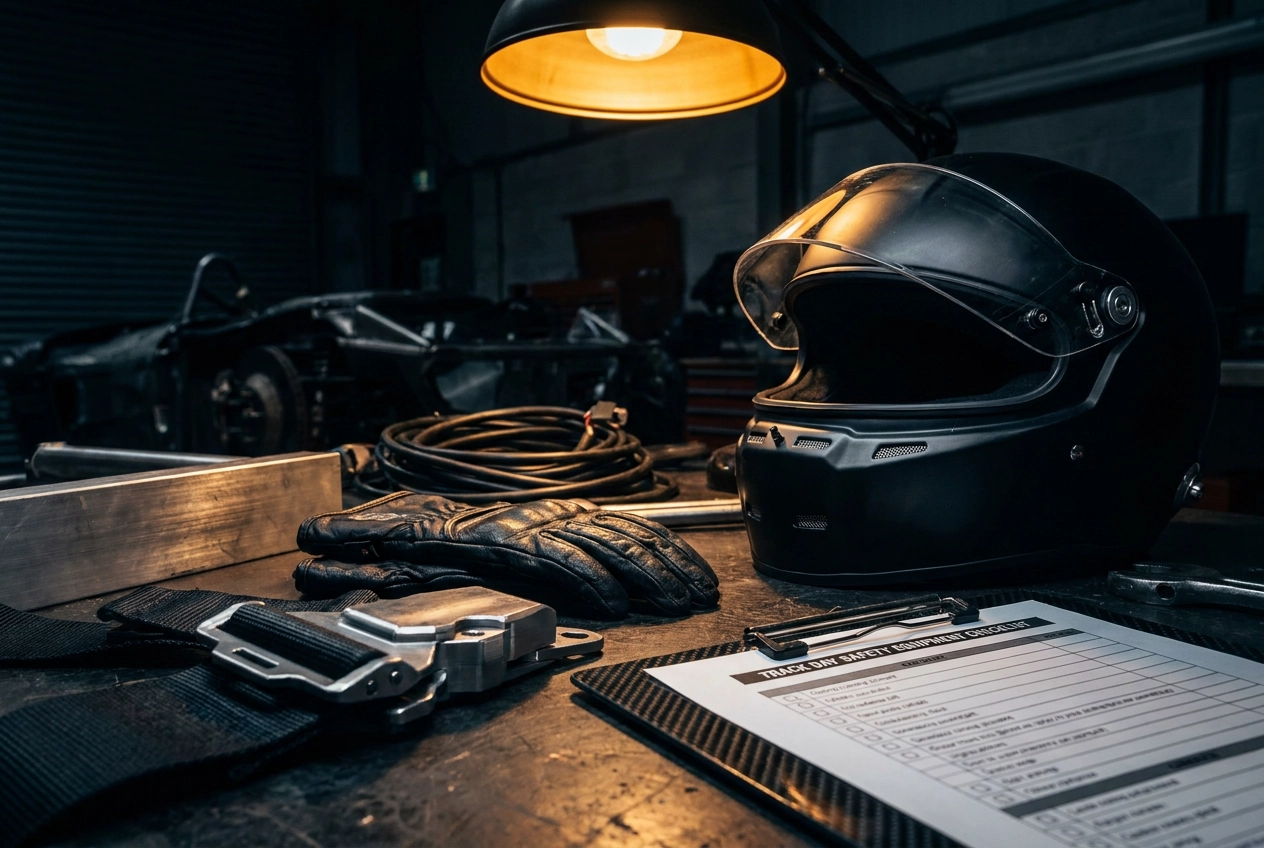
Turning up to your first track day without the right kit does not just ruin your day. It ends it before you reach the gate. UK circuit operators enforce strict minimum safety standards, and drivers who arrive without compliant equipment are turned away. Refund policies vary by operator; do not assume one will be issued.
This is where many first-timers go wrong. They treat safety gear as something to think about later, after booking the session and sorting the car. In reality, your helmet, clothing, and vehicle documentation are the entry requirement. Getting them right is step one.
This guide cuts through the vague advice and gives you a practical, category-by-category checklist of the motorsport accessories every beginner needs before their first circuit session. You will learn exactly which helmet certifications are accepted, why fire-resistant clothing standards matter more than most people realise, what your car must pass on the day, and how circuit-specific rules across venues like Brands Hatch, Oulton Park, and Donington Park can catch unprepared drivers off guard.
Work through each section in order, and you will arrive gate-ready, fully compliant, and focused entirely on enjoying the track.
Why Safety Kit Is an Entry Requirement, Not a Recommendation
UK track day operators run their events under exactly the same strict controls applied to race meetings. MSV Group, which operates seven circuits including Brands Hatch, Oulton Park, Snetterton, Cadwell Park, and Bedford Autodrome, enforces equipment compliance at the gate. This is not a suggestion buried in the booking terms; it is a hard checkpoint with real consequences.
Operators cannot grant individual exceptions because doing so creates liability for every other participant in that session. The rule applies to everyone equally, without negotiation.
Safety standards are not uniform across circuits or session types. Kit that satisfies requirements at one venue may fall short at another, even within the same operator group. This is why venue-specific verification before booking is essential, not something to confirm on the morning of the event.
Road insurance does not cover circuit use, see the insurance section below; and the pre-session window leaves no time to resolve kit gaps on the day.
If you are still planning your car’s setup alongside your safety kit, the guide to performance parts upgrades that transform how your car drives is worth reading alongside this checklist.
The Helmet: Your First and Most Critical Purchase
“Bring a suitable helmet” appears on every UK track day operator’s kit list. The word “suitable” is doing significant work there, and getting it wrong means being turned away at the gate.
Suitable means certified to a recognised motorsport standard accepted by your circuit operator. A motorcycle commuter lid, a cycling helmet, or an uncertified novelty helmet does not qualify, regardless of how protective it looks. Certifications widely cited for UK track day use include Snell SA2020, ECE 22.06, and FIA 8859; verify the accepted standards with your circuit operator before purchasing.
Know Your Snell Ratings
Snell produces two relevant ratings: SA (Sport Application) and M (Motorcycle). Check your helmet carries an automotive SA rating rather than a motorcycle M rating, and confirm it meets the current ECE revision accepted at your venue. “Snell certified” without the SA designation is not the same thing.
Check ECE Certification Dates on Second-Hand Kit
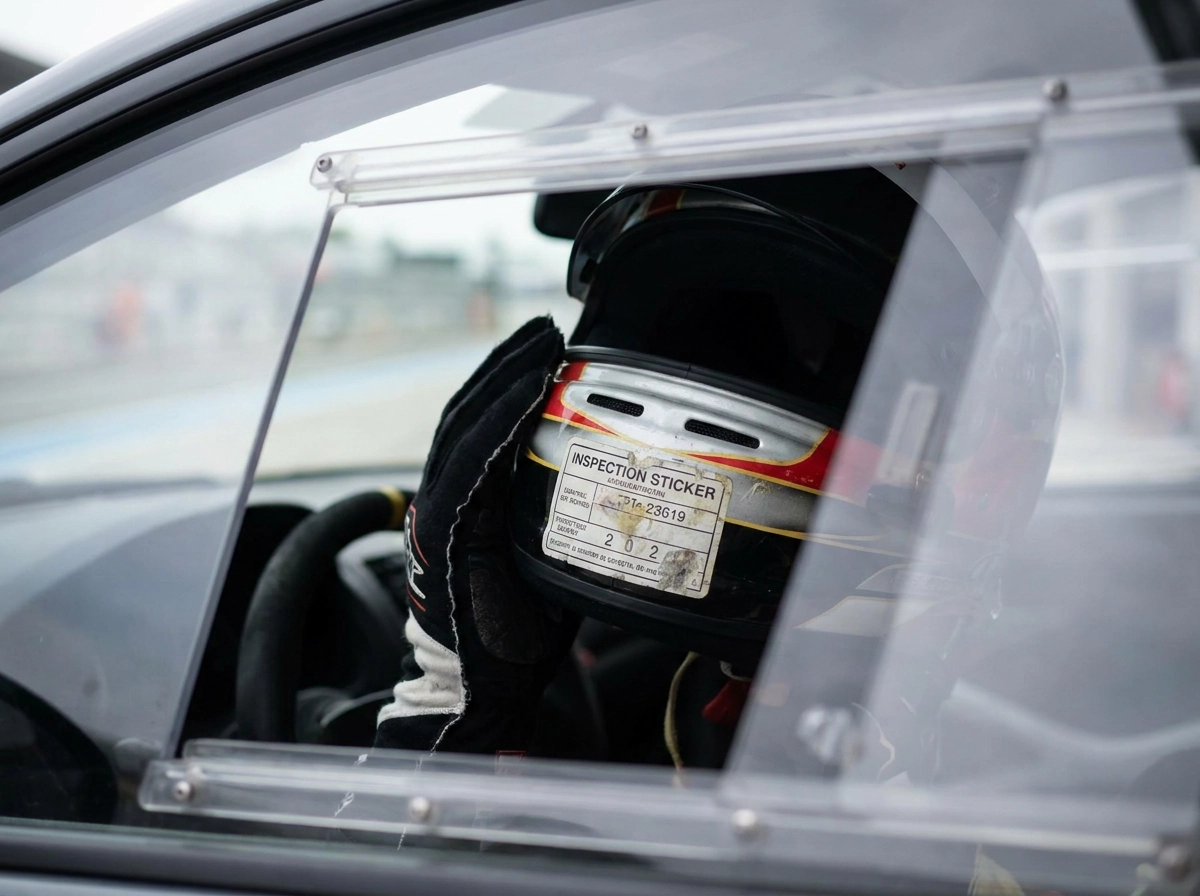
If you have inherited a helmet or are considering used kit, locate the certification sticker inside the liner and confirm it shows the ECE revision your circuit accepts. Confirm this with the operator before purchasing second-hand kit.
Full-Face Is the Practical Default
Open-face helmets leave the chin and jaw unprotected. At some circuits and in certain session categories they may not be accepted. A full-face helmet is the correct starting point for any first-timer and removes any ambiguity at scrutineering.
On Helmet Hire
Some MSV operators offer hire helmets, which lowers the upfront cost for a single session. However, hire stock limits your fit options and raises obvious hygiene considerations. If you plan to attend more than one session, owning a correctly fitted helmet is the more practical and safer position.
Fit is not a comfort preference; it is a safety variable. A helmet that shifts on impact provides materially less protection than one seated correctly. Always try before buying, or use a supplier with a clear returns policy on unworn items.
Race Suits and Fire-Resistant Clothing: Understanding the Standards
Once the helmet decision is made, clothing is the next gate. The rule is absolute: legs must be fully covered. Shorts, cropped trousers, or any exposed skin below the waist will get you turned away. No exceptions, no operator discretion.
What Level of Suit You Actually Need
The requirement depends on your session type. Entry-level road car track days typically accept a cotton or fire-resistant (FR) boilersuit as a minimum. These are low-cost and widely available but offer limited protection in a sustained fire situation.
For structured or competitive sessions, an FIA-rated race suit is required. Even for standard track days, FIA homologation is strongly recommended. The two standards you will encounter are FIA 8856-2000 and the current benchmark, FIA 8856-2018. The 2018 standard is designed to minimise the risk of second-degree burns and sets a higher protection benchmark than the 2000 specification.
Single-Layer vs. Multi-Layer
Single-layer suits are the entry point for motorsport clothing UK buyers and are accepted at the vast majority of UK track day formats. Multi-layer suits extend fire protection significantly and are worth prioritising if you intend to progress toward timed or competitive sessions. Buy the highest layer count your budget allows.
The Label Is the Only Thing That Matters
Colour and branding are irrelevant to compliance. A plain black suit and a heavily branded one offer identical protection if they carry the same homologation. What matters is the label sewn inside the suit. It must be present, legible, and show the correct FIA standard. On second-hand motorsport gear, check this first; a missing or damaged label means the suit cannot be verified and will likely be rejected at scrutineering.
Budget Guidance
Race suits represent the largest single spend in a first-timer’s kit list. Entry-level FIA-rated suits vary in price; check current pricing with a specialist UK motorsport retailer. This is a one-time investment covering multiple sessions. If you are also building a performance-focused car, our guide to buying Audi parts in the UK covers how to approach parts sourcing without compromising on specification.
Gloves and Fire-Resistant Underwear: The Items Most First-Timers Overlook
Once you have a suit sorted, two items remain that consistently catch first-timers out at the gate: gloves and fire-resistant underwear.
Racing gloves are mandatory at most UK circuit operators. Standard leather driving gloves and mechanic’s gloves do not meet FIA or circuit compliance requirements, regardless of quality or material. The standard to target is FIA 8856-2018. Gloves without this rating may be refused at stricter venues, and there is no on-the-day workaround. Gloves and underwear are among the lowest-cost items in the kit list; confirm current pricing with a specialist retailer.
Fire-resistant underwear is the other gap most first-timers discover too late. The required base layer set comprises three items:
- A Nomex balaclava covering the head and neck
- A long-sleeved fire-resistant top
- A long-leg base layer
Many participants arrive believing the suit handles everything, only to be told at sign-on that underwear is also required.
The Nomex balaclava is worth particular attention. It satisfies the fire protection requirement for the head and neck area beneath the helmet, and it also provides a practical hygiene benefit for anyone using hire lids or sharing equipment between sessions.
FIA-rated underwear uses the same homologation label system as race suits. Look for the FIA 8856-2018 tag sewn into each garment. Older FIA 8856-2000 rated items may be accepted at some venues; confirm acceptance with your circuit before the event. If buying new, 8856-2018 is the correct target.
Gloves and underwear together represent the smallest spend in your kit build. Arriving without them risks the entire day’s entry fee.
Footwear Specifications and What Gets You Turned Away
Footwear is the final clothing item to check before leaving home, and it catches more first-timers off guard than gloves or underwear.
The absolute minimum at every UK track day operator is a closed-toe shoe. Sandals, flip-flops, and open-toe footwear are an immediate disqualification at the gate, regardless of what else you are carrying. No exceptions are made.
Closed-toe, however, is not the same as compliant. Road trainers fail on two counts: thick rubber soles impair pedal feel and can catch on pedals under load, and the synthetic upper materials in most modern trainers melt under heat exposure rather than charring, which is a material failure in a fire scenario. High-specification road shoes do not resolve either problem.
Racing boots are the correct choice. They are purpose-built with thin, flexible soles for direct pedal feedback, ankle support for lateral stability under braking, and fire-resistant construction throughout. The target specification is FIA 8856-2018, the current benchmark standard for motorsport footwear. Entry-level FIA 8856-2018 boots are available from specialist motorsport retailers at varying price points.
Three footwear types that are commonly misjudged as acceptable:
- Trainers with thick rubber soles (impair pedal feel, snagging risk)
- Boots with protruding metal buckles or zips (footwell obstruction hazard)
- Footwear with synthetic non-FR uppers (melt under heat rather than char)
Ankle coverage is also a practical safety requirement. Low-cut racing shoes that leave the ankle exposed may be refused at circuits operating stricter fire protocols. Full ankle coverage is the safer assumption to build your purchase around.
If dedicated boots are not yet in the budget, a flat-sole, leather-upper lace-up boot (not a trainer) is the fallback minimum. Treat it as a one-session bridge; motorsport-specific footwear should be a priority purchase before your second session.
Vehicle Requirements: What Your Car Must Pass Before You Drive
Your personal kit covers you inside the car. The car itself faces its own compliance checks, and failing them at the gate means the same outcome: turned away, no refund.
1. MOT-standard roadworthiness is the baseline
The vehicle must arrive in a condition that would pass a standard MOT. Cracked windscreens, faulty lights, and worn tyres below the 1.6mm legal minimum are all grounds for refusal at scrutineering. Seatbelts must function correctly; a jammed or frayed belt is an immediate fail.
2. Static noise testing applies at most UK circuits
Before any car turns a wheel on track, it must pass a static noise test. Limits vary by venue; check the specific decibel threshold with the circuit operator before the event. Aftermarket exhausts can push a car over the limit even when well-engineered. Reading about exhaust pipes for performance cars will help you understand how pipe design and material affect output levels before you commit to any changes.
3. Confirm the noise testing policy with each operator
Some circuits do not require a static noise test; confirm the testing policy with the specific operator at the time of booking. Do not assume any circuit operates the same way as another.
4. Loose items must be removed before scrutineering
Floor mats, sat-nav units, loose tools in the boot, and any unsecured aftermarket accessories are cited failure reasons at pre-session checks. Strip the cabin before you leave home.
5. Modifications introduce separate compliance obligations
Harnesses and roll cages are not mandatory for standard road-car track days, but fitting them creates new requirements. A roll cage fitted without an accompanying harness upgrade can increase injury severity in certain impacts. Verify any modifications against the specific circuit’s safety standards before the event.
6. Legal tyre tread is not the same as track-ready tread
The legal minimum tread depth is the floor, not the target; replace borderline tyres before the session.
Track Day Insurance and Documentation: Closing the Gap Your Road Policy Leaves Open
Your car passes scrutineering and the noise test clears. The next gap to close is financial and legal, and it is one that catches more first-timers off guard than any piece of missing kit.
Standard road insurance policies explicitly exclude circuit use. This is not a grey area or a policy loophole; it is a standard exclusion written into virtually every UK personal motor policy. The moment your car crosses the pit lane exit onto the circuit, your road cover is void. Any incident, whether a spin into the barriers or contact with another car, leaves both the vehicle and any resulting liability entirely uninsured.
The absence of a mandatory requirement from an operator does not mean cover is unnecessary. Some UK track day operators make track day insurance a booking prerequisite and verify it at sign-on. Others leave the decision to the participant. Where an operator does not enforce it, they have chosen not to, not confirmed that your road policy is adequate.
Single-event track day insurance is available from UK specialist providers; obtain quotes before booking. That cost is marginal relative to the uninsured repair bill from even a minor circuit incident. If you are also thinking about the mechanical side of preparation, the section on cooling as cheap insurance elsewhere in this guide covers another frequently overlooked risk.
At sign-on, expect to present: a valid DVLA photocard driving licence, your booking confirmation, and, where required, evidence of track day insurance. Arriving without the photocard licence is an automatic refusal. No exceptions are made.
Most UK circuit operators’ terms and conditions specify how liability for on-track incidents is allocated; review the operator’s T&Cs before the event.
Confirm documentation requirements directly with the circuit operator before the event.
Circuit-Specific Variations: Why You Must Verify Before You Book
The same verification discipline that applies to documentation extends to the kit itself. Safety standards are not uniform across UK circuits, and the variation is not minor. Brands Hatch, Oulton Park, Snetterton, Cadwell Park, and Bedford Autodrome each operate under operator-managed compliance protocols. What satisfies the minimum at one MSV Group venue may fall short at another, depending on session type and any updates made since your last event.
Session category is as important as circuit. A standard road car track day carries different minimum kit requirements to a race preparation or competition licence session held at the same venue on a different date. Identify the exact session category when booking, not after, and source kit to that specification.
There is no publicly available centralised resource mapping operator requirements by circuit and session type. Contact the specific circuit operator before booking and ask for the current minimum equipment specification for your session category in writing. This single step prevents the most avoidable refusals at the gate.
Seasonal sessions introduce additional variables. Evening track day sessions, available at selected UK circuits from April to September, may operate under different noise limits or supervision ratios compared to full-day events at the same circuit. Confirm the session format and any format-specific requirements at the time of booking, not on the day.
Do not assume kit that was compliant last season remains compliant now. Helmet certification expiry, suit recertification intervals, and circuit noise limits are all subject to annual review by operators. Check every label on existing kit before each new season, not just before your first session.
For any first-timer, targeting FIA-rated kit across every category is the most reliable approach; see the checklist section below for the full category breakdown.
The Complete Track Day Safety Checklist at a Glance
With the circuit-specific variations covered, use this checklist as your final gate-ready reference. Every item below must be confirmed before you leave for the circuit.
1. Helmet Full-face recommended; certified to a recognised motorsport standard accepted by your circuit operator. Certifications widely cited for UK track day use include Snell SA2020, ECE 22.06, and FIA 8859; verify the accepted standards with your circuit before the event. Check the certification label is present and legible before packing.
2. Race Suit FIA 8856-2018 rated, single or multi-layer. The internal homologation label must show the standard reference, manufacturer name, homologation number, and expiry date. A faded or missing label is treated as no certification.
3. Racing Gloves FIA 8856-2018 rated, covering the back of the hand and wrist. Standard leather driving gloves and mechanic gloves are not compliant and will be rejected at scrutineering.
4. Fire-Resistant Underwear A complete FIA 8856-2018 rated set: Nomex balaclava, long-sleeve top, and long-leg base layer. At circuits running FIA-specification sessions, underwear is a separate requirement alongside the race suit.
5. Footwear Closed-toe, flat-sole, ankle-covering motorsport boots. FIA 8856-2018 rated where possible. Trainers with thick rubber soles, synthetic non-FR materials, or protruding metal fittings are not acceptable substitutes.
6. Vehicle Roadworthy to at least MOT standard; all seatbelts operational. Remove all loose cabin items including floor mats and unsecured accessories. Confirm your car’s noise level against the specific circuit limit before the day, not on arrival.
7. Documentation Valid DVLA photocard driving licence (no licence means automatic refusal), proof of booking, and track day insurance evidence where the operator requires it. Confirm documentation requirements with the circuit before the event.
8. Pre-Arrival Timing Arrive 60 to 90 minutes before the session starts. This window covers sign-on, the static noise test, and the mandatory safety briefing. Kit queries, sourcing missing items, or resolving certification questions cannot be addressed inside this window; the briefing will proceed without you if you are late.
Where to Source Your Motorsport Gear Before the Day
With your checklist confirmed, the next step is sourcing each item from the right place before the session date.
Buy from a single specialist supplier where possible. Sourcing all your motorsport apparel and accessories from one retailer reduces the risk of mismatched certification standards across your kit and simplifies exchanges if sizing is wrong. This matters most for helmets and race suits, where an incorrect fit is a safety issue, not an inconvenience. Performance Cars Parts stocks helmets, race suits, gloves, and motorsport accessories suited to UK track day compliance requirements, with customer support available via email and WhatsApp for specification queries before you purchase.
Avoid general marketplaces for safety-critical items. A helmet listed as “Snell rated” on a general marketplace, without a verifiable homologation label attached to the product, is a liability. Certification authenticity cannot be confirmed through a listing photo. Buy from a specialist retailer that can confirm the standard.
Budget realistically. A complete entry-level FIA-rated kit set represents a one-time investment; contact a specialist UK motorsport retailer for current pricing across all categories. The kit scales directly to more competitive use and is not a cost you repeat each season.
Approach second-hand kit with caution. Never purchase a used helmet without full provenance and confirmed absence of prior impact. Used race suits and gloves carry lower risk but must display readable, valid homologation labels. If the label is missing or illegible, treat the item as non-compliant and buy new.
Allow sufficient lead time before your session for sizing exchanges; avoid ordering in the final days before the event.
Arrive Gate-Ready: Your Pre-Session Action Plan
With your kit sourced and ordered, the final step is executing the day itself without avoidable errors.
- Contact the circuit operator directly before booking. Request the current minimum equipment specification for your specific session type in writing. Operator websites carry generic marketing copy that may not reflect updated requirements; only the circuit team can confirm what scrutineers will enforce on the day.
- Source FIA-rated kit across every category. As covered in the circuit variations section above, FIA homologation is widely accepted and remains valid as you progress to more structured or competitive sessions. Buying to the minimum per operator risks non-compliance the moment you change venue or session type.
- Check every certification label before you pack. An unreadable homologation label on a helmet, suit, or gloves is treated identically to no certification at all. Inspect each item under good light; if the label is faded, detached, or illegible, the equipment will fail scrutineering regardless of its apparent condition.
- Arrange track day insurance before the event. As confirmed in the insurance section above, single-event track day cover is essential regardless of whether the operator mandates it. Road policies explicitly exclude circuit use, and the absence of a mandatory requirement does not close your liability exposure.
- Arrive 60 to 90 minutes before your session. Sign-on, noise testing, and the mandatory safety briefing all occur within this window. As noted at the start of this guide, this window exists for compliance and orientation; there is no time to resolve kit gaps once you have arrived.
Every item on this list can be resolved in advance. None of it can be resolved at the gate.
Conclusion
Track day safety is not a last-minute consideration; it is the foundation your entire session is built on. Get your helmet rated, your suit certified, your car inspected, and your insurance arranged well before you reach the gate. Verify requirements directly with your circuit, because standards vary and assumptions cost entries.
The investment you make in compliant, quality kit pays dividends beyond your first session. FIA-rated equipment travels with you as your experience grows, from open pit lane days to more structured club events.
Now take action: build your checklist, book your gear, and contact your circuit. Every item covered in this guide is achievable with a few weeks of preparation. Show up gate-ready, briefing-ready, and track-ready. Your first circuit session should begin with confidence, not a conversation about missing documentation at the scrutineering bay.