
Your car leans into roundabouts, the front washes wide on a damp B-road and the steering feels vague when you turn in hard on track. Search for a fix and two parts come up again and again: a thicker or adjustable anti-roll bar, and a strut brace across the top of the engine bay. Both are bolt-on, both are sold as handling upgrades, and both are often bought together. But they work in completely different ways, and fitting the wrong one first can leave you disappointed.
Written for UK owners who drive on the road and do the odd track day, this guide compares the anti-roll bar vs strut brace question properly. You will learn what each part actually does, why an anti-roll bar upgrade changes the balance of the car while a strut brace mainly changes how the body responds to load, which one suits your car and driving, and what to check for the MOT and your insurer before you spend money.
Quick Answer: Anti-Roll Bar or Strut Brace First?
If you want to reduce body roll and change how the car balances between understeer and oversteer, an anti-roll bar is the part that does that job. A strut brace does not meaningfully change roll or balance; it ties the suspension towers together so the body deflects less under cornering loads, and the effect is usually subtler and depends heavily on the car. For most road and track-day cars with healthy suspension, the anti-roll bar is the more noticeable first step, with a strut brace as a complementary extra.
| Your car and driving | Recommended starting point | Main compromise |
|---|---|---|
| Front-drive hot hatch that understeers on the road and at track days | Stiffer or adjustable rear anti-roll bar | Car becomes more lively at the rear; too stiff can make it snappy in the wet |
| Rear-drive coupe or saloon that rolls a lot in quick direction changes | Judge the current balance first: a stiffer front bar if it oversteers too readily, a stiffer rear bar if it understeers | A stiffer rear bar reduces rear grip relative to the front, and a stiffer front bar does the opposite; a matched front-and-rear kit is not automatically better |
| MacPherson strut car with soft turn-in, after tyre pressures, alignment, bushes, steering parts and dampers have been checked | Front strut brace | Benefit depends on how stiff the body already is; it will not fix worn parts or poor setup |
| Four-wheel-drive car (e.g. GR Yaris) wanting a more neutral feel | Adjustable rear bar on its softest setting first | Small changes are noticeable; go step by step |
| High-mileage car with tired bushes or drop links | Replace worn bushes, drop links and dampers before either upgrade | Less exciting, but neither part will work well on worn suspension |
Final choice always depends on the manufacturer’s fitment listing for your exact model and on your existing suspension. Browse our anti-roll bar upgrades and strut braces by vehicle. This guide covers road cars with conventional passive anti-roll bars; cars with active or electronically decoupled roll control need specialist advice.
Anti-Roll Bar vs Strut Brace: Key Differences
| Factor | Anti-roll bar upgrade | Strut brace |
|---|---|---|
| Body roll | Directly reduces roll on the axle it is fitted to | Little or no direct effect on roll |
| Steering precision | Can sharpen response by reducing roll, but also shifts front-to-rear balance | May make turn-in feel slightly crisper on cars where the towers flex; effect varies by car |
| Ride comfort | Couples left and right wheels, so one-sided bumps are partly fed across; stiffer bars can feel busier on broken roads | Little direct effect on ride |
| Fitting complexity | Usually under-car work; may involve subframe or exhaust access and setting drop links | Usually a top-side bolt-on job, subject to engine bay clearance |
| Typical benefits | Less lean, adjustable balance (on adjustable bars), tyres held in a better attitude | More consistent load path between the towers; a modest, low-risk finishing touch |
What an Anti-Roll Bar Actually Does
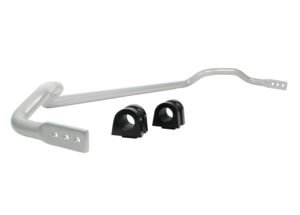
An anti-roll bar (also called a sway bar or stabiliser bar) is a torsion spring, usually a U-shaped steel bar that runs across the car and connects the left and right suspension on the same axle. It is mounted to the body or subframe in rubber or polyurethane bushes, and each end connects to the suspension through a drop link (sometimes called an end link).
When both wheels on an axle rise or fall together, for example over a speed hump, the bar simply rotates in its bushes and does very little. When one wheel compresses and the other extends, as happens when the body leans in a corner, the bar has to twist. It resists that twist and so resists body roll. As the reference overview of anti-roll bar design explains, the bar’s stiffness rises with its diameter and material, and falls as its lever arms get longer.
Why the bar changes handling balance
This is the part most people miss. A stiffer bar does not change the total amount of weight that transfers across the car in a steady corner; that is set mainly by centre-of-gravity height and track width. What it changes is where that load transfer happens. Make the front bar stiffer and more of the load transfer goes through the front tyres, which tends to increase understeer. Make the rear bar stiffer and the rear axle takes a bigger share, which tends to reduce understeer and push the car towards oversteer.
That is why so many front-drive hot hatch owners fit a stiffer rear bar: it helps the car rotate on corner entry rather than pushing wide. The exact result, though, depends on the existing springs, dampers, tyres, alignment and the car’s weight distribution, so treat the direction of change as reliable and the size of the change as something you find by testing.
Benefits manufacturers claim
Whiteline describes its aftermarket bars as reducing body roll, keeping the tyres more upright and spreading cornering loads more evenly, and its adjustable bars offer between two and four adjustment points so you can tune roll stiffness without swapping the whole bar. Treat those as manufacturer claims rather than guaranteed results.

What a Strut Brace Actually Does
A strut brace (strut bar or strut tower brace) is a rigid bar, typically steel or aluminium, that bolts between the tops of the two front or rear suspension towers. On a MacPherson strut car, the strut top is a major load path: cornering, braking and bump forces are fed into the body through that mounting. Under hard cornering the towers can move slightly relative to each other, which subtly changes suspension geometry and how quickly the car responds to steering input.
Linking the towers spreads the load across both sides of the body and reduces that movement. Car Throttle’s explainer on chassis bracing makes the useful points that braces matter most on MacPherson strut layouts, that the benefit on double-wishbone cars is smaller, and that the effect is far less dramatic than a suspension upgrade such as coilovers. It also notes a brace makes little sense on a car with worn suspension parts.

Vague steering? Check these before fitting a brace
A strut brace will not necessarily cure vague steering, because that feeling has many possible causes. Rule these out first:
- Tyre pressures, tyre condition and tyre choice.
- Wheel alignment, particularly front toe and camber.
- Worn suspension bushes, top mounts and ball joints.
- Steering components such as track rod ends and the steering rack.
- Tired or leaking dampers.
Only once those are in good order is a brace worth judging on its own merits, and even then its benefit depends on how structurally stiff your particular car already is.
Upper, lower and rear braces
- Front upper strut brace: the familiar bar across the engine bay. Easiest to fit and the most common choice.
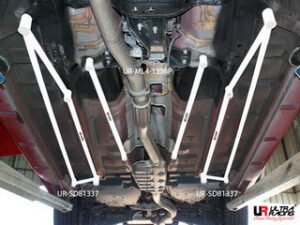
- Front lower brace: ties the subframe or lower arm mounts together under the car. Often less visible but can stiffen a different load path.
- Rear strut or upper brace: fitted inside the boot or behind the rear seats on some hatchbacks, where the open tailgate aperture can be a flexible area.
When an Anti-Roll Bar Upgrade Makes Sense
An anti-roll bar upgrade is the better first purchase when the complaint is about body roll or balance rather than precision. Typical signs include:
- Noticeable lean in long corners and slow, rolling direction changes through chicanes or S-bends.
- Persistent understeer on a front-drive or four-wheel-drive car, especially mid-corner on track.
- Lowering springs fitted without other changes, leaving roll stiffness that no longer suits the new spring rates.
Which end to change depends on how the car behaves now, not on whether it is front- or rear-drive. On front-drive cars a stiffer rear bar is a common choice because it reduces rear grip relative to the front and helps the car rotate. On a rear-drive car, the same change can make an already lively rear end more prone to oversteer, so a car that oversteers too readily may suit a stiffer front bar instead, while one that understeers may suit a stiffer rear bar. A matched front-and-rear kit is not automatically better for every car; it simply changes both ends at once. An adjustable bar is the safer bet for a dual-purpose car because you can start soft for winter roads and firm it up for a summer track day.
Stiffer is not the same as more grip
A stiffer anti-roll bar can sharpen response, but it does not automatically increase total cornering grip. Because the bar links both wheels on an axle, excessive stiffness makes each wheel less able to follow the road independently, which can reduce traction over bumps, cambers and broken surfaces. That matters on typical UK B-roads, especially in the wet, where a setting that feels great on a smooth circuit can feel nervous on the way home. If in doubt, err towards a softer setting for road use.
Drop links and bushes matter as much as the bar
A stiffer bar fed through worn rubber bushes or tired drop links loses much of its benefit and can knock or clunk. Many owners pair a bar with polyurethane mounting bushes; our Powerflex polyurethane vs rubber bushes guide covers the trade-offs. If you lower the car or corner-weight it, adjustable drop links let you set the link length so the bar is not preloaded at rest. In a MotoIQ project-car install, adjustable links were used for exactly this reason, so bind could be removed from the bar after ride height and corner weight changes. You can find replacement and uprated parts in our stabiliser and drop link range.
When a Strut Brace Makes Sense
A strut brace is the better buy when the balance is already good, the basics above have been checked, and you want a modest improvement in consistency, or when you are finishing off a suspension build. Good candidates include:
- MacPherson strut cars, which covers most front-drive hot hatches and many saloons.
- Older shells, convertibles or high-mileage cars where the body may be less stiff than a modern design.
- Cars already running stiffer springs, coilovers or sticky tyres, which put more load through the towers.
- Owners who want a simple, reversible, low-risk upgrade they can fit at home.
Check engine bay clearance with any intake or intercooler pipework before you buy, and note that some cars have a brace from the factory.
How to Fit and Set Up an Anti-Roll Bar Upgrade
There is no universal procedure or torque figure for anti-roll bars; mounting design, bush type and tightening specs vary by manufacturer and vehicle, so always follow the instructions supplied with the kit and the vehicle’s workshop data. The general principles are consistent, though:
- Follow the tightening procedure: use the vehicle and kit manufacturer’s tightening procedure. Bonded rubber suspension bushes may require tightening at normal ride height, while anti-roll bar mounts and drop links have their own specific requirements.
- Set drop links without preload: with the car level and on its wheels, the links should drop onto the bar without forcing. Adjustable links make this easy on lowered cars.
- Start soft: on an adjustable bar, begin on the softest or middle setting and change one hole at a time, ideally at a track day.
- Check alignment afterwards: fitting a bar should not change alignment by itself, but if you lowered the car or disturbed subframe mounts at the same time, get it checked. Our wheel alignment guide explains camber, toe and caster settings.
If you are running coilovers, set ride height and damping first, then fine-tune balance with the bars. Our coilover setup guide walks through that order step by step.
Anti-Roll Bar and Strut Brace Upgrades for Popular UK Tuned Cars
| Vehicle family | What owners should check |
|---|---|
| VW Golf GTI / Golf R / Audi S3 (MQB-based) | Front-drive and four-wheel-drive versions can use different parts; check whether you need a front or rear bar, the bar diameter, and whether uprated drop links are recommended for lowered cars. |
| Ford Fiesta ST / Focus ST | Check whether a factory brace is fitted, engine bay clearance with induction kits, and rear suspension type (twist beam or independent) before choosing a rear bar. |
| BMW 3 Series (E46 / E9x) and 1 Series | Rear-drive balance is sensitive to bar changes; judge the current balance and change one end at a time, and inspect anti-roll bar bushes and drop links, which are common wear items on older cars. |
| Honda Civic Type R (FN2 / FK2 / FK8 / FL5) | Fitment differs between generations; check whether the part is front or rear and whether adjustable links are needed at your ride height. |
| Toyota GR Yaris / GR86 | Four-wheel-drive and rear-drive cars react differently; start on softer settings and change one end at a time, noting any electronic driving modes you use on track. |
Examples from our range
- Whiteline 24mm 2-point adjustable rear anti-roll bar for the VW Golf R Mk8
- Whiteline 24mm 3-point adjustable rear anti-roll bar for the Toyota GR Yaris and GR Corolla
- Whiteline 26mm adjustable front anti-roll bar for the Honda Civic Type R FN2
- Whiteline strut brace for the BMW 3 Series E46
Anti-Roll Bars, Strut Braces and the UK MOT
Neither part is illegal to fit, and the MOT does not require you to keep the factory items. What testers look at is condition and security. In the DVSA MOT inspection manual for cars, anti-roll bars are covered under section 5.3.3 alongside suspension arms, rods and struts. Defects there include components that are insecurely attached, excessively damaged or corroded, fractured, or fitted with an unsafe modification, with the more serious cases graded as dangerous. Suspension joint and bush wear is assessed separately under section 5.3.4.
In practice:
- Use a proper bolt-on kit for your vehicle. Welding or heating suspension components to make something fit is exactly the kind of modification the manual treats as unsafe.
- Make sure the bar, links and brace cannot foul brake lines, hoses, the exhaust or steering components at full lock and full suspension travel.
- Re-check fixings after the first few hundred miles and after track days, and replace split bushes or play-ridden drop links promptly.
Do You Need to Tell Your Insurer?
Yes, you should assume so. UK insurers generally ask you to declare any modification from the manufacturer’s standard specification, and suspension changes are no exception. AXA’s guidance on car modifications, for example, says customers must tell it about all modifications, ideally before the work is done, and that failing to declare them can lead to a voided policy and unpaid claims. Modifications made by a previous owner count too.
Whether a bar or brace changes your premium depends on the insurer and the rest of your modification list, so the only reliable answer is to ask yours. Note too that track days are usually excluded from standard road policies, regardless of modifications.
Anti-Roll Bar and Strut Brace FAQs
Does a strut brace reduce body roll?
Not in any meaningful way. Body roll is resisted by the springs and anti-roll bars, which control how far the body leans on its suspension. A strut brace stiffens the structure between the strut towers instead, so the car may feel more consistent on turn-in, but the amount it leans in a corner stays largely the same.
Is a rear anti-roll bar worth upgrading on a front-wheel-drive car?
Often, if the car understeers more than you would like. A stiffer rear bar shifts more load transfer to the rear axle, helping the car rotate rather than push wide. Choose an adjustable bar, start on a soft setting and test in the dry and wet, because too much rear stiffness can make the back end snappy on slippery roads.
Can an anti-roll bar make handling worse?
Yes. A bar that is too stiff at one end can upset the balance, producing excessive understeer or sudden oversteer, and very stiff bars can reduce traction over bumpy surfaces because each wheel is less free to follow the road. Worn bushes or preloaded drop links can also cause knocks and inconsistent behaviour. Careful choice and setup avoid most of these problems.
Do strut braces make a noticeable difference?
It depends on the car. On an older or less rigid MacPherson strut car driven hard, some owners notice slightly crisper, more consistent turn-in. On a stiff modern shell, or a car with worn suspension parts, the difference may be hard to feel. Treat a brace as a modest finishing touch rather than a transformation.
Will an anti-roll bar or strut brace affect my UK MOT?
Fitting either part will not fail an MOT by itself. The tester checks that suspension components are secure, undamaged, not excessively corroded and free from unsafe modifications, and that nothing fouls other components. A correctly fitted bolt-on kit in good condition should pass; welded or heat-modified parts, loose fixings or worn joints may not.
Anti-Roll Bar and Strut Brace Checklist: Before You Buy and Fit
- Decide what you are fixing: body roll and balance (bar) or precision and response (brace).
- Inspect existing bushes, drop links, dampers and top mounts, and replace anything worn first.
- Confirm fitment by model year, chassis code, drivetrain and suspension type.
- Check engine bay clearance for strut braces and exhaust or subframe clearance for bars.
- Choose an adjustable bar if the car does both road and track use.
- Budget for adjustable drop links if the car is lowered.
- Follow the vehicle and kit manufacturer’s torque figures and tightening procedure.
- Declare the modification to your insurer before you drive.
- Re-check all fixings after the first drive and after every track day.
Shop Anti-Roll Bars and Strut Braces
Conclusion
The anti-roll bar vs strut brace decision comes down to what you want to change. If the car rolls too much or understeers, an anti-roll bar upgrade, ideally adjustable and paired with good bushes and drop links, is the part that alters roll stiffness and balance. If the balance is already right but turn-in feels a little soft, a strut brace is a simple, low-risk way to tighten up the front end on many strut-suspended cars. For a lot of road and track-day builds the best answer is both, fitted in that order, on suspension that is in good condition.
Ready to sharpen up your car? Browse our anti-roll bar range and the full catalogue at performancecarsparts.co.uk. Not sure which bar or brace fits your model, or which setting to start on? Contact the team via WhatsApp or email and we will help you check fitment before you order.