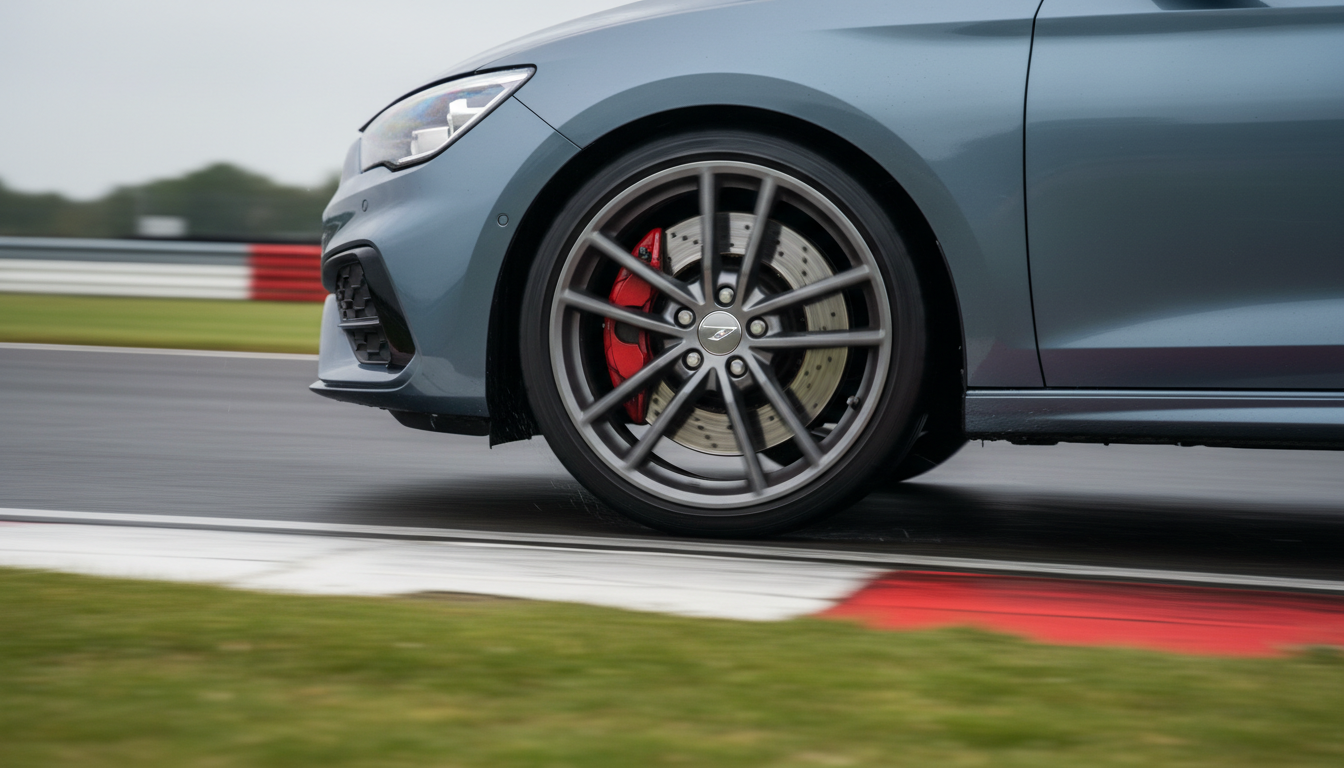
You have booked the track day, fitted fast-road pads and checked the tyres. Then, halfway through the third session, the brake pedal starts sinking further towards the floor at the end of the main straight. A pedal that becomes longer or softer during repeated heavy braking can be a warning sign of overheated brake fluid. Air in the system, leaks and other faults can cause similar symptoms, so any change in pedal feel should be inspected before the car goes back out. Choosing the best brake fluid for track days is one of the cheapest braking upgrades you can buy, yet it is also one of the most overlooked.
The labels do not make it easy. DOT 4, DOT 5.1, “super DOT 4”, racing fluid and silicone DOT 5 all sound like steps on the same ladder, but they are not. Some can be mixed and some must never meet. A few racing fluids also have impressive dry boiling points but fall away quickly once they absorb moisture.
This guide explains what the DOT ratings actually guarantee, why the wet boiling point matters more than the headline figure, how often to change brake fluid for road and track use, and how to match a fluid to the way you drive. It also covers what the MOT does and does not check, so you know where the legal line sits.
Quick Answer: Which Track Day Brake Fluid Should You Choose?
For most UK enthusiasts, a quality DOT 4 or DOT 5.1 fluid that is changed regularly beats an exotic racing fluid that sits in the system for three years. Move up to a high-temperature racing DOT 4 when you are on track several times a season, running sticky tyres or carrying extra power. This guide covers conventional glycol-based systems found on almost every modern road car. Never use silicone DOT 5 unless your car’s manufacturer specifies it.
| Your car and driving | Recommended starting point | Main compromise |
|---|---|---|
| Daily driver, fast road, no track days | Fresh fluid of the grade your handbook specifies, changed on schedule | No real compromise; the key is changing it on time |
| Fast road plus one or two track days a year | Quality DOT 5.1 or high-spec DOT 4, flushed before the first event | Costs a little more than basic fluid; still needs regular changes |
| Regular track days, sticky tyres, uprated pads | High-temperature racing DOT 4 with a strong wet boiling point | Shorter change intervals; bleeding before events becomes routine |
| Dedicated track or competition car | Specialist racing fluid chosen for dry boiling point, bled before every event | Some racing fluids have low wet boiling points and suit frequent changes only |
The final choice should always follow your car’s specification and the fluid manufacturer’s compatibility guidance. Browse our performance brake fluid range to compare DOT 4, DOT 5.1 and racing options.
Best Brake Fluid for Track Days: Compare Our Top Picks
If you already know you want to upgrade, here are four fluids from our range that suit fast-road and track day use. The boiling points below are the figures published by each manufacturer. Always check the fluid is approved for your braking system before you buy.
| Brake fluid | Type | Dry boiling point | Wet boiling point | Best suited to |
|---|---|---|---|---|
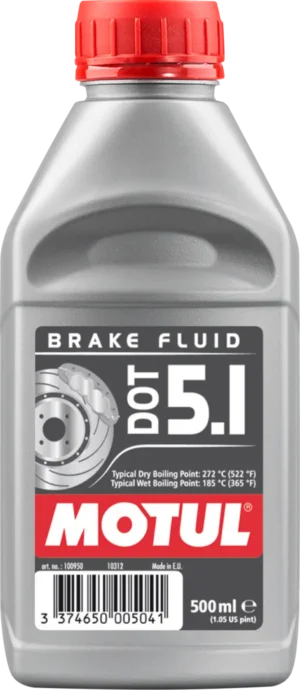
| Motul DOT 5.1 Brake Fluid | DOT 5.1 | 267°C | 188°C | Fast road with occasional track days |
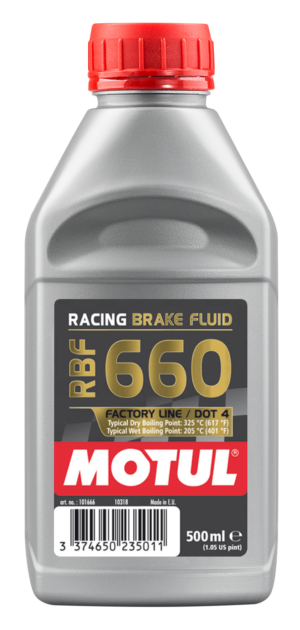
| Motul RBF 660 Factory Line | Racing DOT 4 | 325°C | 205°C | Regular track days and uprated pads |
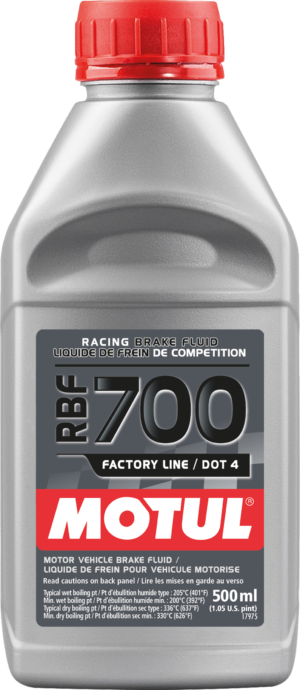
| Motul RBF 700 Factory Line | Racing DOT 4 | 336°C | 205°C | Demanding track use where approved for your system |
| PFC RH665 Racing Brake Fluid | Racing DOT 4 | 325°C (min.) | 195°C (min.) | Track days and racing, bled before each event |
Motul figures are taken from Motul’s technical data sheets, which you can download from each product page. PFC figures are PFC’s guaranteed minimums. Current prices and stock are shown below.

Not sure which brake fluid suits your car? Message Performance Car Parts UK on WhatsApp or by email with your vehicle, year, brake setup and how you use the car. We will help you check the specification before you order.
Why Brake Fluid Matters More on Track Than on the Road
Your brakes turn speed into heat. On the road most of that heat has time to escape between stops. On a circuit you might brake hard from high speed every few seconds for twenty minutes, so the discs, pads and calipers keep getting hotter. Some of that heat soaks through the pads and pistons into the fluid in the caliper.
Liquid brake fluid is close to incompressible, which is why a firm pedal works. Once the fluid in the caliper reaches its boiling point, vapour bubbles form. Unlike liquid, vapour compresses, so part of your pedal travel goes into squashing bubbles instead of clamping the pads. The result is the classic long, soft or sinking pedal, often called fluid fade or vapour lock.
Fluid fade is different from pad fade:
- Fluid fade: the pedal goes long or spongy, but when it does reach the bite point the car still slows reasonably well. Pumping the pedal may temporarily help.
- Pad fade: the pedal stays firm but the car simply does not slow down as it should, because the pad compound is outside its working temperature. Our guide to brake pad compounds explains how to match pads to your driving.
- Both at once: this is common on heavier, more powerful cars with standard brakes, and is a sign the whole system needs attention, not just one part.
If you are planning a wider braking upgrade, our guide to performance brake upgrades in the UK explains how pads, discs and big brake kits fit together. Fluid is the foundation those parts depend on.
DOT 4 vs DOT 5.1 vs DOT 5: What the Ratings Actually Mean
The “DOT” labels come from the US Federal Motor Vehicle Safety Standard No. 116, which almost every brake fluid sold in the UK is tested against. The standard sets minimum boiling points and maximum cold-temperature viscosity for each grade. You can read the full requirements in the FMVSS 116 regulation text.
| Grade | Base | Minimum dry boiling point | Minimum wet boiling point |
|---|---|---|---|
| DOT 3 | Glycol ether | 205°C | 140°C |
| DOT 4 | Glycol ether / borate ester | 230°C | 155°C |
| DOT 5.1 | Glycol ether / borate ester (non-silicone) | 260°C | 180°C |
| DOT 5 | Silicone | 260°C | 180°C |
Three points are worth understanding before you buy:
- The rating is a floor, not a ceiling. A fluid labelled DOT 4 only has to beat the DOT 4 minimums. Many high-performance “racing DOT 4” fluids comfortably exceed the DOT 5.1 minimums, so a DOT 5.1 label does not automatically mean a better track fluid than every DOT 4.
- DOT 5.1 also has a stricter cold-viscosity limit. The standard allows DOT 5.1 a much lower maximum viscosity at -40°C than DOT 4, which helps ABS and stability control systems in very cold conditions.
- DOT 5 and DOT 5.1 are completely different fluids. DOT 5 is silicone-based and is required to be dyed purple. DOT 5.1 is glycol-based like DOT 3 and DOT 4. The similar names cause real mistakes.
Is DOT 5.1 Better Than DOT 4?
Not automatically. Buyers often assume the higher number means better performance, but a specialist racing DOT 4 can have higher boiling points than a good DOT 5.1. AP Racing lists typical figures of 269°C dry and 180°C wet for its Factory R DOT 5.1 performance brake fluid. Motul’s RBF 660, a racing DOT 4, is published at 325°C dry and 205°C wet. Both are well-regarded products. They are simply designed for different jobs.
Before buying any brake fluid, check:
- The fluid specification your vehicle manufacturer requires
- Both the dry and wet boiling points
- Low-temperature viscosity requirements, particularly for cars with ABS and stability control
- The fluid maker’s approved applications and compatibility notes
- The recommended change interval for the way you use the car
Why Not Silicone DOT 5?
Silicone fluid does not absorb water, which sounds ideal. But it does not mix with glycol fluids, and it is not what modern ABS-equipped road cars are designed around. Fluid makers are clear on the point. Motul’s own data sheet for its DOT 5.1, for example, warns against mixing it with silicone DOT 5. Unless your car’s manufacturer specifies DOT 5, which is rare outside some classics and specialist applications, stick to glycol-based fluids.
Dry vs Wet Brake Fluid Boiling Point: The Number That Really Counts
Every glycol-based brake fluid is hygroscopic, which means it absorbs moisture from the air. That happens even in a sealed system, because water vapour slowly works its way in through flexible hoses and the reservoir. As water content rises, the boiling point falls, and internal corrosion becomes more likely.
That is why fluids quote two figures:
- Dry boiling point: fresh fluid straight from a sealed bottle. Useful for comparing products, but only true on day one.
- Wet boiling point: the same fluid after a set amount of water has been added in the test, roughly simulating fluid that has been in a car for a while. This is far closer to what is in most cars on a typical track day.
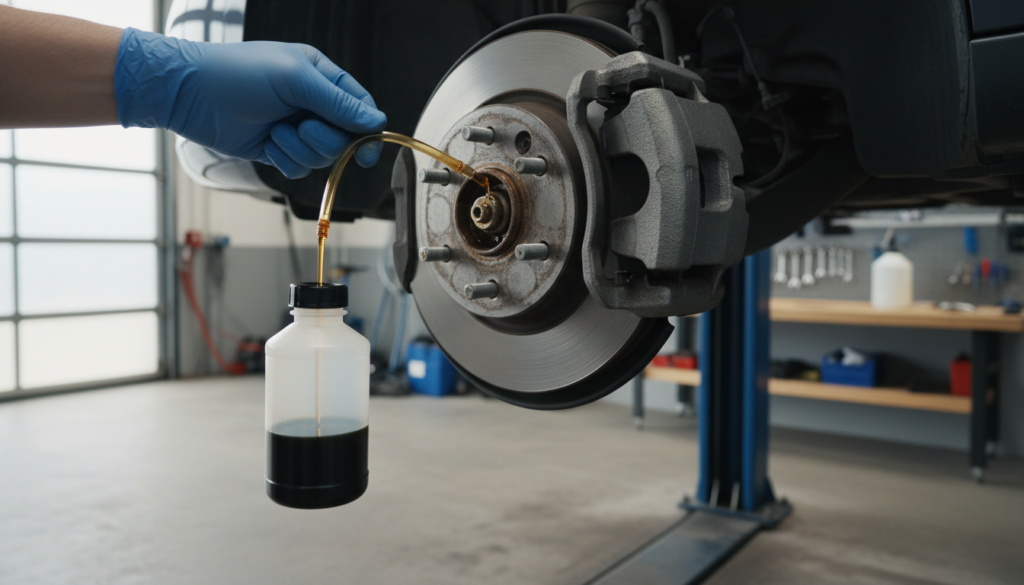
Real products show how much these figures vary. Motul’s technical data sheet for its DOT 5.1 brake fluid lists a 267°C dry and 188°C wet boiling point. PFC states guaranteed minimums of 325°C dry and 195°C wet for its RH665 racing brake fluid, which is classed as DOT 4. That is a good example of a “DOT 4” fluid beating the DOT 5.1 minimums by a wide margin.
At the other extreme, some pure racing fluids are built for maximum dry boiling point and accept a weaker wet figure. AP Racing publishes typical figures of 269°C dry and 140°C wet for its Radi-CAL R1 motorsport brake fluid, which it classifies as DOT 3. That works well in a competition car that is bled before every event. It makes far less sense in a road car that might go a year between changes.
The practical lesson: for a car that is driven on the road and taken on the odd track day, look closely at the wet boiling point and how often you will actually change the fluid. Then pick a product that suits that routine.
How Often to Change Brake Fluid for Road and Track Use
There is no single universal interval. It depends on the fluid, the car, the climate and how hard the brakes are used. Car makers usually set a time-based interval in the service schedule, commonly every two or three years depending on the brand, regardless of mileage. Check your own handbook or service book for the exact figure.
Track use shortens that dramatically. As examples of how specialist makers approach it:
- Motul suggests changes every 12 to 24 months in line with the vehicle maker, and recommends a yearly drain and refill for safety.
- PFC advises bleeding fresh RH665 through the system before each event, and again after the brakes have been very hot or conditions have been especially humid.
Requirements vary with the fluid, the vehicle, how hard you use it and how much moisture it is exposed to, so no single routine suits every car. As a starting point, many track day drivers work along these lines and then adjust to the fluid maker’s and vehicle maker’s guidance:
- Full flush at the start of the season, or when switching to a new fluid, so the whole system is on fresh fluid.
- Bleed each caliper before track days during the season. This pushes out the fluid that has been cooked closest to the pistons.
- Bleed again after any day where the pedal went long, even if it recovered once cooled.
- Never exceed the manufacturer’s road interval, even if you stop doing track days.
Testing Brake Fluid Condition
If you are unsure how old the fluid in a car is, assume it needs changing. Workshop testers that heat a fluid sample and measure the actual boiling point are the most meaningful check. Cheap pen-type testers that measure electrical conductivity are generally regarded as less reliable, and some braking specialists advise against relying on them. For a car going on track, fresh fluid is cheap enough that testing rarely makes sense. Just change it.
Mixing Brake Fluids: What Is Safe and What Is Not
Glycol-based DOT 3, DOT 4 and DOT 5.1 fluids are generally designed to be miscible, so topping up one with another will not cause an immediate failure. That does not mean it is a good idea:
- Mixing dilutes the performance of the better fluid. PFC, for example, states that RH665 can be mixed with other DOT 4 fluids but that doing so degrades its properties.
- Some racing fluids should not be mixed at all. Motul’s data sheet for RBF 700, for example, advises avoiding mixing it with other polyglycol-based brake fluids, so a full flush is the right way to switch.
- Never mix silicone DOT 5 with any glycol fluid. They do not combine, and cleaning the system out afterwards is a major job.
- Keep bottles sealed. An opened bottle on a garage shelf absorbs moisture too, so buy sizes that match the job and use fresh fluid for a pre-event bleed.
When you switch to a performance fluid, do a full flush rather than a top-up. Otherwise you are paying for a high boiling point and diluting it with whatever was already in the system.
Supporting Upgrades: Braided Brake Lines, Pads and Cooling
Brake fluid works as part of a system. A few related upgrades help it do its job:
- Braided brake hoses: stainless-braided hoses expand less under pressure than ageing rubber hoses, which helps pedal firmness. They do not raise the fluid’s boiling point, but they remove one source of a soft pedal so you can tell what the fluid is doing. Browse our braided brake lines by vehicle.
- Track-capable pads: pads with a higher temperature range keep stopping when the brakes are hot. But a pad that works at higher temperatures also passes more heat towards the caliper, so fluid choice matters even more once you upgrade pads. Our EBC brake pads guide compares compounds for road and track.
- Cooling and technique: a cool-down lap without heavy braking, and not holding the car on the footbrake in the pit lane with very hot brakes, both reduce heat soak into the calipers and fluid.
Track Day Brake Fluid for Popular UK Performance Cars
Every car below can be well served by a quality glycol-based fluid, but each has its own points to check before you start bleeding. Always confirm the specified fluid grade and bleeding procedure for your exact model.
| Vehicle family | What owners should check |
|---|---|
| VW Golf GTI / Golf R / Audi S3 | The specified fluid grade in the service schedule, whether a diagnostic tool is needed if air gets into the ABS unit, and whether a manual gearbox’s clutch shares the brake reservoir |
| Ford Fiesta ST / Focus ST | Whether the clutch hydraulics share the brake reservoir, the condition of the rubber hoses on older cars, and the correct bleeding sequence for the ABS layout |
| Honda Civic Type R (EP3, FN2, FK2, FK8, FL5) | Pad and fluid temperatures on heavier, more powerful later generations, and hose condition on older cars that may still be on original rubber lines |
| Toyota GR Yaris / GR86 and GT86 | The specified fluid grade, how quickly the pedal changes during longer sessions, and whether pads have been upgraded beyond the fluid’s comfortable range |
| BMW M135i / 335i and similar | Weight and power relative to the standard brakes, bleeding procedure for the stability control system, and fluid age on cars with long service intervals |
Examples from Our Range
- HEL Braided Brake Lines for the Fiesta Mk8 ST: pair with fresh fluid for a firmer pedal.
- HEL Braided Brake Lines for the Civic FK8 Type R: a sensible companion upgrade when flushing to a racing fluid.
Brake Fluid, the MOT and UK Insurance
The MOT does not measure the boiling point or water content of your brake fluid. According to the DVSA MOT inspection manual for brakes, the tester looks at things that can be seen, including:
- Fluid level in transparent reservoirs or those with a level indicator. Testers do not remove the cap, and a level well below the minimum mark or not visible at all is a fail.
- A missing reservoir cap, which is a major defect.
- Leaks from pipes, hoses, calipers or the master cylinder, many of which are classed as dangerous.
- The brake fluid warning lamp, which should work correctly and not stay lit.
- Visibly contaminated fluid, although the manual notes contamination is often not visible.
That means a car can pass its MOT with tired, moisture-laden fluid that would boil within a few laps of a circuit. Passing the test is not proof that the fluid is fit for track use.
On insurance, changing to a different grade of brake fluid is normally regarded as servicing rather than a modification. Braided hoses, big brake kits and other hardware changes are a different matter. Many insurers expect those to be declared, so check with your insurer before fitting. Also remember that many standard road policies exclude track days, so look at specialist track day cover if you want protection on circuit. Our track day safety equipment checklist covers the rest of the preparation.
Track Day Brake Fluid Checklist: Before You Buy and Bleed
- Confirm the fluid grade your car’s manufacturer specifies and that it is glycol-based, not silicone.
- Compare wet boiling points, not just the dry headline figure.
- Match the fluid to how often you will realistically change it.
- Buy enough sealed fluid for a full flush plus a pre-event bleed.
- Check rubber hoses for age, cracking or bulging, and consider braided lines.
- Find the correct bleeding sequence and whether ABS or clutch circuits need attention.
- Check pad thickness and disc condition so the fluid is not covering for worn parts.
- Bleed again after any session where the pedal went long.
- Recheck the reservoir level and look for leaks before driving home.
Buying Brake Fluid for Track Days: FAQs
How much brake fluid do I need for a full flush?
It depends on the car, the size of the system and how thoroughly it is flushed, so there is no single figure. Check with your workshop or the vehicle’s service information. Opened fluid absorbs moisture, so it is better to buy a sensible quantity of sealed bottles for the job than to store a half-used bottle for months.
Can I use DOT 5.1 in a car that specifies DOT 4?
DOT 5.1 is glycol-based like DOT 4, and Motul states its DOT 5.1 can be blended with DOT 3 and DOT 4 fluids. Even so, your vehicle manufacturer’s specification comes first. If in doubt, check the handbook or ask us before ordering.
Can I use racing brake fluid on the road?
Some racing fluids are approved for road use and some are aimed purely at motorsport. Motul, for example, says RBF 700 can be used in high-performance road cars as well as on track. Fluids with a low wet boiling point need changing much more often, which makes them a poor fit for a car that goes a long time between services. Check the fluid maker’s approved applications first.
Do I need to change my brake lines at the same time?
Not necessarily, but a fluid change is a good time to inspect the hoses. If they are old, cracked or bulging, fitting braided brake lines during the same job saves bleeding the system twice.
Can you help me choose the right fluid?
Yes. Send us your vehicle, year, brake setup and how often you go on track by WhatsApp or email, and we will help you pick a fluid that suits your car and your maintenance routine.
Shop Brake Fluid
Conclusion
Brake fluid is the cheapest part of your braking system and often the first to give up on track. The DOT rating tells you the minimum a fluid must achieve, not how good it is. For most road cars that do the odd track day, a quality DOT 4 or DOT 5.1 with a strong wet boiling point is a sound starting point. Regular track drivers may want a high-temperature racing DOT 4. How often to flush and bleed depends on the fluid, the car, how it is used and the manufacturers’ instructions, so treat any routine as a starting point rather than a universal rule.
Ready to prepare your car? Browse our track day brake fluid range or explore the full catalogue at performancecarsparts.co.uk. If you are not sure which fluid or braided lines suit your car, contact our team on WhatsApp or by email and we will help you choose the right parts for your build.