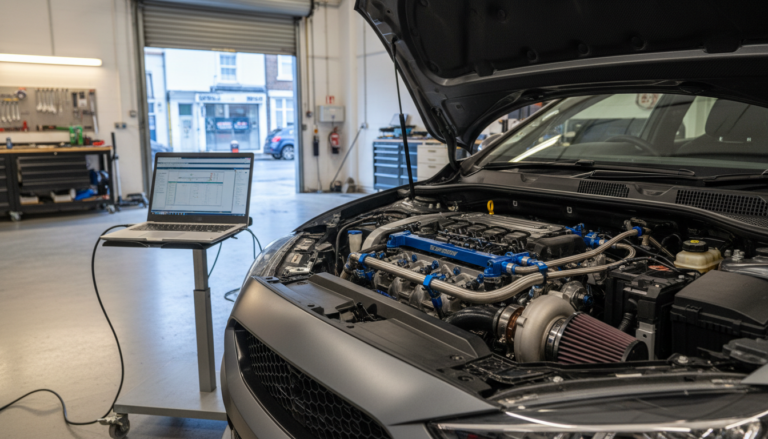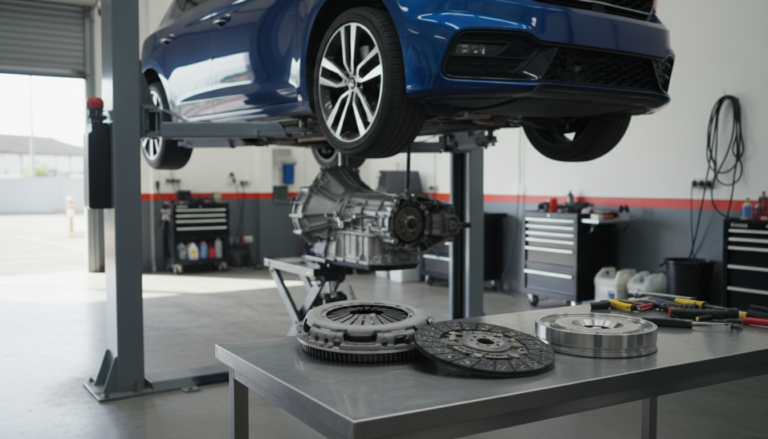
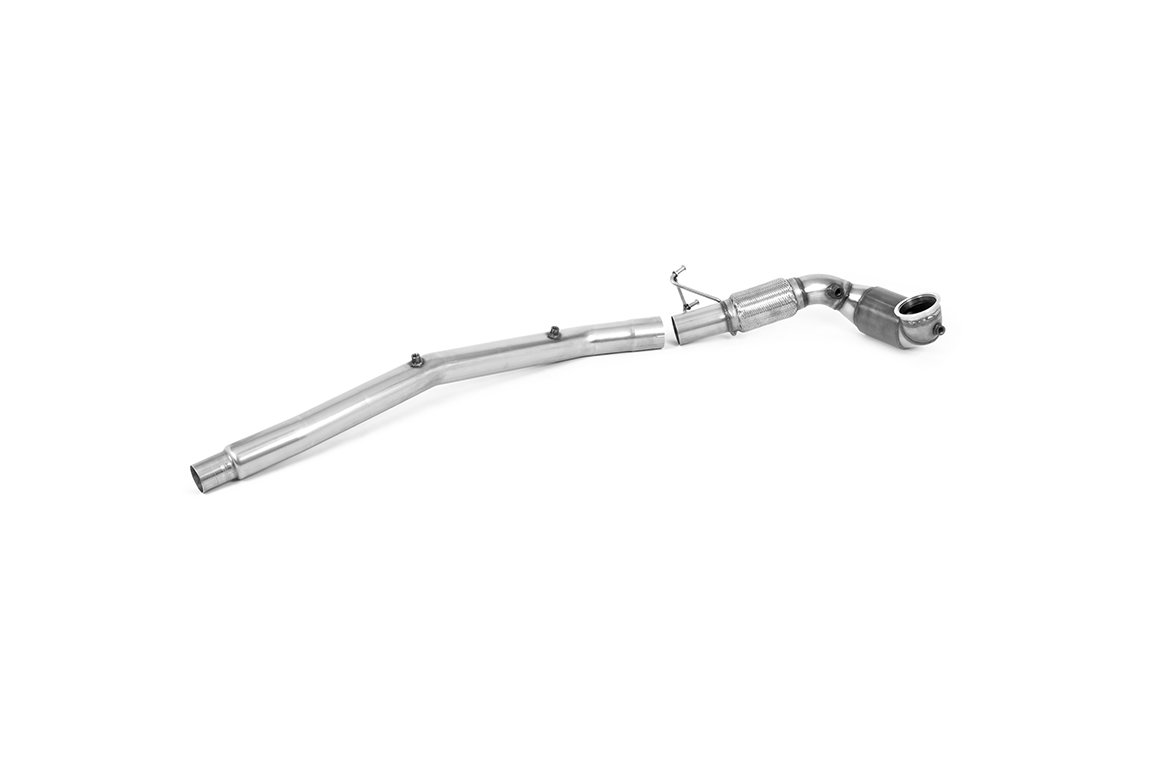
This downpipe upgrade UK guide is for owners of turbocharged hot hatches and saloons. On those cars, the downpipe is usually the first exhaust part that tuners talk about once you move past a basic remap. It is the section that bolts straight to the turbo outlet, and on many modern engines it also carries the first catalytic converter. That is exactly why a downpipe upgrade raises more questions than a cat-back: it touches emissions equipment, the ECU and, increasingly, the law.
Online, the choices tend to get boiled down to “sports cat or decat”, with very little about what each actually means for an MOT, for your insurance or for a car that still has to start on a cold Monday morning. Add the Department for Transport’s 2026 consultation on in-use emissions and the picture can feel confusing.
This guide explains what a downpipe does, how a sports cat downpipe differs from a decat pipe, why most aftermarket downpipes need a downpipe remap, what MOT testers check, and what to tell your insurer. We will also run through checks for popular UK platforms and a short buying checklist.
Quick Answer: Which Downpipe Should You Choose?
For a downpipe upgrade UK road cars can live with every day, the sensible starting point is a catted downpipe with a hi-flow sports cat, paired with a calibration written for it. A decat pipe removes emissions equipment the manufacturer fitted, so it is only appropriate for a vehicle that is genuinely used off-road or in competition. Shop performance downpipes UK to see what is listed for your model.
| Your car and driving | Recommended starting point | Main compromise |
|---|---|---|
| Stock or Stage 1 road car, occasional track day | Keep the OE downpipe; spend on a remap, intake or cat-back first | Less exhaust flow headroom than an aftermarket pipe |
| Stage 2 road car with a tuner-supplied map | Catted downpipe with hi-flow sports cat plus a matching map | Cost of pipe and calibration; possible extra noise and drone |
| GPF/OPF-equipped car driven on the road | A downpipe that retains (or is designed around) the particulate filter and cat | Fewer product choices; check the listing carefully |
| Dedicated track or competition car, trailered | Race-cat or decat pipe as allowed by your series rules | Not suitable for road use; MOT and insurance implications |
Final choice depends on the manufacturer’s fitment notes and on whether a calibration exists for your exact engine. This guide covers turbocharged petrol cars; diesel DPF removal is a separate subject and is not covered here.
What Does a Downpipe Actually Do?
On a turbocharged engine, exhaust gas leaves the cylinders, drives the turbine wheel and then exits the turbine housing into the downpipe. From there it flows into the rest of the system: mid-pipe, silencers and tailpipes. Because the downpipe sits immediately after the turbo, the way it is shaped and how much restriction it adds has a direct effect on how freely the turbine can exhaust.
Factory downpipes are designed around many priorities at once: emissions light-off (getting the catalyst hot quickly after a cold start), refinement, packaging, cost and durability. Aftermarket designs typically use a larger bore, smoother mandrel bends and a less restrictive catalyst. COBB, for example, describes shaping the outlet so turbine and wastegate flow merge with less turbulence, and states that the gain depends on matching tuning changes. If you want a refresher on how each exhaust section fits together, our guide to every exhaust component covers the full system.
Where the gains come from
- Lower post-turbine restriction: less resistance after the turbine can help the turbo spool and lets the map target more boost without exhaust temperatures and pressures rising as much.
- A less restrictive catalyst: OE cats are often dense to meet emissions targets from cold; a hi-flow sports cat usually uses a lower cell density.
- Calibration: on its own, a new pipe often changes very little. The real change usually comes from the map that is written to use the extra flow.
There is no universal horsepower figure. Results vary with the turbo, the rest of the exhaust, fuel quality, intake temperatures and how aggressive the calibration is. Treat any claim as specific to the car and map it was measured on, and compare before-and-after runs on the same dyno in similar conditions.
Sports Cat vs Decat Downpipe: The Real Differences
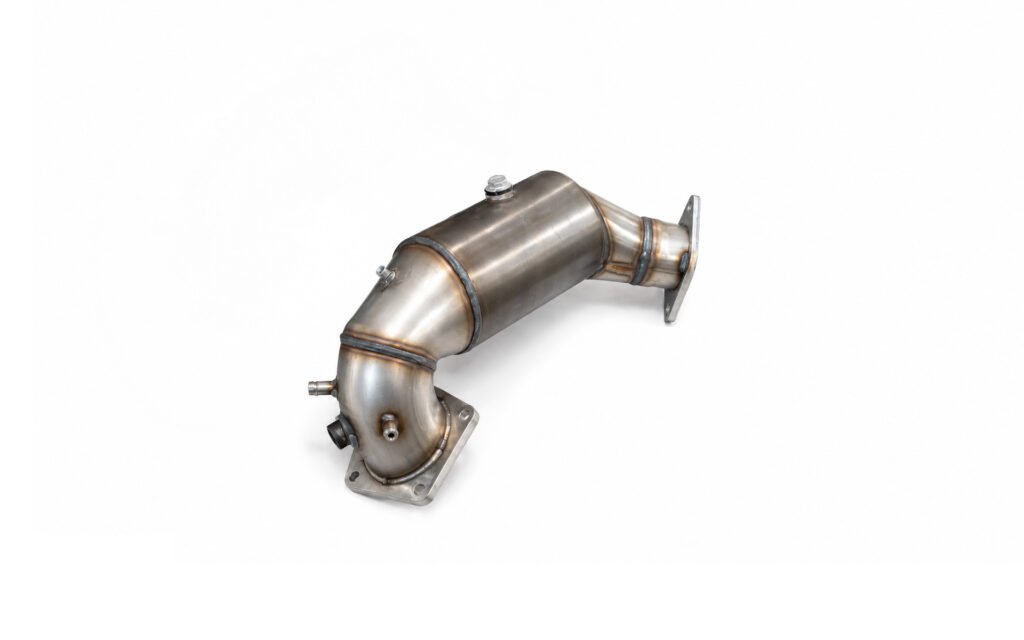
A hi-flow sports cat keeps a catalytic converter in the system, but with a less restrictive substrate than the factory unit. A decat downpipe (sometimes called a cat bypass or test pipe) removes the converter entirely. You will also see “race cat” pipes, which keep a catalyst but with a very open substrate aimed at competition use.
Catted / sports cat downpipe
- Keeps a catalyst where the manufacturer fitted one, which matters for MOT emissions checks and for the law on altering emissions equipment.
- Usually still needs an updated map so the ECU’s catalyst and lambda monitoring do not throw a fault.
- Not automatically road legal: whether a sports cat is accepted depends on its construction, its condition and how it performs on the emissions test.
Decat / cat bypass downpipe
- Removes emissions control equipment, so a road car fitted with one should be expected to fail the MOT visual check where the manufacturer fitted a cat.
- Will almost always trigger catalyst-efficiency faults. Switching off catalyst or emissions monitoring in software to hide this is emissions tampering, not a legitimate road-car upgrade.
- Usually louder and smellier, especially from cold, and only appropriate for vehicles used off the public road.
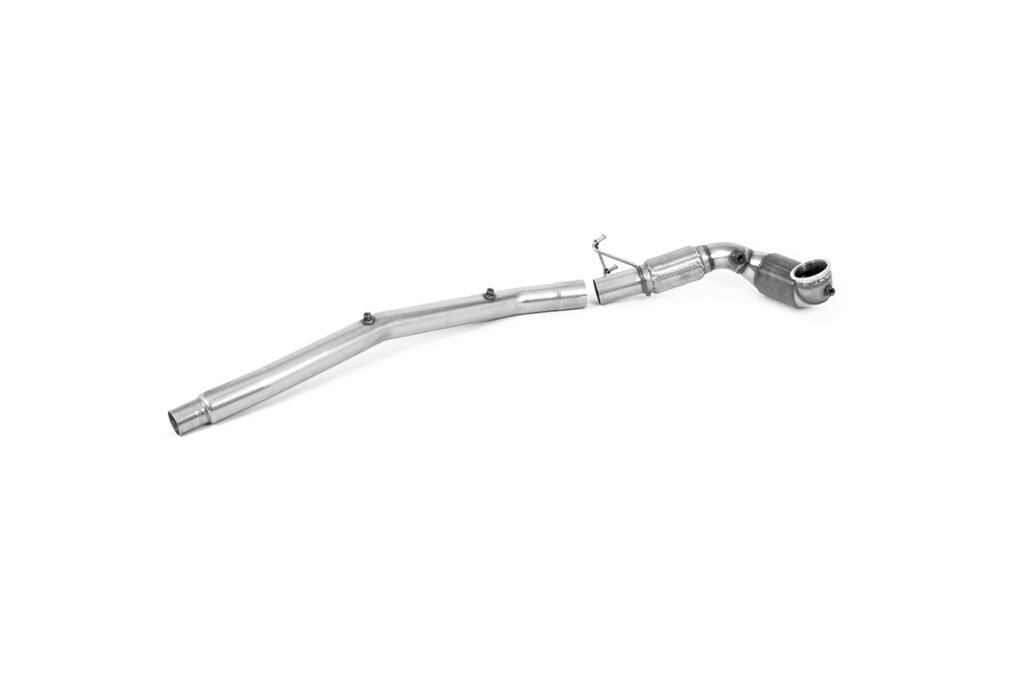
Product listings often tell you more than the marketing does. Milltek’s own listing for one of its hi-flow sports catalyst pipes, for example, states that it requires a Stage 2 ECU remap, must be fitted with its matching cat-back system, is not E-marked and is flagged as a race product (Milltek Sport product page). Reading those details before you buy saves a lot of disappointment later.
Do You Need a Remap After Fitting a Downpipe?
In most cases, yes. Modern engines use a pre-cat lambda sensor to control fuelling and a post-cat sensor to check that the catalyst is working. Change the catalyst and the post-cat signal changes, which the ECU may read as a failed converter and log a fault. Change the exhaust flow and boost control can behave differently, sometimes causing over-boost or under-boost faults.
This is why most tuners treat a downpipe as a “Stage 2” modification: it comes with a map written for the hardware. Our explainer on Stage 1, Stage 2 and Stage 3 tuning goes into what each step usually includes. A legitimate road calibration adapts fuelling, boost and diagnostics to the new hardware while keeping emissions monitoring working; it should never be used to hide a missing or failing catalyst. Stage 2 power can also push fuelling and temperatures, so it is worth reading our guides to fuel pump and injector upgrades and engine cooling for tuned cars.
- Ask your calibrator which downpipe (and which cat) their map assumes. A map written for a decat pipe is not the right map for a sports cat, and vice versa.
- Check whether your car’s software can be read and written at all. Some newer ECUs are harder to access, which limits the options.
- Plan for a check-up after fitting: data-log boost, fuel trims and knock to confirm the car is happy, rather than relying on how it feels.
- Remember a warning light is not just cosmetic. An illuminated engine malfunction indicator lamp is an MOT failure in its own right on most petrol cars from mid-2003 onward.
GPF and OPF Cars: Why Newer Models Are Different
Many petrol performance cars sold in the UK in recent years are fitted with a gasoline particulate filter (GPF, also called OPF). On some models it sits in or just after the downpipe area. Aftermarket listings increasingly specify “GPF/OPF equipped” or “non-OPF/GPF models only”, and some products described as “GPF delete” remove the filter entirely.
- Check which version your car is before you look at a pipe. The same model name can be sold with and without a GPF depending on market and year.
- A product that deletes a manufacturer-fitted particulate filter removes emissions equipment, so treat it exactly like a decat for road-use purposes.
- Where a listing says it retains the GPF or is designed around it, confirm the part numbers and whether a specific cat-back or map is required.
Is a Decat Legal in the UK? MOT, Law and the 2026 Consultation
The MOT is the most immediate test. Under section 8 of the DVSA MOT inspection manual, emission control equipment fitted by the manufacturer that is missing, obviously modified or obviously defective is a major defect. For vehicles first used from 1 September 2002, testers reject cars where original emissions parts are missing, modified or defective. Testers can only judge components they can see and identify, such as catalytic converters and oxygen sensors.
Petrol cars with catalysts also face a tailpipe test. The basic emissions limits include CO up to 0.2% and a lambda value between 0.97 and 1.03 at fast idle, HC up to 200ppm at fast idle and CO up to 0.3% at normal idle, unless the manufacturer specifies its own limits. A worn or very open aftermarket cat may struggle with these, which is one reason cheap race cats are not a shortcut to an MOT pass.
Beyond the MOT, regulation 61A of the Road Vehicles (Construction and Use) Regulations 1986 restricts using a vehicle on the road if it fails the emissions requirements because of an alteration to the engine or exhaust system. In July 2026 the DfT opened a consultation on in-use emissions of road vehicles that would require road vehicles to keep their factory-fitted emission control devices and software. As Evo reported, the proposals cover removing catalytic converters and using software that raises emissions, with fines of up to £1,000 suggested and a proposed start in 2027 after a six-month lead-in. The consultation closed on 6 September 2026. These are proposals, not law: when this guide was written the government had not published its response, and the final rules could differ.
DVSA’s earlier guidance on modifying vehicle emissions was withdrawn in July 2026 while it is reviewed in light of that consultation. Check GOV.UK for the published outcome before you spend money, and read our breakdown of the 2026 emissions consultation for what it could mean for modified cars. This is general information, not legal advice.
Downpipes, Remaps and Your Insurance
A downpipe and the remap that comes with it are both modifications that insurers will normally want to know about. The Financial Ombudsman’s guidance on car modifications highlights a case where a driver did not disclose an ECU remap and the insurer voided the policy; the Ombudsman agreed that was fair. In another case, a simple air filter change was judged not to be something a reasonable consumer would have seen as a modification (Financial Ombudsman Service).
- Tell your insurer about the downpipe, the catalyst type and the remap before the car is driven, not after a claim.
- Ask whether they need the power figure or the tuner’s details, and keep invoices.
- Expect some mainstream insurers to decline or load the premium; a specialist modified-car insurer may be a better fit.
- A decat on a road car is likely to be hard to insure and could undermine a claim even if it is declared.
Downpipe Upgrades for Popular UK Tuned Cars
Downpipe designs are model-specific, and small differences in engine code, model year or emissions equipment can change which pipe fits. Use the table as a set of things to check rather than a promise of fitment.
| Vehicle family | What to check before buying |
|---|---|
| VW Golf GTI / Golf R, Audi S3 (Mk7 to Mk8 / 8V to 8Y) | Generation and engine code, whether the car has a GPF/OPF, whether the pipe is designed for the OE cat-back or a specific aftermarket system, and which map your tuner supplies |
| Ford Fiesta ST and Focus ST | Mk7 1.6 EcoBoost and Mk8 1.5 three-cylinder Fiestas use different pipes; Focus listings can also differ by body style. Check GPF fitment on later cars |
| BMW M135i / 335i (N55) and B48/B58 models | Engine code and production date, as early and late N55 cars can need different parts; xDrive versions may differ; confirm calibration support |
| Honda Civic Type R (FK2 / FK8 / FL5) | Exact chassis code, whether the pipe suits the OE or an aftermarket cat-back, and gasket and sensor provisions |
| Hyundai i30 N / i20 N | Model year and GPF fitment, transmission, and whether the product retains a catalyst or is a delete pipe |
Examples from our range
- Milltek large-bore downpipe and hi-flow sports cat for Mk8 Golf R and Audi S3 8Y
- Milltek large-bore downpipe and hi-flow sports cat for Fiesta Mk7/Mk7.5 ST (SSXFD096)
- Large-bore downpipe and hi-flow sports cat for Hyundai i30 N 2.0 T-GDi
- Skunk2 downpipe kit with cat for Honda Civic Type R FK8
Always read the individual listing for model years, emissions equipment, required cat-back and any “track/off-road use only” wording. If your car is not listed, browse the wider exhaust system range or ask us.
Fitting a Downpipe: What to Expect
A downpipe is rarely a quick driveway job. It sits close to the turbo, the subframe and often the driveshafts, and the studs and bolts have been through thousands of heat cycles.
- Seized fixings: turbo studs can snap. Budget for new studs, nuts and gaskets, and use a penetrating oil well in advance.
- Sensors: lambda sensors need transferring with care; damaged threads or wiring lead to faults that look like map problems.
- Torque figures: there is no universal value; use the vehicle and pipe manufacturer’s figures for flanges, V-bands and sensors.
- Alignment: fit everything loosely, align the system to the hangers and then tighten, so nothing is preloaded and cracks later.
- Heat: check clearance to wiring, fuel lines and the bulkhead. Some kits include heat shielding; reuse OE shields where they fit.
- Leak check: an exhaust leak ahead of the lambda sensor can upset fuelling and is itself an MOT major defect.
Noise, Drone and Everyday Living
A freer-flowing downpipe usually makes the car louder, particularly when combined with a non-resonated cat-back. That can be fun on a B-road and tiresome at 70mph on the M6. The MOT also treats exhaust noise above permitted levels as a major defect. If you want to keep things civilised, pair the downpipe with a resonated cat-back exhaust and be wary of maps that add pops and bangs on the overrun, which can draw unwanted attention from enforcement officers as well as neighbours.
Downpipe Upgrade UK Checklist: Before You Buy and Fit
- Confirm engine code, model year and whether the car has a GPF/OPF.
- Choose a catted downpipe for any car used on the road.
- Read the listing for cat-back requirements, E-mark/type-approval status and any “race product” wording.
- Agree the calibration with your tuner before ordering the pipe.
- Budget for gaskets, studs, nuts and possibly a sensor extension or spacer if specified.
- Declare the downpipe and remap to your insurer before driving.
- Data-log after fitting and check for fault codes and warning lights.
- Keep receipts and product documentation with the car’s paperwork.
Downpipe Upgrade UK FAQs
Can a sports cat downpipe pass a UK MOT?
It can pass the tailpipe emissions test if the catalyst is healthy and the engine runs within the limits. Passing the emissions test does not by itself make the part road legal, though: the tester also checks that manufacturer-fitted emissions equipment is not missing or obviously modified, and the warning lamp must not be on.
Is a decat downpipe legal for road use in the UK?
Removing a catalytic converter the manufacturer fitted should be expected to fail the MOT and can put the car outside the emissions rules for road use. Decat pipes are only suitable for vehicles that are used off the public road, such as dedicated competition cars.
Do I need a Stage 2 remap after installing a downpipe?
It depends on the car, the pipe design and the existing calibration, but most aftermarket downpipes are sold on the basis that a matching map is fitted. The map should adapt the engine to the new hardware, not switch off emissions monitoring.
How much horsepower does a downpipe add?
There is no guaranteed figure. Gains depend on the engine, turbo, the rest of the exhaust and the calibration, so treat any number as specific to the car it was measured on and look for like-for-like dyno testing.
Is a 200-cell sports cat road legal in the UK?
Cell count alone does not tell you whether a catalyst is road legal or MOT-suitable. Check the manufacturer’s documentation, including any type-approval or E-mark information and “race product” wording, and how it suits your vehicle’s requirements.
Will a downpipe upgrade affect my car insurance?
Potentially, yes. The downpipe and the remap that comes with it should be declared to your insurer, which may change your premium or the cover offered.
Shop Sports Cat Downpipes

Conclusion
Done properly, a downpipe upgrade UK drivers can live with every day is one of the most effective supporting mods on a turbocharged car, but only when it is part of a plan: the right pipe for your exact engine, a catalyst that keeps the car honest on the road, and a calibration written for that hardware. A decat may look like a shortcut to more flow, yet for a road car it brings MOT, legal and insurance problems that outweigh any gain, and the 2026 consultation suggests the rules are heading in a stricter direction.
Ready to plan your Stage 2 build? Browse our performance downpipes and the full exhaust range at performancecarsparts.co.uk. If you are not sure which pipe suits your car or whether a sports cat version exists for it, message our team on WhatsApp or email us with your registration and current mods, and we will help you check fitment.
Shop related performance parts

Explore related products
Always check the individual product listing for your vehicle and engine before ordering.