




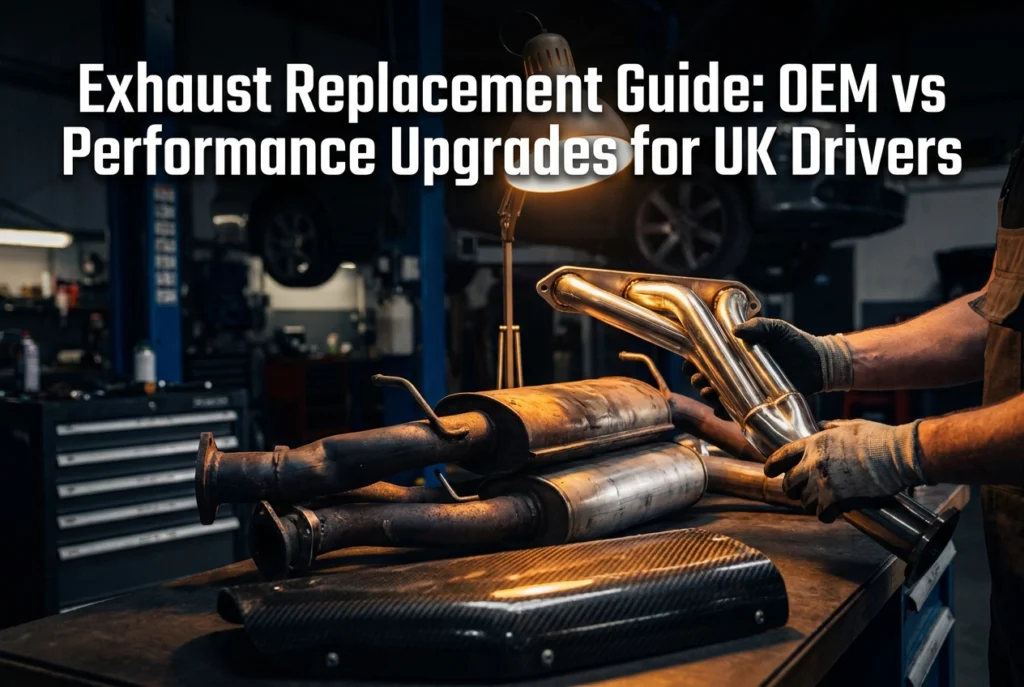
That rattling drone underneath your car is rarely a coincidence, and ignoring it rarely ends well. Whether you are dealing with a corroded mid-pipe, a failing catalytic converter, or simply want to extract more performance from your engine, understanding your exhaust replacement options is essential knowledge for any serious UK driver.
The choice between OEM (Original Equipment Manufacturer) components and aftermarket performance upgrades is not simply a matter of budget. It involves trade-offs between longevity, sound profile, emissions compliance, and power output, all of which carry specific implications under UK regulations and MOT requirements.
In this guide, we will walk you through the complete exhaust replacement process, breaking down the mechanical differences between OEM and performance systems, helping you assess which option suits your vehicle and driving needs, and covering the key legal considerations that apply in the UK. By the end, you will have a clear, practical framework for making an informed decision, whether you are visiting a specialist garage or tackling the job yourself with a trolley jack and a socket set.
How Do You Know Your Exhaust Needs Replacing?
Exhaust system failure rarely announces itself all at once. More often, it progresses through recognisable stages, and understanding those stages early gives you the information needed to choose between a targeted section replacement and a full system swap.
The Five Warning Signs
Unusual noise is typically the first signal. A blowing sound at idle or under acceleration points to a breach at a joint, flexi-pipe, or corroded seam. Rattling at low revs often indicates a failed mounting rubber or loose heat shield, while a persistent droning tone that changes with engine speed suggests a resonance problem caused by a compromised silencer. None of these sounds resolve on their own.
Visible corrosion or rust at joints, flanges, and seam welds is the dominant replacement driver in the UK. OEM systems on many mainstream petrol cars use mild steel with a basic coating, and exposure to road salt accelerates surface and internal corrosion significantly. The rear silencer and centre section typically deteriorate before the manifold or downpipe, because exhaust gases cool and condense moisture in those rearward sections. Short-journey driving compounds this: if the system never reaches full operating temperature, condensation accumulates and corrodes from within. MOT defect data across over six million tests shows some petrol models recording exhaust failure rates above 16%, concentrated in low-mileage vehicles averaging roughly 5,000 to 5,500 miles per year.
Increased cabin fumes or a sulphur smell indicates a breach in the exhaust path that allows gases to migrate toward the passenger compartment. This is a health concern and a MOT failure point.
Reduced fuel economy can result from exhaust leaks disrupting back-pressure and forcing the engine management system to compensate with richer fuelling.
Failed MOT emissions or visual inspection is the formal endpoint. According to the latest DVSA failure category data, “Noise, Emissions and Leaks” ranks among the top ten MOT failure categories in the UK, covering audible blowing, insecure mountings, excessive corrosion, and catalytic converter condition.
Identifying Your Failure Category Before Buying Parts
The DVSA MOT Inspection Manual assesses exhaust systems under Section 6.1.2, examining leaks, mounting security, structural integrity, and catalytic converter presence. Before purchasing any replacement component, identify which sub-category caused or is likely to cause your failure. A blown gasket at the downpipe flange requires only a targeted repair; a corroded rear silencer makes section replacement the cost-effective choice; a failed catalytic converter is a distinct and typically more expensive fix. Physical damage from kerb strikes, speed bumps, or tow bar interference most commonly affects the back box or mid-pipe, given their lower ground clearance, making selective section replacement practical in those cases. Matching the replacement scope precisely to the failure mode avoids unnecessary expenditure while ensuring the vehicle passes its next inspection.
Exhaust Replacement vs Exhaust Upgrade: Which Is Right for You?
Once you have confirmed that your exhaust system needs attention, the next decision is whether to replace it like-for-like or use the opportunity to upgrade. These are meaningfully different choices with different outcomes, and the right answer depends on your vehicle, your budget, and your intentions.
OEM Replacement: The Conservative Case
A like-for-like OEM replacement restores your vehicle to its original specification. It maintains emissions compliance, passes the MOT without complication, and returns the system to factory performance levels. For a vehicle approaching end-of-life, or where budget is the primary constraint, this is a rational choice. However, it offers no added value beyond restoring what was already there. You are spending money to stand still, and the replacement part will likely be manufactured from mild steel with the same flow restrictions as the original.
Understanding Aftermarket Upgrade Categories
Performance aftermarket exhaust systems fall into four distinct categories, each with different implications for performance, legality, and cost.
- Cat-back systems replace everything from the catalytic converter rearward, including the mid-pipe, silencers, and rear section. These are the most accessible upgrade for road use.
- Manifold-back systems replace the entire exhaust from the engine outward, including the manifold or headers. These deliver the largest gains but require significantly more labour.
- Downpipe upgrades replace the section connecting the turbocharger outlet to the main exhaust run. Particularly relevant on turbocharged platforms.
- Decat and sports catalyst fitments remove or replace the catalytic converter. Decat pipes are illegal for road use in the UK under the Road Vehicles (Construction and Use) Regulations 1986, will trigger MOT failure at the emissions test, and are appropriate only for track-day or motorsport applications.
Why Cat-Back Systems Are the Practical Choice for Most UK Owners
For the majority of UK performance car owners, a stainless steel cat-back system represents the best balance of gain, legality, and installation accessibility. On naturally aspirated engines, a well-specified cat-back typically delivers gains in the region of 5 to 15 bhp by reducing back-pressure and improving exhaust gas scavenging. On forced induction setups, those gains can be considerably higher when the upgrade is paired with an ECU remap, since the engine management system can then take full advantage of the improved flow.
The Decision Framework
The upgrade case is strongest in three specific situations. First, when the OEM system has already failed and replacement is unavoidable regardless. Second, when the vehicle already carries other performance modifications such as an induction kit, intercooler upgrade, or engine tune, and the standard exhaust has become a bottleneck. Third, when the owner wants a lasting solution rather than a temporary fix.
On the budget question, an OEM replacement costs less upfront but returns nothing beyond baseline function. A quality stainless steel performance cat-back costs more initially, but stainless construction resists corrosion far more effectively than the mild steel used in standard systems, meaning it will often outlast the remaining life of the vehicle. On modified-friendly models, a recognised performance exhaust brand can also add resale appeal to buyers in the enthusiast market.
If the vehicle is a daily driver with no other modifications and a limited remaining service life, OEM replacement is defensible. For any other scenario, the upgrade path offers better long-term value.
Understanding Exhaust System Components
Before you can make informed decisions about exhaust replacement or upgrade, you need a clear understanding of what each component does and where it sits in the system. A complete exhaust assembly is not a single part; it is a series of interconnected sections, each with distinct functions, failure modes, and upgrade potential.
Exhaust Manifold and Headers
The exhaust manifold is the first component in the gas path, bolting directly to the cylinder head and collecting combustion gases from each individual cylinder before routing them into a single outlet. OEM cast iron manifolds are engineered for durability and packaging efficiency rather than performance; they are heavy, thermally inconsistent across runners, and impose measurable restriction on gas flow. Aftermarket tubular headers, typically fabricated from mild steel or stainless steel, use equal-length or tuned-length runners to improve exhaust scavenging, the effect by which the momentum of exiting gases actively draws the next exhaust pulse through the system. This scavenging effect is particularly pronounced at higher RPM, making header upgrades a worthwhile investment on naturally aspirated engines where every efficiency gain matters.
Downpipe
On turbocharged engines, the downpipe connects the turbine outlet to the main exhaust run and is arguably the single highest-impact upgrade point in the entire system. OEM downpipes are heavily restricted by emissions-compliant catalyst bricks positioned immediately after the turbo, in a location where exhaust gas temperatures are highest. This placement prioritises catalyst light-off speed over flow efficiency. An aftermarket high-flow or decat downpipe significantly reduces backpressure at the turbine outlet, improving spool response and peak power. Sports downpipes with higher cell-density catalysts offer a practical middle ground between outright flow improvement and retained emissions capability.
Catalytic Converter
The catalytic converter is the most expensive individual component in a standard exhaust assembly, and it accounts for 31.8% of the global exhaust product market by value in 2026, according to market research from Future Market Insights. Sports catalysts use a higher cell-count substrate than standard OEM units while maintaining the chemical conversion function required for MOT compliance. Understanding the parts of exhaust systems in performance builds is essential before specifying a sports cat, as the cell density, substrate material, and precious metal loading all affect both flow and emissions output.
Mid-Section and Resonator
The mid-pipe or centre section bridges the catalytic converter and the rear silencer. Many performance vehicles include a resonator box within this section, which uses chamber geometry and acoustic cancellation to reduce exhaust drone at cruising RPM without introducing the additional backpressure associated with a second silencer. The mid-section is frequently the first area to corrode through on older vehicles, particularly where dissimilar metals meet at flanged joints, making it a common replacement item on high-mileage performance cars regardless of upgrade intent.
Rear Silencer and Back Box
The rear silencer, or back box, is the most visible section of the exhaust and the most commonly replaced component. Aftermarket options span mild steel OEM-specification replacements through to mandrel-bent stainless systems and lightweight titanium units. Titanium back boxes can weigh less than half the equivalent mild steel component, offering a meaningful unsprung and total mass reduction on track-oriented builds. Sound character varies considerably between designs; straight-through perforated core silencers produce a more aggressive tone than chambered OEM-style units.
Lambda and Oxygen Sensors
Lambda sensors and wideband oxygen sensors are mounted directly within the exhaust pipe and feed live data to the engine management system. As the complete guide to exhaust system components from WayGo confirms, these sensors are integral to emissions management across the full exhaust assembly. During any exhaust replacement, existing sensors must be transferred to the new pipework at the correct thread positions, or replaced if damaged by corrosion. Failure to refit them correctly, or leaving sensor bungs unplugged, will immediately trigger engine management warning lights and can force the ECU into a conservative fuelling map, directly undermining the performance gains the replacement was intended to deliver.
Mild Steel, Stainless Steel or Titanium: Choosing the Right Exhaust Material
Material selection is one of the most consequential decisions in any exhaust replacement or upgrade project, and it extends well beyond upfront cost. Each material carries a distinct combination of durability, weight, acoustic character, and long-term value that should align with how and where you drive.
Mild Steel: The Budget Baseline
Mild steel remains the standard fitment on many production vehicles, particularly older or budget-oriented models. It is inexpensive to manufacture and straightforward to work with, which explains its continued presence in OEM applications. The critical limitation is corrosion resistance. On UK roads, where road salt is applied throughout winter and high rainfall is a near-constant variable, bare mild steel exhaust systems typically show significant corrosion within three to seven years. For a replacement where longevity is a priority, mild steel is the least cost-effective choice over a full ownership cycle, even if the initial outlay is lower.
409 Stainless Steel: Entry-Level Aftermarket Durability
Grade 409 stainless steel is a ferritic alloy that offers considerably better corrosion resistance than mild steel while remaining one of the more affordable aftermarket stainless options. It is well suited to daily-driven performance cars where budget is a genuine constraint but where the buyer still wants a meaningful step up in longevity over a standard replacement. As an entry-level aftermarket upgrade, 409 provides a practical middle ground without the premium associated with higher-grade alloys.
T304 Stainless Steel: The Performance Standard
T304 stainless steel is the grade you will encounter most frequently across the exhaust range at performancecarsparts.co.uk, and for good reason. It offers excellent corrosion resistance, handles the thermal cycling demands of sustained hard driving without degradation, and delivers the clean polished finish associated with quality aftermarket systems. For road-registered performance cars that also see occasional track use, T304 represents the optimal balance of durability, aesthetics, and thermal performance.
Titanium: Maximum Weight Reduction for Track Applications
Titanium exhausts occupy a distinct performance tier. At component level, titanium delivers approximately 40 to 45 percent weight savings over comparable stainless steel construction, with a typical stainless muffler weighing between 3.5 and 7 kg versus under 2.5 kg for an equivalent titanium unit. Across a full cat-back system, those savings compound meaningfully. Reduced weight concentrated over the rear axle directly lowers unsprung mass, which is the proportion of a vehicle’s weight not supported by the suspension. Lower unsprung mass improves the suspension’s ability to maintain tyre contact with the road surface, translating into more precise handling responses on circuit. For track-oriented builds where every kilogram has a measurable effect, titanium is a serious performance component rather than a cosmetic upgrade. The characteristic blue and purple heat discolouration that develops on titanium pipework is a recognised visual marker of high-performance builds. Titanium also produces a distinctly sharper, higher-pitched exhaust note compared to the deeper tonal character of stainless steel systems, making material choice relevant to acoustic tuning as well as outright performance.
Innovation in lightweight materials including titanium and advanced stainless grades is increasingly recognised as a performance differentiator in the global aftermarket, reinforcing that the choice you make here carries real consequences for how your car behaves, not just how long the system lasts. For a detailed comparison of titanium versus stainless exhaust performance, the trade-offs across both material categories are worth reviewing before committing to a specification.
UK Emissions Compliance: What You Need to Know Before Buying
Before purchasing any aftermarket exhaust component for a road-going performance vehicle, understanding UK emissions legislation is not optional. Getting this wrong can result in MOT failure, financial penalties, invalidated insurance, and in some cases, criminal liability under construction and use legislation.
MOT Emissions Standards and the Catalytic Converter
For petrol performance cars, the MOT emissions test requires CO readings within prescribed limits at both idle and fast idle (typically around 2,500 rpm). Post-2002 petrol vehicles with a closed-loop fuel system must produce no more than 0.3% CO at idle and no more than 0.2% CO at fast idle, alongside a lambda reading between 0.97 and 1.03. Removing or bypassing the catalytic converter guarantees an immediate MOT failure on emissions grounds. Beyond the test itself, operating a vehicle without a functioning catalyst on a public road constitutes an offence under the Road Vehicles (Construction and Use) Regulations 1986, regardless of the vehicle’s age or engine specification. There are no exemptions for older performance cars on this point.
ULEZ, Clean Air Zones, and Type Approval
Most petrol performance cars registered from January 2006 onwards meet Euro 4 standards and are therefore compliant with the London Ultra Low Emission Zone and comparable Clean Air Zones across the UK. However, exhaust modifications that materially alter a vehicle’s emissions output could, in principle, affect its type approval status. If a vehicle’s type approval is compromised through modification, ULEZ compliance cannot be assumed. Buyers should verify with the system manufacturer that their chosen exhaust does not alter the vehicle’s certified emissions classification. The RAC’s guide to Euro 1 to Euro 7 emissions standards provides a useful reference point for understanding which standard your vehicle was originally homologated to.
Euro 7 and the Future of Replacement Parts
Euro 7 has entered force for new type approvals, introducing mandatory gasoline particulate filters (GPF) for petrol engines and additional selective catalytic reduction (SCR) stages for diesel powertrains. For buyers of vehicles already in the performance fleet, this has no immediate compliance impact. The practical consequence, however, is that replacement assemblies for newer vehicles are becoming progressively more complex and more expensive. This trend will only intensify as Euro 7-homologated vehicles age into the replacement cycle. Understanding the Euro 7 rulebook for UK exhaust systems is increasingly relevant for performance car owners planning longer-term maintenance strategies.
Sports Catalyst vs Decat: The Critical Distinction
A sports catalyst replaces the OEM catalyst with a higher-flow alternative, typically using a 200-cell or 100-cell metallic substrate rather than the standard ceramic unit. It retains full emissions control functionality, passes the MOT catalytic converter presence test, and remains road-legal on the vast majority of UK performance vehicles. For any car used on public roads, a sports catalyst is the correct upgrade path. It delivers measurable improvements in exhaust flow and throttle response without the legal and compliance risks associated with catalyst removal.
A decat pipe, by contrast, eliminates the catalytic converter entirely. It is not road-legal. Using a decat pipe or a full race exhaust system on a public road constitutes a construction and use offence under UK law. It will also invalidate your motor insurance policy, as the vehicle no longer conforms to the specification under which it was insured. This point is non-negotiable regardless of how briefly the vehicle is driven on public roads or whether an MOT is currently due.
Noise Limits: An Overlooked Compliance Factor
Exhaust noise is a separate and independently enforceable compliance area. Under the Road Vehicles (Construction and Use) Regulations 1986, most passenger cars are subject to a 74 dB(A) limit. Aftermarket systems without resonators, or those designed primarily for track use, frequently exceed this threshold. When selecting a system, request the manufacturer’s stated dB rating at the relevant test conditions and compare it directly against the 74 dB(A) ceiling. Exceeding this limit makes the vehicle liable to a prohibition notice and potential prosecution, even if all other emissions criteria are met.
Fitment Guide for Popular UK Performance Models
Ford Focus ST and RS (Mk2, Mk3)
The Ford Focus ST and RS remain two of the most active performance platforms in the UK aftermarket, with sustained owner demand for exhaust upgrades across both generations. Cat-back systems for the Mk2 RS (2.5T Duratec) and the Mk3 ST and RS (2.3 EcoBoost) are widely available and deliver meaningful gains in exhaust flow and acoustic character. Before purchasing, buyers must confirm the precise model and generation, as exhaust routing differs between the Mk2 and Mk3 platforms, and ST-specific systems are not compatible with RS variants due to differences in rear diffuser geometry and exit positioning. Checking your registration against the manufacturer build sheet, not just the model name, is essential before ordering.
Vauxhall Astra VXR and GSi (J-Body, K-Body)
The Astra VXR and GSi powered by the 2.0T engine respond well to both downpipe and cat-back upgrades, with improvements in throttle response and mid-range torque delivery commonly reported after fitment. One of the most practical reasons to upgrade on these models is corrosion. The OEM back boxes on J-body and K-body Astras are manufactured from mild steel, and they corrode aggressively in UK driving conditions, making a stainless steel replacement a high-value choice that addresses both performance and longevity simultaneously. A critical fitment point: J-body and K-body exhausts are not interchangeable. The mounting configurations, pipe diameters, and rear valance exits differ between generations, so buyers must identify their body generation precisely before selecting a system.
BMW M2, M3 and M4 (S55, S58)
The factory exhaust systems on S55 and S58 engined M-series cars are already engineered to a high standard, but aftermarket cat-back and downpipe systems remain popular for sound enhancement and incremental weight reduction through the use of titanium or lighter-gauge stainless steel. There is one specification check that is non-negotiable for post-2019 cars: vehicles equipped with an OPF (Otto Particle Filter) require an OPF-back system, not a conventional cat-back. Installing a non-OPF-compatible system on an OPF car will result in fitment failure and potential emissions non-compliance. Buyers should confirm OPF fitment via their VIN or build date before purchasing.
Honda Civic Type R (FK2, FK8, FL5)
The K20C1 engine used across the FK8 and FL5 generations is notably sensitive to exhaust restriction, and aftermarket cat-back systems on both platforms produce measurable improvements in sound and power delivery. The large OEM rear silencer box is the most common replacement target, as its conservative flow characteristics represent the most significant restriction in the system. The FK2, FK8, and FL5 use different mounting configurations and pipe routing, so generation-specific fitment confirmation is required. Do not assume that a system listed for one Type R generation will transfer to another.
Confirming Fitment Before You Buy
Regardless of platform, buyers should verify three things before purchasing any exhaust component: the exact engine code, the vehicle build date, and whether the car is fitted with an OPF or non-OPF system. Product listings on performancecarsparts.co.uk include fitment compatibility data to help narrow selection accurately. Taking two minutes to confirm these details eliminates the risk of ordering an incompatible system and avoids the delays associated with returns and reordering.
UK Exhaust Replacement Cost Guide
Planning your exhaust replacement budget requires a clear framework, because costs span a remarkably wide range depending on which component has failed, what material you choose, and whether you are replacing like-for-like or taking the opportunity to upgrade.
OEM-Equivalent Component Costs
For a straightforward like-for-like replacement on a mainstream performance car, OEM-equivalent pricing breaks down by section. A rear silencer in mild steel OEM spec typically costs between £80 and £200 for the component alone. A mid-section or centre resonator runs from £100 to £250. A full cat-back system in mild steel OEM specification lands between £150 and £350 depending on the platform. These figures represent the absolute floor of your budget and should be treated as a starting baseline rather than a realistic all-in cost once labour is factored in.
Aftermarket Stainless Steel Systems
Stepping up to aftermarket stainless steel opens a considerably wider price band. Entry-to-mid tier cat-back systems for popular UK performance models, constructed in 409 or 304 stainless steel, typically range from £300 to £800 at the component level. Premium T304 stainless systems with mandrel-bent pipework, polished tips, and engineered silencer designs move into the £800 to £1,500 bracket. Price variance within this tier reflects pipe diameter, wall thickness, silencer construction, and the number of vehicle-specific fitment hours invested in the design. For a practical overview of what is available across current performance platforms, the Best Car Exhaust Systems 2026 buyer’s guide provides useful context on the spread of the current market.
Downpipe and Sports Catalyst Pricing
For turbocharged performance cars, the downpipe is where meaningful power gains begin. A sports catalyst downpipe for a mainstream turbocharged platform ranges from £200 to £600 for the component. Decat downpipes are cheaper, typically £100 to £300, but carry a critical caveat: they are track-use only, will cause an immediate MOT emissions failure, and must never be factored into any road-use replacement budget. This distinction is non-negotiable from both a legal and practical standpoint.
Titanium Systems
Full titanium cat-back systems sit at the premium end of the market, typically ranging from £1,200 to £3,000 or above for top-tier performance applications. The cost reflects both raw material prices and the precision fabrication required to work titanium to consistent wall tolerances. The weight saving over a comparable stainless system is material, and on a dedicated track car where every kilogram has a measurable lap time implication, the investment is justifiable. For a road car used occasionally on track, the cost-to-benefit calculation is considerably harder to defend.
Labour Costs and Total Fitted Budgets
Professional fitting at an independent specialist costs between £80 and £200 for a straightforward cat-back swap. Manifold or downpipe work is more involved; expect to budget £300 or more when the job requires heat shield removal, O2 sensor transfer, and clearance management on a lowered vehicle. A complete manifold-back replacement on a turbocharged performance car, fully fitted at a specialist workshop, can reach £2,500 to £5,000 or above. Given that cost exposure, section-by-section replacement is a sensible cost management strategy for most owners. Replacing only the failed component preserves budget for future work while keeping the car roadworthy. You can find a broader breakdown of repair and replacement cost ranges in this exhaust system repair cost guide for additional reference.
DIY vs Professional Fitting: What to Consider
Cat-Back Replacement: What a Competent DIYer Can Handle
Cat-back exhaust replacement sits at the accessible end of the difficulty spectrum for a home mechanic with moderate experience. The job requires axle stands or a two-post ramp for safe underbody access, a basic socket set, a torque wrench, penetrating fluid applied generously to every fastener at least 24 hours before you begin, and ideally a second person to support the system during alignment. On a standard performance hatchback such as a Focus ST or Civic Type R, most cat-back installations take between one and three hours when corrosion is not a complicating factor. The work involves unbolting the mid-section or centre section at the downpipe connection, removing the existing silencer and pipework from rubber mounting hangers, and fitting the new system in reverse order while ensuring all joints align before final torque is applied.
Downpipe and Manifold Work: Where Complexity Escalates
Downpipe and manifold replacement is a meaningfully different proposition. The downpipe sits directly at the turbocharger outlet on forced induction cars, meaning the work involves proximity to the turbo oil feed and return lines, removal of heat shielding, and navigation of tight engine bay packaging that varies significantly between platforms. Unless you have ramp access, previous experience on the specific model, and access to specialist exhaust tools including a lambda sensor socket and breaker bar setup, professional fitting is strongly advisable for any work upstream of the cat. Manifold replacement carries additional risk due to the high torque values on manifold studs and the frequency with which those studs shear on older cars, turning a straightforward job into an extraction task that requires drilling equipment and thread repair inserts.
O2 Sensor Handling: A Step That Demands Precision
Lambda probe and O2 sensor transfer is one of the most commonly mishandled steps in DIY exhaust work. Sensors must be removed carefully using the correct socket to avoid rounding the hexagonal body, and the threads in the bung must be inspected before refitting. Anti-seize compound applied to the sensor threads on reassembly is not optional; it prevents thread galling under the extreme heat cycles the exhaust system experiences. A stripped lambda port in a new exhaust section is a costly error, as welded repair or section replacement may be the only resolution. After refitting, an OBD scan for fault codes is standard procedure if any sensor was disturbed, since even a briefly disconnected sensor can trigger a stored code.
Corrosion, Post-Fitting Checks, and When to Go Professional
Corrosion is the most significant practical obstacle on UK road cars. Vehicles with more than five to seven years of road salt exposure frequently have seized exhaust bolts and flanges that will not release with penetrating fluid alone. Applying heat via a gas torch is often necessary to break the corrosion bond, and this technique requires experience to apply safely, particularly where heat shielding or underfloor insulation is in close proximity. This is one of the clearest indicators that a job is better suited to a workshop environment.
After any exhaust replacement, the system should be run to full operating temperature and inspected carefully at every joint and flange for leaks, which are audible as a ticking or hissing sound under load. An exhaust leak upstream of the first oxygen sensor will affect fuelling calculations and may also present a carbon monoxide risk if the leak is near the cabin.
Professional fitting is the correct decision in several specific scenarios: any car still under manufacturer warranty, any work involving the turbocharger or exhaust manifold, and any vehicle used for track days where scrutineering requires a secure, leak-free installation. For accessible reference on the practical side of the process, this step-by-step exhaust replacement guide on YouTube covers the core DIY workflow clearly. Knowing where your own skill level and equipment capability sit against the demands of the specific job is the most important assessment you can make before starting.
Why the Performance Exhaust Aftermarket Still Matters in 2026
The broader automotive industry narrative around electrification might suggest that exhaust system expertise is a declining discipline, but the market data tells a more nuanced story. The UK exhaust system market is valued at approximately $417.1 million in 2026, and while it is projected to contract to $347.4 million by 2031 at a -4.5% CAGR driven by EV adoption, this contraction does not diminish the performance aftermarket. It concentrates it. As mainstream replacement volume erodes, the owners who remain committed to ICE vehicles are disproportionately enthusiasts: people actively choosing to retain, maintain, and upgrade their cars rather than transition to electric alternatives. Demand becomes more specialist, not less relevant.
Globally, the picture reinforces this position. Passenger cars account for 64.7% of exhaust system demand in 2026, and gasoline powertrains represent 58.3% of the fuel type segment, according to Fact.MR’s exhaust system market analysis. Petrol-powered performance cars are not a niche within the exhaust market; they are its dominant segment. OEM channels currently hold 71.6% of global exhaust sales, which means the independent aftermarket, while structurally smaller, serves a distinct buyer profile: owners making discretionary, performance-oriented decisions rather than warranty-driven replacements.
Industry analysis from MarketsandMarkets explicitly recommends that market participants respond to UK decline by focusing on aftermarket solutions for the remaining ICE vehicle fleet. That recommendation directly validates the specialist retailer approach and confirms that the performance aftermarket is where informed commercial attention should be directed through the remainder of this decade.
Materials innovation is accelerating this dynamic further. Titanium and advanced stainless steel construction, combined with performance-optimised flow geometries, are cited as primary growth and differentiation opportunities in the global exhaust device market through 2033. The best aftermarket exhausts available today are not simply louder alternatives to factory fitments; they are lighter, more thermally efficient, and demonstrably superior in scavenging performance.
Finally, the growth of mild hybrid and performance hybrid vehicles creates an emerging replacement demand that is frequently overlooked. These platforms retain full conventional exhaust systems requiring identical replacement and upgrade pathways to purely ICE vehicles. As the UK performance hybrid parc grows, so does the pool of owners who will need exactly the components covered throughout this guide.
Why Buy Your Exhaust from a Performance Specialist?
When a performance car’s exhaust fails, the instinct to source a replacement quickly can lead owners toward generalist automotive retailers. The problem is that those retailers are built around OEM-equivalent volume. You will find a like-for-like substitute that meets emissions type approval and bolts into position, but you will not find a stainless cat-back, a sports catalyst calibrated for high-flow applications, or a titanium silencer sized for your specific platform. The mainstream retail channel serves the majority, and the majority are not driving turbocharged hot hatches or track-prepared saloons. Performance car owners have different requirements, and those requirements need a different kind of supplier.
Performance Cars Parts operates exclusively online, which keeps overheads low and prices competitive without compromising the depth or specificity of the range. The exhaust systems and downpipes stocked are selected with performance car applications in mind, not generic fitment coverage. That distinction matters practically because an online-only specialist can maintain a curated, fitment-accurate catalogue that a bricks-and-mortar generalist cannot justify on shelf space alone.
Specialist knowledge becomes especially important at the point of selection. Deciding between a mid-section replacement and a full cat-back is not straightforward without platform-specific context. Neither is understanding whether a modern turbocharged petrol engine requires an OPF-back configuration rather than a standard cat-back, given that Otto Particle Filters are now integrated into the exhaust routing on many post-2018 performance vehicles. Product listings built around fitment data, rather than broad cross-reference numbers, reduce the risk of ordering incorrectly and having to reverse the purchase.
Customer support via email and WhatsApp provides a direct route to platform-aware answers for buyers who are uncertain about compatibility, material choice, or configuration. That kind of access is a genuine advantage over browsing a generic catalogue where fitment notes are absent or vague.
Establishing a supplier relationship at the exhaust stage also creates a foundation for future purchases. Brakes, suspension, engine components, and force induction parts will all require attention over a performance car’s life. Working with a knowledgeable specialist from the outset makes those subsequent decisions faster, lower risk, and better informed.
Key Takeaways: Getting Your Exhaust Replacement Right
Start by identifying your replacement trigger before committing to any purchase. Corrosion-driven failure, impact damage, and MOT rejection each point toward different solutions, and conflating them leads to overspending or under-specifying. Once you have confirmed the trigger, the replacement-versus-upgrade decision becomes straightforward.
For road-used performance cars, a T304 stainless steel cat-back paired with a sports catalyst remains the most balanced specification available. It clears MOT emissions testing, resists corrosion for the life of most platforms, delivers measurable flow improvements over OEM mild steel systems, and sits at a price point that justifies the investment. Avoid decat configurations entirely on any vehicle driven on public roads; the legal and financial exposure is not worth it.
Fitment verification is non-negotiable, particularly on post-2019 European performance cars where OPF and non-OPF variants use physically different downpipe and cat configurations. Always cross-reference engine code, build date, and particulate filter variant before ordering.
Budget for professional installation on any job involving the manifold, downpipe, or turbo outlet unless you have ramp access and direct experience with the platform.
Visit performancecarsparts.co.uk to browse the full exhaust range, or contact the team via email or WhatsApp for fitment confirmation before you buy.
Conclusion
Replacing your exhaust is a decision that rewards careful thinking. OEM components offer reliability, emissions compliance, and a straightforward MOT experience, while performance upgrades can unlock meaningful gains in power and sound, provided you stay within UK legal boundaries. Budget matters, but so does your intended use, your vehicle type, and your long-term ownership goals.
Before committing to any system, verify MOT compliance, check noise regulations, and choose a reputable installer who understands both the mechanical and legal landscape.
The right exhaust transforms your driving experience without creating costly headaches down the road. Use the guidance in this post to make an informed decision, gather quotes from trusted specialists, and take that next step with confidence. Your car performs better when every component works in harmony, and a well-chosen exhaust is the perfect place to start.