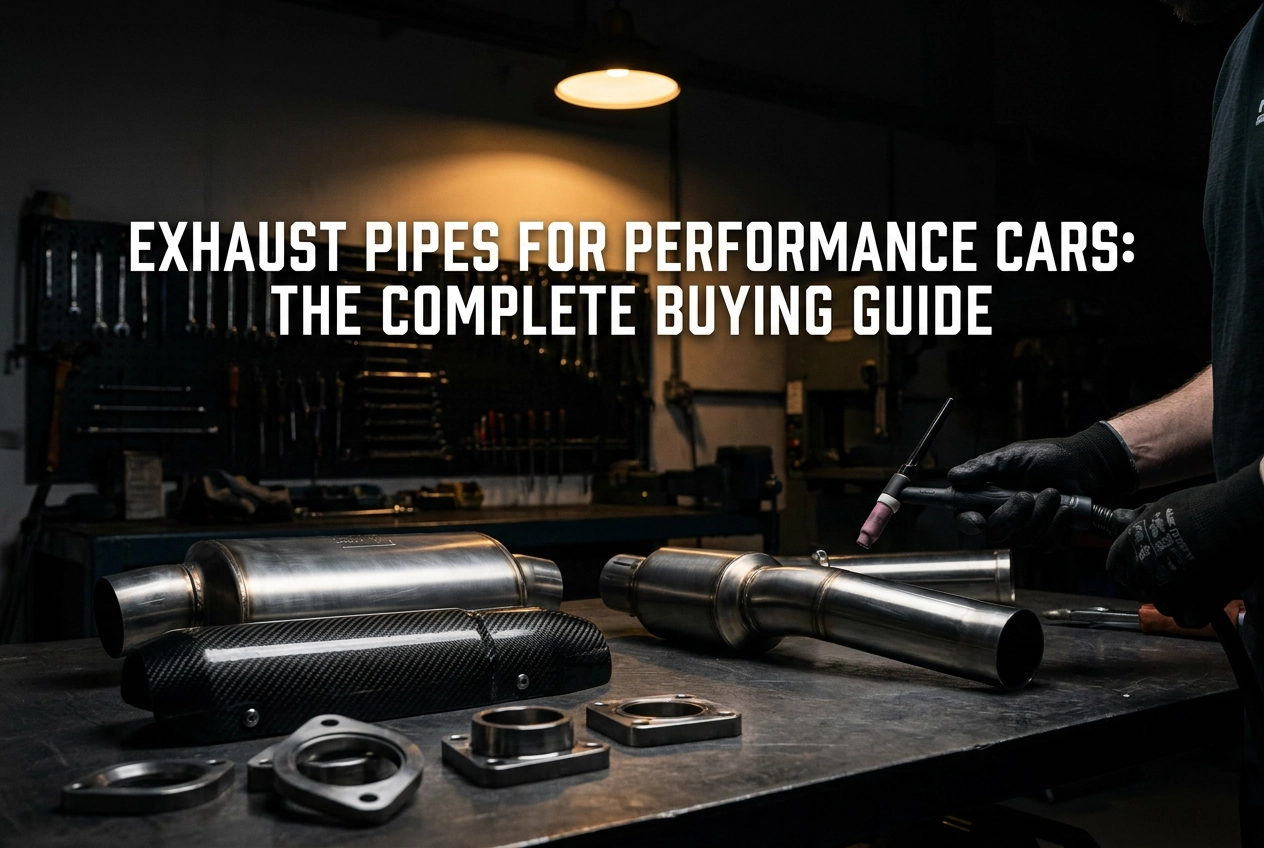
Every fraction of a horsepower matters when you’re pushing a performance car to its limits, and your exhaust pipe plays a far bigger role in that equation than most enthusiasts realize. The exhaust system is not just a noise-maker or an aesthetic upgrade; it is a critical component that directly influences backpressure, exhaust gas velocity, and overall engine efficiency.
Whether you’re chasing faster quarter-mile times, sharper throttle response, or a more aggressive exhaust note, selecting the right exhaust pipe requires a solid understanding of materials, diameters, bends, and flow dynamics. Making the wrong choice can actually hurt performance rather than help it.
In this guide, we break down everything an intermediate-level enthusiast needs to know before making a purchase. You’ll learn how pipe diameter affects scavenging efficiency, why mandrel bends outperform crush bends, which materials offer the best durability-to-weight ratio, and how to match your exhaust setup to your specific engine build. By the end, you’ll have the technical knowledge to make a confident, informed buying decision that genuinely moves the needle on performance.
Why Your Exhaust Pipe Matters More Than You Think
Most car owners think of the exhaust pipe as little more than a tube that routes fumes away from the engine and produces a note. In reality, it is a precision flow component whose internal diameter, bend geometry, and material composition directly govern how efficiently spent combustion gases exit the cylinder head. When exhaust gases cannot escape freely, back pressure builds in the system, forcing the engine to work harder during the exhaust stroke and robbing it of power, throttle response, and fuel efficiency. Variables like pipe bore sizing, mandrel bending versus crush bending, and stainless steel versus mild steel construction are not cosmetic choices; they determine how much of your engine’s potential actually reaches the wheels.
OEM exhaust systems are engineered around a different set of priorities entirely. Manufacturers design these systems to satisfy noise, vibration, and harshness regulations, pass emissions certification, meet warranty longevity targets across average consumer driving cycles, and hit cost-per-unit budgets at volume. For a tuned, high-revving, or forced-induction engine, those objectives are fundamentally at odds with unrestricted gas flow. The aftermarket exists precisely to address that compromise with pipes sized, bent, and fabricated for performance rather than compliance.
The commercial scale of performance exhaust upgrades reflects genuine enthusiast demand. The automotive exhaust systems market is forecast to grow from USD 134.6 billion in 2026 to USD 243.3 billion by 2036, with passenger cars commanding approximately 64.5% of vehicle type demand. Aftermarket channels already account for over 70% of global exhaust system sales, according to exhaust system market analysis, confirming that upgrade and replacement demand, rather than OEM fitment, drives the majority of revenue in this segment.
For UK performance car owners, timing matters. As the ICE fleet ages and the supplier base progressively diversifies toward EV thermal management components, specialist support and product availability for bespoke ICE exhaust pipework will become more selective. The window to upgrade your exhaust system with strong parts availability and knowledgeable support is open now, but it will not remain so indefinitely.
Cat-Back vs. Full System: Which Upgrade Suits Your Build
Choosing between a cat-back and a full exhaust system is one of the most consequential decisions in any performance build, and getting it wrong is an expensive mistake.
1. Cat-Back: The Road-Legal Default
A cat-back system replaces everything rearward of the catalytic converter, typically covering the mid-pipe, resonator, and rear silencer. Because it leaves the catalytic converter and front pipe untouched, it avoids the emissions-critical hardware that draws scrutiny during an MOT inspection. This makes it the default choice for road-registered performance cars in the UK, where catalytic converter retention is a mandatory pass requirement. A quality mandrel-bent cat-back maintains consistent internal pipe diameter through every bend, preserving exhaust gas velocity rather than restricting it as crush-bent pipework does. Expect modest but real power improvements of 5 to 15 bhp depending on platform, with the greatest gains on engines that are clearly restrictive from the factory.
2. Full System: Maximum Flow, Greater Compliance Risk
A full system replacement works from the manifold downward, incorporating headers or a performance manifold, downpipe, and the entire exhaust tract. This configuration delivers the largest flow improvement available, with naturally aspirated engines potentially seeing gains of 20 to 30 bhp when combined with an ECU remap. However, removing or replacing the catalytic converter creates immediate MOT complications, and exceeding the 74 dB(A) drive-by noise limit is a realistic risk with unrestricted pipework.
3. Track and Motorsport Builds
Builds operating under a Motorsport UK permit are exempt from standard road-legal requirements, opening the door to full-system replacements using titanium or Inconel pipework. Titanium systems can weigh 40 to 60 percent less than equivalent stainless steel setups, a meaningful reduction where every kilogram counts. For a complete exhaust buyer’s guide covering system types and material choices, the priorities shift entirely toward outright flow and weight saving.
4. Matching the System to Your Build Intent
For the majority of UK road cars, a high-quality cat-back with mandrel-bent pipework represents the optimum balance of performance, legal compliance, and daily usability without the drone and NVH issues that poorly specified full systems introduce at motorway speeds. Confirm your build’s specific requirements before purchasing; fitment mismatches and legal complications from selecting the wrong configuration are entirely avoidable with the correct groundwork.
Exhaust Pipe Materials: Stainless Steel vs. Titanium
Material selection is one of the most technically significant decisions in any exhaust pipe build, and understanding the properties of each alloy helps you match the specification to the actual use case.
1. 304 Stainless Steel: The Road Car Benchmark
304 stainless steel is the default material for aftermarket performance exhaust pipes, and for good reason. It delivers excellent corrosion resistance, withstands sustained operating temperatures of around 870°C, and sits at a price point that makes it accessible for road builds where long-term durability and value are the primary objectives. The higher chromium and nickel content compared to OEM-grade 409 stainless gives it a noticeably more polished finish and stronger oxidation resistance, which matters on a system exposed to the thermal cycling of daily driving. For the majority of performance road car builds, 304 stainless represents the most rational choice.
2. 316 Stainless Steel: The UK Winter Upgrade
316 stainless introduces molybdenum into the alloy composition, which meaningfully improves resistance to chloride-induced corrosion. For UK drivers in coastal regions, or anyone running on roads treated with road salt between October and March, this is a practical consideration rather than a theoretical one. The price premium over 304 is modest, making 316 a sensible specification for builds where long-term corrosion resistance justifies a small additional investment.
3. Titanium (Grade 5, Ti-6Al-4V): The Track Material
Grade 5 titanium, designated Ti-6Al-4V, is the preferred alloy for motorsport and track-focused exhaust pipework. The weight saving versus equivalent stainless steel is approximately 40 to 45%, which translates directly into reduced unsprung and total vehicle mass. In track applications, where every kilogram removed from the rear of the car improves both handling balance and acceleration response, that reduction has a measurable effect on lap time. Titanium also has a lower thermal expansion coefficient than stainless, reducing long-term weld stress in high-RPM and turbocharged environments.
4. The Titanium Cost Argument
Titanium pipework typically carries a cost premium of 2 to 4 times equivalent stainless steel pricing, and the material requires specialist inert-gas welding techniques that affect both build cost and repairability. For a road car build without a specific weight reduction target, the performance delta is often imperceptible in street driving conditions. The performance-per-pound case for titanium is genuinely compelling on track; on public roads, the justification becomes harder to make.
5. Material Quality Is Improving Across the Board
Advances in corrosion-resistant materials are cited as an active driver of growing exhaust pipe demand in current industry data. Buyers in 2026 can access meaningfully better durability from both stainless and titanium systems at comparable price points relative to five years ago, as manufacturing tolerances and alloy processing have improved across the aftermarket segment. You can review current stainless and titanium exhaust specifications to assess how these material improvements translate into real-world product performance before committing to a specification.
Pipe Diameter and Bend Geometry: The Numbers That Affect Power
Internal pipe diameter sits at the heart of exhaust system performance, and the margin for error is narrower than most builders expect. Size the pipe too small and you create a hard restriction at high RPM, choking the engine precisely when it needs to breathe most freely. Size it too large and you sacrifice exhaust gas velocity at lower RPM, undermining the scavenging effect that pulls spent gases out of the combustion chamber and draws in the fresh charge. For the majority of performance car applications, the optimal working range sits between 2.25 inches (57mm) and 3 inches (76mm), with the correct selection dependent on engine displacement, power output, and induction type.
As a practical sizing guide, engines producing up to approximately 250bhp typically suit 2.25 to 2.5 inch pipework. Builds targeting 250 to 400bhp tend toward 2.5 to 3 inch diameter. Higher-output applications may warrant 3 inch or above, though this should always be validated against engine-specific mapping data and dyno results rather than applied as a universal rule. It is also worth noting that forced-induction engines can have different mass flow characteristics compared to naturally aspirated units at equivalent power levels, which means the bhp-to-diameter table is a starting point, not a final answer.
Bend geometry is where a significant amount of performance gain or loss is determined at the fabrication stage. Mandrel bending maintains the tubing’s full diameter at every curve by supporting the pipe internally during the bending process, preventing the ovalling and internal collapse that crush bending introduces. Crush bending can reduce the internal diameter by up to 20mm per bend, creating measurable turbulence and elevated back pressure at every curve in the system. On a multi-bend exhaust, these restrictions compound. For any performance application, mandrel bending is not a premium option; it is the minimum acceptable standard for a pipe claiming to outperform OEM.
Beyond bend method, weld quality at join points deserves equal scrutiny. Step-welds and poorly finished internal joins introduce turbulence directly into the gas flow path, negating gains achieved elsewhere in the system. Fully TIG-welded, internally polished joins that create flush, smooth transitions are what to look for when evaluating any aftermarket pipe. Budget systems frequently cut corners here, and the restriction created by a poorly executed weld can rival that of a crush bend. Inspect join quality as carefully as you assess material grade or bend method.
UK MOT Compliance and Noise Regulations: What You Need to Know
Fitting an aftermarket exhaust pipe changes your compliance picture immediately, and understanding the framework before you buy saves you from an MOT failure or a roadside enforcement encounter.
1. MOT Assessment Is Subjective, Not Instrument-Based
MOT examiners do not carry calibrated sound meters. The assessment is based on whether the exhaust note is unreasonably louder than a comparable standard vehicle at idle. A practical threshold of approximately 82 dB under load is widely cited as a likely fail trigger, but the tester’s discretion is the deciding factor. Persistent fail triggers include visibly removed baffles, straight-through pipes replacing silenced OEM sections, and missing catalytic converters. A well-engineered cat-back system using correctly sized resonators and high-flow silencers will almost always pass; a gutted centre section with no silencing will not.
2. Road Noise Law and Police Enforcement
The Road Vehicles (Construction and Use) Regulations 1986 set statutory construction limits at 85 dB(A) for motor cars, with type-approval limits currently sitting at 72 dB, dropping to 68 dB for vehicles type-approved after July 2026. On the road, enforcement is discretionary rather than threshold-triggered. Officers can issue on-the-spot fines of £50, instruct the vehicle off the road until compliant, and apply Section 59 powers under the Police Reform Act 2002 for vehicles causing alarm or distress, up to and including seizure. The UK government also launched a £300,000 noise camera trial in 2022; these are expected to become as common as speed cameras in coming years.
3. Catalytic Converters Are Non-Negotiable
Removing the catalytic converter is illegal for road use and guarantees an MOT failure. On Euro 6-registered vehicles, removal will also trigger a check engine light through oxygen sensor imbalance, creating additional diagnostic complications at any future service or inspection. Retaining the cat is the single most important compliance decision in any road-legal build.
4. Euro 7 and GPF Compatibility
Euro 7 regulations, phasing in from 2025 onwards, mandate gasoline particulate filters on petrol engines as standard aftertreatment. If you are fitting a cat-back system to a Euro 7 vehicle, verify that the aftermarket pipework maintains full GPF compatibility and does not reposition lambda or pressure sensors in ways that generate fault codes.
5. Track Builds and Road Transit
A stripped, de-catted track car operates under none of these constraints at the circuit itself. However, any vehicle driven on public roads, even solely to transit to a track day venue, must be in a fully road-legal configuration for that journey. There is no legal grey area here: the road legal requirements apply the moment the vehicle leaves private land.
Real-World Performance Gains: What an Upgraded Exhaust Pipe Actually Delivers
Understanding what an exhaust pipe upgrade genuinely delivers requires separating dyno-backed reality from marketing claims. Here is what the numbers actually look like across different configurations.
1. Naturally Aspirated Engines: 5-15bhp from a Matched Cat-Back
On a naturally aspirated performance engine, a well-specified cat-back system with mandrel-bent pipework of the correct bore typically yields 5-15bhp alongside a comparable torque increase. Critically, these gains are concentrated in the mid-to-upper RPM range, where exhaust gas velocity is sufficient to generate meaningful scavenging effects. At lower RPM, the benefits are less pronounced, which is why pipe sizing relative to displacement matters so much. A correctly matched system on a 2.0-litre hot hatch will perform very differently from the same pipe fitted to a 1.4-litre unit.
2. Turbocharged Platforms: Back Pressure and Spool Response
On turbocharged cars, the exhaust pipe downstream of the turbocharger primarily influences turbine back pressure rather than scavenging. Reducing restriction in this section can improve spool time and sharpen mid-range throttle response, but outright peak power gains from the cat-back alone are modest. The full system, including the downpipe, must be addressed to see meaningful numbers.
3. Downpipe Upgrades: The Biggest Single Gain on Forced Induction Cars
A high-flow downpipe combined with an ECU remap is where turbocharged platforms unlock significant performance. Many popular forced induction applications yield 20-40bhp from this combination. For road use, a high-flow sports catalyst is the compliant route, as removing the catalyst entirely is illegal for road-registered vehicles and will result in MOT failure. You can read more about 5 must-have exhaust upgrades to understand how downpipes sit within a broader upgrade strategy.
4. Weight Savings: A Meaningful Secondary Benefit
Switching from an OEM mild steel system to a stainless aftermarket cat-back typically saves 3-8kg. Moving to a titanium equivalent can roughly double that saving. Given that exhaust weight sits at the rear of the car, its removal has a measurable effect on weight distribution and handling balance, not just straight-line performance.
5. Tuning Dependency: Gains Are Not Automatic
Fitting a large-bore exhaust pipe without adjusting fuelling can reduce low-end torque on some configurations if exhaust gas velocity drops below the threshold needed for effective scavenging. On modern drive-by-wire platforms, closed-loop fuelling corrections can partially mask the gains or introduce flat spots. A remap or piggyback ECU solution is not optional on these engines; it is a prerequisite for realising the full benefit of the exhaust pipe upgrade.
Fitment and Compatibility: DIY vs. Professional Installation
Getting fitment right is as important as choosing the correct specification. Before placing any order for an aftermarket exhaust pipe or system, verify compatibility against vehicle make, model, engine code, and production year — not model name alone. Popular performance platforms are a prime example of where this matters. The Honda Civic Type R spans the EP3, FN2, FK2, FK8, and FL5 generations, each with different flange specifications, pipe diameters, and OEM mounting configurations. The Ford Focus ST similarly varies between the Mk2, Mk3, and Mk4 platforms. Assuming cross-generation compatibility without checking engine codes and OEM fitment data is one of the most common and avoidable purchasing errors in the aftermarket exhaust market.
Cat-back installation sits within the capability of an intermediate home mechanic, provided the correct equipment is available: a sturdy ramp or axle stands rated to the vehicle’s kerb weight, a basic socket set, penetrating fluid, and patience. The most frequent practical obstacle on any vehicle with more than four or five years of road use is seized OEM hardware. Exhaust clamp bolts and slip-joint fasteners are subject to sustained heat cycling and road salt exposure, and they corrode into a single mass over time. Apply penetrating fluid liberally and allow adequate dwell time before applying torque. A critical fitment principle documented by aftermarket manufacturers is to loosely fit all components before final tightening, allowing positional adjustment throughout the assembly and preventing stress at hanger points. You can find practical DIY exhaust installation guidance here.
Full system replacements — covering the manifold, downpipe, or any lambda sensor relocation — sit in different territory. Incorrect torquing of manifold studs can lead to warping or exhaust leaks at the cylinder head face, which introduces combustion gases into the engine bay and generates persistent fault codes from upstream oxygen sensors. Sensor wiring errors during a lambda relocation can produce inaccurate fuelling data and trigger limp mode. These tasks are better routed through a professional installer with the correct torque tools and diagnostic equipment.
Exhaust hangers and rubber mounts deserve dedicated attention during fitment planning. Aftermarket systems frequently use different hanger positions to OEM, and an unsupported section of pipework will transmit vibration directly into the body, cause stress cracking at weld joints over time, and generate drone at specific RPM bands. Map every hanger point before installation and source any additional brackets or extended mounts needed for the specific system.
Finally, a post-installation inspection after the first 50 to 100 miles is strongly recommended for every exhaust fitment. Heat cycling causes minor settling at all joint points, and any developing leak should be identified and addressed before it corrupts downstream sensor readings or causes further component damage. For a broader overview of aftermarket exhaust options before committing to a purchase, this aftermarket exhaust systems buyer’s guide is a useful reference point.
What to Look For When Buying a Performance Exhaust Pipe
With the technical groundwork covered in previous sections, here is a consolidated buying checklist to apply at the point of purchase.
1. Verify material grade explicitly. Look for confirmed 304 or 316 stainless steel grading stated directly in the product specification, not just the word “stainless.” Grade 304 contains 18% chromium and 8% nickel, delivering proven corrosion resistance under the salt-heavy conditions typical of UK roads year-round. Grade 316 adds molybdenum for superior resistance in coastal environments. Budget listings using unverified “stainless” claims frequently refer to 409-grade ferritic alloy or aluminised steel, both of which carry significantly shorter service lives on UK roads. Aerospace-grade titanium is a legitimate premium option for track-focused builds, offering reduced weight alongside strong corrosion resistance, but it commands a substantial price premium over stainless.
2. Confirm mandrel-bent construction. Mandrel bending maintains a consistent internal bore diameter through each bend radius, preserving flow characteristics that crush bending destroys. Mandrel bending adds roughly 25 to 35% to manufacturing cost compared to crush bending, which is why budget products default to the cheaper process. If a listing does not explicitly state mandrel bending, treat the product as crush-bent and evaluate it accordingly.
3. Check wall thickness figures. Quality stainless performance pipe specifies 1.5mm to 2mm wall thickness. Thinner walls reduce marginal weight but increase susceptibility to heat damage, denting, and resonance-driven cracking over time, particularly relevant on variable UK road surfaces.
4. Prioritise vehicle-specific fitment over universal sections. Vehicle-specific systems use correct flanges, hanger positions, and routing geometry for your platform, eliminating fabrication work and reducing installation time and cost. Universal pipe sections require custom fabrication and are better suited to bespoke motorsport builds.
The exhaust systems range at Performance Cars Parts covers vehicle-specific options across popular UK performance platforms, allowing buyers to filter by vehicle compatibility and confirm correct specification without guesswork.
Choosing the Right Exhaust Pipe: Key Takeaways
Five principles consolidate everything covered in this guide into a practical decision framework.
1. Match the upgrade type to your build objective. A cat-back system is the correct choice for road-legal performance gains; it preserves emissions compliance while delivering measurable flow improvements. A full system, including headers and downpipe, is appropriate for track or motorsport builds where road-use restrictions are not a constraint.
2. Let material selection follow your use case. Grade 304 stainless steel suits road cars where durability and value are priorities. Titanium is justified on track builds where the weight saving directly contributes to performance objectives and the cost premium is acceptable.
3. Never compromise on pipe diameter or mandrel-bent geometry. These two specifications have the greatest direct impact on exhaust flow performance and cannot be offset by other factors.
4. UK MOT compliance and Euro 7 compatibility are non-negotiable for road use. Retain the catalytic converter, and verify GPF compatibility on any vehicle registered post-2025.
5. Confirm fitment by engine code and model year before ordering, and allocate budget for professional installation if the scope exceeds a straightforward cat-back swap.
Conclusion
Choosing the right exhaust pipe is one of the most impactful upgrades you can make to a performance car. To recap the essentials: pipe diameter directly controls backpressure and scavenging efficiency, mandrel bends preserve flow velocity where crush bends fall short, and your material choice shapes both weight savings and long-term durability. Most importantly, every component must be matched to your specific engine build and performance goals.
Now it is time to put this knowledge to work. Measure your current setup, define your goals, and use what you have learned here to make a confident, informed purchase. Do not settle for a generic bolt-on when a purpose-matched system can unlock real, measurable gains.
The right exhaust pipe does not just free up horsepower; it transforms how your car feels, sounds, and performs at every RPM. Build smart and drive faster.