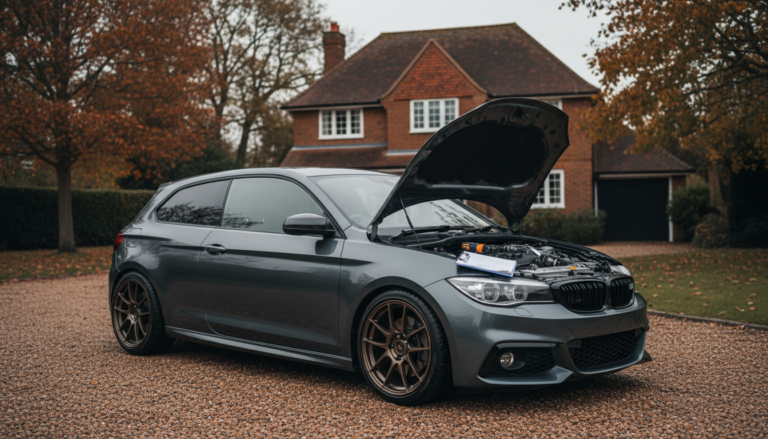
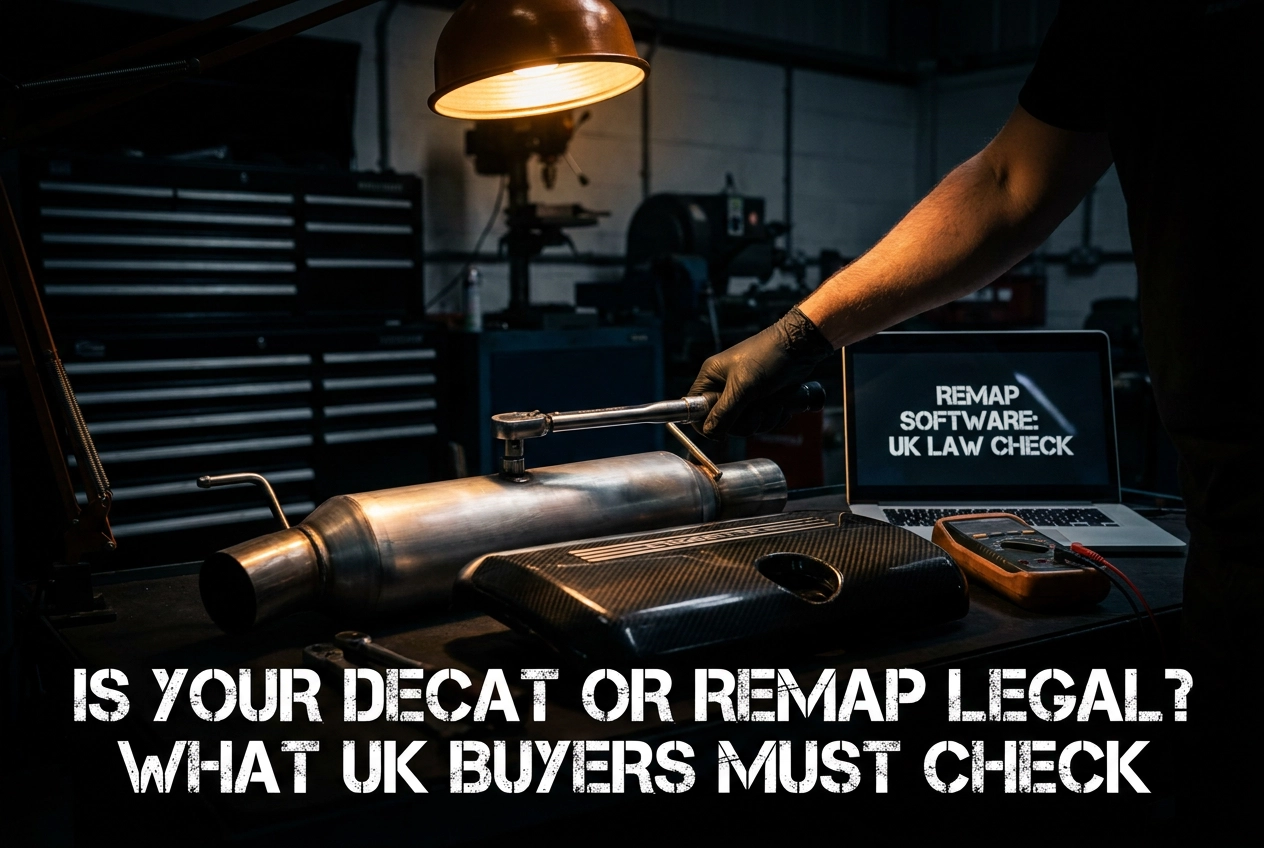
Two UK workshops have just been fined for fitting illegal modifications, and the details matter to anyone buying performance parts. Maidenhead-based SVG Motorsport Ltd was ordered to pay £1,600 for removing a catalytic converter and recalibrating an ECU to change a car’s sound, without warning that the vehicle would become illegal to drive and fail its MOT. A second firm, AET Motorsport, faced similar findings for advertising and fitting non-compliant components. The court’s message was blunt: business owners have an obligation to know the law.
For buyers, the real risk sits at the order stage, not the roadside stop. A replacement link pipe in place of a cat is an immediate MOT failure. A pop and bang remap pushes noise above legal limits. Get these wrong and you own a car that cannot legally be driven. This guide walks you through the rules covering exhaust system parts and ECU maps, the costs of non-compliance, what to check on a listing, what to ask a workshop before booking a fit, and what to do if your current setup is already non-compliant. It is essential reading before you choose components for your next performance build.
Why the DVSA Decat Prosecutions Matter at the Order Stage
The prosecution is not a warning shot aimed at drivers. It lands on the trade, and that is precisely why it changes how you should buy. The DVSA fined Maidenhead-based SVG Motorsport Ltd £1,600 after an undercover operation found the firm had removed a catalytic converter and recalibrated an ECU to alter a car’s sound, as evo reported. The detail that matters for buyers is what the business failed to say: it did not warn the DVSA’s undercover team that the work would make the car illegal to drive and invalidate its MOT.
It was not an isolated case. AET Motorsport was separately ordered to pay £7,234 in fines and costs in 2023, after the DVSA said it gave no forewarning of the illegality, “just like SVG Motorsport Ltd”. The court’s conclusion was blunt: this was “a lesson that any business owner has an obligation to know what the law is”. That obligation places the compliance conversation squarely at the point of sale, before money changes hands.
So shift your mental model. The risk to you does not arrive at a roadside stop; it arrives when you click order. The seller and fitter face prosecution, but the illegal car, the failed MOT and the insurance questions land on the registered keeper. If your build involves emissions-adjacent work, our guide to UK emissions rules for modified cars in 2026 sets out the wider legal picture before you commit.
What the Rules Actually Cover on Exhaust System Parts and Maps
With the prosecution context established, the practical question is what the rules cover for exhaust system parts. A well-built exhaust system does not make an illegal part legal.
- Catalytic converter removal. Replacing a cat with a link pipe, sold as a decat or decat pipe, is an immediate MOT failure and increases emissions, whatever the quality of the rest of the exhaust system.
- Cat-backs and silencers. An exhaust system cat back changes pipework and silencers behind the cat but keeps emissions hardware in place. Road legality depends on type approval for your exact vehicle and on noise limits, so ask the seller for documented confirmation rather than assuming.
- Pop and bang maps. A remap that retards ignition and reduces overrun fuel cut-off deliberately produces crackles and noise above the legal limit. ECU recalibration was part of the work the DVSA prosecuted over.
- Sports cats. A sports cat that retains a functioning, approved catalyst may be road legal on some vehicles. This research does not establish a single verification test, so treat approval paperwork as a question for the seller, not an assumption.
- Diesel particulate filters. Since February 2014 MOT testers must check for a DPF on diesel vehicles, and removing one makes the vehicle illegal to drive. The government blog on DPFs notes garages cite performance and cost as reasons for removal.
MOT Failure, Fines and Insurance: What Non-Compliance Costs You
A failed MOT is not a warning slip. Once emissions equipment is missing, the car is not road legal for normal use, so a decat or link pipe can take a perfectly sound performance car off the road until the original hardware is restored.
The financial exposure is documented. The DVSA’s 2017 guidance on diesel particulate filters records maximum fines of £1,000 for a car and £2,500 for a light goods vehicle driven with the filter removed. Treat those as historical maxima and check current guidance before relying on them.
Enforcement reaches the trade too: 761 warnings or disqualifications were issued to garages or testers in 2016-17, out of more than 60,000 MOT testers in Britain. That 2017 figure shows how seriously testing integrity is treated.
Insurance is the quieter cost. Undeclared modifications that make a car illegal can put your cover at risk, so confirm your position with your insurer or against current DVSA guidance. Do not trust a listing or a forum post on this point.
Policy also moves. A 2026 consultation on in-use emissions was reported as targeting tuned vehicles, but its scope and closing date were not verified for this article. Check the live GOV.UK consultation before making decisions based on it.
Our exhaust pipe buying guide covers material, diameter and UK legal compliance. The same care you apply when choosing the right oil filter for your performance car belongs in checking approval paperwork before you order.
Before You Order: What to Check on an Exhaust System Cat Back Listing
The cost is now clear, so treat the listing as a compliance document rather than a sales pitch. Work through it in this order.
- Scan for trigger words. Decat, de-cat, decat pipe, link pipe, race, track only and not for road use all signal a part that removes or bypasses emissions hardware. That is the configuration that fails an MOT.
- Confirm the configuration. An exhaust system cat back or a rear silencer replacement keeps the original catalyst in place. A turbo-back or downpipe kit that swaps the cat for a straight pipe does not, and a single listing can hide that difference in its fitment notes. Our Aftermarket Exhaust Systems: The Complete UK Buyer’s Guide sets out the types before you start comparing prices.
- Look for type approval. The road-use statement should name your make, model and engine code. If no certificate is shown, ask for it. “MOT friendly” and “sounds great” tell you nothing about legality.
- Read the map description. Pops, bangs, crackles, overrun or decat-ready wording usually means altered ignition timing and fuelling. Remember that at MOT, exhaust noise must not be unreasonably above the permitted level, as the MOT inspection manual states.
- Check the whole exhaust system parts order. Gaskets, lambda sensor spacers and mounting hardware count too. A cheap O2 spacer sold as a warning-light fix often masks a system that is no longer compliant.
- Treat claims as claims. Ask the seller to send a part number, a manufacturer certificate and a written statement that the item leaves your vehicle legal for road use.
If a seller cannot clear these six points before you pay, that is your answer.
What to Ask a Workshop or Seller Before Booking a Fit or Remap
The listing checks tell you what the paperwork should say; the next step is putting the same questions to a human and keeping the reply.
- Ask in writing. Will this work leave the vehicle legal to drive on the road and able to pass an MOT? Ask by email or message so the answer sits on record, not in a verbal exchange at the counter.
- Check approval status. Does the replacement cat or sports cat in the new exhaust system carry type approval for your vehicle and engine code, and can the certificate arrive with the quote? A seller who cannot name your engine code cannot confirm approval for it.
- Interrogate the calibration. Does the map retain standard overrun fuel cut-off and ignition timing, and will it produce crackles or noise beyond legal limits? A pop and bang remap retards ignition and reduces overrun fuel cut-off to generate noise above the limit, the exact conduct behind the DVSA crackdown on illegal exhaust modifications.
- Price the reversal. If the car fails an MOT or your insurer objects, will they refit the original parts or restore the factory file, and what does that cost? Get the figure before booking.
- Ask who carries liability. The court said business owners have an obligation to know the law, which makes “who answers if this is illegal?” a fair question for any workshop or seller.
- Reject contradictions. If the listing says track use only and the workshop says it will be fine, both cannot be true for a road car. Walk away.
Hold the booking until every answer arrives in writing, the same discipline you would apply to any claim about performance upgrades that transform your car.
Already Running a Decat or Pop and Bang Map? What to Do Now
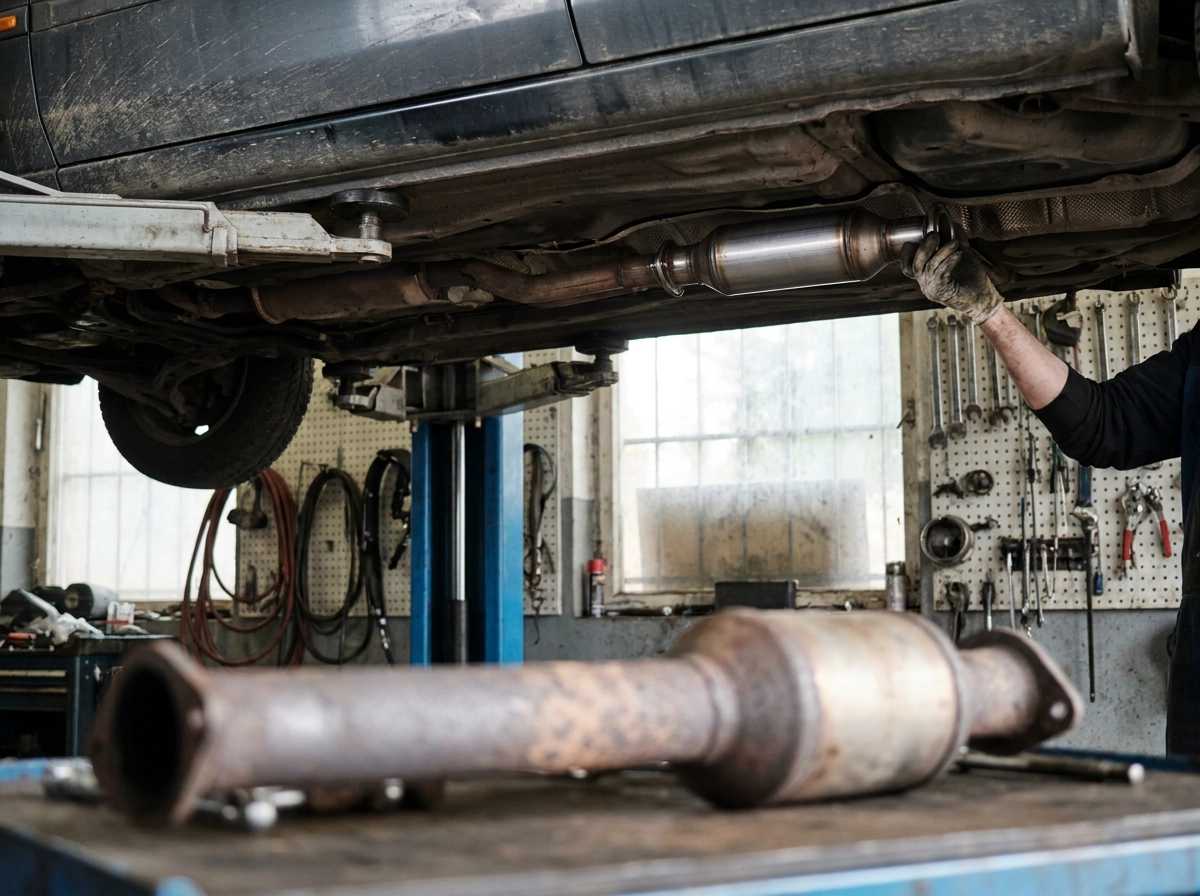
If you already own the hardware the workshop conversation was meant to prevent, remediation is the next step.
For a decat, you have three realistic routes: refit an approved cat, fit a compliant sports cat, or keep the decat for track-only use and restore road-legal hardware before the car returns to the road. Swapping back just before an MOT does not undo the weeks of illegal driving beforehand.
For a pop and bang map, ask the mapper whether the original calibration file can be restored. Confirm in writing what the new file does to overrun fuel cut-off and noise before you pay for anything. If you are weighing up whether to keep the map at all, our guide to remapping after fitting performance parts sets out the trade-offs.
For a removed DPF, refitting or professionally cleaning and refitting a DPF restores compliance. Removal carries historical fines of up to £1,000 for a car and £2,500 for a light goods vehicle, with current figures to be checked.
Tell your insurer what is fitted and get their position in writing. Undeclared modifications may invalidate cover, and it is far cheaper to ask now than to argue after a claim.
Book an MOT or a pre-check soon rather than waiting for renewal. Keep every invoice and reversal record, and treat that paperwork as part of the car’s history if you ever sell it.
Ordering With Confidence on Performance Cars Parts
With your car back to a compliant baseline, the next decision is where to order replacement or upgrade parts. Performance Cars Parts is a UK online-only retailer of performance car parts and upgrades, with exhaust systems, engine parts, brakes, electrical components, suspension and cooling parts in its range. Because it trades online only rather than through branches, prices stay low and product questions go to support by email or WhatsApp before you commit to an order.
Use those channels to ask three questions before you buy:
- What does this item replace?
- Does it keep my emissions hardware intact?
- What documentation comes with it?
For an exhaust system cat back or other exhaust system parts, get those answers in writing, including any type approval or road-use statement for your make, model and engine code.
Nothing in this article is legal advice for your specific car. Confirm road legality and insurance cover with your insurer or the relevant authority before fitting.
Conclusion: The Order Is the Risk Point, Not the Roadside
Whatever channel you use to ask, treat the answer as the final checkpoint before payment. The DVSA case puts the legal burden on sellers and fitters, and the court stated plainly that business owners must know the law. A seller who shrugs at your legality question has still told you something useful: walk away.
Before you order, confirm three things in writing:
- the part keeps your catalytic converter or DPF in place;
- the calibration does not breach noise or emissions limits;
- the seller can provide documented approval for your make, model and engine code.
If you already run a decat, a pop and bang map or a removed DPF, restore compliance first. Tell your insurer, keep the invoices, and get the work documented before your next MOT. That paperwork is your evidence, not the listing.
Shop related performance parts

Explore related products

Always check the individual product listing for your vehicle and engine before ordering.