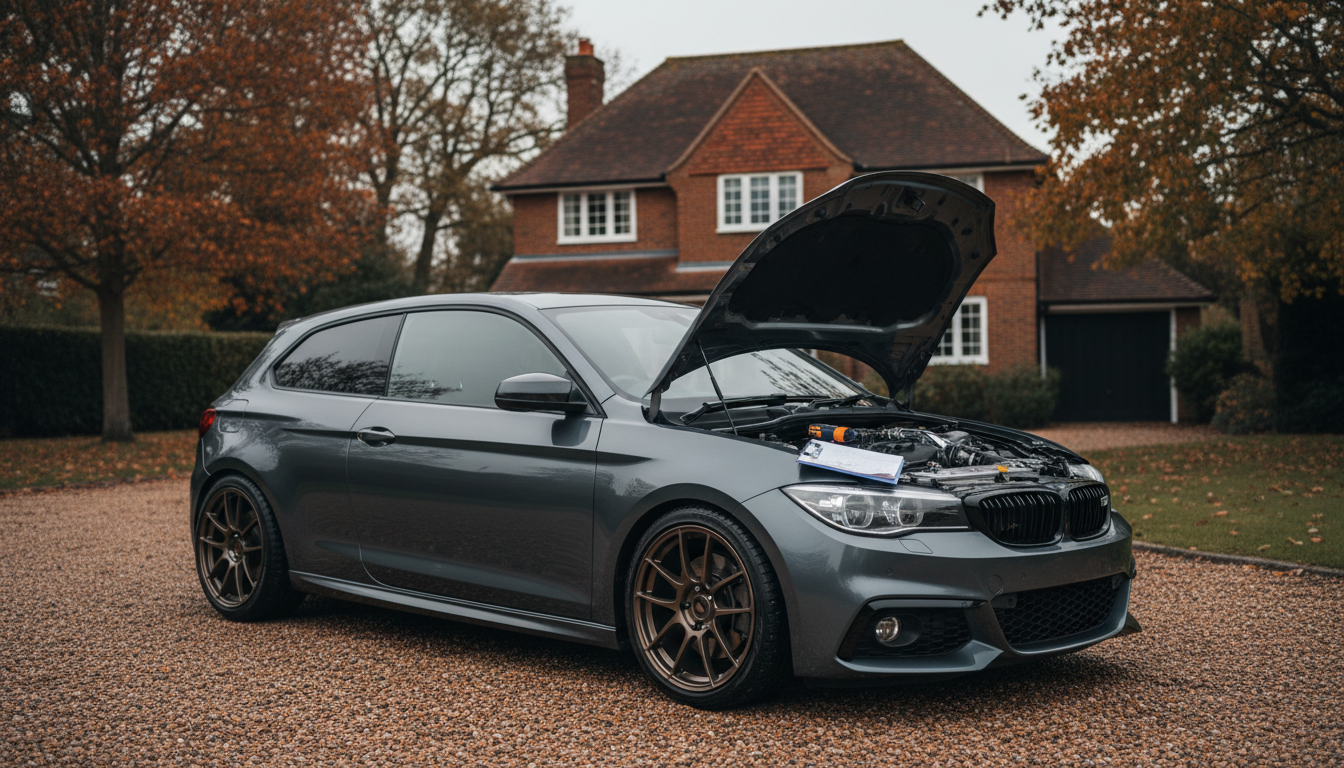
A modified car can be one of the best-value buys in the UK performance market. Someone else has already paid for the coilovers, the brake upgrade and the exhaust, and the asking price rarely reflects what those parts cost new. But the same car can also be a money pit: a cheap remap that has been quietly cooking the clutch, a decat that will fail its next MOT, or an insurance history that falls apart the moment you need to make a claim.
The difference between a bargain and a headache usually comes down to how carefully you check the car before money changes hands. A standard used-car inspection is a good start, but it was never designed to tell you whether a tune was done properly or whether the suspension was set up by someone who knew what they were doing.
This guide walks you through a practical checklist for buying a used modified car in the UK: the paperwork and online checks to run first, what to look for on the engine, drivetrain, suspension and brakes, the MOT and legal red flags, how insurance works when the car is already modified, and how to put a sensible value on the upgrades.
What Should You Check When Buying a Modified Car?
Quick answer: Before buying a modified car in the UK, check its MOT history, make sure the V5C details match the car, ask for receipts for every modification and get insurance quotes based on the full modification list. Then inspect the engine and ECU tune, clutch, gearbox, suspension and brakes, and look for anything that would fail an MOT, such as missing emissions equipment. For heavily modified or high-value cars, pay for an independent inspection by a specialist who knows the model, and be sure every modification is road legal and declared before you hand over a deposit.
Why Modified Cars Need a Different Approach
With a standard car, you are mostly assessing wear and how well it has been maintained. With a modified car, you are also assessing the judgement of every person who has worked on it. The questions change from “has it been serviced?” to “who fitted these parts, were they the right parts, and has the rest of the car been upgraded to cope?”
Good modified cars tend to share a few traits:
- A clear, documented list of every modification, with receipts and the name of the fitter or tuner.
- Upgrades that make sense together, for example a power increase backed up by a stronger clutch, better cooling and uprated brakes.
- Quality, recognisable parts rather than unbranded copies.
- A seller who can explain why each change was made and is happy for you to inspect the car properly.
Bad ones usually show the opposite: vague answers, no paperwork, a long list of cheap parts and a power figure that came from “a mate with a laptop”. Keep those two profiles in mind as you work through the checks below.
Used Modified Car Paperwork and History Checks
Do this before you travel to see the car. It costs little or nothing and filters out a surprising number of bad listings.
MOT history
The free GOV.UK MOT history check only needs the registration number. It shows pass and fail results, the mileage recorded at each test and, for tests in England, Scotland and Wales, which items failed and which advisories were noted. For a modified car, read it carefully for patterns: repeated emissions fails, advisories for exhaust noise, tyres worn on the inner edge (often a sign of excessive camber or poor alignment), or mileage that jumps around or goes backwards.
V5C and history checks
Check that the V5C logbook details match the car in front of you: VIN, engine number, colour and registered keeper. Some modifications have to be recorded on the logbook. GOV.UK lists the changes that must be updated on the V5C, including colour, engine, cylinder capacity and fuel type. If the car has had an engine swap, a big-capacity rebuild or a full colour change and the logbook has not been updated, ask why.
A paid vehicle history check is also worth the money on any performance car. It will flag outstanding finance, stolen-vehicle markers and insurance write-off records. Modified cars are disproportionately likely to have had an accident at some point, so pay particular attention to write-off categories. As What Car? explains, Cat S cars have suffered structural damage and Cat N cars non-structural damage. Neither is automatically a deal-breaker, but both should be reflected in the price and you need to know exactly what was repaired and by whom.
The modification list and receipts
Ask the seller for a full written list of modifications before you view. Then compare it with the advert, the MOT history and, later, the car itself. Gaps between the three are your first red flags. Receipts from known retailers and invoices from reputable workshops add real value; a box of parts with no paperwork does not.
Modification verification table
Use this table to work through each modification on the seller’s list. The more boxes you can tick with real evidence, the more confidence you can have in the car.
| What to verify | Good evidence | Why it matters |
|---|---|---|
| Part manufacturer | Brand named on the part and on the receipt | Known brands have support, spares and predictable quality |
| Part number | Number on the part matches the invoice and suits the exact model | Confirms the correct part for the chassis and engine was fitted |
| Installation invoice | Dated invoice from a named workshop, or the seller can explain a DIY fit in detail | Shows who fitted it and when, which matters for warranty and resale |
| Specialist setup evidence | Dyno sheet, map details, alignment printout or corner-weight sheet | Many upgrades only work properly once set up correctly |
| Insurance disclosure | Seller’s policy schedule lists the modification | Undisclosed changes are a warning sign and must be declared by you anyway |
| Original parts | Standard parts included in the sale or their whereabouts known | Makes it easier to return the car to standard for an MOT, sale or insurance |
Buying a Remapped Car: Engine and ECU Checks
Engine tuning is where the biggest risks hide, simply because you cannot see a bad map. Your job is to establish how the car was tuned, by whom, and whether the supporting hardware matches the power claim. If you are unsure what a typical stage 1 or stage 2 car should include, our guide to stage 1, stage 2 and stage 3 tuning sets out what each step normally requires.
Questions to ask the seller
- Who carried out the remap, and was it an off-the-shelf file or a custom calibration on a rolling road?
- Is there a dyno sheet, and does it show both power and air-fuel ratio or boost data?
- Can the car be returned to its standard map, and does the seller still have the original file?
- What oil has it been running, and how often has it been changed since the tune?
- Has it ever been tracked, and if so, how often?
Physical checks
Ask for the engine to be cold when you arrive. Listen for rattles on start-up, look for blue or black smoke from the exhaust, and check for oil weeping around turbo pipework, intercooler joints and the rocker cover. Look inside the intake pipework if it is easy to remove: excessive oil can point to worn turbo seals or crankcase ventilation problems. Check the coolant for any oily film and the underside of the oil filler cap for mayonnaise-like residue.
On the test drive, watch for hesitation, misfires or flat spots under load, and make sure there are no warning lights. If you can, plug in a cheap OBD reader and look for stored fault codes. A car that has had its codes cleared just before your visit will often show “not ready” readiness monitors.
Drivetrain: Clutch, Gearbox and Differential
Extra torque goes straight through the clutch, gearbox and driveshafts, and these are expensive to fix. A remapped car still running its original clutch is not necessarily a problem, but it is something to test properly.
- Clutch slip: In a high gear at low revs, press the throttle firmly. If the revs rise without a matching increase in speed, the clutch is slipping.
- Bite point: A very high bite point usually means a worn clutch. A very sharp, on-off engagement may indicate an uprated paddle or sintered clutch that will not suit everyone for daily use.
- Gear changes: Crunching on fast changes, particularly into second or third, can point to worn synchros.
- Driveline noise: Whines, clunks on and off the throttle and vibration at speed can all point to worn mounts, bearings or driveshafts.
If the clutch is on its way out, factor the cost of a replacement into your offer. On a tuned car it often makes sense to step up to a properly rated part rather than another standard clutch; our performance clutch kits are a good place to see what is available for common platforms. Also ask whether any aftermarket limited-slip differential has had its oil changed with the correct fluid, as plate-type diffs in particular are sensitive to this.
Checking Modified Car Suspension and Wheels
Suspension upgrades are among the most common modifications, and quality varies hugely. Get the car on a ramp or at least look carefully behind each wheel with a torch.
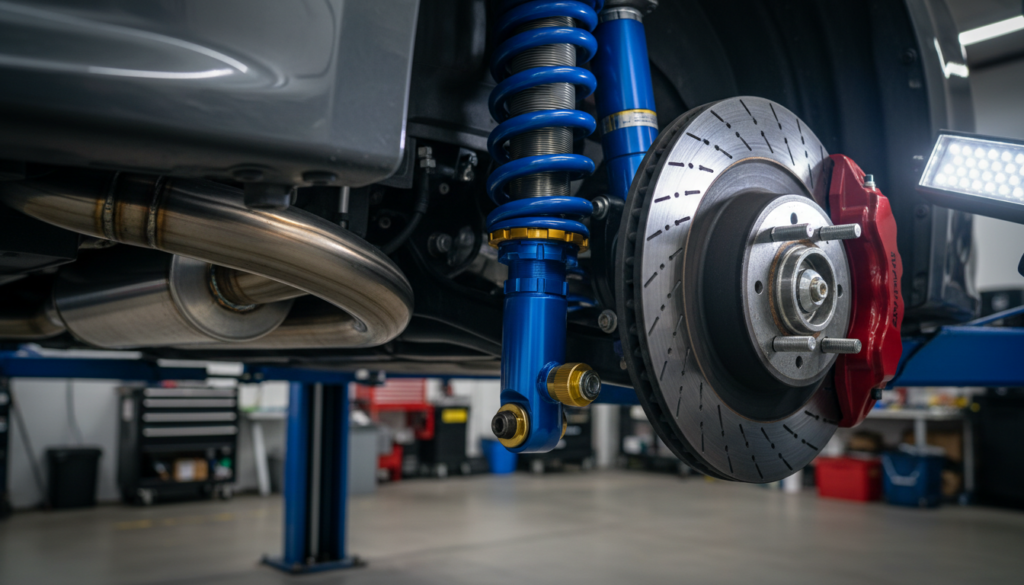
- Coilovers: Check for oil leaks down the damper bodies, seized or heavily corroded adjusters and collars, and missing locking rings. Ask what brand they are and whether they have been serviced or refreshed.
- Ride height: A car slammed to the floor may look good in photos but can have compromised suspension geometry, rubbing tyres and damaged undertrays.
- Tyres: Uneven wear, especially heavy inner-edge wear, suggests extreme camber or toe settings or a car that has not had an alignment since being lowered.
- Bushes and arms: Look for split rubber, perished polyurethane and any signs of welding or bent arms.
- Wheels: Check for cracks, buckles and spacers. Larger or wider wheels than standard are a modification that should be declared to your insurer.
Unbranded coilovers that are worn out are rarely worth saving. If the car otherwise checks out, budget to replace them with a known set from our coilover range and then have it set up properly. Our coilover setup guide explains ride height, damping and corner weights so you can judge whether the current setup has been done with care.
Brakes: Upgrades That Match the Power
More power should come with more braking capacity. A car making well beyond its factory output on standard, worn brakes is a sign the previous owner’s priorities were in the wrong place. Check:
- Disc thickness and any lip on the outer edge, plus cracks around drilled holes.
- Pad thickness on both sides of each caliper.
- Braided hoses for chafing and secure routing away from wheels and suspension.
- The date of the last brake fluid change, which matters even more if the car has been tracked.
- The pedal: it should feel firm and consistent, without sinking or pulsing.
Big brake kits add value, but only if they are from a reputable manufacturer, fitted correctly and still in good order. If the pads are track compounds, be aware they may squeal or feel wooden when cold on the road. Fresh, road-appropriate performance brake pads are a sensible early purchase on any modified car whose brake history is unclear.
How to Spot Poor-Quality Modifications
A modification is only as good as the way it was fitted. Some of the most common warning signs are easy to spot once you know what to look for:
- Cut springs: Lowering a car by cutting the standard springs is a cheap shortcut. Look for a spring that does not sit properly in its seat, an unevenly finished end coil or a car that sits lower on one corner than the others.
- Unsafe wiring: Gauges, lighting, audio and engine electronics wired in with crimped splices, bare joints, loose cables, household-style connectors or no fuse are a fire and reliability risk. Neat, loomed and fused wiring is a good sign.
- Poorly supported exhaust: Missing hangers, cable ties or wire holding up the system, cracked welds and a system that knocks against the floor all point to a rushed job.
- Missing heat shields: Heat shields around the turbo, downpipe and exhaust protect wiring, fuel and brake lines and the floor. If they have been removed, look for melted plastics or scorched wiring nearby.
- Leaking or neglected coilovers: Oil on the damper body, seized adjusters and corroded threads suggest the coilovers have not been maintained.
- Questionable engine calibration: No information on who wrote the map, warning lights, misfires, black smoke under load, or an engine that runs roughly when cold all deserve an explanation before you buy.
- Mismatched upgrades: Big power with standard brakes, cooling and clutch, or a stiff suspension setup on worn bushes, suggests the car was modified for numbers rather than balance.
MOT and Legal Red Flags
Some modifications will make the car fail its next MOT, and that becomes your problem the moment you buy it. The section on noise and emissions in the DVSA MOT inspection manual is the one to know:
- Missing or obviously modified emissions equipment: On petrol cars first used from 1 September 2002, a missing, obviously modified or obviously defective catalytic converter fitted by the manufacturer is a major defect.
- Diesel particulate filters: Evidence that a DPF has been tampered with is a major defect, and a car with a DPF that emits visible smoke also fails.
- Exhaust noise: An exhaust that is clearly louder than a comparable car with a standard silencer is a major defect.
- Smoke: Dense blue or clearly visible black smoke at idle on a petrol car is a major defect.
Be wary of any seller who says the car “sails through” its MOT with a decat or delete fitted. Even if it has passed before, the rules are clear, and enforcement attention on emissions tampering is growing. Our article on UK emissions rules for modified cars in 2026 covers where the regulations are heading. If a car has a decat or delete, ask whether the original parts come with it, and price in the cost of putting it back to a road-legal specification.
Other areas worth checking include very dark window tints on the front side windows and windscreen, aftermarket lighting, wheels and tyres that stick out beyond the bodywork, and seats or harnesses that may not suit road use.
Modified Car Pre-Purchase Inspection vs MOT: Why a Pass Is Not Enough
A fresh MOT is reassuring, but it is easy to read too much into it. GOV.UK describes the MOT as a check that a vehicle meets road safety and environmental standards. It is a snapshot of the car on the day of the test against a minimum standard. It is not a judgement on how well a modification was engineered, how healthy a tuned engine is or how long a clutch has left.
That is why an independent inspection is worth considering on any modified car you are serious about. Citizens Advice suggests getting an independent report if you are still unsure after your own checks, and gives a typical guide of around £120 to £250. A specialist who knows the model, or a performance workshop familiar with the type of modifications fitted, will usually spot more than a general inspector.
A specialist inspection is particularly sensible when:
- The car is heavily tuned, or the power figure is well above standard.
- It has had an engine swap, a forged rebuild or major drivetrain changes.
- It is recorded as a Cat S or Cat N write-off.
- The price is high enough that an unexpected repair would hurt.
- You are buying privately and have limited legal protection.
Modified Car Insurance UK: What Buyers Must Check
Insurance is where buying a modified car can go badly wrong long after the sale. The Financial Ombudsman Service has warned that it is hearing from increasing numbers of drivers whose claims were rejected or policies voided because of undeclared modifications. Its guidance is clear: modifications fitted before you bought the car still need to be declared, and buyers should ask questions and check the paperwork to find out what has been changed.
The Ombudsman’s examples cover everything from ECU remaps and exhausts to larger alloy wheels. In practice, that means:
- Get a full modification list from the seller and keep it with your records.
- Get insurance quotes before you commit to buying, using that full list. Some mainstream insurers will decline certain modified cars, and specialist insurers may be your only option.
- Check whether your policy actually covers the value of the modifications, or only insures the car at standard value.
- If you are unsure whether something counts as a modification, ask the insurer and keep a record of the answer.
A car that is cheap to buy but impossible to insure at a sensible price is not a bargain.
Your Rights: Dealer vs Private Sale
Many modified cars are sold privately or through enthusiast forums and social media groups, and that changes your legal position. According to MoneyHelper, cars bought from a dealer are covered by the Consumer Rights Act 2015, so they must be of satisfactory quality, fit for purpose and as described. In a private sale you have much less protection: the car must match the seller’s description, be roadworthy and be theirs to sell, but checking its quality is your responsibility.
For a private sale, ask the seller to put the modification list and any key claims, such as “custom rolling-road map” or “new clutch at 60,000 miles”, in writing or in the advert. That written description is your main protection if something turns out to be untrue.
Quick Reference: Green Flags vs Red Flags
| Area | Green flag | Red flag |
|---|---|---|
| Paperwork | Full modification list, receipts and invoices from known retailers and workshops | No receipts, vague answers, details that do not match the V5C |
| Engine tune | Named tuner, dyno sheet, original map available | Unknown file, “mate with a laptop”, warning lights or cleared codes |
| Drivetrain | Uprated or recently replaced clutch with receipt | Slipping clutch, crunching gears, driveline clunks |
| Suspension | Known brand coilovers, recent alignment, even tyre wear | Leaking dampers, seized adjusters, heavy inner-edge tyre wear |
| Brakes | Upgrades matched to power, recent fluid change | Worn standard brakes on a heavily tuned car |
| MOT and legality | Clean MOT history, emissions equipment in place | Decat or DPF delete, repeat emissions or noise advisories |
| Insurance | Seller has declared everything, quotes obtained in advance | Seller unsure what is declared, insurers declining to quote |
How to Value the Modifications
Sellers often price modified cars based on what they spent on parts. Buyers rarely value them the same way. As a rule of thumb, treat modifications as adding value only where they are quality parts, correctly fitted, documented and in good condition, and where they match what you would have done anyway.
- Add value: Recognised suspension, brake and drivetrain upgrades in good order, with receipts.
- Neutral: Cosmetic changes and parts that suit the seller’s taste but not necessarily yours.
- Reduce value: Anything that needs reversing to be road legal, worn-out parts that must be replaced, and modifications that make the car harder to insure.
Many buyers find that a lightly modified car with quality, reversible upgrades is the sweet spot. You get the benefit of the upgrades, the original parts can sometimes be included in the sale, and the car is easier to insure and resell.
Budgeting After Purchase
Even a good modified car will need some money spent on it once you own it. Setting aside a budget from the start means you can sort the basics without stress. Costs vary widely by car, parts and workshop, so get quotes for your specific model rather than relying on general figures.
| Item | Why you need it | When |
|---|---|---|
| Full service with the correct oil and filters | Gives you a known baseline, especially after a tune | Straight after purchase |
| Brake fluid change | Fluid condition is rarely known on a used car and matters more on track | Straight after purchase |
| Geometry check and alignment | Lowered cars often run with incorrect settings that wear tyres | Within the first few weeks |
| Tyres | Mismatched, old or unevenly worn tyres are common on modified cars | As needed after inspection |
| Specialist diagnostics or health check | Confirms the tune, logs data and finds hidden faults | Within the first month |
| Contingency fund | Covers the repair you did not see coming | Keep in reserve |
If you need to replace worn parts early on, choose upgrades that suit how you will actually use the car rather than simply copying the previous owner’s setup.
Printable Pre-Purchase Checklist
Print this checklist or save it to your phone and take it to the viewing. Tick each item off as you go and note any costs you discover along the way.
1. Before you travel
- ☐ Registration and VIN match the advert and V5C
- ☐ MOT history checked for gaps, mileage and repeat failures
- ☐ History check run for outstanding finance, theft and write-off records
- ☐ Full written modification list received
- ☐ Insurance quotes obtained using the full list
2. Paperwork at the viewing
- ☐ Original V5C seen and details match the car
- ☐ Receipts and invoices for modifications
- ☐ Dyno sheet or map details for any tune
- ☐ Service history and recent work
3. Engine and ECU tune
- ☐ Engine started from cold
- ☐ No rattles, smoke or warning lights
- ☐ No oil leaks around turbo, intercooler or rocker cover
- ☐ Fault codes scanned, readiness monitors ready
4. Gearbox and clutch
- ☐ No clutch slip in a high gear
- ☐ Bite point normal
- ☐ Clean gear changes with no crunching
- ☐ No clunks, whines or vibration
5. Brakes and suspension
- ☐ Disc and pad thickness OK
- ☐ Firm, consistent brake pedal
- ☐ Coilovers dry with free adjusters
- ☐ Even tyre wear on all four corners
- ☐ No cut springs, split bushes or bent arms
6. Legality and insurance
- ☐ Emissions equipment present and unmodified
- ☐ Exhaust noise reasonable
- ☐ Seller’s insurer was told about the modifications
- ☐ Your insurer has confirmed cover for the car
7. Test drive notes
- ☐ Pulls cleanly with no hesitation
- ☐ Brakes straight without pulling
- ☐ Steering straight with no knocks
- ☐ No new warning lights after driving
8. Estimated repair costs
List each fault you found and a quoted or estimated cost, then add them up. Use the total when you make your offer.
9. Final decision
- ☐ Buy: checks passed and price fair
- ☐ Negotiate: faults found, price adjusted to cover them
- ☐ Walk away: missing paperwork, legal issues, insurance problems or a seller who will not allow proper checks
Conclusion
Buying a used modified car in the UK does not have to be a gamble. The best examples are well documented, sensibly specified and honestly described, and they can save you a lot compared with building a similar car yourself. The worst can cost you an MOT fail, an expensive drivetrain repair or a rejected insurance claim. Running the online checks first, inspecting the car with modifications in mind, understanding the MOT and insurance rules and valuing the upgrades realistically will put you firmly on the right side of that line.
Once you have found the right car, the first jobs are usually refreshing whatever the last owner skimped on. Browse our suspension and handling upgrades and the full range at performancecarsparts.co.uk. If you are unsure what will fit your new car or what it needs first, get in touch with the team on WhatsApp or by email and we will help you check fitment before you order.