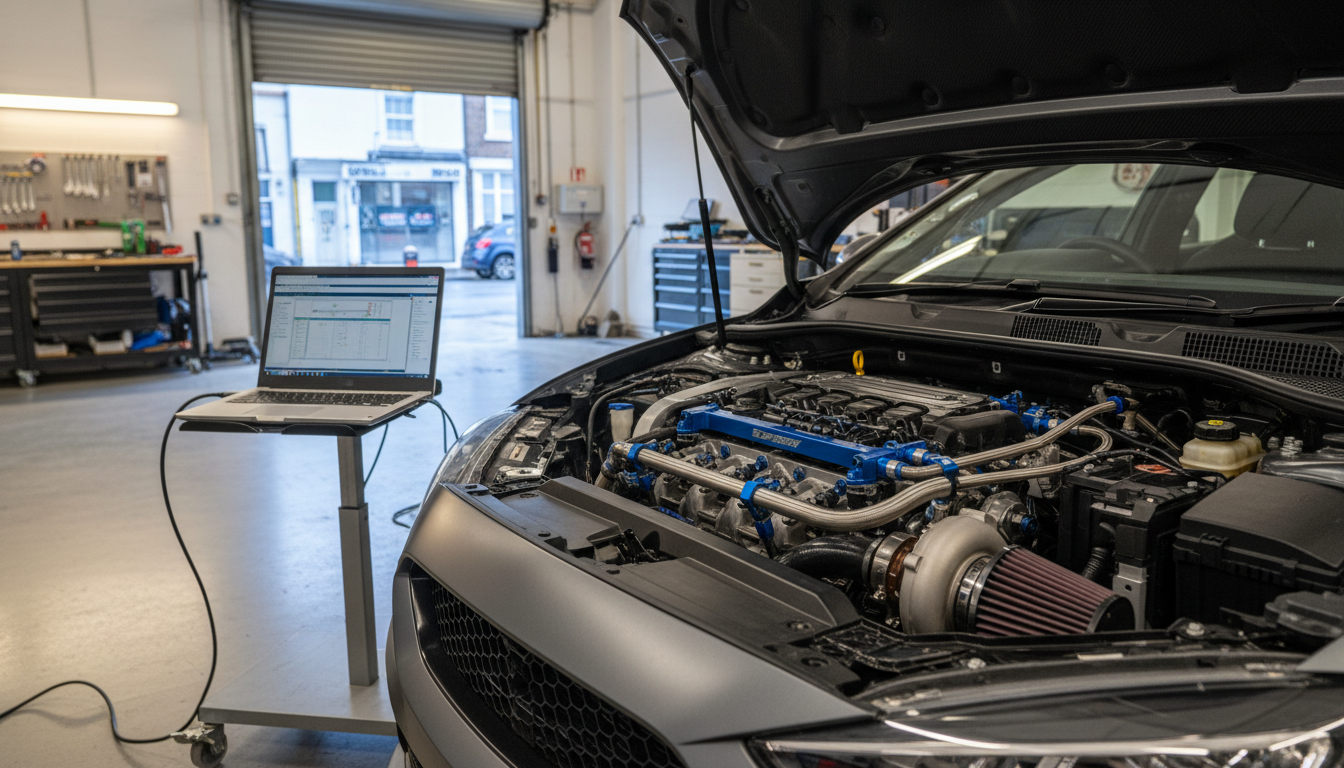
A fuel pump upgrade may be necessary when your tuned car starts demanding more fuel than the factory system can reliably supply. Whether you are running a Stage 2 remap, upgrading to a larger turbo or preparing your car for track days, sufficient fuel delivery is essential for reliable performance.
But does every tuned car need an uprated fuel pump or larger injectors? Not necessarily. A failing regulator, a blocked filter or a voltage drop can cause the same symptoms as a pump at its limit, and those need repairing rather than upgrading.
This UK fuel pump and injector upgrade guide explains the warning signs, how to choose between 255 lph and 340 lph pumps, injector sizing, fuel pressure requirements and what to check before buying performance fuel system components. We also cover popular UK performance cars, including the Honda Civic Type R, Mitsubishi Lancer Evolution, Nissan Silvia and Skyline, VW Golf GTI and Golf R, and Toyota GR Yaris, along with MOT, insurance and budgeting.
Explore our performance fuel system upgrades to find fuel pumps, injectors, fuel rails and related components for your build.
Quick Answer: Do You Need a Fuel Pump and Injector Upgrade?
Most cars on a mild Stage 1 remap do not need fuel system hardware. The need usually appears once you add a larger turbo, significantly raise boost, switch to ethanol blends or push an older engine well beyond its factory output. Use the table below as a starting point, then confirm with data logs from your tuner before you spend money.
| Your car and driving | Recommended starting point | Main compromise |
|---|---|---|
| Stage 1 remap on standard hardware, road use | Keep the factory fuel system; ask your tuner to log fuel pressure | None if logs are healthy |
| Stage 2 with intake, exhaust and intercooler | Log low-side and (if fitted) high-side pressure; uprated in-tank pump if pressure sags | Pump wiring and fitting time |
| Hybrid or bigger turbo, track days | Log first, then upgrade whichever part reaches its limit: the in-tank pump, the injectors, the HPFP on direct-injection engines, or more than one of them | Recalibration needed; idle and cold-start quality depend on the map |
| Ethanol blends or E85 conversion | Ethanol-compatible pump and injectors with plenty of headroom, plus a flex-fuel or dedicated map | Higher fuel consumption and fuel availability |
| Older port-injected JDM or Honda build | Vehicle-specific pump kit and matched injectors; check lines and regulator | Age of original wiring and fuel lines |
Final choice always depends on the manufacturer’s flow rating, fuel compatibility and fitment for your exact engine. Buy uprated fuel pumps from our range and check each listing against your model year and engine code. This guide covers petrol engines only; diesel and rotary fuel systems are outside its scope.
How a Petrol Fuel System Works
Before deciding what to upgrade, it helps to understand the chain of parts between the tank and the cylinder. Each one has a limit, and the weakest link sets the ceiling for the whole system.
- Low-pressure (lift) pump: usually an electric pump inside the fuel tank. On a port-injected engine it supplies the injectors directly; on a direct-injection engine it feeds the high pressure pump.
- Lines, filter and regulator: carry fuel forward and hold it at the pressure the ECU expects. Many port-injected turbo engines use a boost-referenced regulator, which raises fuel pressure as boost rises so the injectors can still push fuel into a pressurised manifold.
- High pressure fuel pump (HPFP): found on direct-injection engines and usually driven mechanically from a camshaft. It raises fuel to the very high pressures needed to spray straight into the combustion chamber.
- Fuel rail and injectors: the rail distributes fuel to each injector, and the ECU controls how long each injector stays open.
One point that catches people out is that a pump does not really “make” pressure on its own. As TI Automotive’s technical guidance explains, the pump supplies flow, and pressure is the result of that flow meeting the restriction of the rest of the system. That is why simply fitting an adjustable regulator and turning the pressure up rarely adds power on its own, and why pumps, lines, rail and injectors need to be chosen as a matched set.
Port Injection, Direct Injection and Dual Injection
Older performance engines such as the Mitsubishi 4G63, Nissan SR20DET and RB25DET, and naturally aspirated Honda K-series use port injection, where injectors spray into the intake runners. Upgrading these systems is well understood: an uprated in-tank pump, larger injectors and sometimes a better rail and regulator.
Most modern turbocharged engines use direct injection, and some use both systems together. Toyota’s GR Yaris engine, for example, uses the D-4ST system that combines direct and port injection, and many VW Group EA888 Gen 3 engines also carry both sets of injectors. On these engines the limit may be the low-pressure pump, the HPFP, the injectors, or a combination, so you need logs to see which part is running out first.
6 Signs You May Need a Fuel Pump or Injector Upgrade
A struggling fuel system tends to show itself under sustained high load, which means you are most likely to notice it on a long pull in a high gear, on a track day straight, or on a hot day with a low tank. Common symptoms include:
- Power that tails off or stutters at high rpm rather than pulling cleanly to the limiter.
- Logged fuel pressure that drops away from its target as rpm and boost climb.
- Air-fuel ratio readings that go leaner than the map is asking for at full load.
- Injector duty cycle (port injection) close to or at its maximum at peak power.
- On direct-injection engines, high-side rail pressure falling short of the requested value.
- Hesitation that is worse with a low fuel level, especially in long corners where fuel surges away from the pump pickup.
Do not diagnose a fuel problem by feel alone. Similar symptoms can come from boost leaks, ignition breakdown, a clogged filter, a tired factory pump or a weak electrical supply. A sensible tuner will log the car first, and that data is what should drive your parts list. Our Stage 1 vs Stage 2 vs Stage 3 tuning guide explains where fuel system hardware usually enters the picture as power targets rise.
Fuel Pump Upgrade: How to Choose the Right Pump
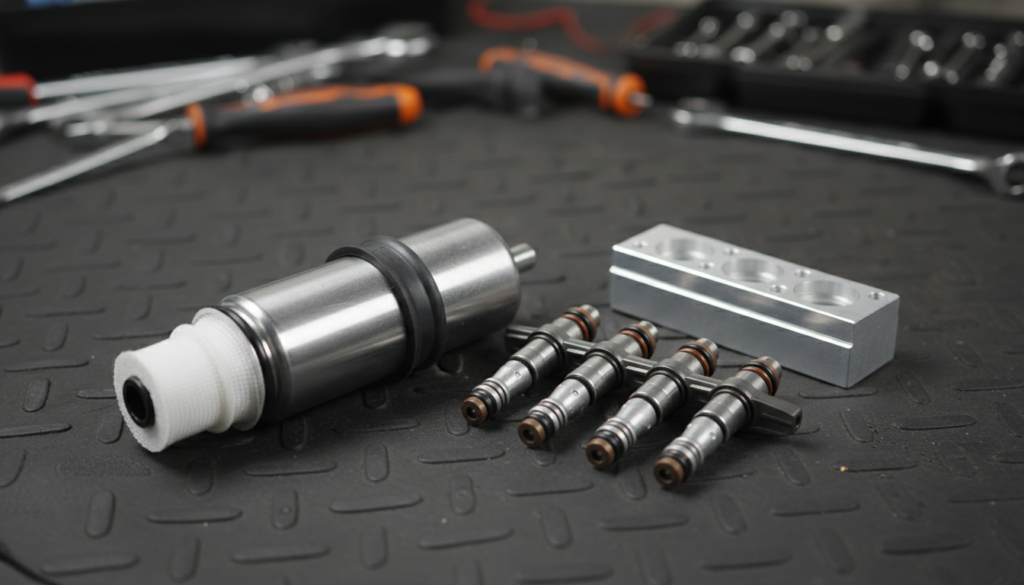
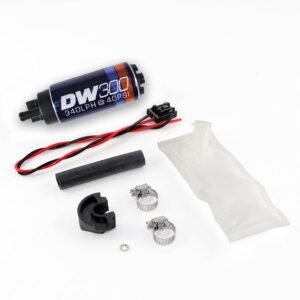
Pumps are usually advertised with a headline flow figure such as 255 or 340 litres per hour (lph). That number is useful for comparison, but it is only true at one particular pressure and voltage. As pressure rises, flow falls. The DeatschWerks DW300 technical sheet is a good example: the pump is rated at 340 lph at 40 psi, but the same sheet shows flow dropping to 235 lph at 100 psi, measured at 13.5 volts. On a boosted port-injected engine with a rising-rate regulator, the pump is working against base pressure plus boost, so the flow you can actually rely on at peak power is well below the headline figure.
When comparing pumps, look at:
- Flow at your real operating pressure, not just the headline rating. Ask for, or look up, the manufacturer’s flow chart.
- Fuel compatibility. If you plan to run ethanol blends, choose a pump the manufacturer states is ethanol or E85 compatible.
- Physical fitment. Vehicle-specific kits include the correct hanger, sock filter, wiring and isolators, which saves a lot of time compared with a universal pump.
- Electrical supply. A higher-flow pump usually draws more current. TI Automotive lists low pump voltage as a common cause of poor flow, so check the relay, earth, connectors and wiring, especially on older cars.
- Pump control. Many modern cars vary pump speed through the ECU or a pump control module. Check the replacement pump is suitable for the factory control strategy.
Bigger is not automatically better. An oversized pump returns more fuel to the tank, which can warm the fuel and adds noise and current draw for no gain. Choose a pump with sensible headroom over your target, not the largest one that fits.
High Pressure Fuel Pump Upgrade for Direct Injection
On direct-injection engines, an uprated in-tank pump only solves half the problem. If the HPFP cannot keep rail pressure up at peak power, you will need an upgraded high pressure pump, which is typically an engine-specific part fitted in place of the original on the cylinder head. These are calibration-sensitive, so they should always be fitted alongside a map written for them. Some dual-injection platforms can also add fuel through the port injectors, which tuners use to support higher power targets. There is no universal power figure at which an HPFP upgrade becomes necessary, because it depends on the engine, fuel, boost and how the calibration uses each set of injectors.
Fuel Injector Upgrade: Sizing for Your Tuned Engine
Injector size is described by flow, usually in cc per minute (cc/min) at a stated pressure. The ECU controls fuel delivery by changing how long each injector stays open, and on a port-injected engine this is expressed as duty cycle: the percentage of each engine cycle that the injector is open.
An injector running close to 100% is effectively stuck open with nothing left in reserve. Experienced tuners on HP Academy’s tuning forum generally aim for a maximum of around 80 to 85% duty at peak power, staying below 90%, so there is headroom for hot days, fuel quality variation and future changes. Older injector designs can also become less predictable when pushed very hard.
Things to check when choosing injectors:
- Flow rating and test pressure. Compare like with like, as flow figures quoted at different pressures are not directly comparable.
- Physical dimensions. Length, O-ring size and top/bottom feed must suit your rail and manifold. Adapters exist but add complexity.
- Connector type. Different plug styles are common, and a mismatch means adaptor pigtails or rewiring.
- Characterisation data. Quality injectors come with data your tuner can load into the ECU, which makes idle, cruise and cold-start behaviour much easier to get right.
- Matched sets. Flow-matched sets help each cylinder receive the same amount of fuel.
Oversizing injectors is a common mistake. Very large injectors can make small-throttle and idle fuelling harder to control, especially on older ECUs. Size them for your realistic target plus headroom, then let your tuner match the calibration. Shop performance fuel injectors in our range and check the flow rating and connector type on each listing.
E10, E85 and Ethanol: What Changes for Your Fuel System
Since September 2021, standard 95-octane unleaded in Great Britain has been E10, containing up to 10% ethanol, while E5 remains available as the super grade at many forecourts, according to the government’s E10 guidance. Many tuned cars are mapped for super unleaded, so check which fuel your calibration was written for and stick to it.
Higher ethanol blends such as E85 are popular with tuners because of their knock resistance and charge-cooling effect, but ethanol contains less energy per litre than petrol. The engine therefore needs a substantially greater volume of fuel for the same power, which puts more demand on every part of the fuel system. If you are considering ethanol:
- Use pumps, injectors, hoses and seals that the manufacturers state are ethanol compatible.
- Size pump and injectors with generous headroom, based on your tuner’s calculations for the blend you will actually run.
- Consider a flex-fuel sensor and map so the ECU can adapt to the ethanol content in the tank.
- Plan for availability. High-ethanol fuels are not sold at ordinary UK forecourts, so you may need a specialist supplier or a map that works on pump fuel as well.
- Expect higher fuel consumption on ethanol-rich blends.
Fuel Pump and Injector Upgrades for Popular UK Performance Cars
Every platform has its own fuel system layout and its own common limits. Rather than quoting power figures that vary from car to car, the table below lists what owners should check before buying parts.
| Vehicle family | Injection type | What to check |
|---|---|---|
| VW Golf GTI / Golf R, Audi S3 (EA888) | Direct injection; many Gen 3 variants also have port injectors | Confirm your engine code, log low- and high-side pressure, and check whether your tuner uses the port injectors before buying an HPFP or low-pressure upgrade |
| Toyota GR Yaris (G16E-GTS) | Combined direct and port injection (D-4ST) | Ask your tuner which part of the system limits your target; check ethanol plans and fuel grade the map expects |
| Mitsubishi Lancer Evo VII–IX (4G63) | Port injection | Condition of the original in-tank pump and its wiring; injector size versus target power; regulator and rail condition on older cars |
| Nissan S14 / S15 / R33 / R34 non-GTR (SR20DET, RB25DET) | Port injection | Age of the pump, wiring and rubber fuel lines; injector connector type and size when moving to bigger turbos |
| Honda Civic Type R EP3 / FN2 and K-series swaps | Port injection | Whether a pump kit is needed for your power or ethanol plans, rail and injector compatibility, and the ECU solution used to recalibrate |
Examples From Our Range
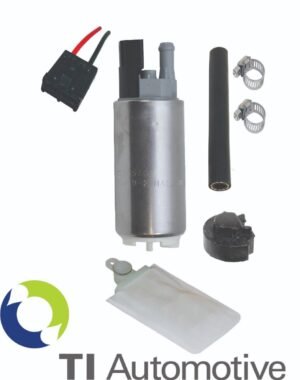
- Ti Automotive 255 lph fuel pump kit for the Mitsubishi Evolution VII–IX, a vehicle-specific in-tank upgrade.
- Sytec Motorsport 340 lph fuel pump upgrade kit for the Honda Civic Type R EP3 and Integra DC5.
- DeatschWerks DW300C fuel pump for the 10th-generation Honda Civic; check the listing for exact model and engine fitment.
- DeatschWerks 550cc fuel injectors for Honda K20/K24 and S2000 F22 engines.
- DeatschWerks DW420 fuel pump for the Mitsubishi Evo VII–IX, a higher-flow option for bigger Evo builds.
- Hybrid Racing K-Series fuel rail and fittings for the Honda Civic EP3 and Integra DC5.
Not sure which upgrade fits your car? Send us your vehicle model, year, engine code and target power via WhatsApp or email, and our team can help identify suitable fuel system components.
Supporting Mods and Fitting Tips
Fuel system hardware rarely goes on alone. It normally arrives alongside a bigger turbo or improved charge cooling, which is covered in our guide to turbo and intercooler upgrades. If you are still planning the wider build, see our guide to the best car modifications for more power. A few practical points help the fuel system job go smoothly:
- Book the map first. New injectors and HPFPs always need calibration changes, so plan the fitting and the remap together.
- Replace the in-tank filter sock and inline filter while the system is open; a blocked filter can mimic a weak pump.
- Upgrade the wiring if needed. A dedicated relay and heavier gauge feed are common additions on older cars running higher-flow pumps.
- Fit a fuel pressure gauge or sensor so you and your tuner can see what is happening during logging and on track.
- Keep fuel in the tank on track days. TI Automotive advises keeping at least a quarter of a tank to reduce the risk of fuel starvation, and long corners make surge worse when the level is low.
- Take fuel safety seriously. Work in a ventilated area, depressurise the system before disconnecting anything, and have a qualified technician fit high pressure components.
Fuel Pump Upgrade Cost UK: What Should You Budget For?
There is no single price for a fuel pump upgrade, because the total depends on your engine, how much power you want and how much of the system needs to change. A port-injected car that only needs an in-tank pump is a very different job from a direct-injection engine that needs a low-pressure pump, a high pressure pump and a new calibration. When you plan the budget, allow for each of these items:
- The pump itself, either a pump only or a vehicle-specific kit with hanger parts, sock filter and wiring.
- Injectors, usually bought as a matched set, plus any adaptors or connector pigtails your engine needs.
- A high pressure fuel pump on direct-injection engines, if logs show the factory HPFP is the limit.
- Supporting parts such as an inline filter, a relay and wiring upgrade, fuel lines, a regulator, a fuel rail and a pressure gauge or sensor.
- Fitting labour. Access to the in-tank pump varies a lot between cars, so ask your garage how long your model takes.
- Calibration and dyno time, which is needed whenever injectors or the HPFP change, and is often needed for a new pump too.
- Ethanol extras such as a flex-fuel sensor and ethanol-compatible hoses, if you plan to run high-ethanol blends.
You can see current prices on each product page in our range. For the labour and mapping, ask your tuner for a written quote that covers parts, fitting and calibration together, so there are no surprises once the car is on the ramp.
UK MOT, Emissions and Insurance
Fuel system upgrades are not illegal in themselves, but the car still has to pass the MOT and you need to keep your insurer informed.
- Leaks: the MOT inspection manual’s nuisance section lists excessive fluid leaks that could harm the environment or create a safety risk as a major defect. Any fuel leak after fitting new lines or a pump should be fixed immediately, MOT or not.
- Emissions and warning lamps: petrol cars are tested for exhaust emissions, and on later cars an illuminated or faulty engine management light is a major defect. Poorly matched injectors or a rushed calibration can cause both, so make sure your car runs cleanly on the map before the test.
- Emission control equipment: the same section allows testers to fail cars first used from September 2002 if original emission control components are missing or obviously modified, so keep catalysts and sensors in place.
- Insurance: specialist broker Howden advises declaring all modifications, including engine tuning, because undeclared changes can lead to a claim being refused or a policy being cancelled. Tell your insurer about the fuel system work and the remap that goes with it, and keep receipts.
Extra power also means more heat, so it is worth reviewing your cooling system at the same time. Our engine cooling upgrades guide explains when radiators, oil coolers and hoses are worth upgrading.
Fuel Pump and Injector Upgrade Checklist: Before You Buy and Fit
- Have your tuner log fuel pressure, air-fuel ratio and injector duty (or rail pressure) at full load first.
- Rule out boost leaks, a blocked filter, poor wiring and ignition faults.
- Set a realistic power target and fuel type before choosing parts.
- Check pump flow at your real operating pressure, not just the headline figure.
- Confirm ethanol compatibility if you plan to run blends beyond E5/E10.
- Match injector flow, dimensions and connector type to your engine and rail.
- On direct-injection engines, find out whether the HPFP, low-pressure pump or injectors limit first.
- Budget for calibration, filters, wiring and fitting, not just the parts.
- Pressure-test for leaks after fitting and re-check before the MOT.
- Tell your insurer about the modification and the remap.
Fuel Pump and Injector Upgrade FAQs
Does a Stage 1 remap require a fuel pump upgrade?
Not necessarily. Many petrol cars on a Stage 1 remap keep the factory pump and injectors because the standard system still has enough capacity. Your tuner should confirm this from fuel pressure and fuelling logs rather than assuming either way.
Is a 340 lph fuel pump better than a 255 lph pump?
A 340 lph pump can supply more fuel, but bigger is not automatically better. The right choice depends on your fuel pressure, supply voltage, engine demand, fuel type and fitment. Compare the manufacturers’ flow charts at your real operating pressure rather than the headline figures.
How do I know if my fuel injectors are too small?
Your tuner’s logs are the best guide. On a port-injected engine, injector duty cycle approaching its maximum at full load is the main warning sign, often alongside air-fuel ratios that go leaner than the map is asking for. Injectors at their limit cannot deliver the fuel the ECU requests, so the engine can run lean, which is unsafe. Have injector capacity checked before raising boost or power.
Do larger fuel injectors require an ECU remap?
Yes. Larger or different injectors need a matching ECU calibration and the correct injector characterisation data. Without it, starting, idle, fuel consumption and engine safety can all suffer.
How do I know whether my fuel pump is failing?
Hesitation, poor starting and a loss of fuel pressure are common signs. The same symptoms can also come from a blocked filter, a faulty regulator or wiring problems, so pressure testing, electrical checks and data logging are the reliable way to find the cause.
Can I fit a performance fuel pump to my daily driver?
Yes, as long as the pump suits your car, fuel type and the factory pump control system, and it is fitted correctly. A pump that is much bigger than you need can add noise, electrical load and fuel heating without any benefit.
Can an uprated fuel pump improve horsepower?
Not on its own. A fuel pump does not add power by itself; it gives the engine the fuel supply it needs to make more power safely once boost and the calibration are raised. If your factory pump is already keeping up with demand, fitting a bigger one will not change the power output.
How much does a fuel pump upgrade cost in the UK?
It depends on your car and how much of the fuel system needs to change. A straightforward in-tank pump swap on a port-injected engine is a much smaller job than a direct-injection upgrade involving a high pressure pump, new injectors and a fresh calibration. Check current part prices on our product pages, ask your tuner for a written quote that covers fitting and mapping, and use the budget list in the cost section above so nothing is missed.
Shop Fuel Pumps, Fuel Injectors and Fuel Rails

Conclusion
A fuel pump and injector upgrade is not something every tuned car needs, but once you move beyond a mild remap it is often what separates a car that is safe and consistent from one that runs lean when it matters. The right approach is to let data lead: log the car, find which part of the system is reaching its limit, then size the pump, injectors and any high pressure pump together for your realistic power target and fuel. Treat the parts and the calibration as one job, keep everything leak-free for the MOT, and declare the work to your insurer.
Ready to upgrade? Shop performance fuel system upgrades at performancecarsparts.co.uk, including pumps, injectors and rails for popular performance platforms. If you are unsure what fits your car or how big to go, contact our team via WhatsApp or email with your vehicle details and power target and we will help you choose the right parts.
Shop related performance parts

Explore related products
Always check the individual product listing for your vehicle and engine before ordering.