
Most enthusiasts reach for a shiny new intake manifold the moment they decide to turn up the boost. That instinct is usually wrong, and it is an expensive mistake to make early in a build. On the vast majority of turbo cars, an upgraded air intake manifold is the last induction component you should buy, not the first. The hardware that sits on top of the engine has to work with the intake, the intercooler and the calibration before it can deliver anything meaningful.
This analysis unpacks exactly when a performance manifold earns its money and when it is simply jewellery. You will learn why the manifold usually comes last, the three conditions where it genuinely helps, and what the evidence says about plenum volume and runner length. We also cover material choice, the sequencing rule that puts intake, intercooling and mapping first, how to judge whether your engine is manifold-limited, and the gaskets, hoses and fitment details to check before you order anything.
Why the Air Intake Manifold Is Usually the Last Induction Purchase
Before buying a performance manifold, trace the air path. The filter, air intake hose, turbo inlet, compressor, intercooler and charge pipework all sit upstream of the air intake manifold, so a restriction earlier in that chain caps whatever the plenum could add. Spend in the order the air flows.
Most turbo road cars at standard or mildly raised boost flow comfortably through the OEM plastic plenum. The binding constraints are usually charge cooling, fuel supply and calibration, not plenum volume. Cost per horsepower is the honest comparison, and in our experience a manifold swap scores poorly on it. On an unmodified car the change can easily disappear inside normal dyno repeatability.
The strongest published plenum-volume evidence remains a 2008 SAE study of a restricted, naturally aspirated 600 cc motorcycle engine, where peak power rose from 54 kW to 63 kW across the sizes tested. That is roughly 17 percent calculated from the reported figures rather than stated by the authors, and it belongs to a restricted NA race engine, not a turbocharged road car. Treat any turbo-specific percentage as unproven.
Be equally sceptical of vendor charts showing one pull before and one after, with no logged intake air temperature, no fixed boost target and no map control. Start with performance air intake and induction upgrades instead, and work downstream from there.
The Three Conditions Where a Performance Manifold Earns Its Money
With the air intake manifold established as the last induction purchase, the question becomes when it stops being last. Three conditions do the work.
A restrictive OEM plastic plenum. Thin moulded walls, minimal internal volume, sharp runner entries and a shape that was not designed primarily for flow. This is the one condition you can confirm from logs: a manifold air intake pressure that sits below target and falls further with rpm. The physics is unforgiving; once the smallest cross-section chokes flow, more boost cannot pass it (DesignJudges).
Poor runner design. Unequal lengths, tight bends, casting flash, stepped port transitions or a log plenum that starves end cylinders. In our experience, cylinder-to-cylinder scatter in fuel trims or per-cylinder EGT is the first thing worth checking; equal charge distribution is the design aim (Ilardo et al.).
Big boost targets. Well above standard, mass flow rises and the factory margin disappears, but only if intercooling and fuel supply are already ahead of the curve.
The triage rule: two conditions plus mapped supporting modifications, such as an exhaust upgrade, justify a controlled dyno test. One condition alone does not. And condition three can collapse if the turbo is already near the limit of its compressor map, because a manifold cannot add airflow the compressor does not supply.
Plenum Volume: What the Evidence Actually Shows
Once the conditions point at the plenum, the next question is how large it needs to be. The authors of the key study note there is very little information in the literature, which is why it matters. Hamilton and Lee (SAE 2008-01-3007) tested a restricted 600 cc four-cylinder with a 20 mm restrictor, plenum sizes from 1.2 to 6.0 litres and engine speeds from 3,000 to 12,500 rpm. The headline power gain is covered above, and it comes from a restricted normally aspirated race engine, so the thresholds are the more useful result. Performance increased modestly from two to eight times engine displacement, with significant improvement reported beyond eight times. That is steady-state behaviour; the authors explicitly state transient performance was not explored. For a turbo car, pressurised air means those displacement multiples are a starting principle, not a target volume to copy. The useful principle is headroom: once the air intake manifold plenum stops being the restriction, extra litres add nothing. Aim to remove a measured pressure drop, not buy the biggest box that fits. Apply the same evidence-first discipline when specifying exhaust pipes for performance cars.
Runner Length and Design Decide the Rev Range
Plenum volume is only half the story. Wave-resonance and Helmholtz theory make runner length the variable tuners can most easily predict in an air intake manifold swap: the pressure wave must complete its round trip within the valve-open window, so length sets which engine speed gets the volumetric-efficiency peak (DieselNet). Longer runners generally favour lower-rpm volumetric efficiency; shorter runners move the advantage higher, making a manifold a torque-band decision as much as a peak-power one.
Design type shifts that window too. As a rule of thumb, single-plane layouts are associated with higher engine speeds, while two-plane designs usually target a broader lower-rpm band. Independent-runner setups can be rpm-limited and prone to fuel stand-off from reversion, where exhaust residue flows back into the manifold until cylinder and manifold pressures equalise, so check cam overlap before choosing one.
On a turbo car, the turbine already masks much of the exhaust-side tuning effect, so expect runner length to move the torque curve rather than unlock a large peak gain. Treat that as inference from tuning principles, not a measured turbo result. If you are still assembling the supporting package, read supporting mods for a bigger turbo before choosing runner length.
Material Choice: OEM Plastic Plenums Versus Aluminium
Runner geometry is only half the decision. Material choice sets what the manifold can do thermally and how easily it can be modified.
OEM plastic is generally thought to heat-soak less than metal, which may help charge temperature recover faster after a standstill. Its limits are fixed volume, difficulty modifying it, and a risk of cracking or splitting under sustained high boost and heat cycling.
Cast aluminium gives volume, porting headroom and bosses for sensors and injectors, but it heat-soaks, weighs more, and you should check it for casting flash and misaligned runner entries before fitting. Recent modelling of a turbocharged four-cylinder treats the plenum and charge cooler as one integrated assembly, which shows how much behaviour changes when you alter the box. Fabricated sheet-metal manifolds offer the most shape freedom of the common constructions, so weld quality, internal tidy-up and a properly machined throttle body flange matter more than the material badge.
Whatever the material, confirm injector bosses, IAT ports, and PCV and breather take-offs.
No supplied source quantifies material effects on a turbo road car. Treat dramatic charge-cooling or flow claims without before-and-after IAT logs as marketing until proven. If you are spending on induction while you gather that evidence, an aftermarket exhaust system guide is a useful parallel read on sequencing.
Intake, Intercooling and Mapping Come First: The Sequencing Rule
Material choice settles what the part is made of. Sequence settles whether it can add anything. We recommend working the air intake side first: filter, pipework and air intake hose. Those are the parts that set the ceiling for whatever the manifold can add, so they should already be on the car before the manifold is.
Charge cooling comes second. Manifold pressure only becomes airflow when the air is dense, and a heat-soaked intercooler hides the gain a larger plenum is meant to release. If your standard or top-mount cooler is already marginal, read our front-mount intercooler upgrade guide before funding a manifold.
Mapping comes third and is not optional. A manifold swap alters volumetric efficiency and the MAP or MAF scaling the ECU depends on, so expect to see fuel trim drift, boost error and possibly a check-engine light unless the map is corrected. On the dyno, test in fixed order with the same boost target, intake air temperature and ambient conditions. Otherwise you cannot separate the manifold from the map and the weather. Only after intake, intercooling and mapping are complete is the manifold’s own restriction likely to show clearly in logs. That is a big reason some owners see little gain from one.
How to Tell Whether Your Engine Is Manifold-Limited
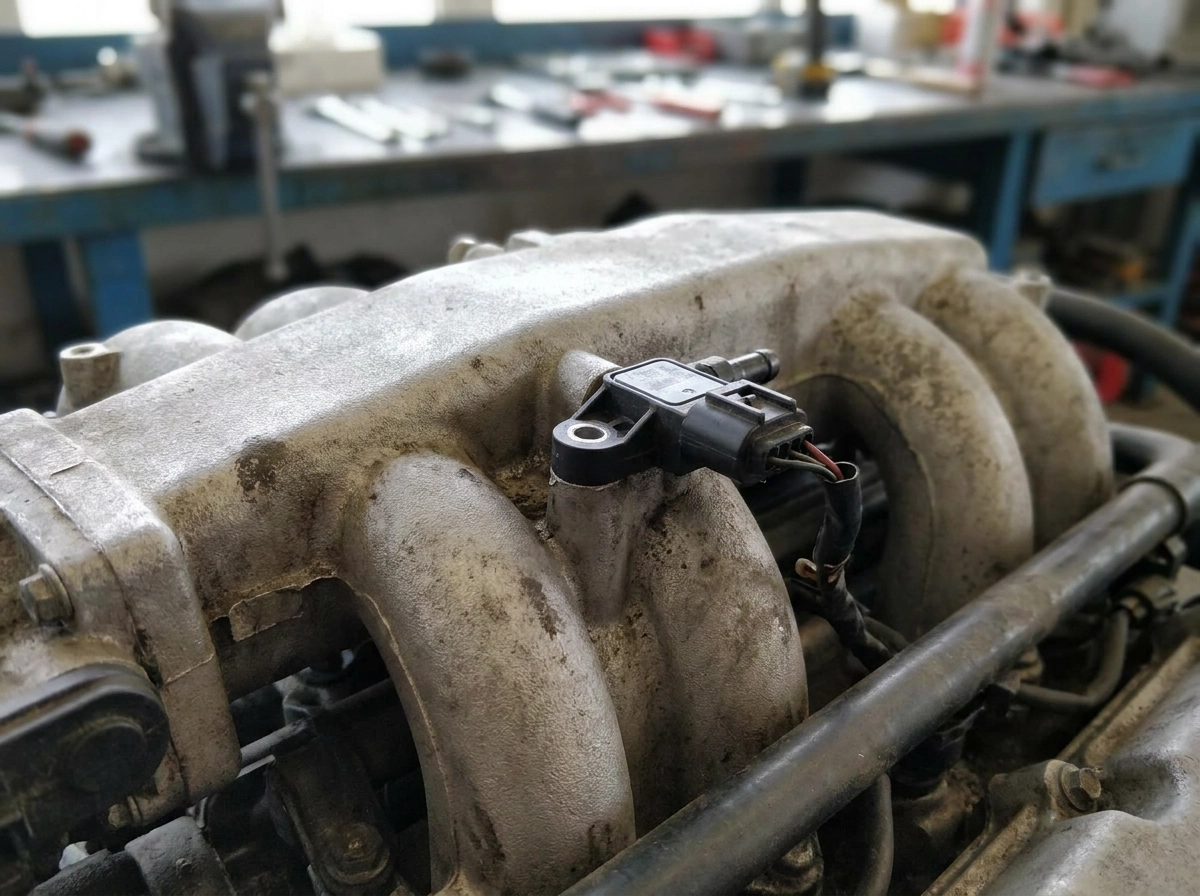
Once intake, charge cooling and mapping are sorted, diagnosis has to be evidence-led. Our working method starts by logging manifold absolute pressure at the plenum against the boost target the map requests. A flat gap suggests a sensor or calibration fault; a gap that widens with rpm points to a restriction. Next, measure pressure drop across the throttle body, then separately across the pipework and intercooler. If most of the drop occurs upstream, the manifold is not your bottleneck and no purchase will fix it. Check cylinder balance using per-cylinder fuel trims or exhaust gas temperature probes. Scatter at the top end can point to uneven runner feeding on a factory plenum. Watch high-rpm boost taper, which points back to the compressor limit covered earlier. Finally, book a rolling road with proper airflow and run a repeatable baseline, ideally several pulls, logging boost, intake air temperature and power together. A single before-and-after pull is not evidence. If you are reviewing the exhaust side alongside induction, our exhaust replacement guide covers OEM versus performance systems for UK drivers.
Gaskets, Hoses and Fitment Before You Order the Manifold
Once you have evidence the manifold is the restriction, the parts you order around it decide whether the swap works. Start with the air intake gasket: match port shape and material type, check whether a thicker thermal gasket misaligns the runner entry, and confirm the original studs are long enough for the new flange thickness.
Choose the air intake hose by bore, bend angle and take-off points, not colour. Silicone generally resists heat and vacuum collapse better than aged rubber, and a smooth internal bore usually beats a ribbed one. This matters as much as the open intake you feed it.
Torque the manifold in the OEM sequence with a calibrated wrench. Aluminium flanges can warp under uneven clamping, a known source of post-fit vacuum leaks and rough idle. Before the ramp, check service access: dipstick, oil filler, coolant hoses, brake reservoir, bonnet clearance, throttle body connector reach and MAP sensor plug orientation.
Have the full kit on the bench: gasket, hose, correct clamps, new studs and nuts, thread sealant and spare injector O-rings. Performance Cars Parts sells engine and forced-induction parts as a UK-based online-only retailer, with email and WhatsApp support for confirming fitment before you commit.
The Verdict: Buy the Manifold Last, and Only With Evidence
With fitment checks done, the purchasing decision should be equally disciplined. If your turbo car runs standard or lightly raised boost on a plastic plenum that logs no widening pressure drop, stop. Put the money into the air intake side, intercooling and mapping instead. A manifold here is expensive noise.
If logs show a restrictive plenum, uneven runner feeding or a boost target well beyond factory, prove it before ordering. Then test it under the fixed-boost, logged conditions described above.
Budget supporting parts in fitment order: air intake gasket, air intake hose, clamps and studs, then the remap that corrects the new manifold air intake calibration. Without that remap, fuel trims and boost error will mislead you.
Log first, then confirm fitment before you order.
Conclusion
A performance intake manifold is a supporting part on a turbo car, not a starting point. Three takeaways matter most. First, let evidence lead: log the pressure drop, check runner feeding and confirm your boost target genuinely exceeds what the factory plenum can handle before spending. Second, sequencing beats speculation, so intake, intercooling and mapping come first, and any new manifold needs a calibration remap to stop fuel trims and boost error misleading you. Third, fitment counts as much as flow: gaskets, hoses, clearances and sensor reach decide whether the part ever works properly.
Your next step is simple. Log a fixed-boost pull, compare intake air temperature and pressure drop, then email or WhatsApp Performance Cars Parts to confirm fitment before ordering from their engine and forced-induction range.
Buy the manifold last, and only when your own data asks for it. That discipline turns a parts list into a faster, better-sorted car.
Shop related performance parts

Explore related products



Always check the individual product listing for your vehicle and engine before ordering.