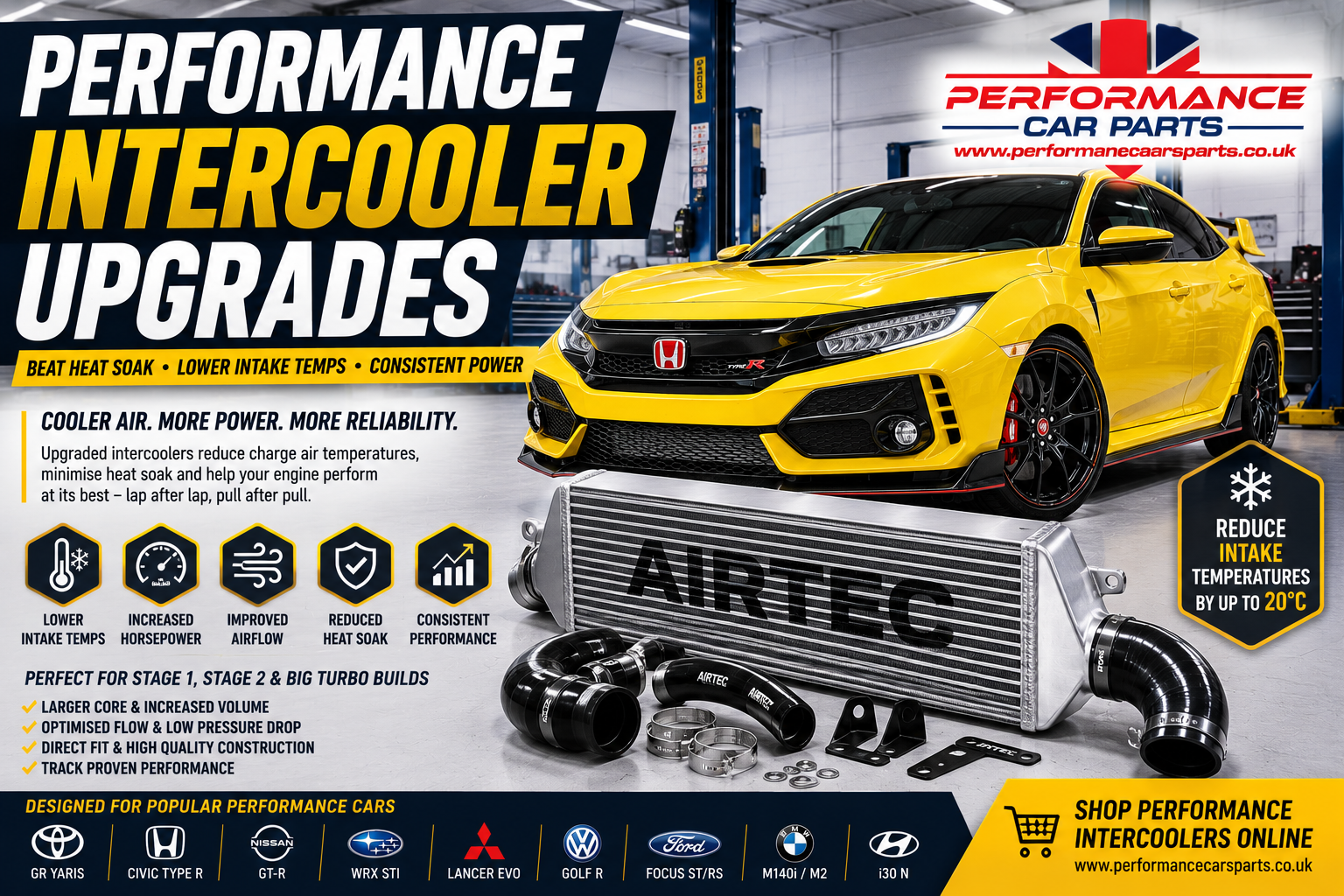
Performance Intercooler Upgrades UK – Complete Guide for Turbocharged Cars
Modern turbocharged performance cars can produce impressive horsepower from relatively small engines.
Cars such as the Toyota GR Yaris, Honda Civic Type R, Volkswagen Golf R, Hyundai i30 N, Ford Focus ST/RS, BMW M140i, Toyota GR Supra, Subaru WRX STI, Mitsubishi Evo and Nissan GT-R all rely heavily on forced induction.
But turbocharging creates a challenge:
Heat.
Compressing intake air increases its temperature.
As boost pressure and engine load increase, controlling charge-air temperature becomes increasingly important.
This is where the intercooler comes in.
A quality performance intercooler upgrade can help reduce charge-air temperatures, resist heat soak and provide more consistent performance during repeated acceleration or demanding driving.
But does every turbocharged car need a bigger intercooler?
Does an intercooler actually increase horsepower?
And should you upgrade your intercooler for Stage 1 or Stage 2 tuning?
This Performance Cars Parts UK guide explains everything you need to know.
What Is an Intercooler?
An intercooler is a heat exchanger used on forced-induction engines.
Its job is to cool the compressed air produced by the:
Turbocharger
or
Supercharger
before that air enters the engine.
You can think of an intercooler in a similar way to a radiator, although it performs a different job.
A radiator primarily removes heat from engine coolant.
An intercooler removes heat from the compressed intake charge.
Why Does a Turbocharger Heat the Air?
A turbocharger uses exhaust-gas energy to drive a turbine.
That turbine spins a compressor.
The compressor forces additional air into the engine.
This allows the engine to burn more fuel and potentially produce more power.
However, compressing air raises its temperature.
Higher boost levels can increase this thermal challenge further, especially when a turbo is operating outside its most efficient range. Garrett notes that increasing turbo speed to generate more boost can reduce compressor efficiency and raise charge-air temperature, increasing the likelihood of intercooler heat soak.
This is why intercooling is so important on tuned turbocharged engines.
What Does an Intercooler Actually Do?
Hot compressed air enters the intercooler.
Heat is transferred away from the charge air.
Cooler air then leaves the intercooler and travels towards the engine.
The aim is to provide the engine with a cooler, denser and more consistent intake charge.
A well-designed intercooler must do two jobs effectively:
Remove heat
while
Maintaining efficient airflow.
Too much restriction across the intercooler can increase the work required from the turbocharger. Garrett specifically highlights the importance of balancing heat rejection against pressure drop.
What Is a Performance Intercooler?
A performance intercooler is designed to improve upon the capabilities of the original factory intercooler.
Depending on the application, upgrades may include:
- Larger core
- Increased frontal area
- Increased core volume
- Improved internal fin design
- Larger inlet and outlet sizes
- Improved end tanks
- Better airflow distribution
- Stronger construction
Many vehicle-specific aftermarket intercoolers are designed to install in the factory location.
Others use a larger front-mounted arrangement.
What Is a Front Mount Intercooler?
A front mount intercooler, commonly abbreviated to FMIC, is positioned towards the front of the vehicle where it can receive airflow.
Front-mounted intercoolers are extremely common on modified turbocharged cars.
You’ll often see searches such as:
FMIC kit
front mount intercooler UK
performance FMIC
turbo intercooler kit
Stage 2 intercooler
A front-mount setup can provide substantial cooling capacity when correctly sized and installed.
What Is Heat Soak?
Heat soak is one of the most important terms to understand when modifying a turbocharged car.
During repeated acceleration, track driving or extended high-load operation, the intercooler absorbs increasing amounts of heat.
Eventually it may become so hot that its ability to cool the incoming charge air is reduced.
This is commonly described as heat soak or heat saturation.
The result can be progressively increasing intake temperatures.
Garrett’s testing on a 2.3-litre EcoBoost application demonstrated this clearly: the factory intercooler reached a higher outlet temperature and saturated earlier than the upgraded intercooler during repeated dyno pulls.
Why Is Heat Soak Bad?
When intake temperatures rise, several things can happen.
Depending on the vehicle and ECU strategy, the engine-management system may respond by reducing performance to protect the engine.
This can involve changes to:
- Ignition timing
- Boost
- Torque targets
- Engine protection strategies
This means a car that feels strong during the first acceleration run may feel less consistent after several repeated pulls.
For fast-road and track cars, consistency is one of the biggest reasons to upgrade the intercooler.
Does a Bigger Intercooler Increase Horsepower?
Potentially.
But the answer requires some explanation.
A performance intercooler does not create power in the same way that increasing boost pressure or adding fuel does.
Instead, it improves the thermal conditions under which the engine operates.
Cooler intake air can help the engine maintain more favourable operating conditions.
On some applications, measurable power improvements can occur even without additional tuning.
For example, Garrett’s published Civic Si testing recorded peak gains of 17 hp and 14 lb-ft after fitting its intercooler during its specific test procedure. That should be treated as a vehicle-specific example, not a universal expectation for every intercooler or car.
Will Every Intercooler Add 10–20 BHP?
No.
Never assume a fixed horsepower gain.
The result depends on:
- Vehicle
- Engine
- Turbocharger
- Boost pressure
- Standard intercooler efficiency
- Ambient temperature
- ECU calibration
- Other modifications
- Testing conditions
A lightly driven standard car with an efficient factory intercooler may show little difference during ordinary use.
A heavily tuned turbocharged car suffering significant heat soak may benefit considerably more.
Bigger Isn’t Automatically Better
It’s tempting to assume:
Bigger intercooler = better intercooler.
That isn’t always true.
An intercooler must be correctly engineered for the airflow requirements of the engine.
Factors include:
- Core dimensions
- Internal design
- Fin density
- End-tank design
- Pressure drop
- Airflow distribution
- External airflow
- Turbocharger capability
An enormous poorly designed core can potentially introduce unnecessary restriction.
Garrett’s intercooler engineering documentation emphasises balancing cooling surface area with airflow efficiency and controlled pressure drop.
So choose an intercooler designed around the vehicle and expected power level rather than simply buying the largest unit available.
What Is Intercooler Pressure Drop?
Pressure drop describes the reduction in charge pressure as air travels through the intercooler.
Some pressure loss is unavoidable.
However, excessive pressure drop is undesirable because the turbocharger may have to work harder to achieve the desired manifold pressure.
A quality performance intercooler therefore aims to achieve:
Strong cooling performance + Low/controlled pressure drop
rather than focusing exclusively on one characteristic.
Bar-and-Plate vs Tube-and-Fin Intercoolers
Two common intercooler construction styles are:
Bar-and-Plate
Common in aftermarket performance applications.
Potential characteristics include:
- Robust construction
- High thermal capacity
- Strong performance potential
Tube-and-Fin
Often lighter and widely used in OEM applications.
Potential advantages can include:
- Lower weight
- Good airflow
- Efficient packaging
Neither construction method is automatically superior in every situation.
Core design and application matter enormously.
Air-to-Air vs Air-to-Water Intercoolers
There are also different methods of removing heat from the intake charge.
Air-to-Air Intercooler
Uses ambient airflow passing through the intercooler core.
This is the traditional FMIC arrangement found on many turbocharged performance cars.
Advantages include:
- Relatively simple system
- No additional coolant circuit required
- Proven design
- Strong performance potential
Air-to-Water Intercooler
Also called an air-to-liquid intercooler or, in some applications, a chargecooler.
This system transfers heat from the intake charge into a liquid cooling circuit.
These systems can be compact and effective but require additional components such as:
- Coolant
- Pump
- Heat exchanger
- Reservoir
- Pipework
Some modern high-performance engines use air-to-water systems from the factory.
What Is a Chargecooler?
The term chargecooler is commonly used for an air-to-water charge-air cooling system.
BMW S55-powered models are a good example of vehicles for which upgraded chargecoolers are available.
Current aftermarket S55 systems are specifically designed to increase cooling capacity and resistance to power-reducing heat soak on modified M2 Competition, M3 and M4 applications.
Stock Intercooler vs Performance Intercooler
A factory intercooler must satisfy manufacturer requirements involving:
- Cost
- Packaging
- Weight
- Standard engine output
- Production volume
- Everyday driving
- Crash structure
- Air-conditioning/radiator airflow
For a standard road car, the factory unit may be entirely adequate.
But when you increase:
Boost
Power
Track usage
or
Repeated high-load driving
the thermal demands can exceed what the original system was designed around.
This is where an upgraded intercooler becomes more attractive.
Do I Need an Intercooler for Stage 1?
Not necessarily.
Stage terminology varies between tuners, so there is no universal answer.
Some Stage 1 calibrations are specifically designed for standard hardware.
However, increasing boost can increase charge-air temperature.
If your vehicle is known to suffer from heat soak, an upgraded intercooler may improve consistency even at Stage 1.
This can be especially useful if you:
- Drive hard regularly
- Attend track days
- Drive during warmer weather
- Perform repeated acceleration runs
Always follow the requirements of your tuner.
Do I Need an Intercooler for Stage 2?
On many turbocharged platforms, an upgraded intercooler becomes increasingly worthwhile at Stage 2.
Again, Stage 2 isn’t an industry-standard specification.
But it commonly involves supporting hardware such as:
Performance intake
Exhaust/downpipe
Intercooler
and
ECU calibration
UK performance manufacturers specifically market larger intercoolers for remapped and Stage 2 applications because of the increased thermal demands.
Does an Intercooler Need a Remap?
Usually, fitting a direct-replacement intercooler alone does not automatically mean the ECU must be remapped.
However, the exact requirements depend on the vehicle.
The greatest benefit may be achieved when the intercooler is combined with appropriate tuning and supporting modifications.
If your car already has a performance calibration, always check that the intercooler specification suits the tune.
Can an Intercooler Be Too Big?
Potentially.
A poorly matched intercooler can introduce:
- Excessive pressure drop
- Unnecessary volume
- Packaging problems
- Increased weight
- Reduced airflow to other heat exchangers
The objective isn’t to install the largest intercooler that physically fits behind the bumper.
The objective is to install the correct intercooler for the engine’s airflow and cooling requirements.
Does a Bigger Intercooler Increase Turbo Lag?
This is a common concern.
Increasing charge-system volume can theoretically affect transient response.
However, real-world behaviour depends heavily on:
- Core design
- Pipe diameter
- Pipe length
- Turbocharger
- Engine
- Boost level
- Intercooler pressure drop
A properly designed vehicle-specific intercooler system should consider these factors.
Don’t judge an intercooler solely by external dimensions.
Intercooler Upgrade vs Cold Air Intake
These modifications perform different jobs.
Cold Air Intake
Improves or changes the way air enters the turbocharger/engine.
Intercooler
Cools compressed air after it leaves the turbocharger.
On a tuned turbocharged car, the two upgrades can complement each other.
A common performance combination is:
Cold Air Intake → Turbocharger → Performance Intercooler → Engine
Intercooler vs Radiator
These are often confused.
Intercooler
Cools intake charge air.
Radiator
Cools engine coolant.
A heavily modified vehicle may require upgrades to both systems.
For track cars, overall thermal management can include:
Intercooler
Radiator
Oil cooler
Transmission cooler
and other heat-management components.
Should You Upgrade Intercooler Hoses?
A performance intercooler can also be combined with upgraded boost hoses and charge pipes.
Potential benefits can include:
- Increased durability
- Compatibility with higher boost
- Improved airflow path
- Reduced risk of old hose failure
- Improved engine-bay appearance
Silicone hoses are particularly popular on modified turbocharged vehicles.
What Are Intercooler Hard Pipes?
Some cars use restrictive or flexible factory charge pipes.
Performance hard-pipe kits may replace these with:
Aluminium
or other rigid pipework.
Depending on the application, this can provide:
- Stronger construction
- Improved durability
- Smoother airflow path
- Larger diameter
- Better compatibility with increased boost
Best Intercooler for Toyota GR Yaris
The Toyota GR Yaris is one of the most popular modern tuning platforms in the UK.
Common searches include:
GR Yaris intercooler
GR Yaris intercooler upgrade
GR Yaris FMIC
GR Yaris Stage 2 intercooler
GR Yaris cooling upgrades
The turbocharged G16E-GTS engine responds well to tuning, making charge-air cooling an important consideration as power increases.
A modified GR Yaris may combine:
Intake + Intercooler + Exhaust + ECU Calibration
with additional upgrades depending on the target power level.
Best Intercooler for Honda Civic Type R
Turbocharged Civic Type R models have extensive intercooler support.
Popular searches include:
FK8 intercooler
FK8 intercooler upgrade
FL5 intercooler
Civic Type R FMIC
Civic Type R intercooler upgrade
These cars can see increased thermal demands when boost and power are raised.
An intercooler upgrade can therefore be attractive for fast-road and track-focused builds.
Best Intercooler for Volkswagen Golf R & GTI
The Volkswagen EA888 platform is one of the UK’s most popular tuning platforms.
Popular searches include:
Golf R intercooler
Golf R intercooler upgrade
MK7 Golf R intercooler
MK8 Golf R intercooler
Golf GTI intercooler
EA888 intercooler
Aftermarket manufacturers offer larger intercooler systems specifically for tuned EA888 applications, including current Gen 4 systems aimed at fast-road and track use.
Best Intercooler for BMW M140i & B58
BMW’s B58 engine is extremely popular with UK tuners.
Common searches include:
M140i intercooler
B58 intercooler upgrade
BMW M240i intercooler
BMW 340i intercooler
However, cooling-system architecture varies between BMW generations and engines.
Some applications use air-to-water charge cooling rather than a conventional front-mounted air-to-air intercooler.
Always identify the exact engine and cooling arrangement before purchasing.
BMW M2, M3 & M4 Chargecooler Upgrades
Performance BMW applications can use chargecooler systems.
Popular searches include:
BMW M3 chargecooler
BMW M4 chargecooler
S55 chargecooler
M2 Competition chargecooler
For example, Garrett offers an air-to-liquid performance intercooler for F80/F82/F83 M3/M4 applications, while other manufacturers offer enlarged chargecoolers for S55-powered cars.
Best Intercooler for Ford Focus ST & RS
Ford EcoBoost vehicles have a large UK tuning community.
Popular searches include:
Focus ST intercooler
Focus ST FMIC
Focus RS intercooler
Focus ST Stage 2 intercooler
Aftermarket manufacturers specifically offer larger front-mount systems for tuned Focus applications to improve charge-air temperature control.
Subaru WRX STI Intercooler Upgrades
Subaru owners may encounter two common intercooler layouts:
Top Mount Intercooler – TMIC
and
Front Mount Intercooler – FMIC
Popular searches include:
Subaru STI intercooler
WRX STI top mount intercooler
Subaru FMIC
STI front mount intercooler
A larger top-mount intercooler can retain a more factory-style arrangement.
A front-mount system may be chosen for more extensively modified builds.
The correct solution depends on the vehicle and power target.
Mitsubishi Evo Intercooler Upgrades
The Mitsubishi Lancer Evolution has long been associated with large front-mounted intercoolers.
Common searches include:
Evo intercooler
Evo 8 intercooler
Evo 9 intercooler
Evo X intercooler
Mitsubishi Evo FMIC
As turbocharger and boost levels increase, intercooler sizing and pressure drop become increasingly important.
Nissan GT-R R35 Intercooler Upgrades
The R35 GT-R uses twin turbochargers and has enormous tuning potential.
Popular searches include:
GT-R intercooler
R35 intercooler upgrade
GT-R intercooler kit
R35 cooling upgrades
Higher-power GT-R builds can require significantly greater charge-air cooling capacity.
For these applications, intercooler selection should be matched carefully to:
Turbo size + Airflow + Boost + Target horsepower
Hyundai i30 N & i20 N Intercooler Upgrades
Hyundai’s N models have developed a strong UK enthusiast following.
Common searches include:
i30 N intercooler
Hyundai i30 N FMIC
i20 N intercooler
Hyundai N intercooler upgrade
These turbocharged platforms can benefit from improved thermal management when tuned or driven hard.
Best Performance Intercooler Brands
Depending on vehicle application, enthusiasts may encounter brands including:
AIRTEC Motorsport
Mishimoto
Garrett
Wagner Tuning
Forge Motorsport
HKS
GReddy
do88
CSF
PWR
Different manufacturers use different core designs and engineering approaches.
Rather than selecting solely by brand or size, consider:
- Tested temperature reduction
- Pressure drop
- Vehicle fitment
- Core construction
- Power capability
- Installation requirements
Is a Performance Intercooler Worth It?
For many tuned turbocharged cars, yes.
An intercooler becomes particularly attractive when:
- Boost has been increased
- The vehicle is remapped
- You regularly drive hard
- The car attends track days
- Intake temperatures rise rapidly
- Power drops after repeated acceleration
- A larger turbo is planned
On a completely standard road car driven gently, the factory intercooler may be sufficient.
But as the vehicle’s performance increases, charge-air cooling becomes increasingly important.
Signs You May Need an Intercooler Upgrade
Possible reasons to consider an upgrade include:
Performance Drops When the Car Gets Hot
This can indicate thermal limitations.
Your Car Is Remapped
Higher boost can increase charge temperatures.
You’re Moving to Stage 2
Many Stage 2 builds include upgraded charge cooling.
You Attend Track Days
Repeated high-load operation can expose heat-soak problems.
You’re Installing a Bigger Turbo
Greater airflow and power can require increased cooling capacity.
You Want More Consistent Performance
Consistency is one of the biggest benefits of improved thermal management.
Performance Intercooler Upgrade Path
Level 1 – Standard Turbo Road Car
Factory intercooler may be sufficient.
Monitor condition and performance.
Level 2 – Stage 1 / Fast Road
Performance intercooler can help improve thermal consistency, particularly on platforms known for heat soak.
Level 3 – Stage 2
Performance intercooler
Performance intake
Exhaust upgrades
ECU calibration
Upgraded boost hoses where appropriate
Level 4 – High-Power Build
Large performance intercooler
High-flow charge pipes
Larger turbocharger
Fuel-system upgrades
Performance intake
Exhaust system
Oil/coolant cooling upgrades
Custom ECU calibration
The exact requirements depend on the vehicle.
Buy Performance Intercoolers in the UK
Looking for a performance intercooler or intercooler upgrade in the UK?
At Performance Cars Parts UK, you can find performance cooling and forced-induction components for a wide range of Japanese and European performance vehicles.
Shop for:
Performance Intercoolers
Front Mount Intercooler Kits
FMIC Kits
Chargecoolers
Intercooler Hoses
Silicone Boost Hoses
Charge Pipes
Cooling Upgrades
and other turbo performance components.
Find performance parts for vehicles including:
Toyota GR Yaris
Honda Civic Type R
Toyota GR Supra
Nissan GT-R
Subaru WRX STI
Mitsubishi Evo
Volkswagen Golf GTI / Golf R
BMW Performance Models
Ford Focus ST / RS
Hyundai i20 N / i30 N
and many more.
Visit:
www.performancecarsparts.co.uk
and search by vehicle or part number to find compatible performance cooling upgrades.
Frequently Asked Questions
Does a bigger intercooler increase horsepower?
It can help maintain or improve power by reducing charge-air temperatures, particularly where the original intercooler is thermally limited. Actual gains vary significantly between vehicles and setups.
What is intercooler heat soak?
Heat soak occurs when the intercooler becomes thermally saturated and its ability to reduce charge-air temperature declines during sustained or repeated high-load use.
Do I need an intercooler for Stage 1?
Not always. Some Stage 1 tunes are designed for factory hardware, but an upgraded intercooler may improve consistency on vehicles that suffer from high intake temperatures.
Do I need an intercooler for Stage 2?
It is commonly recommended or required on many Stage 2 turbocharged applications, but the exact requirements depend on the tuner and vehicle.
Will an intercooler make my car faster?
Potentially, particularly when the factory intercooler is limiting performance through high charge temperatures. However, don’t assume a fixed horsepower increase.
Can an intercooler be too big?
Yes. Correct sizing, pressure drop, core design and airflow are more important than simply installing the largest possible core.
Does a bigger intercooler cause turbo lag?
Changes in charge-system volume can influence response, but the real-world effect depends on core design, pipework, pressure drop, turbocharger and engine.
What is the difference between an intercooler and a radiator?
An intercooler cools compressed intake air. A radiator primarily cools engine coolant.
What is the difference between an intercooler and a chargecooler?
“Chargecooler” commonly refers to an air-to-water charge-air cooling arrangement, while conventional FMIC systems are usually air-to-air.
Should I upgrade my intercooler before a bigger turbo?
In many builds, improving charge-air cooling is an important supporting modification before or alongside a larger turbocharger.