










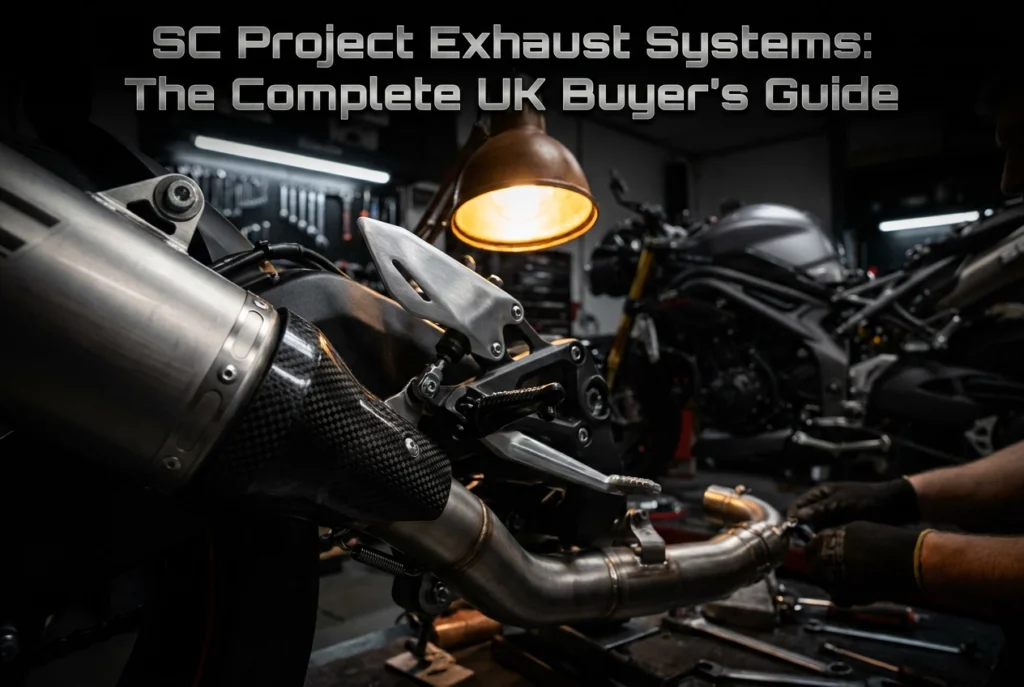
There is a reason serious riders across the UK keep coming back to one name when it comes to performance exhausts. An SC Project exhaust is not simply a bolt-on upgrade; it represents a genuine transformation in how your motorcycle sounds, performs, and feels beneath you.
Born in Italy and trusted by MotoGP teams, SC Project has built a reputation that extends far beyond the racetrack. Whether you ride a naked streetfighter, a sports tourer, or a full-blooded superbike, there is a system designed specifically for your machine. But with so many options available, including slip-ons, full systems, titanium, carbon, and stainless steel variants, knowing where to start can feel overwhelming.
That is exactly why we put this guide together. Over the following sections, you will discover the key differences between product lines, understand what to look for when buying in the UK, learn about noise regulations and road legality, and find out which systems offer the best value for your budget. By the end, you will have everything you need to make a confident, informed purchase.
The SC Project Exhaust Range Explained
Understanding the SC Project range starts with a fundamental choice: a full exhaust system or a slip-on silencer. A slip-on replaces only the muffler section, bolting directly onto your existing headers and mid-pipe. It delivers noticeable sound and modest weight benefits with a straightforward installation, making it the practical choice for street riders who want improved character without a full strip-down. A full system replaces everything from the headers back, unlocking maximum performance gains through improved exhaust gas scavenging, better throttle response, and significant weight reduction across the entire exhaust path. For track day use, a full system starts to make genuine sense; for a dedicated race build, it is essentially non-negotiable.
Material selection is where SC Project’s engineering hierarchy becomes clear. Stainless steel sits at the entry point of the range, offering excellent corrosion resistance and long-term durability, making it well-suited to year-round road use in the UK’s variable conditions. Stainless systems also tend to produce a fuller, deeper tone. Titanium occupies the premium tier, valued for its exceptional strength-to-weight ratio and superior heat tolerance under sustained high-rpm use. Titanium systems typically save several kilograms over OEM units and deliver a sharper, more mechanical exhaust note, a difference that is immediately noticeable on track. Advanced lightweight and high-temperature-resistant materials like titanium are directly linked to power output improvements of up to 12% when combined with optimised pulse-reflection design.
SC Project’s catalogue is structured around distinct product families. The CR-T prioritises minimal weight and maximum sound with raw motorsport intent, while the GP-22 brings MotoGP-derived technology to street applications. The SC1-R draws from WorldSBK development, and the S1 balances sport-touring refinement with race-level construction. Each family differs in outlet configuration, internal baffle design, and performance intent, so matching the right family to your use case is as important as choosing the correct fitment.
What separates SC Project from mid-market alternatives is the depth of its manufacturing infrastructure. Every system is 100% Made in Italy, precision TIG-welded by hand in a facility exceeding 15,000 square metres, with an in-house R&D department using CAD/CAM modelling, rapid prototyping, and a dedicated dyno facility for performance validation. SC Project supplies factory race teams across MotoGP, Moto2, Moto3, WorldSBK, and WorldSSP, and has been a four-time Moto2 World Championship exhaust supplier. In a category where engines are spec-controlled, the exhaust is the decisive variable, which is precisely why SC Project’s racing pedigree translates directly into measurable performance gains for road and track buyers.
MotoGP Technology on Your Street or Track
SC Project’s connection to MotoGP is not a marketing footnote. It is the engineering foundation on which every consumer product is built. For the 2026 MotoGP season, SC Project is the official exhaust partner of Aprilia Racing, supplying systems to the factory Aprilia RS-GP machines ridden by 2024 World Champion Jorge Martin and Marco Bezzecchi. This is an active, race-by-race development programme where exhaust geometry, materials, and thermal management are being refined under genuine championship pressure. The knowledge generated at that level flows directly into the aftermarket products you can fit to your own machine.
How Race Engineering Reaches Your Bike
The performance gains associated with premium exhaust engineering come from pulse-reflection design optimisation, a discipline that SC Project has refined through years of factory competition. By precisely controlling how exhaust gas pulses travel, interact, and return through the system, engineers can create a scavenging effect that draws fresh charge into the combustion chamber more efficiently. This approach, developed for MotoGP conditions, contributes to power output improvements of up to 12% in well-optimised aftermarket systems. SC Project’s Italian factory supports this process with dedicated dyno facilities where engineers spend considerable time fine-tuning every ratio and parameter of each exhaust design before a product reaches the catalogue.
Built to Survive Race Conditions
High-temperature resistance and pressure management are not optional features in a MotoGP exhaust system; they are survival requirements. SC Project’s use of titanium, carbon fibre, and precision TIG-welded stainless steel reflects engineering priorities born directly from race conditions. Those same thermal and structural properties make SC Project systems exceptionally resilient during track days, spirited road riding, or sustained high-rev use where lesser exhausts begin to deteriorate.
Active R&D Versus Legacy Branding
The 2026 Aprilia MotoGP programme is actively driving new material and coating innovations that SC Project is commercialising for aftermarket buyers, with new applications continuing to reach the catalogue throughout the season. This matters when making a purchasing decision. A brand with a live factory race programme is continuously solving real engineering problems under competition pressure. That is a fundamentally different proposition from a brand coasting on historical motorsport associations. You can explore SC Project’s current exhaust and performance systems for the Yamaha YZF-R1 or the Aprilia RS-660 range to see how directly race-derived product lines translate into street and track-ready hardware.
Road Legal vs. Track-Only: What UK Buyers Must Know
One of the most consequential decisions any UK buyer faces when purchasing an SC Project exhaust is whether the product is homologated for road use or designated for race and track use only. These are not interchangeable categories. Fitting a non-homologated system to a road-registered vehicle creates genuine legal exposure: MOT failure, a potentially voided insurance policy, and the possibility of a police notice to remove or rectify the modification. SC Project clearly distinguishes between these product types, and understanding that distinction before purchasing is essential.
Noise Regulations and Type Approval
UK noise regulations for aftermarket exhausts are governed by the Road Vehicles (Construction and Use) Regulations 1986, with motorcycle-specific noise limits derived from UN ECE Regulation 41, which the UK retained post-Brexit as part of its domestic legal framework. Homologated SC Project systems are engineered to comply with these thresholds and carry the relevant E-mark certification. On SC Project products, look for the term “Omologato” (the Italian homologation designation used across their product range), an ECE approval reference number, and a physical homologation stamp on the silencer body itself. If a product listing describes it as “racing use only” or “not for road use,” treat that as a definitive compliance warning.
Emissions Compliance in 2026
Noise compliance and emissions compliance are separate legal tests, and both apply to road-registered vehicles. For motorcycles registered under Euro 5 or Euro 5+ standards, fitting a non-standard exhaust that alters the emissions configuration can affect compliance with those standards. As UK regulators continue tightening urban air quality rules and expanding low emission zones in major cities, this distinction carries increasing practical weight for road riders.
Track-Only Systems: The Performance Upside
For dedicated track day vehicles, the compliance calculation changes entirely. Non-homologated SC Project systems, particularly full titanium builds, deliver meaningful advantages in weight reduction and unrestricted sound performance. However, UK circuits operating under ACU or MCRCB guidelines typically enforce their own static noise limits, commonly set at 105 dB or below, so even a race exhaust must clear that bar. Browse the SC-Project catalogue to cross-reference homologation status against your specific model before adding to cart.
How SC Project Compares to Other Premium Exhaust Brands
Within the premium performance exhaust segment, SC Project occupies a clearly defined position that rewards buyers who understand what separates genuine race-derived engineering from strong brand heritage alone.
SC Project vs. Akrapovic
Both SC Project and Akrapovic are Italian and Slovenian European manufacturers respectively, each with active involvement in top-tier motorcycle racing. The differences lie in emphasis and execution. Akrapovic has built an extensive global dealer network with well-documented E-marked road systems and strong ECU integration credentials, making it a consistent choice across street and circuit environments. SC Project’s engineering is demonstrably biased toward aggressive mid-range and top-end performance gains, reflecting its track-focused identity. On materials, Akrapovic utilises Inconel alongside titanium for select high-specification systems; SC Project competes closely on titanium and high-grade stainless but without Inconel in its current consumer catalogue. For UK buyers, pricing favours SC Project, which typically delivers comparable performance output at a marginally lower price point than equivalent Akrapovic configurations.
SC Project vs. Arrow and Yoshimura
Arrow competes directly in the sport and roadster category alongside SC Project, with a solid reputation built largely on heritage and consistent fitment quality. Yoshimura operates in a different functional tier, appearing more prominently in touring and adventure applications rather than track-focused sport riding. What separates SC Project from both is the live engineering feedback generated by its 2026 factory MotoGP partnership with Aprilia Racing. That race programme produces measurable data on heat resistance, titanium fatigue thresholds, and header pulse dynamics under extreme operating conditions. Heritage is valuable, but active factory race data translates more directly into product refinement for performance-oriented buyers.
Materials, Construction, and Real-World Performance
Across premium brands, titanium grade specification and weld quality are the primary indicators of long-term durability and weight efficiency. Lightweight titanium and optimised stainless systems have demonstrated power output improvements of up to 12% through pulse-reflection design refinement. SC Project’s header design reflects its race programme priorities: extracting maximum scavenging efficiency while managing heat concentration at critical joints. Buyers comparing systems should examine weld finish, mounting hardware quality, and heat shield construction as practical durability indicators beyond headline weight figures.
Price-to-Performance and Choosing a UK Specialist
SC Project sits firmly within the premium tier while offering strong value for track-focused buyers who prioritise engineering substance. Purchasing through a specialist UK retailer such as Performance Cars Parts ensures access to accurate fitment guidance, warranty support, and compatible complementary components including O2 eliminators, mounting hardware, and ECU solutions that are often essential for realising the full performance benefit of a system upgrade.
What Does an SC Project Exhaust Actually Sound Like?
Sound is one of the most subjective yet genuinely important factors in choosing a performance exhaust, and SC Project delivers meaningfully different acoustic results depending on the system you select.
Material shapes the baseline tone more than almost any other variable. Stainless steel produces a deeper, more resonant exhaust note, while titanium delivers a sharper, higher-frequency character across the rev range. This is not marketing language; it reflects the differing physical and vibrational properties of each metal. SC Project’s titanium systems, including the CR-T range, carry a distinctly aggressive, race-bred quality that stainless systems do not replicate. The newer CR-T M2 Ti-Carbon composite takes this further, combining titanium structural reinforcement within a carbon weave for both acoustic and weight advantages.
Whether you fit a slip-on or a full system determines the acoustic outcome as much as any component specification. Retaining stock headers, a mid-pipe, and a catalytic converter leaves significant acoustic dampening in place. Owner feedback from riders running SC Project titanium slip-ons with the factory cat intact consistently describes the result as noticeably subdued. Removing those upstream components as part of a full-system fit produces a fundamentally different result in volume, tone, and rev-range progression.
Internal baffle geometry and outlet diameter work together to shape how the note develops from idle through to full throttle. SC Project uses specialised baffle design and advanced exhaust flow engineering to control gas acceleration and expansion within the silencer. Larger-diameter outlets, as specified on systems like the SC1-R, reduce back-pressure and allow a more open, expansive note at high RPM without sacrificing low-speed composure.
Road-homologated systems must comply with regional noise limits, which meaningfully constrains raw output versus track-only configurations. A catalytic converter, legally required in many road-legal builds, softens the sound signature considerably. Track-spec SC Project systems operate without these restrictions and deliver the unrestricted acoustic performance their engineering is capable of.
Crucially, SC Project explicitly positions sound as a core performance pillar alongside weight reduction and power output. The acoustic character of their systems is a deliberate engineering outcome, benchmarked against World Superbike competition standards, not a cosmetically amplified afterthought.
Is an SC Project Exhaust Worth the Price?
The price of an SC Project exhaust reflects a precise stack of manufacturing decisions, each one justified by the demands of competitive motorsport. Raw titanium and high-grade stainless steel carry significant material costs before a single weld is laid. Precision TIG welding, performed by hand in Italy, requires skilled labour and exacting quality control at every joint. Motorsport-spec heat-resistant coatings add further process overhead. Layered on top of all this is the R&D burden of an active factory race programme; SC Project’s role as official exhaust partner to Aprilia Racing in the 2026 MotoGP season means consumer products are continuously informed by engineering developed at the absolute limit of performance. That R&D investment does not come free, and it does not disappear from the unit price.
The performance case for that investment is measurable. Pulse-reflection design optimisation in lightweight exhaust systems has demonstrated power output improvements of up to 12% in industry testing, framing the cost of an SC Project system against the equivalent spend on alternative performance modifications such as fuelling upgrades, air filtration systems, or engine internals. For many riders, a properly specced exhaust system delivers a broader return across power, weight, and sound than other single modifications at a comparable price point.
Weight reduction is a dimension that raw horsepower figures do not fully capture. A titanium SC Project system removes meaningful unsprung and rotating mass, improving handling balance and sharpening throttle response in ways that are felt immediately on road and track. The upgrade is physical and dynamic, not just acoustic.
Build quality supports the long-term value argument directly. Motorsport-standard construction and premium materials mean these systems are engineered to outlast budget alternatives, making the higher upfront cost easier to justify across a full ownership period.
Finally, the wider market context reinforces the case. The UK mainstream exhaust market is contracting at a CAGR of -4.5% through to 2031, with electrification steadily reducing overall volume. That contraction is concentrating specialist ICE demand into the premium segment. For enthusiasts committed to internal combustion performance, sourcing the best available hardware from a retailer such as Performance Cars Parts is an increasingly logical position: as the mainstream market shrinks, premium engineering becomes the defining standard for those who remain serious about ICE performance.
Compatibility and Fitting: Getting the Right SC Project System
1. Matching the System to Your Exact Vehicle
SC Project builds its catalogue around precise fitment data, and the purchasing process reflects this directly. To identify the correct system, you must supply the exact make, model, and year of your vehicle before any compatible products are returned. This is not administrative formality; it reflects the engineering reality that exhaust geometry, mounting positions, and connection diameters can vary significantly across model years of the same platform. Even a single model year can return multiple distinct options. The Yamaha YZF-R1 2026, for example, lists eight separate SC Project products split across half-system and slip-on configurations. Purchasing on general compatibility claims without confirming year-specific fitment risks mismatched mounting brackets, incorrect pipe diameters, or clearance conflicts with bodywork and subframes.
2. Slip-On Installation: Tools, Process, and When to Go Professional
A slip-on fitment is the more accessible of the two installation routes, typically requiring a torque wrench, spring-hook tool, heat-resistant anti-seize compound, and an O2 sensor socket if the mid-pipe connection sits near a sensor. SC Project supplies a detailed installation guide and all required hardware with each system. For most riders and drivers with basic mechanical competence, swapping an end can is a manageable DIY task. Professional installation becomes advisable when bodywork or subframe removal is required for access, when OEM flange connections are corroded, or when the installer is unfamiliar with correct torque specifications on heat-resistant fasteners. Getting these specifications wrong risks exhaust leaks, vibration damage, or fastener failure at operating temperature.
3. Full System Fitment: What You Will Also Need
A complete SC Project exhaust system replaces the headers, mid-pipe, and silencer, and introduces additional fitment requirements that go beyond the base kit. Where a decat link pipe is included or used, lambda sensor blanking plugs are required to prevent fault codes and fuelling errors on fuel-injected vehicles. New gaskets at the header-to-head junctions should always be used on reassembly rather than reusing OEM items. Critically, the changed back-pressure characteristics of a full performance system will almost always benefit from an ECU remap or fuelling adjustment; without it, the engine may run lean across parts of the rev range, limiting performance gains and potentially affecting reliability. Fuelling calibration should be treated as a standard part of the full-system installation budget, not an optional extra.
4. Complementary Upgrades That Maximise Exhaust Performance
An SC Project exhaust delivers its full performance potential most effectively when the surrounding systems are also optimised. Exhaust flow improvements interact directly with air intake quality, fuelling accuracy, and engine internals; fitting a premium exhaust to an otherwise stock, untuned vehicle captures only a portion of the available performance headroom. Performance Cars Parts supplies components across engine, force induction, and suspension categories, giving enthusiasts a structured route to building a coherent performance package rather than upgrading in isolation. Suspension calibration also matters; improved throttle response and power delivery from an exhaust upgrade changes the balance and handling characteristics of the vehicle, making suspension setup a logical complementary step.
5. Post-Installation Checks That Protect Your Investment
Once the system is fitted, a structured heat-cycling process is essential before sustained hard use. Run three to five warm-up and cool-down cycles, allowing the exhaust to reach full operating temperature and cool completely between each cycle. This settles new gaskets and allows titanium or stainless steel components to normalise their expansion characteristics. After the initial heat cycles, re-check all mounting point torques, as fasteners can relax slightly after thermal expansion. Inspect clearances between the exhaust and any bodywork, frame members, or wiring looms, and verify that no contact points have developed. Light surface bluing on titanium systems is a normal indicator of heat exposure; persistent discolouration at joints or flanges warrants closer inspection for leaks before further use.
Final Verdict: Should You Buy an SC Project Exhaust?
SC Project delivers on its core promise: MotoGP-derived engineering, premium titanium and stainless steel construction, measurable weight savings, and a sound profile that reflects genuine racing pedigree rather than aftermarket theatre. For intermediate to advanced performance enthusiasts who want the closest available link between factory race technology and their own vehicle, the case is well established across this guide.
Before purchasing, work through this checklist:
- Road legal vs. track-only: Confirm your chosen SKU carries UK homologation. dB killers affect sound character and are often required for road compliance.
- Exact vehicle compatibility: Fitment is model and year specific with no assumptions to be made.
- ECU remapping: Budget for a compatible remap. Mismatched maps cause documented drivability issues.
- Material tier: Choose titanium or stainless steel based on weight priorities, budget, and intended use.
- Authorised source: A growing counterfeit market makes verifying you’re buying a genuine SC Project exhaust from a reputable stockist a critical safeguard, not an optional step.
For UK buyers, the logical next step is browsing the exhaust systems category at Performance Cars Parts, where SC Project options are available with UK-specific fitment support from a specialist retailer that understands exactly what performance enthusiasts require.
Conclusion
Choosing the right SC Project exhaust comes down to understanding your riding style, your budget, and the legal requirements that apply on UK roads. Whether you opt for a slip-on for a straightforward upgrade or invest in a full titanium system for maximum performance, the quality and craftsmanship behind every SC Project product is beyond question. Road legality matters, material choice affects both weight and longevity, and fitting the correct system for your specific model ensures you get the results you are paying for.
If you are ready to transform your ride, browse our full range of SC Project exhausts and use our fitment checker to find the perfect match for your motorcycle. The difference between a good ride and an unforgettable one is closer than you think. Make it happen today.
