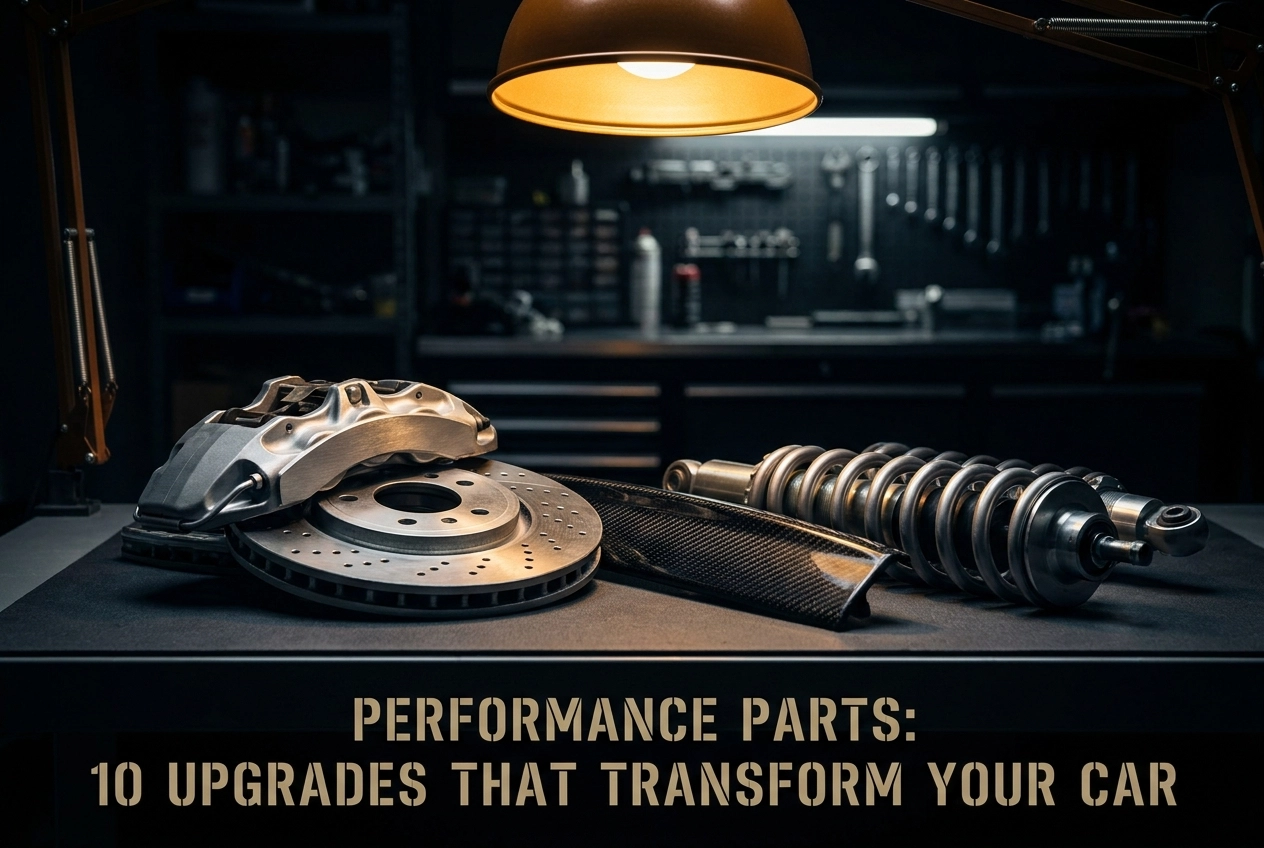
Every serious car enthusiast reaches a point where stock just isn’t enough. You’ve mastered the basics, you understand how your engine breathes, and now you’re ready to push your vehicle beyond its factory limitations. That’s exactly where the right performance parts come in.
Upgrading your car isn’t about throwing money at random components and hoping for results. It’s a strategic process that, when done correctly, transforms how your vehicle accelerates, handles, stops, and feels on both the street and the track. The difference between a thoughtful build and a chaotic one comes down to knowledge, and that’s what this guide delivers.
In this post, we’re breaking down 10 proven performance parts upgrades that deliver real, measurable improvements to your driving experience. From forced induction systems to suspension geometry changes, each upgrade on this list has been chosen for its impact, reliability, and value. Whether you’re building a weekend track car or simply want more response from your daily driver, these upgrades will give you a clear roadmap for getting there. Let’s get into it.
1. Force Induction: Turbochargers and Superchargers
Power adders represent the single most sought-after upgrade category in the global performance parts market, commanding 36.4% of total product-type demand in 2026. That figure alone tells you everything about where enthusiast priorities lie. Force induction transforms an engine’s fundamental capability by increasing the density of the air charge entering the combustion chamber, and the two dominant approaches, turbocharging and supercharging, each bring distinct engineering characteristics that suit different driving styles and build objectives.
How Turbochargers Work and Why They Dominate
Turbochargers harvest exhaust gas energy that would otherwise be wasted, using it to spin a turbine wheel connected to a compressor that forces denser air into the intake manifold. The result is a substantially richer air-fuel mixture and measurable power gains, often 30-50% above the naturally aspirated baseline on a well-mapped setup. At steady motorway cruising speeds, the turbo operates under light boost or none at all, which means fuel economy penalties are relatively modest compared to the headline power increases on offer. According to automotive turbocharger market data from Fact.MR, variable-geometry turbochargers now account for 46.9% of the technology segment in 2026, with their adjustable vane geometry delivering precise boost control across a broader RPM range than fixed-geometry units. This technology is particularly relevant for UK enthusiasts running turbocharged petrol platforms who want strong low-end torque without sacrificing high-rpm response.
Superchargers: Lag-Free Power for Track Platforms
Superchargers are belt-driven directly from the crankshaft, which eliminates the spool-up lag associated with exhaust-driven turbines. Power delivery is linear and immediate from idle, making supercharging the preferred choice on high-revving naturally aspirated petrol engines and dedicated track-day builds where predictable throttle response matters more than peak efficiency. Roots-type, twin-screw, and centrifugal designs each offer different torque curves, allowing builders to match the supercharger architecture to their specific power band requirements.
Intercoolers, Charge Pipes, and Supporting Hardware
Forced induction raises intake air temperatures significantly, and elevated charge temperatures reduce air density while increasing the risk of detonation under sustained boost. A properly sized intercooler reduces post-compression air temperatures before the charge enters the engine, protecting pistons, rings, and head gaskets during hard driving. Upgraded charge pipes complement this by reducing pressure drop between the turbo or supercharger outlet and the throttle body. These supporting components are not optional additions; they are fundamental to a reliable, safe forced induction build. You can review industrial turbocharger application principles at Market Data Forecast for additional engineering context on thermal management in boosted applications.
Road Legality and Insurance Obligations
Any forced induction modification on a road-registered vehicle in the UK carries legal responsibilities. Insurers must be notified of the change, as failure to declare a material modification can invalidate your policy entirely. On Euro 6-compliant vehicles, you should also verify that the modification does not push emissions beyond MOT thresholds, particularly for NOx and CO outputs under the relevant test cycle. Some aftermarket forced induction setups are supplied with emissions compliance documentation; always request this before purchasing.
Performance Cars Parts stocks a focused range of force induction components, including intercoolers and supporting charge pipe hardware for popular UK performance platforms, giving you a reliable single source for the core components of a well-engineered boosted build.
2. Uprated Brakes: Stopping Power to Match Your Build
Boosting power is pointless if you cannot bring that power under control. For any modified car, especially one used on track days or fast A-roads, upgraded brakes are arguably the highest-priority safety investment you can make. Factory braking systems are engineered around stock vehicle weights, standard tyre grip levels, and typical road use patterns. Once you add power, lower the suspension, and fit stickier rubber, the OEM brakes quickly become the weakest link in the chain.
Start Smart: Uprated Pads and Braided Lines
Before committing to a full big brake kit, two cost-effective upgrades deliver an immediate and measurable improvement. First, swap the standard pads for a higher-temperature compound. Options like EBC Yellowstuff and Ferodo DS2500 are formulated to operate effectively across a far wider thermal range than OEM pads, resisting the fade that sets in when standard compounds overheat under repeated hard braking. They bed in reliably for fast road use and offer genuine track-day capability without the noise and dust penalties of full race compounds.
Second, replace the rubber OEM brake hoses with braided stainless steel lines. Rubber hoses expand slightly under high hydraulic pressure, introducing a soft, spongy sensation into the pedal. Braided lines resist this expansion, transmitting pressure directly to the callipers and producing a firmer, more progressive pedal feel. This is a relatively inexpensive modification that makes a noticeable difference on a spirited road drive and is considered standard practice before any track outing.
Stepping Up: Big Brake Kits
When pad and line upgrades are no longer sufficient, a full big brake kit is the logical next step. Brands like Brembo replace OEM callipers and discs with larger, multi-piston assemblies and bigger vented or slotted rotors. The increased surface area and thermal mass allow repeated heavy braking with far less fade. A typical performance kit features multi-piston billet callipers paired with directional slotted rotors, significantly outperforming factory hardware under sustained load.
Track Day Compliance
UK track day scrutineering rules typically impose a minimum disc thickness requirement and will reject cars running severely worn pads. Regular inspection is not optional; it is essential. Performance Cars Parts stocks brake discs, pads, and callipers covering both fast road and motorsport applications, making it straightforward to source the right components and stay within scrutineering guidelines before you reach the pit lane.

3. Performance Exhaust Systems: Sound, Flow, and Power
Few modifications deliver as immediate and satisfying an impact as a well-chosen exhaust upgrade. The transformation touches performance, weight, and character simultaneously, making it one of the most rewarding investments in any performance build.
Cat-Back Systems: The Foundation of Exhaust Tuning
A cat-back exhaust replaces everything rearward of the catalytic converter, including the mid-pipe, resonator, and rear silencer. By using wider-diameter, smoother pipework, these systems reduce exhaust back pressure and improve scavenging, the process by which departing exhaust gases help draw fresh intake charge into the cylinder. The result is measurable power and torque across the rev range, not just at peak output. According to Paramount Performance, this is one of the most accessible and impactful modifications available for road and track cars alike.
Material choice matters considerably at this level. Premium manufacturers such as Akrapovic produce systems in both titanium and aerospace-grade stainless steel. Titanium systems offer substantial weight savings over heavy OEM assemblies, directly improving power-to-weight ratio and reducing unsprung mass. Stainless steel remains the more accessible option while still outperforming stock pipework on flow and durability.
Decats, Sports Cats, and UK Legality
Increasing flow further requires addressing the catalytic converter itself. Decat pipes remove it entirely, maximising exhaust gas flow, but this carries a critical legal consequence in the UK: a decat pipe will cause an MOT failure on the emissions test, making the vehicle unlawful for road use. High-flow sports catalysts, typically 200-cell specification versus the 400 to 600 cells found in OEM units, offer the performance-compliance balance most road drivers need. Quality varies significantly across the market, so investing in properly engineered units is essential for both longevity and consistent results.
Sound Engineering and Sustainability
Exhaust note drives many purchasing decisions. Mandrel-bent pipework maintains a consistent internal diameter through bends, preserving flow and producing a cleaner, more refined tone. Resonator-delete configurations increase volume and sharpen the note character, while resonated variants suppress motorway drone at cruising speeds. Valved systems take this further, allowing drivers to switch between subdued and open modes depending on the situation.
The sustainability angle is increasingly relevant here. Sports cats retain meaningful emissions control while significantly outperforming restrictive OEM setups, making them the responsible choice under growing UK regulatory scrutiny. For enthusiasts building road-legal performance cars, this framing matters both practically and from an insurance declaration perspective.
Performance Cars Parts stocks a broad range of exhaust components for popular performance cars, including downpipes, back boxes, and mid-pipes, giving builders the flexibility to upgrade in stages or spec a complete system from the catalytic converter rearward.
4. Suspension Upgrades: Coilovers, Springs, and Handling Kits
Suspension is where handling character is truly defined. Power and braking upgrades operate at the extremes of speed, but it is the suspension setup that governs everything in between: turn-in response, body roll, mid-corner composure, and the feedback you feel through the steering wheel on every single corner.
Coilover Kits: Maximum Adjustability
Coilover kits replace the factory spring and damper assembly entirely with a single integrated unit. The key advantage is adjustability: threaded collars allow precise ride height adjustment, spring rates can be swapped for different applications, and higher-specification units offer independent damper rebound and compression tuning. According to the Coilovers Buyer’s Guide from QA1, this configurability makes a quality coilover kit the most versatile suspension investment available, capable of serving street, track day, and competition use from the same hardware. For popular UK platforms such as the Ford Fiesta ST, VW Golf GTI, or Honda Civic Type R, a platform-specific coilover kit fitted correctly delivers measurable gains in cornering composure and lap consistency.
Lowering Springs: The Sensible Starting Point
Lowering springs are the natural first step for many enthusiasts. By replacing the factory springs with shorter, stiffer items, they reduce ride height by an average of 20 to 40 mm, dropping the centre of gravity and directly reducing body roll through corners. They retain the OEM dampers, which keeps the initial cost lower, though worn dampers should always be replaced simultaneously to avoid premature wear on the new springs.
Anti-Roll Bars and Geometry: The Details That Matter
Uprated anti-roll bars (sway bars) stiffen lateral resistance through corners without affecting the primary spring rate. The result is a car that resists roll under cornering loads while retaining vertical compliance over bumps, making sway bar upgrades particularly well-suited to road cars. Geometry setup after any suspension change is non-negotiable; incorrect camber, toe, and caster settings accelerate tyre wear significantly and can introduce handling characteristics that become dangerous at speed.
UK road surfaces add another layer of complexity. Varied tarmac quality, urban speed humps, and potholed side streets mean spring rates must balance circuit-level performance with real-world compliance. A motorsport-only spring rate that performs brilliantly on a smooth circuit will feel punishing and unpredictable on a typical British A-road.
Performance Cars Parts stocks a range of suspension components including coilovers and uprated polyurethane bushings compatible with popular UK performance and hot hatch platforms. Polyurethane bushings reduce flex in the suspension geometry, complementing spring and damper upgrades by ensuring the gains in precision are not lost through movement in the mounting points.
5. Engine Internals: Building for Power and Reliability
Engine internals are where a build transitions from serious to genuine. Bolt-on modifications have a ceiling, and once you approach it, the only path to significant, reliable power runs straight through the bottom end and cylinder head.
Forged pistons are the logical starting point for any high-output build. Unlike cast OEM pistons, forged items are manufactured from a denser aluminium alloy with a tighter grain structure, giving them superior fatigue resistance and thermal tolerance. This matters enormously under forced induction or high-compression tuning, where combustion pressures spike well beyond factory tolerances. Builders regularly targeting 400-500bhp from turbocharged four-cylinder platforms specify forged pistons as non-negotiable, and for good reason: a failed cast piston at full boost is a catastrophic, engine-ending event.
Uprated connecting rods follow the same logic. OEM con rods are engineered to handle factory power outputs across a typical service life, not the sustained high-load cycles that accompany aggressive tuning. On most four-cylinder engines, 350-400bhp is the realistic threshold beyond which standard rods become the weakest link in the drivetrain. H-beam connecting rods are the most widely adopted upgrade at this level, offering a significant improvement in tensile strength without excessive weight penalty. Forged pistons and uprated rods should always be specified together rather than piecemeal, as they work as a system under combustion load.
Head work addresses the other side of the power equation: airflow. Head porting and polishing removes casting imperfections and reshapes intake and exhaust ports to reduce turbulence and increase charge velocity. Paired with performance camshafts offering increased lift and duration, the combined effect on volumetric efficiency is measurable on a flow bench and noticeable on a dyno. Upgraded valves, valve springs, and retainers complete the cylinder head package for serious builds.
Head studs are perhaps the most cost-effective insurance in this entire list. As cylinder pressure increases under boost, the clamping force holding the head gasket becomes critical. Standard head bolts stretch under repeated thermal cycling and high-pressure events; head studs provide more consistent clamping across the entire head surface, dramatically reducing the risk of head gasket failure. Their cost relative to the damage they prevent makes them an easy inclusion.
Critically, none of these components should be commissioned without a professional remap or ECU calibration to follow. New internals alter the engine’s fundamental operating parameters, and running an unmodified map against a freshly built bottom end risks detonation, fuelling errors, and immediate damage. The hardware and the calibration are inseparable disciplines in any properly executed build.
6. Performance Engine Oil: Why Your Oil Choice Matters
Engine oil is one of the most overlooked performance parts decisions a modified car owner makes, yet it operates at every single component interaction inside a running engine. Getting it wrong does not announce itself immediately; it simply accelerates wear until something fails.
Why Fully Synthetic Oil Is Non-Negotiable for Modified Engines
High-performance fully synthetic engine oils are engineered from purpose-built molecular structures rather than refined from crude oil. That consistency matters enormously once a modified engine starts generating heat and load beyond factory design parameters. Fully synthetic formulations maintain viscosity stability at the elevated operating temperatures a tuned engine regularly reaches, preserving the oil film that separates bearing surfaces and cam lobes from direct metal contact. Under hard driving, that film is the only thing standing between your components and accelerated wear. Conventional or semi-synthetic oils shear down far more rapidly under these conditions, leaving critical surfaces under-protected precisely when protection is most needed.
Matching Viscosity Grade to How You Drive
Viscosity grade selection is a genuine technical decision, not a marketing one. A road car on a standard map might run comfortably on a 5W-40, but a track-day build sustaining high RPM for extended sessions generates oil temperatures that demand greater film strength at operating temperature. In those conditions, a thicker grade such as 10W-60 is often the correct specification, providing a higher HTHS (High-Temperature High-Shear) viscosity rating and a more robust film under load. Fitting the wrong grade is effectively under-engineering one of your engine’s most critical protection systems.
Forced Induction and Change Intervals
On forced-induction engines specifically, oil change intervals must be shortened significantly compared to OEM schedules. Turbocharger bearing feeds expose oil to extreme heat soak during and after hard use, while combustion blow-by introduces fuel and combustion gases into the sump, degrading additive packages faster than any factory maintenance schedule anticipates. Motul’s fully synthetic FAQ confirms that motorsport and high-performance engines require more frequent changes than standard 10,000 to 15,000 km road intervals. Ignoring this on a boosted engine is a false economy.
Motorsport-Grade Formulations and the Problem With Eco Oils
Brands including Motul, Castrol, and Fuchs produce motorsport-grade formulations specifically engineered to exceed OEM specifications for shear stability and thermal resistance. Motul’s 300V range, built on Ester Core technology and used across MotoGP, WEC, and World Rallycross, represents the kind of pedigree worth considering for a serious build. The inverse risk is equally important: low-viscosity, low-SAPS eco oils designed to satisfy manufacturer warranty requirements and fuel-economy targets are simply not formulated for the shear loads and sustained full-throttle operation of a heavily modified engine. Using them is a specification mismatch, not a cost saving.
Performance Cars Parts stocks a curated range of performance engine oils suited to modified road cars and track-driven vehicles, covering the grades and formulations that serious builds actually require.
7. Cooling and Heating Systems: Keeping Temperatures in Check
Thermal management is one of the most consequential and frequently underestimated disciplines in any performance build. Once engine output climbs beyond OEM design limits, the factory cooling architecture quickly becomes the weakest link in the system.
Uprated radiators are the foundation of any serious cooling upgrade. The OEM radiator is sized to manage heat rejection under standard operating conditions, with minimal headroom for sustained hard use. A performance radiator with a larger core, increased thickness, and higher coolant flow rate dramatically increases heat-rejection capacity, preventing coolant temperatures from climbing into dangerous territory during track sessions or spirited road driving. The principle is straightforward: core volume, defined by face area multiplied by thickness, directly determines how much heat the unit can shed per unit of time.
Performance thermostats complement a larger radiator by opening at a lower temperature than standard units. Where an OEM thermostat may not fully open until coolant reaches 88 to 92 degrees Celsius, a performance thermostat begins circulating coolant through the radiator earlier in the cycle, reducing heat soak during back-to-back hard runs and giving the radiator more time to do its job.
Oil coolers are equally critical, particularly in turbocharged and high-revving engines. Oil temperatures can spike well beyond the safe operating ceiling of approximately 130 degrees Celsius without dedicated cooling in place, accelerating wear on bearings, rings, and turbocharger internals. This is a non-negotiable upgrade once power levels rise significantly.
Aluminium coolant pipes and silicone hoses replace OEM rubber components that soften, swell, or crack under the elevated pressure cycling and thermal stress of a modified engine. The dimensional stability of aluminium and silicone prevents failures that would be catastrophic on track.
Water-to-air intercoolers are increasingly the preferred solution in high-power builds where packaging space is limited. By positioning the core directly at the intake manifold and using a separate water circuit to carry heat away, they eliminate the long charge piping and associated heat soak inherent to front-mounted air-to-air units. For a deeper look at cooling system upgrades and why they matter for modified engines, specialist resources provide useful platform-specific context. Performance Cars Parts supplies cooling components including performance thermostats, uprated radiators, and associated hardware, covering the key upgrade points outlined above.
8. Electrical Upgrades and ECU Remapping
Electrical upgrades are the connective tissue of a high-performance build, yet they remain the most frequently neglected category. Getting them right means the difference between a car that performs consistently and one that lets you down mid-session.
ECU remapping delivers the strongest power-to-cost ratio of any single modification. On a turbocharged engine, a Stage 1 remap typically produces 20 to 30% gains in power and torque by recalibrating boost targets, fuelling maps, and ignition timing curves simultaneously. Manufacturers deliberately build conservative margins into factory calibrations to accommodate varying fuel quality, emissions regulations, and global operating conditions. A professional remap recovers that headroom intelligently, working within your engine’s existing mechanical limits rather than pushing beyond them. Note that petrol engines running a performance map will often require 98 or 99 RON fuel; running high-octane calibrations on standard unleaded causes the ECU to retard timing, negating the gains entirely. For reference, stage tuning and ECU remap stages explained provides a clear breakdown of how staged tuning builds upon each modification layer.
Ignition components must keep pace with the denser air-fuel mixtures produced by forced induction or high-compression builds. Uprated coil packs deliver higher-energy sparks capable of reliably igniting compressed, fuel-rich charges that standard coils may misfire under load. Iridium-tipped spark plugs complement this by maintaining a fine electrode geometry over a longer service life, improving combustion efficiency consistently across the rev range.
Wideband lambda sensors are essential for accurate air-fuel ratio monitoring during any remap. They provide real-time data that a skilled calibrator uses to verify fuelling accuracy across the entire operating map. For road-registered vehicles in the UK, retaining a functional narrowband lambda sensor in its original position remains a legal requirement for MOT emissions compliance; removing or bypassing it will result in an immediate failure.
Performance battery upgrades and dedicated earthing kits address electrical stability under load. Builds running motorsport data logging systems, high-output lighting, or uprated audio place sustained demands on the charging system that OEM wiring and batteries were not sized for. A quality earthing kit reduces resistance across the electrical network, improving sensor accuracy and ignition reliability simultaneously.
For competition vehicles, standalone ECU systems from manufacturers such as Haltech or MoTeC replace the OEM engine management unit entirely. These platforms offer unrestricted access to every calibration parameter, native support for direct and port injection, and integrated wideband controllers. Current-generation standalone units, as illustrated by the development rationale behind the Link G5 platform, now include GPS, dual drive-by-wire control, and CAN Bus enhancements as standard features, reducing the need for auxiliary modules.
On track, electrical reliability is non-negotiable. A failing sensor, corroded earth point, or degraded coil pack ends a session immediately and without warning. Audit every electrical connection as part of your pre-event preparation; it is an investment that consistently underrated builders regret skipping.

9. Motorsport Accessories: Track Day and Competition Essentials
Motorsport accessories move a performance build into an entirely different category of seriousness. Whether you are preparing for a track day at Brands Hatch or entering a timed competition, the right safety and data equipment is not optional; it is foundational.
Roll Cages are the structural backbone of any competition build. A bolt-in cage improves chassis rigidity noticeably, reducing flex and sharpening steering response as a direct result. A weld-in cage goes further, becoming a fully integrated part of the body structure. Under the Motorsport UK National Competition Rules, roll cage fitment is mandatory for most timed competition disciplines including sprint, hill climb, and circuit racing. Choosing the correct specification for your intended championship class is essential before purchasing.
Racing Harnesses work in direct partnership with your roll cage. A 4-point harness offers a meaningful step up from a standard seatbelt, while 5-point and 6-point configurations add a sub-belt or anti-submarine strap to keep the driver planted under heavy braking and sustained lateral G-forces. Critically, multi-point harnesses must be anchored to a roll cage or a purpose-built harness bar. FIA 8853-standard harnesses are widely required in regulated UK competition classes.
Fire Suppression Systems are mandatory in many UK championship regulations and represent sound risk management for any car used regularly on circuit. A properly plumbed system covering the engine bay and cockpit can suppress an ignition event within seconds, significantly reducing the risk of serious injury.
Data Logging transforms every session into a teachable dataset. Systems from brands such as AiM and Racelogic capture GPS traces, lap times, throttle position, and brake pressure, giving drivers actionable insight for the next outing. Joining one of the established UK motor clubs for track day racers adds structured competition context to that data.
Weight Reduction Components complete a dedicated track build. Polycarbonate side and rear windows, FIA-homologated bucket seats, and stripped interiors collectively remove significant mass, improving acceleration, braking, and handling response in proportion to the weight saved.
Performance Cars Parts stocks a comprehensive range of motorsport accessories and safety equipment tailored to UK track day participants and competition drivers, covering everything from harnesses through to data systems.
10. Wheels and Tyres: Where Performance Meets the Road
Wheels and tyres sit at the absolute foundation of any performance build. Every modification made elsewhere, whether to the engine, suspension, or brakes, ultimately transmits its effect through four contact patches, each roughly the size of a hand. Getting this final interface right is not optional; it is decisive.
Lightweight forged wheels represent one of the most mechanically efficient upgrades available. By reducing unsprung mass (weight not supported by the suspension) and rotational inertia simultaneously, forged wheels improve acceleration, braking response, and steering feel in ways that can outperform equivalent power additions. HRE’s Forged Monoblok range, for example, is engineered specifically around lightweight optimisation, and their CRBN carbon fibre barrel technology takes that principle even further. A typical high-quality forged wheel can save 2 to 4 kg per corner compared to a standard cast item; across four corners, that reduction transforms how the car responds to inputs.
Tyre width and compound selection are equally consequential. A wider tyre increases the contact patch with the road surface, delivering measurable gains in lateral grip and cornering stability, provided the suspension geometry is set up to exploit the additional contact area properly. For road-focused builds, premium compounds such as the Michelin Pilot Sport 5 or Bridgestone Potenza Sport consistently outperform budget alternatives by a significant margin in both wet and dry grip. The honest reality is that upgrading to a premium tyre often delivers a larger improvement to real-world performance than many mechanical modifications costing considerably more.
Track day tyres, such as the Toyo Proxes R888R or Nankang AR-1, operate on near-slick compounds while remaining road-legal. However, they require proper operating temperatures to function correctly. In cold or wet conditions, grip can be dramatically reduced compared to a quality road-compound tyre, and wear rates under sustained high-load driving can be aggressive.
Tyre pressure management demands equal attention. Track driving raises tyre temperatures substantially, which increases pressures by typically 4 to 8 psi above cold settings. Starting a session at road pressures will result in significant over-inflation once temperatures build, causing a reduced contact patch and unpredictable handling. Always begin from adjusted cold pressures and monitor with a quality gauge between sessions.
Before finalising any wheel and tyre combination, validate fitment against arch clearance, offset specifications, and suspension geometry. Incorrect offset affects scrub radius and can introduce handling instability or accelerated tyre wear that negates every other upgrade in your build.
Why Buy Performance Parts Online in the UK
The UK auto parts market is on a significant growth trajectory, rising from USD 17.75 billion in 2025 to a projected USD 31.8 billion by 2035 at a 6.0% CAGR. Online channels are driving a substantial share of that expansion, as consumer buying behaviour shifts decisively away from physical retail toward digital purchasing. Speed, stock visibility, and accurate technical listings now matter as much as price when enthusiasts source performance parts, and the businesses positioned to win are those built around digital infrastructure rather than expensive high-street premises.
Online-only retailers carry a structural pricing advantage that directly benefits you as the buyer. Without the overhead of physical showrooms, trade counters, or large retail staff teams, operational costs stay lower, and those savings pass through to more competitive pricing on the same branded parts. For performance builds where component costs accumulate quickly across brakes, exhausts, force induction, and engine internals, that pricing difference is meaningful across a full parts list.
Pre-purchase support is where specialist online retailers genuinely differentiate themselves. Buyers in 2026 expect clear technical specifications and accurate fitment guidance before committing to a purchase. WhatsApp and email support channels allow you to confirm compatibility, ask application-specific questions, and receive expert input before ordering, significantly reducing the likelihood of incorrect purchases and costly returns.
Product range depth is the final decisive advantage. Local trade counters stock primarily fast-moving OEM lines; specialist performance aftermarket parts simply are not their focus. Online catalogues span the full breadth of the aftermarket, from braking upgrades and performance exhausts to force induction systems and motorsport accessories.
Performance Cars Parts operates exclusively online across every one of its categories, combining low prices, wide availability, and direct customer support through WhatsApp and email.
UK Road Legality: What to Check Before You Fit Performance Parts
Fitting performance parts to a road-registered car in the UK carries legal obligations that are easy to overlook when enthusiasm takes over. The six points below cover the compliance checks every intermediate builder should run before anything goes on the car.
1. Exhaust modifications and MOT emissions compliance Removing the catalytic converter is one of the most common causes of MOT failure for modified cars. A decat pipe will cause the vehicle to exceed permitted emissions thresholds at the tailpipe test, resulting in an automatic fail. A sports catalytic converter is the correct road-legal alternative; it retains the catalytic function while offering meaningfully improved exhaust flow over the standard OEM unit, keeping you compliant without sacrificing gains.
2. Suspension lowering and ground clearance Lowered suspension must not reduce ground clearance to a point where the underside of the car contacts standard road furniture, including speed humps. Physical contact with the underside generates MOT advisories and can cause structural damage over time. Always verify ride height against real-world road conditions before signing off a suspension build as road-ready.
3. Insurance disclosure is non-negotiable Any modification that materially alters performance must be declared to your insurer before fitting, not after. ECU remaps, force induction upgrades, uprated brake kits, and suspension changes all qualify. Non-disclosure can invalidate your policy entirely, meaning the insurer can refuse to pay out on any claim. If the vehicle is on finance, lender permission may also be required before modifications are made.
4. Lighting, tinted windows, and aerodynamic additions UK law sets specific visible light transmission limits for tinted windows, and front and rear lighting must meet prescribed colour requirements. Neon underlighting and tinted headlight covers are frequently non-compliant. Aerodynamic additions such as splitters and rear wings require careful verification against Construction and Use Regulations before fitting.
5. Motorsport safety equipment on road cars Harnesses and roll cages fitted without correct mounting points, triangulation, and supporting chassis reinforcement can significantly increase occupant injury risk in a road accident compared to standard seatbelts and crumple zones. This equipment is engineered for track use with helmets and HANS devices. If the car is road-registered, consult Motorsport UK technical regulations before fitting any safety cell components.
6. Progressive emissions tightening The UK Department for Transport has an open consultation on in-use vehicle emissions regulation, updated in August 2026. The regulatory floor is moving upward. Road-legal sports cats and high-flow but compliant exhaust systems are therefore increasingly important purchasing decisions, not just now but as future compliance requirements come into force.
Building Your Performance Car: Where to Start
Every successful performance build begins with a single, honest question: what is this car actually for? Road driving, track days, and motorsport competition each demand a fundamentally different sequence of modifications, and confusing these priorities is one of the most common and costly mistakes intermediate builders make.
- Define your use case first. A dual-purpose road and track car has different priorities from a dedicated competition build. Establish your intent before spending anything, as the wrong sequence forces expensive rework later.
- Support before power. Uprated brakes, corrected suspension geometry, and quality tyres consistently deliver more usable performance per pound spent than power additions on most road cars. These modifications make existing power accessible and controllable, which is more valuable than raw output you cannot exploit.
- Check legality before fitting. Verify road compliance for every modification and notify your insurer before driving on public roads. Undisclosed modifications can invalidate cover entirely.
- Source from specialist retailers. Performance Cars Parts provides a broad catalogue of performance parts at competitive online prices, with fitment support available via WhatsApp and email for complex queries.
- Build in stages. A well-sequenced build protects reliability and avoids the expense of undoing earlier modifications to accommodate upgrades planned later in the process.
Conclusion
Building a faster, more capable car is never about one single upgrade. It is about understanding how each component works together to create something greater than the sum of its parts. The upgrades covered in this guide deliver real results because they address the fundamentals: power, handling, braking, and driver confidence.
The most important takeaways are simple. Start with a clear goal, prioritize upgrades that complement each other, and never sacrifice reliability for raw numbers. A well-planned build will always outperform a rushed one.
Now it is time to take action. Review your current setup, identify your biggest performance gaps, and start with the upgrade that delivers the most impact for your specific driving style. Your perfect build is closer than you think. Start turning wrenches and make it happen.