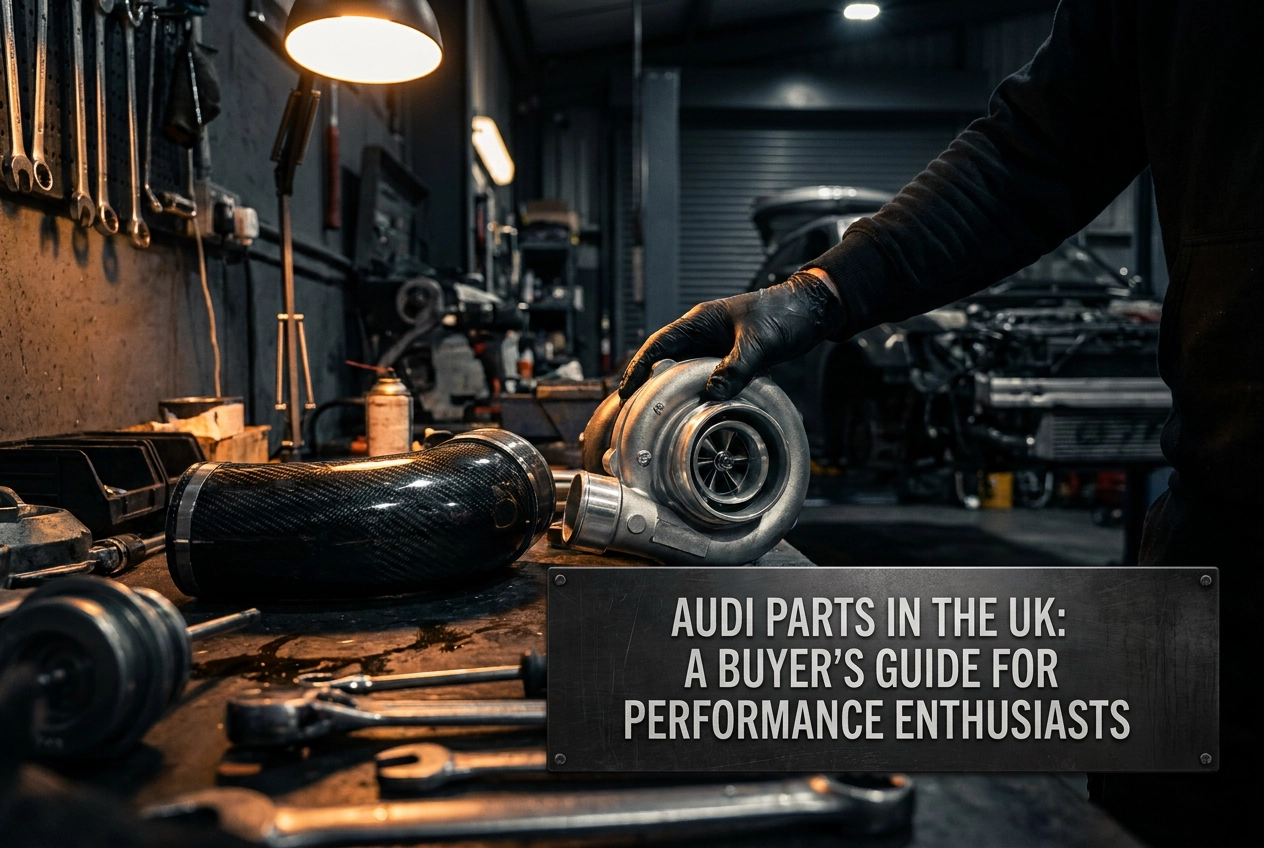
Few things frustrate a dedicated Audi owner more than hunting down the right parts, only to end up with substandard components that compromise performance and reliability. Whether you are maintaining a daily driver or pushing a modified S or RS model to its limits, the quality of your components matters enormously.
Navigating the world of Audi parts UK can feel overwhelming, particularly with so many suppliers, grades of components, and compatibility considerations to work through. The good news is that the UK market offers some excellent options for performance enthusiasts who know where to look and what to prioritise.
In this guide, we have compiled a practical list of everything you need to know before spending a penny. From understanding the difference between OEM, OES, and aftermarket parts to identifying the most reputable UK suppliers, you will come away with a clear picture of how to source components that genuinely deliver. We will also cover pricing expectations, fitment checks, and a few insider tips that experienced Audi owners swear by. Let us get into it.
Why UK Audi Owners Are Choosing Aftermarket Parts in 2026
The UK automotive aftermarket is experiencing a structural transformation, and Audi owners are among the primary beneficiaries. Here are five compelling reasons why more performance-focused drivers are turning to specialist aftermarket suppliers in 2026.
1. The UK Is Europe’s Fastest-Growing Online Parts Market
The United Kingdom is forecast to register a 15.6% CAGR within Europe’s e-commerce automotive aftermarket from 2026 to 2034, outpacing every other country in the region. The broader European market is projected to surge from USD 91.73 billion in 2026 to USD 409.10 billion by 2034. For UK Audi owners, this explosive growth translates into more suppliers competing for your business, which drives better pricing, improved stock depth, and faster delivery windows than previously available.
2. Main Dealer Pricing Carries a Significant Premium
OEM parts sourced through franchised dealerships consistently carry substantial markups over equivalent aftermarket alternatives. Aftermarket specialists can offer competitively priced components without compromising on fitment accuracy or performance quality, particularly for well-documented platforms like the Audi A3, A4, TT, and S-line derivatives.
3. The Market Is Built Around Private Buyers Like You
The B2C segment accounted for 55.4% of Europe’s e-commerce automotive aftermarket in 2024, driven by DIY enthusiasts and performance-conscious owners seeking affordable maintenance. The entire ecosystem of fitment guides, compatibility tools, and technical support has been engineered around independent buyers.
4. Vehicle Customisation Is a Validated Growth Driver
Performance upgrades including brakes, suspension, exhausts, and force induction components sit squarely within vehicle customisation, which is explicitly identified as a primary driver for the global aftermarket retail sector through 2033. Specialist suppliers understand this demand far better than generalist chains.
5. Post-Brexit Supply Pipelines Have Stabilised
Established UK-based online retailers have invested significantly in securing reliable stock pipelines for European-sourced components. For Audi owners, this means consistent availability of quality parts without the delays that characterised the immediate post-Brexit adjustment period.
Brakes: The Highest-Demand Category for Performance Audis
Braking systems represent the single largest product segment in the European e-commerce automotive aftermarket, accounting for 25.3% of total segment share in 2024. That figure is not accidental. It reflects how consistently performance car owners prioritise brake upgrades, and for good reason. Among all the modifications available for performance Audis, brakes are where safety, confidence, and lap time converge most directly.
Models like the RS3, RS4, S3, and TT RS place exceptional demands on their braking systems. Under spirited road driving or track conditions, standard brake components struggle to manage sustained heat cycles effectively. Brake fade, increased pedal travel, and uneven wear all become genuine concerns when factory spec components are pushed beyond their intended operating envelope. This is why Audi A3/S3/RS3 owners are consistently advised to upgrade brake pads as a priority modification rather than an optional one.
Key Upgrade Components to Target
The most impactful brake upgrades for performance Audis fall into four categories:
- Brake discs: Slotted or drilled variants improve heat dissipation and reduce the risk of brake fade under repeated hard stops
- Performance pads: High-friction compounds deliver stronger, more consistent bite across a wider temperature range
- Braided brake lines: Replace the factory rubber hoses to eliminate line expansion under pressure, giving a firmer, more progressive pedal feel
- Caliper hardware: Upgraded calipers and brackets can increase braking surface area, particularly beneficial on rear axle setups
Fitment Accuracy Is Critical
One frequently overlooked challenge is fitment complexity. Audi regularly ran multiple brake specifications across the same model generation. The RS3 alone spans three distinct chassis variants (8P, 8V, and 8Y), each requiring separate part lookups. Even within a single generation, disc dimensions and caliper mounting points can differ depending on the original brake package fitted at the factory. Always verify fitment against your specific model year and brake variant before ordering. Community resources like Audi Club North America’s brake discussion threads illustrate how platform-specific this knowledge needs to be.
Performance Cars Parts stocks a comprehensive range of brake components suited to Audi performance and track applications, available at substantially lower prices than main dealer equivalents.
Exhaust Systems: Performance Gains and the Sound You Actually Want
Factory exhaust systems on the 2.0 TFSI, 2.5 TFSI, and 4.2 FSI are engineered around emissions compliance and noise regulations, not outright performance. Back pressure is an unavoidable consequence of those constraints, and it directly suppresses power the engine is capable of producing. An aftermarket system addresses this by improving exhaust gas flow through optimised pipework, mandrel bends, and reduced restriction at key chokepoints. The result is measurable power recovery, improved throttle response, and a soundtrack that actually reflects what the engine is doing.
Cat-back systems are the natural starting point for most Audi owners. They replace everything rearward of the catalytic converter, meaning they avoid the emissions-critical hardware entirely and remain road-legal in most configurations. This makes them a practical upgrade for daily-driven cars as well as weekend builds. Sound and flow improvement is substantial without the legal and insurance complications that come with touching the front section of the exhaust.
Downpipe upgrades move closer to the turbocharger and deliver the most significant power gains on forced-induction engines when paired with ECU remapping. High-flow sports cats are the road-legal route; decat pipes suit track-only use. The JDY 102mm catless downpipe for the RS3 8V, 8Y, TTRS 8S, and RSQ3 demonstrates the engineering intent: mandrel bends maximise flow while preserving mid-range torque, with a construction lighter than the OEM unit.
Material selection is a genuine performance decision. Stainless steel resists corrosion from road salt and standing water, making it the sensible choice for UK road conditions year-round. Titanium, as seen in JDY’s titanium cat-back for the 2.5T platform, reduces unsprung weight meaningfully and suits track-focused builds where every kilogram counts; the cost premium is real but justified for that application.
Before purchasing, verify that the exhaust system ships with all ancillary hardware. Gaskets, clamps, and rubber hangers are frequently omitted from aftermarket kits, and fitment problems on Audi platforms are more often traced to missing supplementary components than to the main pipework itself. Confirm the full kit contents with your supplier before committing to a purchase.
Suspension Upgrades: Handling That Matches Your Engine Work
Engine power without matching suspension work is a trade-off that Audi owners consistently regret. Here are five suspension upgrades that deliver measurable handling improvements across the S3, RS3, A4, and RS4 platform range.
1. Lowering Springs: The Most Accessible Entry Point
For road-going Audis, lowering springs remain the most cost-effective first suspension upgrade. A 25-35mm drop on an S3 or RS3 meaningfully reduces body roll and sharpens turn-in response by lowering the centre of gravity, without the ride quality compromise that stiffer coilover setups can introduce on UK roads. Brands like Eibach and H&R produce direct-fit kits for the MQB platform, with owners consistently reporting improved stance and handling confidence without sacrificing daily usability.
2. Coilover Kits: Adjustability for Road and Track
Fixed springs cannot match the setup flexibility that coilovers provide. Height and damping adjustability allow owners to run a comfortable road setup during the week and a stiffer, lower track configuration at weekends. For RS3 owners with factory DCC (Dynamic Chassis Control), ensure any coilover kit is either natively DCC-compatible or paired with a cancellation kit to avoid dashboard errors post-fitment. Explore the Audi S3 / RS3 8V suspension range for a full overview of tiered options at different price points.
3. Geometry and Bushing Quality on Quattro Platforms
Audi’s quattro all-wheel-drive system and heavier front-end architecture mean suspension geometry corrections have a proportionally greater impact than on lighter front-wheel-drive platforms. On larger platforms including the A4, A5, and RS4, bushing compliance directly affects steering response and cornering consistency. Adjustable camber ball joints and camber plates are worth considering alongside any spring or coilover upgrade.
4. Anti-Roll Bar Upgrades to Address Understeer
Understeer is a well-documented characteristic of quattro-equipped Audis. Uprated adjustable ARBs and upgraded drop links redistribute lateral load more effectively across both axles, reducing the push from the front end that many enthusiasts find limiting on track. SuperPro’s adjustable ARB range covers both the S3 and RS3 8V, with front and rear options available independently.
5. Full Suspension Refresh Before Track Use
Fitting new coilovers to an Audi with worn top mounts, degraded bushings, or tired bearings will mask the performance benefit entirely. For track day and motorsport preparation, address all four corners simultaneously including top mounts and wheel bearings. A full four-wheel alignment on a 3D system after fitment is not optional; it is the step that actually converts the hardware investment into handling gains you can feel.
Engine Parts: Keeping High-Performance Audis at Peak Output
Audi’s TFSI and TDI engine families represent some of the most sophisticated powerplants in the performance car sector, but they carry well-documented wear points that performance owners encounter well ahead of average drivers. The EA113 2.0 TFSI oil pump is a known weak link, with failure risk increasing significantly under hard driving conditions. Timing chain tensioner wear affects early EA888 units and can escalate from a rattle on cold start to catastrophic chain failure if ignored. Carbon build-up on direct injection engines is unavoidable without periodic intervention, and on a car being pushed on track, the accumulation rate accelerates considerably compared to standard road use.
Why Parts Sourcing Strategy Matters on a High-Value Engine
Selecting a specialist supplier over a generalist retailer is not a preference; it is a risk management decision. Components like timing chain tensioners, head gaskets, valve cover gaskets, and oil filters must meet precise fitment tolerances on turbocharged applications. A substandard gasket or incorrectly rated filter on a high-output Audi engine does not simply fail quietly; it creates secondary damage that multiplies repair costs substantially.
Getting Oil Specification Right
Engine oil selection is one area where Audi owners frequently make costly assumptions. Matching viscosity grade alone is insufficient. The VW Group approval code printed on the bottle is the decisive factor. Petrol TFSI applications typically require VW 502 00 or VW 504 00, while TDI engines with a diesel particulate filter require VW 507 00. Using an unapproved oil in a turbocharged Audi risks bearing damage and can void warranty coverage on newer models.
Performance Cars Parts stocks engine oils meeting VW Group specifications alongside Audi-compatible engine components, making it a practical single-source option for owners servicing their cars between track days or extended runs. For modified Audis running elevated boost pressures, treating the engine as a system rather than individual components is essential. Pairing power upgrades with supporting ancillaries such as uprated intercoolers and oil coolers protects the engine under sustained high-load conditions.
Force Induction: Turbo and Supercharger Upgrades for Audi
Force induction remains the single most impactful upgrade category for performance Audi owners in the UK. The majority of performance Audis sold here from the mid-2000s onward are turbocharged from the factory, meaning the foundation for serious power gains is already in place. The question is not whether to modify the forced induction system, but how to do it correctly and in the right sequence.
1. Start with charge air volume and heat soak
Turbo inlet pipes, upgraded intercoolers, and high-flow induction kits are the natural first stage for cars like the Audi S3, TT RS, and RS3. These modifications increase the volume of cooler, denser charge air reaching the turbo and combustion chamber, reducing heat soak and providing the headroom an ECU remap needs to deliver real gains. Fitting hardware without a remap, or remapping without supporting hardware, leaves measurable performance unrealised.
2. Boost pipe integrity is non-negotiable
The factory plastic boost pipe on the RS3 and TTRS measures 63mm OD and is a documented failure point under sustained boost pressure on high-mileage cars. Uprated aluminium boost pipe kits replace this with a 70mm OD aluminium pipe alongside reinforced silicone hoses throughout. The RacingLine RS3 and TTRS Boost Pipe Kit is pressure-tested beyond the turbo’s operational limits, addressing the deformation risk that causes sudden power loss and potential engine damage.
3. Larger power targets demand fuel system matching
On the RS4 B7, whether running the naturally aspirated 4.2 FSI V8 or the supercharged TFSI variant, forced induction upgrades cannot be treated in isolation. Injector sizing, high-flow fuel pump capacity, and ECU calibration must be matched precisely. Running lean under full load on a high-compression engine is genuinely destructive. Stage 2 and beyond on the 2.5 TFSI platforms, for example, commonly requires uprated injectors alongside any turbo hardware to maintain correct fuelling across the full boost range.
4. Always remap alongside hardware
Every force induction hardware upgrade requires a corresponding professional ECU remap. The Audizine community discussions on charge pipe upgrades consistently confirm that hardware changes without calibration adjustments produce inconsistent results. A mapped car with matched hardware is categorically different from a standard-mapped car with bolt-on parts fitted.
Electrical Components and Cooling: The Systems That Protect Your Investment
Cooling and electrical systems are responsible for a disproportionate share of performance Audi breakdowns, yet they receive far less attention than brakes, exhausts, or suspension. On turbocharged platforms, the consequences of neglect are severe. Thermostat failures, ageing coolant hoses, and water pump deterioration compound quickly under sustained load, particularly on vehicles used for track days or spirited road driving.
The Plastic Impeller Problem on 2.0 TFSI Engines
The OEM water pump fitted to 2.0 TFSI Audis built between approximately 2004 and 2012 uses a plastic impeller that degrades progressively over time. The plastic can crack, delaminate, or spin freely on the shaft, reducing coolant flow without triggering an immediate warning. Audi community forums remain actively focused on this issue in 2026, with owners of 2011-era B8 A4s discussing water pump and thermostat housing upgrades and describing the metal-impeller replacement as a straightforward decision given the labour access required. Upgrading to an aluminium housing and metal impeller eliminates this failure mode entirely and is widely considered a standard preventative measure on any 2.0 TFSI service or performance build.
Thermostats: Both Failure Directions Cause Damage
Thermostat failures present in two directions, each with distinct consequences. A thermostat stuck open prevents the engine reaching proper operating temperature, reducing combustion efficiency, causing fuelling irregularities, and prolonging warm-up times. A thermostat stuck closed blocks coolant circulation entirely, creating the conditions for catastrophic overheating. On the 2.0 TFSI, the P2181 fault code is a recognised indicator of cooling system performance issues, often linked to thermostat degradation at the sealing surfaces. Because the thermostat and housing are an integrated unit on these engines, replacement typically means replacing the complete assembly.
Coil Packs, Sensors, and Ignition System Reliability
Electrical components degrade gradually, and the effect on driveability is often attributed to other causes before the ignition system is properly assessed. Coil packs on modified Audis running elevated boost are a well-documented weak point; standard units can struggle to fire reliably against increased cylinder pressure, producing misfires that worsen under load. A practical diagnostic approach is swapping a suspect coil to a neighbouring cylinder to confirm whether the fault follows the component. Replacing the full set simultaneously is recommended once a failure is confirmed, and sourcing updated revisions of the coil pack is advisable given the multiple revisions released across the 2.0T TSI engine family spanning the A3, A4, A5, A6, Q5, and TT. Performance Cars Parts supplies electrical components and thermostats suited to Audi applications, making it a practical single source for owners completing a full cooling and ignition refresh before the track season.
Motorsport Accessories: Equipping Your Audi for Track Use
Track days and club motorsport events expose every weakness in OEM Audi components that years of road driving will never reveal. Sustained high-speed braking generates heat that overwhelms standard brake fluid, repeated full-throttle runs push coolant temperatures well beyond normal operating ranges, and the cumulative stress of circuit sessions accelerates wear on parts engineered for everyday driving cycles. Understanding these demands before you arrive at the circuit is what separates a successful track day from an expensive one.
Essential Safety and Compliance Equipment
The foundational motorsport accessories for any track-prepared Audi cover four categories. A properly mounted fire extinguisher is a near-universal circuit entry requirement, and the mount itself needs to be secure rather than wedged into a footwell. Tow hooks, both front and rear, are mandatory at most UK circuits including Silverstone and Donington Park; fitting them before the event saves a failed scrutineering moment at the gate. Oil catch tanks are particularly important on turbocharged TFSI engines, which are well documented for blow-by under sustained high-rpm conditions; without one, crankcase vapours enter the intake system and contaminate the intercooler. Uprated brake fluid rated to at least 270°C dry boiling point should replace standard DOT 4 before any circuit session.
Data Logging and Sensor Hardware
Boost gauges, oil pressure gauges, oil temperature gauges, and wideband lambda sensors give Audi track drivers real-time feedback on engine health under load, flagging developing problems before they become terminal. This hardware is increasingly standard equipment among serious track day regulars.
Roll Cages and Harnesses
For owners progressing into time attack or club racing, roll cage and multi-point harness fitment become relevant considerations. Always consult Motorsport UK regulations for your specific series before purchasing, as homologation requirements vary significantly between categories. Performance Cars Parts stocks a curated motorsport accessories range built specifically for circuit preparation, offering considerably more focused product selection than broad-spectrum retailers carrying generic accessories alongside unrelated categories.
How to Buy Audi Parts Online in the UK: What to Look For
Buying Audi parts online in the UK rewards buyers who approach the process methodically. Here are five key principles to apply before you commit to any purchase.
1. Verify fitment by chassis code, engine code, and build year
Model name alone is insufficient when sourcing Audi parts online. The A3, for example, spans the 8P platform (2004 to 2012) and the 8V platform (2013 to 2020), with substantially different component requirements across each generation. Cross-reference your chassis code, engine code, and exact build year before purchasing. Your engine code appears on the V5C registration document and on the engine block itself. For modified or non-standard builds, this step is non-negotiable.
2. Prioritise online-only retailers for competitive pricing
The UK e-commerce automotive aftermarket is growing at a 15.6% CAGR through 2034, the fastest rate in Europe. That growth is driven by buyers who have identified that online-only retailers eliminate showroom and distribution overhead, passing meaningful savings directly to the customer compared with main dealer pricing.
3. Demand responsive, human technical support
Generalist catalogues rely on self-service lookup tools that work adequately for standard service parts. For performance applications, a misidentified intercooler or incorrect brake bracket represents a costly error. Retailers offering direct support via WhatsApp or email provide a material advantage for anyone specifying parts for a modified Audi.
4. Consider Performance Cars Parts for specialist guidance
Performance Cars Parts operates exclusively online, keeping prices competitive across its full range of Audi-compatible components. WhatsApp and email support means buyers can ask targeted technical questions before purchasing, reducing the risk of fitment errors on complex builds.
5. Choose genuine performance specialists over generalist catalogues
A retailer stocking force induction hardware, motorsport accessories, and performance brake upgrades alongside standard service parts understands performance builds at a structural level. A catalogue that simply lists Audi in a dropdown filter does not. For a serious build, that distinction matters considerably.
Building or Maintaining a Performance Audi in the UK: Key Takeaways
Every decision covered in this guide points toward five non-negotiable principles for UK Audi owners in 2026.
Fitment accuracy comes before price. Your chassis code and engine code are the foundation of every parts purchase. A component that saves you money at checkout but requires modification or fails prematurely costs significantly more in the long run.
Start with brakes and suspension. These categories deliver the most immediate, measurable improvements on both road and track. Braking systems alone account for 25.3% of the European e-commerce aftermarket for good reason. Prioritise them before committing budget to engine or forced induction upgrades.
Choose a specialist over a generalist. The UK is the fastest-growing e-commerce automotive aftermarket in Europe, projected at a 15.6% CAGR through 2034. That growth rewards focused suppliers with genuine performance expertise and accessible support channels.
Performance Cars Parts offers a practical, competitive starting point for UK Audi enthusiasts sourcing brakes, exhausts, suspension, engine components, force induction hardware, and motorsport accessories through a single online-only retailer built around keeping prices low.
Whether you are preparing an RS3 for a track season or refreshing the cooling system on a well-used TT, the depth and specialism of the UK aftermarket in 2026 gives you better options than at any previous point.
Conclusion
Sourcing the right Audi parts in the UK does not have to be a frustrating experience. By understanding the distinctions between OEM, OES, and aftermarket components, you can make informed decisions that protect both your budget and your build. Choosing reputable UK suppliers, verifying fitment compatibility, and setting realistic pricing expectations will save you significant time and money in the long run.
Whether you are keeping a daily driver in peak condition or extracting every last ounce of performance from an S or RS model, the quality of your components directly shapes the result. Do not settle for second-best when excellent options are well within reach.
Start by reviewing the suppliers and criteria outlined in this guide, then approach your next parts purchase with genuine confidence. Your Audi deserves nothing less.