There comes a point in most tuning projects where the conversation changes. Up to Stage 2, it is all about bolt-ons: intake, downpipe, intercooler and a remap. Push further with a bigger turbo, more boost, E85 or a hybrid turbo and sooner or later someone will tell you that you need forged pistons and rods. For UK owners, that usually means a four-figure engine build, weeks off the road and a conversation with your insurer, so it is worth knowing when the advice is right and when it is simply forum habit.
Forged internals are not a power upgrade on their own. They do not add horsepower; they raise the margin between the loads your engine sees and the loads that break parts. Whether you need that margin depends on your engine, how much torque the tune makes, how well the calibration controls knock, and what you do with the car. A road car that sees a couple of track days a year has very different needs from a time-attack build running high boost for twenty minutes at a time.
This guide explains the difference between cast and forged pistons, the 2618 vs 4032 alloy question, H-beam vs I-beam connecting rods, why head gaskets and fasteners matter just as much, and the UK insurance and MOT points to think about before you strip an engine. If you are still working out how far your build will go, our guide to Stage 1, Stage 2 and Stage 3 tuning is a useful starting point.
Quick Answer: Do You Need Forged Pistons and Rods?
If your car is mapped within the limits a reputable tuner considers safe for the standard internals, and the engine is healthy, you probably do not need forged internals yet. They start to make sense when you are going beyond what the factory parts are known to tolerate on your specific engine, when you are rebuilding anyway, or when a failure would cost far more than doing it properly the first time.
| Your car and driving | Recommended starting point | Main compromise |
|---|---|---|
| Stage 1 or Stage 2 road car, standard turbo, occasional track day | Keep standard internals; focus on fuelling, cooling and a conservative, well-logged map | Power is capped by what the factory parts tolerate |
| Big or hybrid turbo, torque well beyond standard | Forged pistons and rods, uprated rod bolts, MLS head gasket and head studs as a package | Cost, downtime and the need for a skilled engine builder |
| Engine already needs a rebuild (worn bores, spun bearing, broken ring land) | Consider forged parts during the rebuild if future tuning is likely | More cost now; cold-start noise with some piston alloys |
| Mostly road use, long engine life wanted | Forged pistons in a lower-expansion alloy (such as 4032) with standard-spec clearances where suitable | Less tolerance of severe detonation than a race alloy |
| Track, drag or high-boost build | Race-grade 2618 pistons, forged steel rods matched to your power target | Wider cold clearance, more noise when cold, shorter inspection intervals |
Final choice always depends on the manufacturer’s rating for your specific engine, your builder’s measurements and correct fitment. Browse our pistons and connecting rods range and check the listed application before you buy. This guide covers four-stroke petrol car engines; diesel builds have different load and fuelling considerations.
Why Standard Internals Fail on Tuned Engines
Most factory pistons are cast, and most factory rods are designed around the torque the manufacturer sells the car with, plus a safety margin. That margin varies hugely between engines. Some are famously over-built and tolerate big gains on standard internals; others have a well-known weak point that appears not far above a Stage 2 map. There is no universal power or torque figure at which standard parts fail.
When a tuned engine does break, the cause is rarely just “too much power”. Common contributors include:
- Detonation and pre-ignition: uncontrolled combustion hammers the piston crown and ring lands. Cast pistons are generally less tolerant of this than forged ones.
- Peak torque at low rpm: big low-down torque puts high compressive loads through the pistons and rods, which is why aggressive mid-range maps on small turbo engines can be harder on parts than a higher peak power figure.
- High rpm: inertial loads on rods and rod bolts rise rapidly with engine speed, so raising the rev limit adds a different kind of stress.
- Fuel and heat: lean mixtures, poor fuel quality and heat soak all increase the risk of knock. If your tune is pushing the fuel system, read our guide on fuel pump and injector upgrades before you look at internals.
- Oil starvation and wear: a spun bearing on track is a lubrication or wear problem, and forged rods will not fix it.
That is why the first step is not to buy parts but to understand your engine’s known limits and to have the existing tune logged properly. A well-controlled map on healthy standard internals is often safer than an aggressive map on forged parts with poor knock control.
Forged vs Cast Pistons: What Actually Changes?
Cast pistons are made by pouring molten aluminium alloy into a mould. It is a cheap, repeatable process that suits mass production and allows alloying elements such as silicon to be added. To make a cast piston strong enough, manufacturers often add material, which can make it heavier. US engine specialist LCE Performance summarises forged pistons as better suited to high boost, high compression and higher rpm, and cast pistons as perfectly adequate for standard-octane street use.
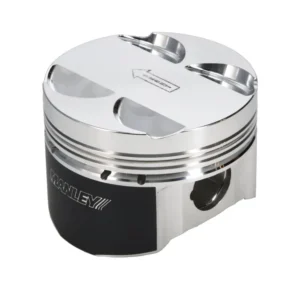
Forged pistons start as a solid billet of alloy that is pressed into shape under very high pressure, then CNC machined. The grain structure is denser and more consistent, which generally makes the piston more ductile: under abuse it is more likely to deform or show damage than to crack and shatter. That ductility is what buys you margin when a tune runs into knock.
Forged does not mean bulletproof, and it comes with compromises:
- Clearances: some forged alloys expand more with heat, so they are fitted with more piston-to-wall clearance when cold. Your builder must use the clearance the piston manufacturer specifies for your bore and alloy.
- Cold-start noise: extra cold clearance can cause audible piston slap until the engine warms up. This is normal for many race-alloy pistons but can surprise road owners.
- Warm-up discipline: forged pistons reward gentle driving until oil and coolant are up to temperature, which is good practice on any tuned car.
- Cost and fitment: forged pistons are made for specific bores, compression ratios and pin sizes. Getting one wrong can mean re-machining the block.
2618 vs 4032 Pistons: Which Alloy Suits UK Road and Track?
Once you decide on forged pistons, the next question is the alloy. The two you will see most often are 4032 and 2618, and JE Pistons’ comparison of the two alloys sets out the trade-off clearly.
4032: the road-friendly forged option
4032 contains a high proportion of silicon, roughly 12 per cent according to JE. That reduces thermal expansion, so pistons can run tighter cold clearances and tend to be quieter on start-up. JE also notes better ring-groove wear resistance, which helps ring seal over higher mileage. The trade-off is lower ductility, so it is less forgiving of severe detonation than 2618.
2618: the race and high-boost option
2618 has very little silicon. It expands more with heat (JE quotes around 15 per cent more than 4032), so it needs more cold clearance and is usually noisier until warm. In return it is stronger and more ductile, and JE positions it for racing and boosted, supercharged or nitrous applications where cylinder pressures and temperatures are highest.
For a UK road car that sees the odd track day and a big but sensible tune, many builders lean towards 4032 for refinement and longevity; for sustained high boost or competition, 2618 is the more common choice. That is a generalisation, not a rule: the piston maker’s recommendation for your engine and power target should decide it.
H-Beam vs I-Beam Connecting Rods
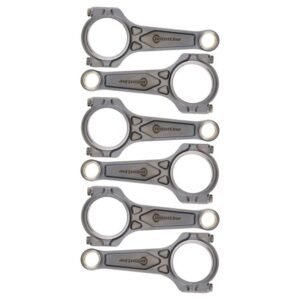
Aftermarket forged rods usually come in two broad shapes. H-beam rods have a beam that looks like an H in cross-section; I-beam rods look like an I, similar in principle to many factory rods but in stronger steel and with better fasteners. Online, you will see plenty of claims that one shape is always stronger. Rod maker Manley does not make that claim: it offers both designs across mild and heavy-duty ranges and says the right choice depends on the engine, power goal, type of use and whether it is turbocharged, supercharged or naturally aspirated.
In practice, what matters more than the letter is:
- The rated power and use: rods are designed and marketed against power and application bands. Pick a rod rated comfortably above your realistic target.
- Material: many performance rods use 4340 chrome-moly steel, with premium alloys for extreme builds.
- Rod bolts: the bolts carry the inertial load that tries to pull the cap off at high rpm. Uprated bolts are often supplied with the rods, and on some engines an uprated bolt kit alone is a sensible upgrade.
- Dimensions and weight: centre-to-centre length, big-end and small-end sizes and pin size must match your pistons and crank. Weight matching across the set matters for smoothness.
- Correct installation: bearing clearances, bolt stretch or torque and the lubricant specified by the bolt or rod maker all need to be followed exactly.
Forged Internals Need Supporting Parts
A forged bottom end with standard head bolts, a tired head gasket and a marginal fuel system is a common way to spend a lot of money and still have a failure. Higher cylinder pressures try to lift the cylinder head, and the weakest link moves to the next part in the chain.
MLS head gaskets and head studs
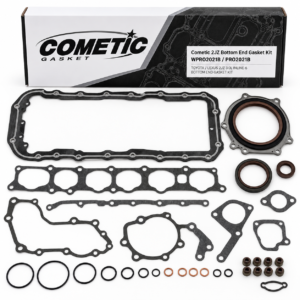
Multi-layer steel (MLS) head gaskets use stacked, embossed steel layers that act like springs, maintaining sealing pressure as the head lifts under combustion pressure. An EngineLabs feature on MLS gaskets notes that they are recommended for boosted and nitrous engines, but they need smoother, flatter sealing surfaces than composite gaskets, should not be reused once heat-cycled, and rely on correct fasteners and torque sequence. MLS gaskets are also available in different compressed thicknesses, which affects compression ratio, so your builder needs to measure deck height and chamber volume rather than guess. Browse our performance head gaskets for your engine code.
Many factory head bolts are torque-to-yield designs intended for one use. Aftermarket head studs are typically designed to be reusable and to give more consistent clamping load, which is why they are commonly paired with an MLS gasket on high-boost builds. Always follow the stud maker’s torque figures and lubricant; there is no universal figure.
Bearings, oiling and the rest of the build
- Bearings: new main and rod bearings are standard practice on any bottom-end build, with clearances measured rather than assumed.
- Oil control: on track cars, look at sump baffling, oil cooling and oil temperature monitoring. Bearing failure from oil surge is not solved by forged rods.
- Fuelling: injectors and pumps must support the new target with headroom, especially on ethanol blends.
- Clutch and drivetrain: more torque moves the weak point to the clutch and gearbox. Our performance clutch upgrade guide covers how to match a clutch to the torque you will make.
- Calibration: a forged engine still needs a proper map with knock monitoring and data logging. Forged parts tolerate abuse better; they do not make abuse safe.
Forged Pistons and Rods for Popular UK Tuned Cars
Every engine family has its own reputation, and the right answer depends on the specific engine code, the year and the condition of your engine. Use the table below as a list of things to check with your tuner and engine builder rather than as a fixed power limit.
| Vehicle family | What owners should check |
|---|---|
| VW Golf GTI / Golf R, Audi S3 (EA888 2.0 TSI) | Exact engine generation (Gen 3 vs Gen 4 parts differ), the torque your tuner considers safe on standard rods, and whether your turbo upgrade pushes beyond it |
| Ford Focus ST / Focus RS (2.0 and 2.3 EcoBoost) | Which EcoBoost engine you have, head gasket history on your engine variant, and whether rods and pistons are offered as matched sets for your bore |
| Honda Civic Type R (K20 / K20C) | Naturally aspirated K20 builds and turbo K20C builds have different needs; check rod length, pin size and whether your build is high rpm, high boost or both |
| Mitsubishi Lancer Evo IV–IX (4G63) and Evo X (4B11T) | Bore size (standard or oversize), crank type, 6-bolt vs 7-bolt on 4G63, and the condition of the block after years of tuning |
| BMW 135i / 335i and later B58 cars | Engine code (N54, N55 or B58), bearing condition on high-mileage cars, and whether rod bolts or bearings are the real priority for your use |
Examples from our range:
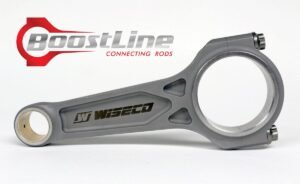
- BoostLine forged connecting rod set for the Ford 2.3 EcoBoost (Focus RS and Mustang)
- Manley 4G63 forged piston set, 85.5mm, for Mitsubishi Evo 4–9
- BoostLine forged conrod set for the Mitsubishi Evo X 4B11T
- Manley H-beam steel connecting rods for Honda K20 / K24
Always confirm the exact engine code, bore size and compression ratio on the product listing, or ask us before ordering.
Cost, Downtime and When a Forged Build Makes Sense
The parts are often only part of the bill. A forged build usually involves engine removal or a strip-down, block inspection, honing or boring, measuring and setting clearances, balancing where needed, new gaskets, bearings and fasteners, then a careful run-in and a fresh map. Labour and machining rates vary widely across the UK, so get a written quote that lists exactly what is included.
A forged engine build tends to make most sense when:
- Your power or torque target is clearly beyond what your tuner considers safe for the standard parts on your engine.
- The engine already needs opening up because of wear or damage, so the extra cost is incremental.
- You plan a bigger turbo, more boost or an ethanol blend and want to do the bottom end once.
- You compete or run long track sessions where a failure would be costly and dangerous.
It makes less sense if you are chasing a few extra horsepower on a healthy engine that is already near its sensible limit. In that case, cooling, fuelling, a better-controlled map or simply enjoying the car as it is can be the smarter spend.
UK Insurance, MOT and Warranty Considerations
Insurance: internal engine changes and the remap that goes with them are modifications. Money.co.uk advises that you must declare a remap to your insurer, that failing to do so can invalidate your policy and lead to a rejected claim, and that some mainstream insurers will not cover remapped cars, in which case a specialist modified-car insurer or broker may help. Declare the engine build and the new power figure if your insurer asks for it, and keep invoices and dyno sheets.
MOT: pistons and rods are not inspected as such, but the car must still meet the emissions and engine warning light requirements set out in the DVSA MOT inspection manual. A rebuilt engine that smokes, has excessive emissions or shows a malfunction indicator lamp can fail. Allow time for the rings to bed in and the map to settle before your test date.
Warranty: opening the engine and remapping will generally affect any manufacturer warranty on the powertrain. Check the terms before you start if your car is still covered.
Forged Pistons and Rods Checklist: Before You Buy and Fit
- Confirm your exact engine code, bore size, stroke and production year.
- Agree a realistic power and torque target with your tuner, and the use (road, track, drag).
- Choose piston alloy and compression ratio to suit that target and your fuel.
- Choose rods rated comfortably above your target, with matching length, pin and big-end sizes.
- Budget for uprated rod bolts, head studs, an MLS head gasket, bearings and a full gasket set.
- Check that your fuel system, cooling and clutch can handle the new target.
- Use a builder who measures and records clearances, and follows the parts makers’ specs.
- Plan the run-in procedure recommended by the piston or ring maker, then remap and log.
- Tell your insurer about the build and the new power figure.
- Keep receipts, build sheets and dyno results for resale and insurance.
Shop Pistons, Connecting Rods and Head Gaskets
Conclusion
Forged pistons and rods are about margin, not magic. They let a well-built, well-mapped engine survive cylinder pressures, rpm and occasional knock that would break cast parts, but they need matching head gaskets, fasteners, fuelling and calibration to deliver that margin. Choose 4032 or 2618 pistons based on your use, pick rods on their rating and fitment rather than the H or I on the beam, and treat the build as a complete package.
Ready to plan your build? Browse our forged pistons and connecting rods or explore the full range at performancecarsparts.co.uk. If you are not sure which parts fit your engine code or bore size, contact our team via WhatsApp or email and we will help you check fitment before you order.
Shop related performance parts

Explore related products

Always check the individual product listing for your vehicle and engine before ordering.