Every time you stamp on the throttle, change gear or come off the power into a corner, your engine and gearbox try to rock in their mounts. On a standard car that movement is soaked up by soft rubber and, often, fluid-filled mounts designed to keep the cabin quiet. Add a remap, a stickier set of tyres and a few track days, and that same softness starts to show up as a vague gearchange, a clunk on and off the throttle, axle tramp in first and second, and a lurch you can feel through the seat.
Uprated engine mounts are one of the cheapest ways to tighten that up, but they are also one of the easiest upgrades to get wrong. Go too stiff and you swap a slightly lazy drivetrain for a car that buzzes at idle, rattles the mirrors and wears out your patience on a motorway run. This guide explains how the different options work, from polyurethane engine mount inserts to hardened rubber mounts, pitch stop mounts and full solid mounts.
You will learn which mount to change first on a front-wheel-drive or four-wheel-drive car, how much extra engine mount vibration to expect, how worn mounts are treated at the MOT, and what to check before you buy for popular UK tuned cars such as the Golf GTI, Fiesta ST, Civic Type R and GR Yaris.
Quick Answer: Which Uprated Engine Mounts Should You Choose?
For most fast road cars that see the odd track day, start with the mount that controls fore-and-aft rocking (the pitch stop, dog bone or lower torque mount on a transverse engine) using a road-grade insert or hardened rubber part, then live with it before stiffening anything else. Full motorsport inserts and solid mounts make most sense on dedicated track or competition cars where comfort no longer matters. This guide covers road-registered cars with conventional petrol engines; electric and hybrid drivetrains use very different mounting arrangements.
| Your car and driving | Recommended starting point | Main compromise |
|---|---|---|
| Daily driver, mild remap, occasional spirited B-roads | Road-grade polyurethane insert in the pitch stop / dog bone only | Slight extra vibration at idle and low rpm |
| Fast road car with Stage 2 tune and regular track days | Hardened pitch stop plus road-grade inserts in the upper engine and gearbox mounts | More noticeable buzz through the cabin, especially from cold |
| Weekend track car still used on the road | Motorsport-grade inserts in all mounts, or uprated complete mounts | Clear increase in noise and vibration; more load on brackets and ancillaries |
| Dedicated track, sprint or race car | Solid or near-solid mounts as specified for the build | Harsh and loud on the road; extra stress on surrounding components |
Final choice depends on the mount manufacturer’s rating and the exact fitment for your engine and gearbox code, so always check part numbers before ordering. Browse our uprated engine mounts to see what is listed for your car.
What Engine and Gearbox Mounts Actually Do
Engine mounts have two jobs that pull in opposite directions. They have to hold the engine and gearbox firmly in place so torque goes into the driveshafts rather than into rocking the whole lump around, and they have to isolate the cabin from the vibration every combustion engine produces. Factory mounts are tuned for comfort and refinement first, because that is what most buyers notice.
Many modern cars use hydraulic (fluid-filled) mounts in some positions. Saab’s workshop documentation for the 9-3, for example, describes hydraulic engine mountings with two fluid chambers linked by a passage, where small movements are taken up by a diaphragm and larger ones push fluid between chambers so damping increases with load. That is very effective at idle and low rpm, but it also lets the engine move more than a performance driver would like.
Transverse vs longitudinal layouts
- Transverse engines (most hot hatches) typically sit on an engine-side mount, a gearbox-side mount and a lower torque arm, often called a pitch stop or dog bone, that stops the engine rocking forwards and backwards.
- Longitudinal engines (rear-drive BMWs, for example) usually sit on two engine mounts either side of the block plus a gearbox mount at the back, with a separate differential mount further back.
- Which mount does the most work under acceleration depends on the layout, which is why there is no single “best” mount to change first on every car.
Signs Your Engine Mounts Are Worn or Too Soft
Before you buy uprated parts, it is worth working out whether you have a soft-mount problem or simply worn mounts. Rubber ages, oil leaks soften it, and fluid-filled mounts can split and leak. Common symptoms include:
- A clunk or thump when you get on or off the throttle, or when pulling away.
- A gear lever that moves noticeably under load, or a gearchange that feels vague and rubbery.
- Wheel hop or axle tramp when launching, particularly on front-wheel-drive cars with grippy tyres.
- More vibration than usual at idle, sometimes a sign that a hydraulic mount has failed.
- Visible cracks in the rubber, fluid weeping from a mount, or the engine visibly lifting when someone blips the throttle with the bonnet open (do this carefully, with the handbrake on and nobody in front of the car).
Some of these symptoms overlap with other faults. Clunks can also come from driveshaft joints, suspension bushes or a worn dual-mass flywheel, so get the car checked properly rather than assuming the mounts are to blame. If you are also chasing driveline shunt, our guide to performance clutch and flywheel upgrades covers how DMF wear and clutch choice feed into the same feel.
Types of Uprated Engine Mounts Explained
Polyurethane engine mount inserts
Inserts push into the voids of your existing factory mount, filling the gaps that allow it to move. They are usually the most affordable route because you keep the original mount, and they are often easy to fit without removing the mount from the car. The trade-off is that they rely on the condition of the original rubber, so there is little point fitting them to a mount that is already split.
Polyurethane comes in different hardness grades. Powerflex, for example, splits its range into a Road Series and a motorsport-focused Black Series. One UK retailer’s explanation of the Powerflex Road, Heritage and Black Series describes the Road Series as roughly 25 to 30 percent stiffer than rubber and the Black Series as a 95 Shore A compound aimed at track and race use. On its own product page for a B58 engine mount insert, Powerflex quotes a 180 percent increase in mount rigidity using that Black Series material. Figures like these are specific to each part, so do not assume every insert from every brand behaves the same way.
Hardened rubber and complete uprated mounts
Some manufacturers supply complete replacement mounts with a firmer rubber compound, sometimes in a stronger bracket. These avoid relying on an old factory mount and can be a sensible choice if your originals are tired anyway. Hardened rubber tends to sit between factory rubber and polyurethane for refinement, although the actual result depends on the compound and design rather than the material name alone.
Pitch stop mounts and dog bones
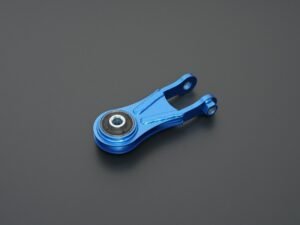
On a transverse engine the pitch stop resists the rocking motion caused by torque reaction. Because it controls the movement you feel most under acceleration and braking, it is often the first mount enthusiasts change. Cusco’s reinforced pitching stopper for the GR Yaris, for example, is described by a UK stockist as a direct replacement for the factory part using a harder rubber bush to reduce pitch under acceleration and deceleration. You can see what fits your car in our pitch stop mount range.
Solid mounts
Solid or near-solid mounts (aluminium or steel with little or no flexible material) remove almost all movement. They are used in some competition cars, but they transmit a great deal of vibration and noise into the shell, and they put more load through brackets, exhaust joints, hoses and wiring that were designed with some engine movement in mind. For a car you drive to work, solid mounts are rarely the right answer.
Engine Mount Vibration: How Much NVH to Expect
NVH stands for noise, vibration and harshness, and it is the price you pay for a tighter drivetrain. How much you notice depends on several factors working together, not on one part:
- Which mounts you change. Stiffening the pitch stop alone usually changes the feel less than stiffening every mount on the car.
- The hardness of the material. Harder compounds transmit more vibration, particularly at idle and low rpm.
- The engine itself. Four-cylinder engines without balancer shafts, and engines with lumpy cams or aggressive idle settings, tend to make stiff mounts more noticeable.
- Your clutch and flywheel. Single-mass flywheel conversions and paddle clutches add their own rattle and judder, which can stack up with stiff mounts.
- The car’s sound deadening. Lightweight or stripped cars let more vibration through to the driver.
The sensible approach is to change one mount at a time, drive the car for a week or two, and only go further if you still want more control. It is much easier to add stiffness than to live with a car you have made unpleasant.
Where Uprated Mounts Help Most on a Tuned Car
Uprated mounts will not add power, but they can help the power you already have arrive more cleanly. Owners commonly fit them to address:
- Throttle response feel. Less engine rock means less delay between pressing the pedal and feeling the car respond, especially in lower gears.
- Gearchange precision. When the engine and gearbox move less, the gear linkage moves less relative to the shell, so shifts can feel more defined.
- Wheel hop and axle tramp. Reducing drivetrain movement can calm hop on launch, though tyres, suspension bushes, damping and differential type all play a part too.
- Consistency on track. Less movement under repeated hard braking and acceleration keeps the drivetrain behaving more predictably lap after lap.
If you are planning a limited-slip differential, mounts and diff often get fitted together, because an LSD can make torque steer and drivetrain shunt more obvious. Our guide to plate, helical and Torsen limited-slip differentials explains how each type behaves on the road and on track.
Uprated Engine Mounts for Popular UK Tuned Cars
Mount designs vary by model, engine and gearbox, sometimes even within one generation. Use this table as a list of things to check rather than a promise of what any part will do.
| Vehicle family | What owners should check |
|---|---|
| VW Golf GTI / R, Audi S3, SEAT Leon Cupra | Confirm platform (Mk4 PQ34, Mk5/Mk6 PQ35, Mk7/Mk8 MQB) and whether the car is manual or DSG; check the condition of the dog bone and the engine and gearbox side mounts before deciding between inserts and complete mounts. |
| Ford Fiesta ST / Focus ST | Check generation and engine (Fiesta Mk7 1.6, Fiesta Mk8 1.5 three-cylinder, Focus Mk2 five-cylinder, Mk3 or Mk4 2.0/2.3); three-cylinder engines in particular are worth stiffening gradually because of their vibration characteristics. |
| Honda Civic Type R (FK2, FK8, FL5) | Confirm chassis code, since pitch stops and mounts differ between generations; look at clutch and flywheel condition if you are chasing shunt. |
| Toyota GR Yaris | Check whether the part is listed for the later facelift model as well as the original; consider whether you want to change only the rear pitch stop or also the upper gearbox mount. |
| BMW 135i / 335i / M135i / M140i | Rear-drive cars use left and right engine mounts plus a gearbox mount; confirm engine code (N54, N55 or B58) and check the differential mounts too if you are seeing wheel hop. |
Examples from our range
- Cusco Reinforced Engine Pitch Stopper for the Honda Civic Type R FK8
- Cusco Engine Pitch Stopper Mount for the Toyota GR Yaris
- Powerflex Upper Gearbox Mount Insert PFF19-2230 for the Fiesta Mk8 and Fiesta ST
- Powerflex Front Engine Mount Dog Bone (Motorsport) for Golf Mk4, Audi A3 8L, TT 8N and Leon Mk1
Always confirm the part number against your vehicle before ordering. If your car is not listed, get in touch and we can check what is available.
Fitting Uprated Engine and Gearbox Mounts
Fitting difficulty ranges from a ten-minute insert job to a half-day task that involves supporting the engine from above or below. A few general points apply to most cars:
- Support the engine properly. If a mount has to come off, use an engine support bar or a jack with a spreader block under a suitable load point, and only remove one mount at a time.
- Follow the manufacturer’s instructions. There is no universal torque figure for engine mount bolts. Use the vehicle manufacturer’s specification, and check the mount maker’s fitting guide; Powerflex, for example, publishes fitting drawings for its inserts.
- Replace stretch bolts. Many manufacturers specify single-use bolts on engine and gearbox mounts. Check before reusing old fasteners.
- Check clearances afterwards. Make sure hoses, wiring, intercooler pipes and the exhaust are not touching anything with the engine in its new position.
- Recheck after a few hundred miles. Look for anything that has worked loose and listen for new knocks or rattles.
If you are already replacing worn suspension bushes, it is often worth planning the job alongside mounts. Our Powerflex bushes guide explains how polyurethane compares with rubber across the rest of the chassis.
Engine Mounts, the MOT and Insurance in the UK
Engine mountings are checked at the MOT. Section 6.1.8 of the DVSA MOT inspection manual lists a mounting or bracket that is severely damaged or deteriorated, resulting in excessive movement, as a major defect, and one that is fractured, missing or excessively loose as dangerous. The check includes gearbox-mounted supports that carry the engine. Uprated mounts are not a fail in themselves; the tester is looking at condition and security.
That makes worn mounts more of an MOT risk than stiff ones. A tired factory mount that lets the engine lift excessively can lead to a major defect, while a correctly fitted uprated mount in good condition should not cause a problem.
Insurance is a different matter. Insurers generally treat any change from the manufacturer’s standard specification as a modification. Howden’s guide to car modifications and insurance advises declaring changes no matter how small and warns that failing to do so could invalidate a policy. Uprated mounts are unlikely to move your premium much on their own, but tell your insurer anyway, along with any remap, exhaust or suspension work.
Uprated Engine Mount Checklist: Before You Buy and Fit
- Confirm your exact model, engine code, gearbox type and year before choosing a part.
- Inspect the existing mounts for splits, leaks and excessive movement.
- Rule out other causes of clunks, such as driveshafts, bushes or a worn DMF.
- Decide how much extra vibration you can live with on a daily drive.
- Start with the pitch stop or dog bone on a transverse engine, using a road-grade part.
- Check whether inserts suit your mounts or whether complete replacements are a better idea.
- Have the correct manufacturer torque figures and new bolts where specified.
- Check clearances and recheck fixings after the first few hundred miles.
- Tell your insurer about the modification.
Shop Engine Mounts, Pitch Stops and Gearbox Mounts
 Innovative Mounts
 Honda Civic EP3 / Integra DC5 Billet Engine Mount Kit B90650
From £507.00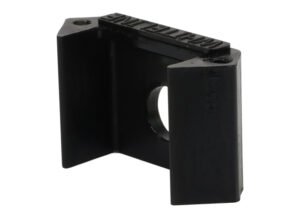

Conclusion
Uprated engine mounts are one of the most effective ways to make a tuned car feel tighter and more responsive, but the right choice is about balance. For most UK road cars that see the occasional track day, a road-grade pitch stop or dog bone is the best place to start, with stiffer engine and gearbox mounts added only if you still want more control. Save motorsport inserts and solid mounts for cars where comfort really comes second.
Check the condition of your existing mounts, confirm the exact fitment and change one thing at a time. When you are ready, browse our engine mounts or explore the full range at performancecarsparts.co.uk. If you are not sure which mount suits your car, message the team on WhatsApp or email us with your registration and we will help you check fitment.
Shop related performance parts

Explore related products

Always check the individual product listing for your vehicle and engine before ordering.