Add a remap, a bigger turbo or even just a set of stickier tyres, and sooner or later the clutch tells you it has had enough. The revs flare in fourth gear on a motorway slip road, the car feels flat even though the boost gauge says otherwise, and there is a faint hot-biscuit smell after a spirited drive. A factory clutch is sized for the factory torque figure with a sensible margin – not for the extra torque a tuned engine can make.
The trouble is that the performance clutch market is full of jargon: stages, organic, cerametallic, paddle, puck, twin-plate, single-mass, dual-mass, clamp load. Pick wrong and you end up with a car that judders in traffic, chatters at idle and wears out its gearbox – or a “stage 3” clutch that grips like a vice but makes every queue on the M25 a misery.
This guide explains how a clutch and flywheel actually work, what changes when you upgrade them, how to match a clutch to your power and driving, and the honest trade-offs of lightweight and single-mass flywheels. We also cover bedding in, warning signs of a slipping clutch, and the UK insurance and warranty points every owner should consider before booking the gearbox-out job.
Quick Answer: Which Performance Clutch Should You Choose?
If you just want a starting point, use the table below, then read on for the detail behind each recommendation. This guide covers manual gearboxes only – DSG, DCT and other automated clutch systems use different components and service procedures.
| Your car and driving | Recommended starting point | Main compromise |
|---|---|---|
| Daily driver, mild remap | Uprated organic clutch | May not support more ambitious future tuning |
| Fast road, occasional track day | Heavy-duty organic or a suitable hybrid / twin-friction clutch | Higher cost or firmer engagement |
| Frequent track use | Suitable cerametallic paddle clutch | Less progressive engagement |
| High-torque competition build | Appropriate twin- or multi-plate clutch | Higher cost and maintenance |
| Daily car with a healthy DMF | DMF-compatible uprated clutch | DMF wear and eventual replacement still apply |
| Track-focused SMF conversion | Engine-specific SMF kit | More vibration and possible gearbox rattle |
These are starting points only. The final choice should always be based on the clutch manufacturer’s quoted torque rating and confirmed fitment for your exact vehicle – you can compare ratings across our performance clutch kits.
How a Clutch and Flywheel Work Together
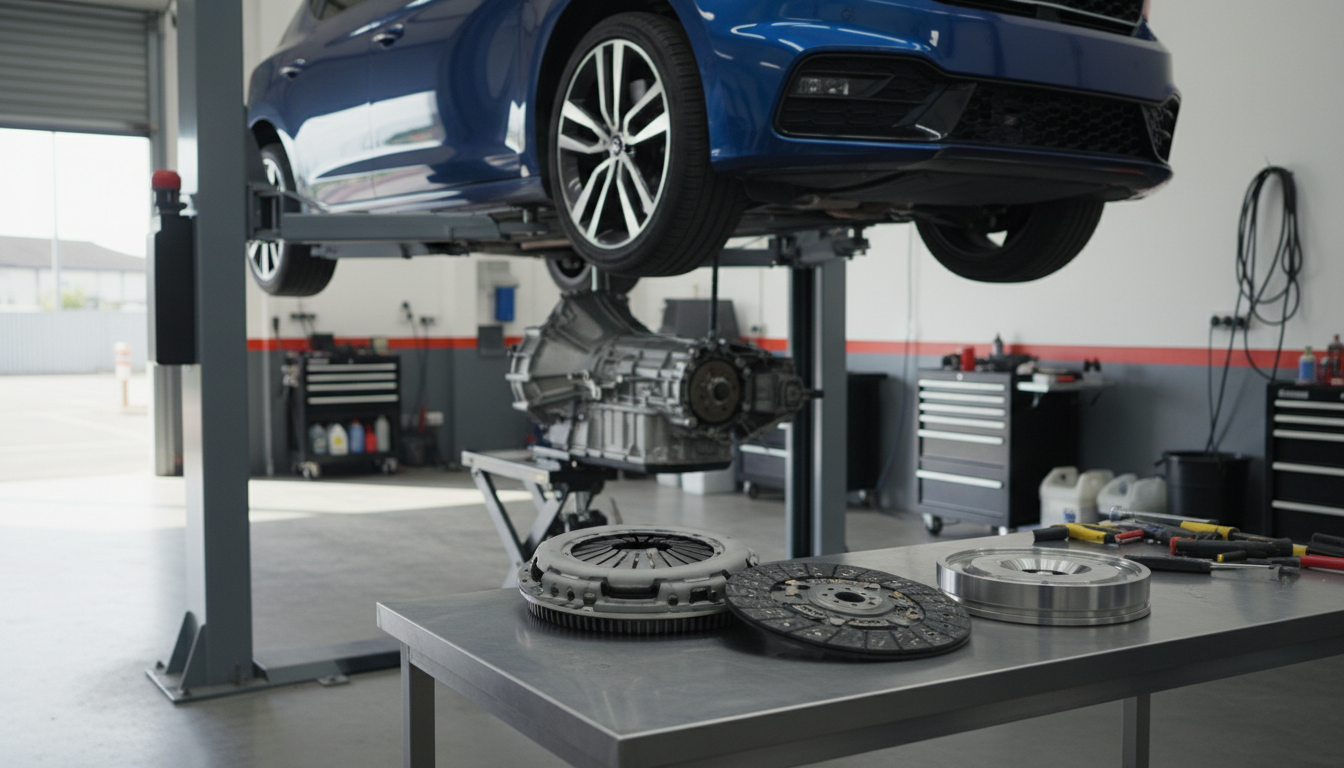
A manual car’s clutch is a friction coupling between the engine and the gearbox. Three main parts do the work:
- The flywheel bolts to the end of the crankshaft. Its machined face is one of the two friction surfaces, and its mass helps smooth out the engine’s power pulses.
- The clutch disc (friction plate or drive plate) sits on the gearbox input shaft splines. It carries friction material on both faces and, on most road clutches, a sprung centre hub to soak up shock and vibration.
- The pressure plate (clutch cover) bolts to the flywheel and uses a diaphragm spring to squeeze the disc between itself and the flywheel. Pressing the pedal pushes the release bearing against the diaphragm, relieving that squeeze so the disc can spin freely.
How much torque a clutch can transmit before it slips depends on a handful of simple variables: the clamping force from the pressure plate, the friction coefficient of the disc material, the effective diameter of the friction surfaces and the number of friction faces. Every performance clutch simply turns one or more of those dials.
Why Standard Clutches Slip After Tuning
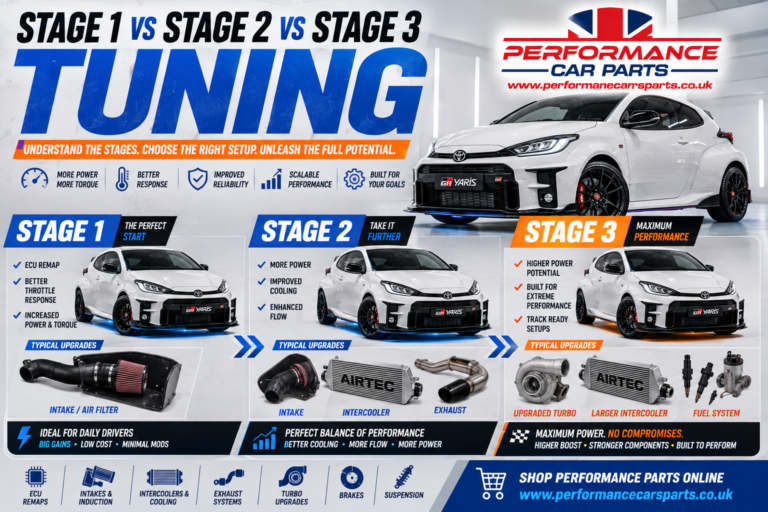
Manufacturers design a clutch to cope with the engine’s rated torque plus a margin for wear, heat and abuse. Modern turbocharged petrol engines respond very strongly to a remap, and torque often climbs much more than peak power. As we explain in our guide to Stage 1, Stage 2 and Stage 3 tuning, the supporting hardware you need grows with every stage, and the clutch is usually one of the first components to reach its limit.
A clutch that was perfectly healthy on a standard map may start to slip immediately after tuning, especially if it is already part-worn. Slip generates heat, heat glazes the friction surfaces, and glazed surfaces slip even more – so a small problem can snowball quickly. Typical symptoms, as summarised in this overview of clutch slip causes and symptoms, include:
- Revs rising without a matching increase in road speed, most obvious in higher gears under full throttle.
- A sharp, acrid burning smell after hill starts or hard acceleration.
- The car feeling sluggish despite the engine sounding busy.
- Stiff or notchy gear changes, sometimes caused by related release or hydraulic issues.
Before blaming power alone, rule out oil contamination. A weeping crankshaft rear main seal or gearbox input shaft seal will coat the disc and cause slip regardless of how strong the clutch is. Fitting an uprated clutch over an oil leak simply ruins an expensive new disc.
Clutch Friction Materials Explained
The friction material is the single biggest factor in how a clutch feels. Specialist manufacturer Phoenix Friction’s breakdown of clutch materials is a useful reference; in broad terms the options look like this.
Organic (including uprated organic)
Organic facings are resin-bonded materials reinforced with fibres – the same family as most OE clutches. They engage smoothly, are kind to the flywheel and pressure plate, and are the right choice for the vast majority of road cars. “Uprated organic” or “heavy-duty organic” versions add more metallic content for better heat resistance. Paired with a stronger pressure plate, a good organic clutch handles a typical Stage 1 or mild Stage 2 car with almost OE manners.
Kevlar / aramid
Aramid facings are prized for longevity and smooth engagement, but they generally need a higher clamp load to hold the same torque and can need a lengthy break-in – Phoenix Friction quotes around 1,000 miles for its aramid discs. They suit owners who want a long-lasting road clutch rather than outright holding power.
Cerametallic (ceramic) and sintered
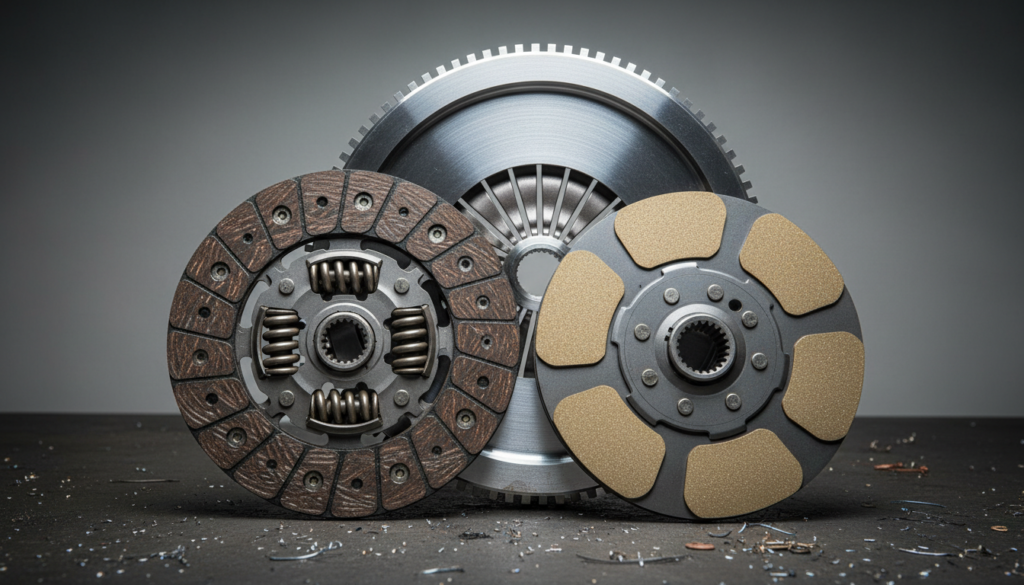
Cerametallic materials are metal-based friction compounds sintered or brazed onto a steel backing. They tolerate far higher temperatures and have a higher friction coefficient than organics, so they hold more torque at a given clamp load. The trade-off is engagement: they tend to bite abruptly, with little slip between “free” and “locked”, and they wear flywheel and pressure-plate surfaces faster. Cerametallic discs are commonly made as paddle or “puck” designs with fewer, separate friction pads.
Mixed-face discs
Some clutches pair an organic face on one side with a cerametallic face on the other. The idea is to keep some of the progression of an organic disc while adding the heat tolerance and bite of a metallic one. They suit fast-road cars that see occasional track days.
Clamp Load, Disc Design and Clutch “Stages”
There is no industry standard for what “Stage 1”, “Stage 2” or “Stage 3” means on a clutch. Each brand uses its own ladder, and a Stage 2 from one manufacturer can be closer to another’s Stage 3. Always read the actual specification – friction material, disc type, clamp load and quoted torque capacity – rather than relying on the stage number.
Clamp load
Raising the diaphragm spring force is the simplest way to increase torque capacity without changing the feel of the friction material. The price of a stronger cover is a heavier pedal, more load on the release bearing and, on cars with self-adjusting or hydraulic systems near their limits, potentially more stress on the clutch hydraulics.
Full-face vs paddle discs
A full-face disc has friction material around the whole circumference, spreading heat and wear and giving more progressive engagement. A paddle disc (typically three, four or six paddles) uses separate friction pads, usually cerametallic. Be careful with the common claim that paddles automatically hold more torque: torque capacity is set by the friction material, clamp load, effective friction radius and number of friction faces together, so paddle construction alone does not guarantee more capacity. In practice, paddle discs are chosen mainly because the cerametallic pads tolerate heat well. Fewer paddles generally means sharper engagement and is better suited to competition use.
Sprung vs solid hubs
A sprung hub has torsion springs between the friction ring and the splined centre, cushioning drivetrain shock. Solid (rigid) hubs save weight and cost but pass every jolt directly into the gearbox, differential and driveshafts. For any car that is driven on the road, a sprung hub is strongly recommended.
Twin- and multi-plate clutches
Adding a second disc doubles the number of friction faces, so a twin-plate clutch can hold far more torque at a smaller diameter and often with a lighter pedal than a single-plate equivalent. They cost more, usually need a matching flywheel and can be noisier at idle.
When you are ready to compare options, browse our performance clutch kits and check the quoted torque rating against your car’s current – and planned – output.
Dual-Mass vs Single-Mass Flywheels
Many modern manual cars – particularly diesels and torquey turbo petrols – leave the factory with a dual-mass flywheel (DMF). A DMF has two halves connected by springs and damping elements, designed to absorb torsional vibration from the engine before it reaches the gearbox. DMFs are heavy, expensive to replace and have a finite life. Common failure signs include knocking at idle, rattles on start-up or shut-down, and vibration through the pedal.
Many performance clutch kits replace the DMF with a single-mass flywheel (SMF). An SMF is mechanically simpler, with no internal springs or bearing to wear, and can sharpen response. It is not automatically the cheaper option, though – a quality engine-specific SMF kit can cost as much as a like-for-like DMF replacement on some cars. As PistonHeads’ explainer on dual-mass flywheels sets out, the DMF exists to absorb the engine’s torque pulses, reducing gearbox rattle, drone and transmission load – so an SMF will transmit more torsional vibration into the drivetrain. Clutch specialist LuK, a major original-equipment supplier, sets out its concerns in its technical note on DMF conversions: a dual-mass flywheel can damp vibration over a far larger angle than the sprung damper in a typical conversion disc, and vibration that is not absorbed can be passed into the gearbox, driveshafts and, in extreme cases, the crankshaft. It also points out that a conversion takes the car away from original equipment specification, with implications for manufacturer warranty.
That does not mean SMF conversions are always a mistake – plenty of performance-focused owners run them happily – but you should expect:
- More gearbox rattle at idle, especially with the clutch pedal released.
- More vibration and boom transmitted into the cabin at low revs.
- The need to avoid labouring the engine at very low rpm in high gears.
- Greater reliance on a well-designed sprung disc.
Choose a conversion engineered for your specific engine and gearbox, rather than a generic kit. For example, our Stage 2 Sport SMF clutch kit for the Ford Focus III is designed as a complete matched package for that platform.
Lightweight Flywheels: Real Benefits and Real Compromises
A lightweight flywheel reduces the rotating mass the engine has to accelerate and decelerate. The effect is most noticeable in neutral and on the overrun – the engine revs up and drops back more quickly, making heel-and-toe downshifts snappier. As Clutch Masters’ guide to lightweight flywheels explains, the benefits include crisper throttle response, quicker turbo spool on some engines and better midrange pick-up on naturally aspirated cars.
The compromises are equally real:
- Noise and vibration: less mass means less damping, and aluminium flywheels are typically the noisiest. Steel is usually the better choice for a road car.
- Gear rattle: more pronounced at idle and low-speed clutch release – annoying, though not in itself a sign of damage.
- Low-speed driveability: pulling away, reversing into a space and crawling in traffic all need more care, and stalling becomes easier until you adapt.
- Maintenance: some aluminium designs use a replaceable steel friction insert that must be renewed periodically.
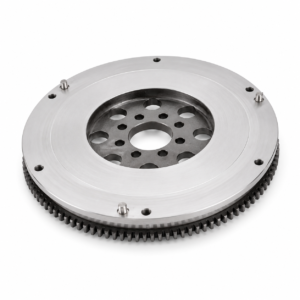
For most UK road cars, a moderately lightened steel flywheel is the sweet spot. Extremely light flywheels make far more sense on a dedicated track car than on something that does the school run. You can browse our performance flywheel range to compare weights and materials for your application.
Matching a Clutch to Your Build
Work through these questions before you buy:
- What is your real torque figure? Use a rolling-road printout or the figure your tuner quotes, not the manufacturer’s standard number. Then think about where the car is heading – it is cheaper to buy once than to fit a second clutch after your next stage of tuning.
- How is the car used? Daily commuting in traffic, weekend B-roads, occasional track days or regular competition all point to different friction materials.
- What is the drivetrain? Four-wheel-drive cars and cars with a limited-slip differential put more load through the clutch on hard launches because there is less wheelspin to relieve shock loads.
- DMF or SMF? Decide whether you value refinement or response and cost. If you keep a DMF, make sure the new clutch is approved to work with it.
- Who will fit it? A gearbox-out job is significant labour. Budget for a new release bearing, spigot/pilot bearing where fitted, and any seals that are leaking while everything is apart.
It is also worth refreshing the rest of the system at the same time – our transmission and clutch parts range covers related components. A braided clutch line can firm up pedal feel on cars with a rubber factory hose, and fresh hydraulic fluid is cheap insurance. If you are also upgrading the gear change itself, our guide to weighted shift knobs and short shifters covers how they affect feel and accuracy.
Performance Clutch Upgrades for Popular UK Tuned Cars
Every platform has its own quirks, so use these as a checklist of what to confirm before ordering – not as a substitute for checking the fitment details on the product listing.
| Vehicle family | What to check |
|---|---|
| VW Golf GTI / Golf R / Audi S3 | Manual or DSG (this guide covers manual only), engine generation, whether the car has a DMF, and the clutch’s torque capacity against your tune |
| Ford Fiesta ST / Focus ST | Exact model generation and engine, intended torque output, and whether the kit is designed for a DMF or an SMF |
| BMW 135i / 335i | Engine and gearbox variant, torque capacity, DMF condition and how much everyday driveability you want to keep |
| Mitsubishi Evo X | 4B11T engine torque demands, manual or SST dual-clutch transmission, and a matching clutch and flywheel system |
Examples from our range
- Fiesta ST owners after OE-like manners with more holding power can look at our Stage 1 organic DMF clutch kit for the Fiesta Mk7 ST180/ST200.
- BMW 335i (E90) owners keeping the dual-mass flywheel can consider the Stage 2 Sport DMF clutch kit for the 335i.
- Heavily modified manual Evo X builds are a typical twin-plate application, such as the MTX twin-plate clutch and flywheel set for the Evo 10.
- Focus III owners considering an SMF conversion can see the engine-specific kit linked in the DMF section above.
Fitting and Bedding In a Performance Clutch
A new clutch only performs as designed if it is fitted correctly and bedded in properly. Key points for fitting:
- Resurface or replace the flywheel if it shows heat spots, scoring or glazing – a fresh disc on a damaged surface will judder and slip.
- Degrease friction surfaces thoroughly and keep fingers and grease away from the disc.
- Use new flywheel bolts where the manufacturer specifies, and torque all fasteners to specification in the correct sequence.
- Align the disc carefully and lightly lubricate the input shaft splines with an appropriate grease – too much will contaminate the facings.
- Bleed the hydraulics fully and check pedal free play.
Bedding in lets the friction surfaces mate evenly and avoids hot spots. There is no universal mileage or procedure that applies to every performance clutch – it depends on the kit and the friction material, so always follow the instructions supplied with yours. For example, UK manufacturer RTS specifies 750 to 1,000 miles of normal driving with positive gear changes, no launches or aggressive downshifts, and explicitly warns never to slip the clutch to bed it in. Other manufacturers use a shorter, staged procedure with progressively increasing load. Whatever the method, avoid launches, full-throttle pulls in high gears and track sessions until bedding in is complete. Some early judder or inconsistent take-up is normal while high spots wear in, but it should settle.
Finally, remember that the gearbox oil often comes out during the job. Refill with the correct specification for your gearbox, or consider an uprated oil if the car is driven hard.
UK MOT, Insurance and Warranty Implications
MOT
The MOT does not assess which clutch or flywheel your car runs. What matters is that the car remains in a safe, roadworthy condition – for example, no fluid leaks, no warning lights caused by related modifications and nothing affecting the security of the drivetrain.
Insurance
Insurers generally define a modification as any change from the manufacturer’s original specification, and that includes drivetrain parts. Specialist insurer Footman James notes in its guide to declaring modifications that undisclosed changes can lead to a refused claim or even cancellation of cover. An uprated clutch is often a sign that the engine has been tuned too – and the tune is something your insurer will definitely want to know about. Tell your insurer before or immediately after the work, not at renewal, and keep invoices.
Manufacturer warranty
If your car is still under a manufacturer or extended warranty, replacing the clutch and especially converting from DMF to SMF moves the car away from factory specification. That may affect claims on the clutch, gearbox and related components. Check your warranty terms before committing.
Clutch Upgrade Checklist: Before You Buy and Fit
- Confirm your real torque figure from a rolling road or your tuner, and allow for planned upgrades.
- Decide how the car is mostly used: commuting, fast road, track days or competition.
- Check whether your car has a DMF, and decide whether to keep it or convert to an engine-specific SMF.
- Compare the manufacturer’s quoted torque rating – not the stage number.
- Check fitment for your exact model, engine, gearbox and year.
- Budget for a release bearing, spigot/pilot bearing, flywheel bolts and any leaking seals.
- Inspect, resurface or replace the flywheel.
- Plan the bedding-in period from the manufacturer’s instructions before any track day.
- Tell your insurer about the modification.
Shop clutch kits and flywheels


Conclusion
An uprated clutch is one of the least glamorous upgrades you can make, but it is the component that lets you actually use the power your tune has unlocked. Start with an honest torque figure and a realistic view of how you drive. For most UK fast-road cars that means a quality uprated organic or mixed-face clutch with a sprung hub and a sensible, steel flywheel. Save cerametallic paddles, solid hubs and featherweight flywheels for cars that genuinely spend their weekends on track.
Weigh the DMF versus SMF decision carefully, fit everything properly, bed it in patiently and declare the change to your insurer. Do all that, and your new clutch will feel as good on the commute as it does on the circuit.
Ready to upgrade? Browse our full range of performance clutch kits and flywheel packages at performancecarsparts.co.uk. If you are unsure which clutch suits your car, power level or driving, contact our team via WhatsApp or email with your vehicle details and we will help you choose the right setup and confirm fitment.