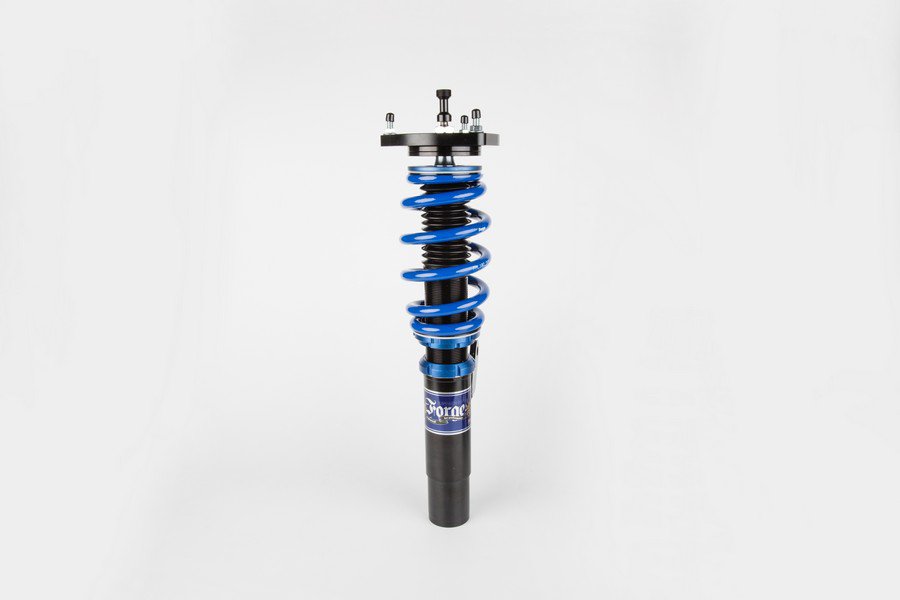
If your car feels floaty over a dip, pitches under braking or bounces across a bumpy B-road, the first instinct is often to order a set of coilovers. But for many UK drivers the real problem is tired or under-specified dampers, not the springs or ride height. Choosing between uprated dampers vs coilovers is one of the most common suspension questions we get, and the right answer depends far more on how you use the car than on what looks best on a forum build thread.
Uprated dampers (performance shock absorbers) replace the factory units and usually keep your existing springs and ride height, or pair with a matched set of lowering springs. Coilovers replace the whole spring-and-damper assembly with an adjustable unit that lets you set ride height and, on most kits, damping too. Both can transform how a car drives, and both can make it worse if they are chosen or set up badly.
In this guide we explain what each option actually changes, who each one suits, what to check on popular UK performance cars, and how suspension upgrades interact with the MOT and your insurance. By the end you should know which route makes sense for a road car that does the odd track day.
Quick Answer: Uprated Dampers or Coilovers?
If you are happy with the ride height and mainly want better body control and a fresher, tighter feel, uprated dampers are usually the most sensible starting point. If you want to choose your own ride height, corner-weight the car or tune it properly for regular track days, a good coilover kit is the more flexible tool. Lowering springs on their own sit in between, but they should always be matched with dampers designed for the shorter spring length.
| Your car and driving | Recommended starting point | Main compromise |
|---|---|---|
| Daily driver, factory ride height, original dampers worn or soft | Uprated OE-shape dampers on standard springs | No ride height change and limited tuning range |
| Fast road car, wants a modest drop and sharper feel | Lowering springs with matched shortened dampers, or a mild road coilover | Less suspension travel; ride height fixed with springs |
| Road car plus several track days a year | Height- and damping-adjustable coilovers | Needs proper setup and alignment; easy to get wrong |
| Mostly track, occasional road use | Higher-specification coilovers with camber-adjustable top mounts | Firmer ride, more maintenance, higher cost |
| Car with factory adaptive dampers | Check whether you want to keep the system before choosing either | Coilovers may need a cancellation kit and lose drive-mode damping |
Final choice always depends on the manufacturer’s intended application, ride height range and fitment for your exact model. This guide covers road cars with conventional steel springs, not air suspension. Browse our performance shock absorbers and coilover kits to see what is listed for your car.
What Dampers Actually Do (and Why Worn Ones Matter)
Springs hold the car up and store energy when the wheel moves. Dampers, also called shock absorbers, control how quickly that energy is released. Without enough damping the car keeps moving after a bump, the body pitches and rolls further than it needs to, and the tyre spends less time pressed evenly onto the road.
Damping is usually described in two directions:
- Compression (bump) – resistance as the wheel moves up towards the body.
- Rebound – resistance as the spring pushes the wheel back down.
Dampers wear gradually, so most owners never notice the decline until something new goes on and the difference is obvious. Common signs of tired dampers include:
- The car keeps bouncing after a crest or speed hump.
- Nose-dive under braking and squat under acceleration feel worse than they used to.
- The steering feels vague or the car wanders on undulating roads.
- Oil on the damper body, knocking over bumps or uneven tyre wear.
That matters for this decision. A car with worn dampers will feel dramatically better on almost any decent replacement, so it is easy to credit coilovers with an improvement that a good set of dampers would also have delivered.
Uprated Dampers Explained: Performance Shock Absorbers
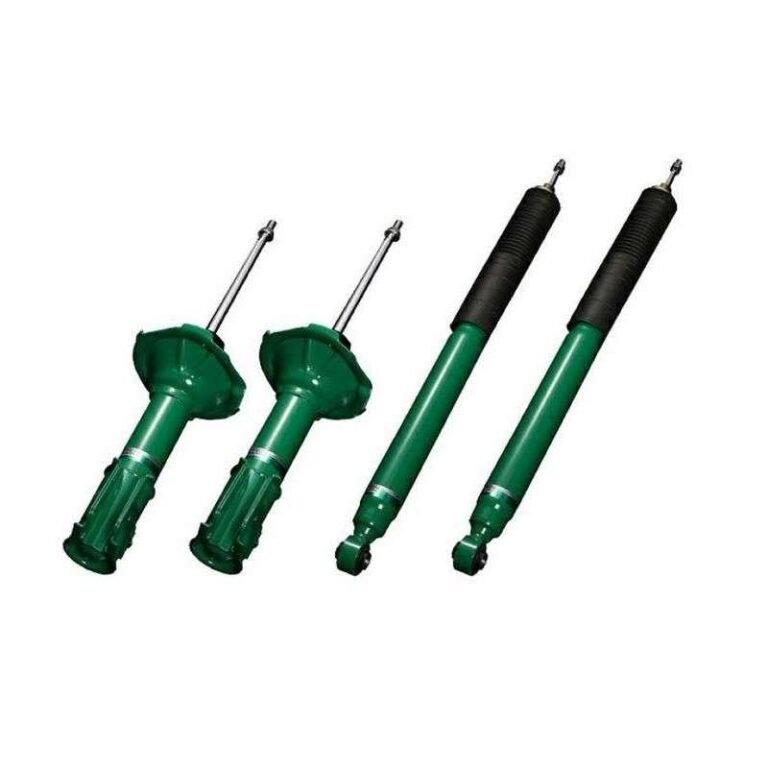
An uprated damper is a performance replacement for the factory unit. It bolts into the original mounting points, uses your existing top mounts and springs (or a lowering spring designed to work with it), and is valved to give better control than a standard replacement part.
Fixed versus adjustable dampers
Many performance dampers have a single, fixed valving chosen by the manufacturer for that model. Others add an adjuster. For example, TEIN describes its EnduraPro and EnduraPro PLUS as OE-shape shock absorbers, with the PLUS version adding a 16-level adjuster that changes compression and rebound together. That gives you a way to soften the car for winter commuting and firm it up for a track day without touching ride height.
Standard-height and shortened dampers
This is the detail that catches people out. A damper designed for factory ride height has a body and stroke length to suit standard springs. If you fit lowering springs, the damper works in a different part of its travel and can run out of stroke sooner. That is why some manufacturers sell separate ranges. Bilstein’s own guidance, for instance, positions its B6 Performance for standard ride height and its B8 Performance Plus for lowered applications. Other brands handle it differently, so always check what the damper is listed for.
Strengths of uprated dampers
- Keep factory ride height, ground clearance and suspension geometry when used with standard springs.
- Usually a straightforward swap that reuses original top mounts, spring seats and bump stops where specified.
- Fewer settings to get wrong, which suits owners who do not want to spend weekends experimenting.
- Often a smaller change to declare to insurers than a lowered car, though you still need to declare it.
Limitations
- No ride height adjustment, so you cannot corner-weight the car or fine-tune rake.
- Spring rates stay as standard unless you change springs too.
- Range for dedicated track use can be limited compared with a well-specified coilover.
- Choice for some models is thin, so you may find more coilover options than damper options for your car.
Coilovers Explained: Adjustable Height and Damping
A coilover is a damper with its own spring mounted around it, usually on a threaded body so the spring platform or the damper body can be moved. Most road and track kits are sold as a complete set for the car, with springs chosen by the manufacturer and, on many kits, new top mounts.
Full-length adjustable versus spring-perch adjustable
Cheaper or older designs lower the car by winding the spring perch down the body, which can eat into usable travel. Full-length adjustable designs move the lower mount instead, so ride height changes without shortening the available stroke. TEIN explains this on its FLEX Z coilover page, noting that its full-length system keeps the damper stroke the same so ride quality changes little as height is adjusted. It also offers 16 levels of combined compression and rebound adjustment.
Strengths of coilovers
- Set your own ride height and rake within the kit’s range.
- Corner-weighting is possible, which matters more on track than on the road.
- Spring and damper are designed together, avoiding mismatched combinations.
- Many kits offer damping adjustment, and some offer camber-adjustable top mounts.
- Wider choice of spring rates and specifications for track-focused builds.
Limitations
- Easy to set badly. Slamming the car or running random damping settings can make it slower and less comfortable than standard.
- Needs a full alignment after fitting and after any height change.
- Threads and adjusters need cleaning and protection through a UK winter.
- Lower ride heights bring scraping, bump-stop contact and tyre-to-arch rubbing.
- Spring rates are often firmer than standard, which UK roads will remind you about.
If you do go down the coilover route, our coilover setup guide walks through ride height, damping and corner weights step by step.
Where Lowering Springs Fit In
Lowering springs are the third option and the one most often fitted without enough thought. A shorter, usually stiffer spring drops the car and reduces roll, but on its own it does nothing to increase damping. Paired with tired factory dampers, the result is often a car that crashes over potholes and feels less settled than standard.
If you like the idea of a fixed, modest drop with no adjusters to maintain, the sensible approach is lowering springs plus dampers designed for lowered use, or a matched spring-and-damper kit from one manufacturer. We compare that route with coilovers in more depth in coilovers vs lowering springs, and you can browse lowering springs for supported models.
Road Comfort vs Track Performance: How to Decide
Neither option is automatically “stiffer” or “better”. Ride quality and grip depend on spring rates, damper valving, ride height, tyre choice, alignment and how well the parts suit the car’s geometry. A quality damper on standard springs can ride better and feel more composed on a bumpy UK B-road than a low, stiffly sprung coilover. On a smooth circuit the coilover car may be quicker. Ask yourself:
- How many track days do you really do? One or two a year rarely justifies a track-biased setup that you live with for the other 50 weeks.
- What are your local roads like? Broken surfaces, speed humps and steep driveways punish low ride heights and high spring rates.
- Will you actually adjust it? Adjustability only helps if you take time to set it up, record settings and re-align.
- Is the car otherwise standard? On a car with standard wheels and tyres, uprated dampers often give the best return. Wider wheels, sticky tyres and more power can shift the balance towards coilovers.
- Does the car have adaptive dampers? Removing them changes how the car behaves in different drive modes and may trigger warnings unless a suitable cancellation kit is used.
Damper and Coilover Upgrades for Popular UK Tuned Cars
Suspension layouts vary a lot between models, and that affects what a “coilover kit” really includes. Use the table below as a list of things to check with the parts listing or with us before you buy, rather than a guarantee of fitment.
| Vehicle family | What owners should check |
|---|---|
| VW Golf GTI / Golf R / Audi S3 (Mk7 and later) | Front-wheel-drive and 4Motion cars can need different kits; check strut diameter in the listing, and whether the car has adaptive damping that needs a cancellation kit. |
| Ford Fiesta ST / Focus ST | Check whether the rear uses separate springs and dampers, how the kit handles that, and the stated ride height range on a twist-beam rear. |
| BMW 1 Series / 3 Series / E46 M3 | Many BMW rear axles use a separate spring and damper; confirm the kit layout, any M-specific versions and whether lowering springs need shortened dampers. |
| Honda Civic Type R | Kits are generation-specific (EP3, FN2, FK2, FK8 and so on). Later cars have adaptive dampers, so check what happens to the system and dash warnings. |
| Nissan 350Z / Infiniti G35 | Check whether you want to keep factory height with adjustable dampers or lower the car; confirm upper mount and spring compatibility. |
Examples from our range
- TEIN EnduraPro Plus shock absorber kit for the Nissan 350Z and Infiniti G35 – an adjustable damper option that keeps factory ride height.
- Bilstein B12 Pro-Kit for the BMW M3 E46 – a matched damper and lowering spring package rather than a height-adjustable coilover.
- VW Golf Mk7 coilover kit – a height-adjustable option for one of the UK’s most popular hot hatch platforms; check drivetrain and strut fitment.
- YSR Dynamic Pro Sport coilovers for the Ford Fiesta ST (2013–2017) – an adjustable kit for the Mk7 Fiesta ST.
Fitting and Setup: What Changes After Installation
Whichever route you choose, budget for more than the parts. Fitting procedures, torque figures and settling advice vary by manufacturer and model, so there is no universal figure to quote. Follow the instructions supplied with your kit and the vehicle manufacturer’s data, and expect to:
- Tighten bushes at ride height where the vehicle design requires it, so rubber bushes are not preloaded in a twisted position.
- Book a four-wheel alignment after fitting. Any ride height change alters camber and toe, and even a like-for-like damper swap is a good moment to check settings.
- Check clearances at full lock and with the suspension compressed, especially with wider wheels or lower ride heights.
- Re-check after a few hundred miles of normal driving, as springs can settle and fixings should be inspected.
- Record your settings on adjustable kits: ride height measured hub-to-arch, and clicks from fully firm or fully soft.
Start any adjustable kit at the manufacturer’s recommended baseline and change one setting at a time. If you cannot tell the difference between two settings on the road, choose the softer one.
UK MOT, Legality and Insurance
Suspension upgrades are not illegal in themselves, but they must be fitted safely and the car still has to pass the MOT. The DVSA’s MOT inspection manual for suspension, wheels and tyres sets out what testers look for. In summary:
- Dampers: an insecure, non-functioning or severely leaking shock absorber, an excessively worn damper bush, or one with negligible damping effect is a major defect. A light film of seepage on its own is not a reason for failure.
- Springs: testers check that coil springs locate correctly when the car is jacked and lowered. An insecure, fractured or unsafely modified spring is a major defect.
- Modifications: modifications likely to affect roadworthiness, welded repairs and excessive heat on highly stressed suspension parts are treated as unsafe.
- Tyres: a tyre fouling part of the vehicle at the time of test is a major defect, which is a real risk on low, wide setups.
For insurance, any change from the factory specification should be declared. Under the Consumer Insurance (Disclosure and Representations) Act 2012, you have a duty to take reasonable care not to misrepresent your car to your insurer. Uprated dampers, lowering springs and coilovers are all suspension modifications, and how much they affect your premium varies by insurer. Our guide to car mods and insurance explains how to declare them properly.
Common Mistakes to Avoid
- Buying on ride height alone. The lowest setting a kit allows is rarely the best setting for a UK road car.
- Mixing old dampers with new springs. Lowering springs on worn or standard-length dampers is a common route to a harsh, bouncy ride.
- Ignoring top mounts and bushes. Fresh dampers on perished mounts, drop links or bushes will not feel as good as they should.
- Skipping the alignment. Poor toe settings after a height change can make a good kit feel nervous and wear tyres quickly.
- Maxing out adjusters. Full stiff is rarely fastest; more damping than the tyre and road can use simply reduces grip.
- Forgetting adaptive systems. Removing factory adaptive dampers without the correct solution can leave warning lights on.
Damper and Coilover Upgrade Checklist: Before You Buy and Fit
- Be honest about the split between road miles and track days.
- Decide whether you want to keep factory ride height or lower the car.
- Confirm exact model, drivetrain, year and whether the car has adaptive dampers.
- If lowering on springs, check the dampers are specified for that drop.
- Check the kit’s stated ride height range, spring rates and what mounts are included.
- Inspect top mounts, bushes and drop links and replace anything worn.
- Budget for professional fitting and a full four-wheel alignment.
- Declare the modification to your insurer before driving.
- Keep a note of settings and re-check fixings after the first few hundred miles.
Shop Shock Absorbers, Coilovers and Lowering Springs

Conclusion
The uprated dampers vs coilovers decision comes down to what you want to change. If the car sits where you like it and simply feels loose or tired, good performance shock absorbers are often the most effective and least compromised upgrade. If you want control over ride height and corner weights, or you are building towards regular track days, a well-specified coilover kit gives you room to grow, as long as you take the time to set it up properly.
Whichever way you go, match the parts to your exact car, check fitment and ride height ranges, get the alignment done and keep your insurer informed. Remember that the best suspension for a UK road car is one that keeps the tyres working on real roads, not just on a smooth circuit.
Ready to upgrade? Browse our coilover range and uprated shock absorbers at performancecarsparts.co.uk. Not sure which suits your car? Message the team on WhatsApp or email us with your make, model and how you use the car, and we will help you check fitment before you order.
Shop related performance parts

Explore related products

Always check the individual product listing for your vehicle and engine before ordering.