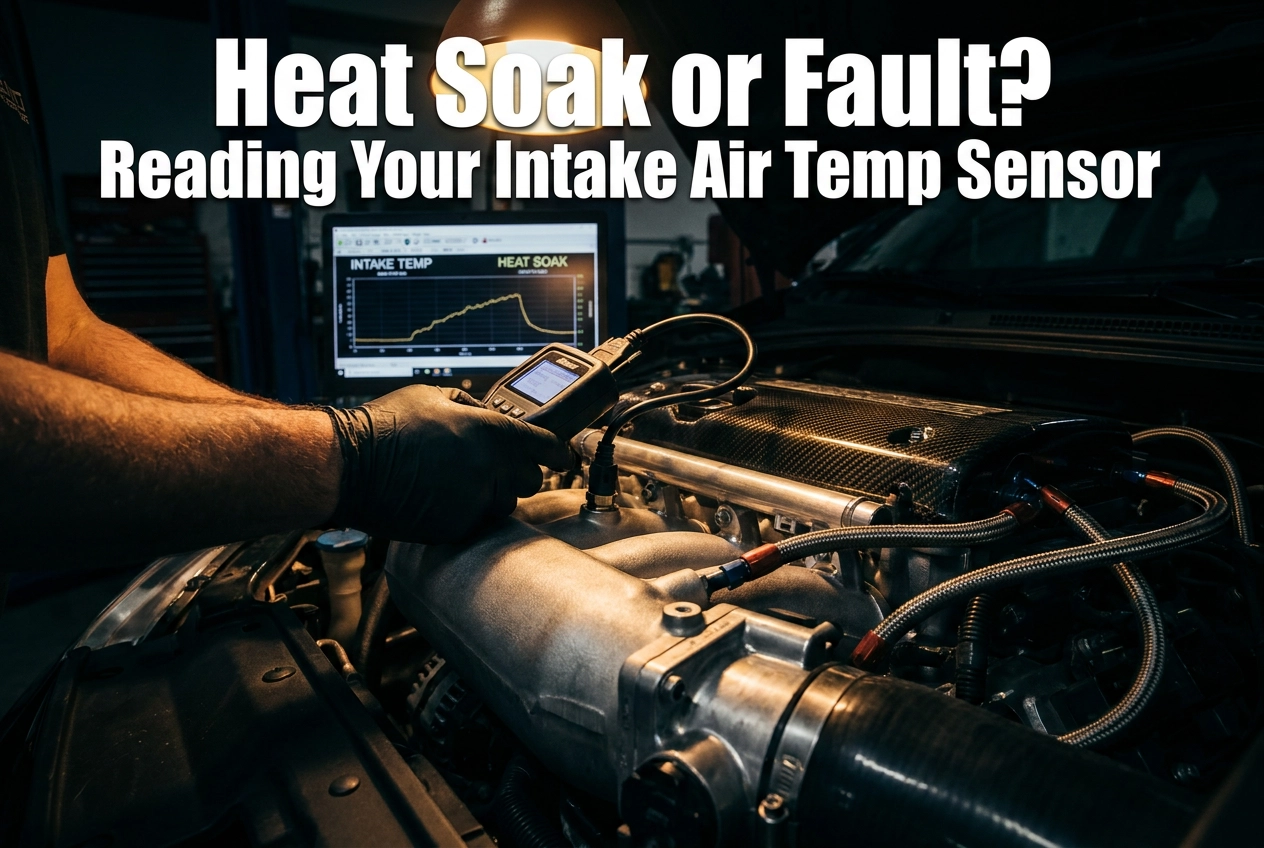
You glance at your gauge or app and see an intake temperature reading that looks alarming. Perhaps it is 30°C above ambient in traffic, or it climbs sharply after you park. The instinct is often to suspect a failed component or a flawed design. Before you buy a replacement, it is worth understanding that a hot reading is not automatically a fault. Treating your air intake temperature sensor as a diagnostic instrument rather than just a part is the key to interpreting this data correctly.
This tutorial will teach you to log intake temperatures and separate a faulty sensor from genuine heat soak or plain unrealistic expectations. We will cover the sensor’s location and fault symptoms, explain how to log values with the correct PID and sample rate, and define a realistic target delta for a UK car in summer. You will also learn the difference between post-shutdown heat soak and heat soak under load. By the end, you will be able to use your log to reach one of three verdicts. The goal is to diagnose with data before replacing anything.
Why a Hot Intake Air Temperature Reading Is Not Automatically a Fault
An intake air temperature sensor is a measuring instrument, not a tuning part. Its only job is to report how hot the charge entering the engine is, so the ECU can correct air density, fuelling and ignition. A hot reading is data, not a verdict.
On a UK performance car, lost power with a high intake air temperature can have three different causes. The sensor may have failed or gone slow, the layout may genuinely heat soak, or the intake may never have offered a power advantage to lose. Each has a different fix: replacement part, airflow or shielding work, or an honest decision to keep or remove the intake. Diagnosis must come before purchase.
Underhood packaging matters. A 2014 Applied Thermal Engineering review, with University of Sunderland co-authors, notes that extra components and noise insulation have squeezed engine bays and created complex airflow and recirculation regions (source). Layout can shape intake temperature as much as the sensor does. That is also why whether a cold air intake or short ram kit actually gains power depends on the installation, not the label.
The rest of this guide gives you a logging method and decision tree, so when power feels down in traffic on a hot day you can identify which of the three problems you have. Read the log, not the hype. Your own intake air temperature data settles the argument faster than any forum thread.
What an Air Intake Temperature Sensor Measures, and Where It Sits
That log begins with a physical part: most intake air temperature sensors are negative temperature coefficient thermistors, where resistance falls as temperature rises and the ECU maps that curve to degrees Celsius. Before you trust any intake air temperature reading, establish where your intake air temperature sensor sits. Many OEM layouts integrate it into the mass airflow housing; speed-density cars, older Japanese and European platforms and most forced-induction builds use a separate probe in the intake pipe, charge pipe or manifold. On a turbocharged or supercharged car, position changes the meaning of the number entirely. Pre-turbo, post-intercooler and manifold readings can differ on one drive, so state which sensor produced the value. The ECU also uses intake air temperature for air density correction, ignition timing and knock margin, boost or torque targets, and plausibility checks against coolant and ambient readings. Your factory service data lists the exact location, expected resistance values and default substitute values. That page beats any generic table when testing a suspect intake air temp sensor, and it is the reference to check before changing air intake hardware.
Intake Air Temp Sensor Fault Symptoms to Log Before You Buy Anything
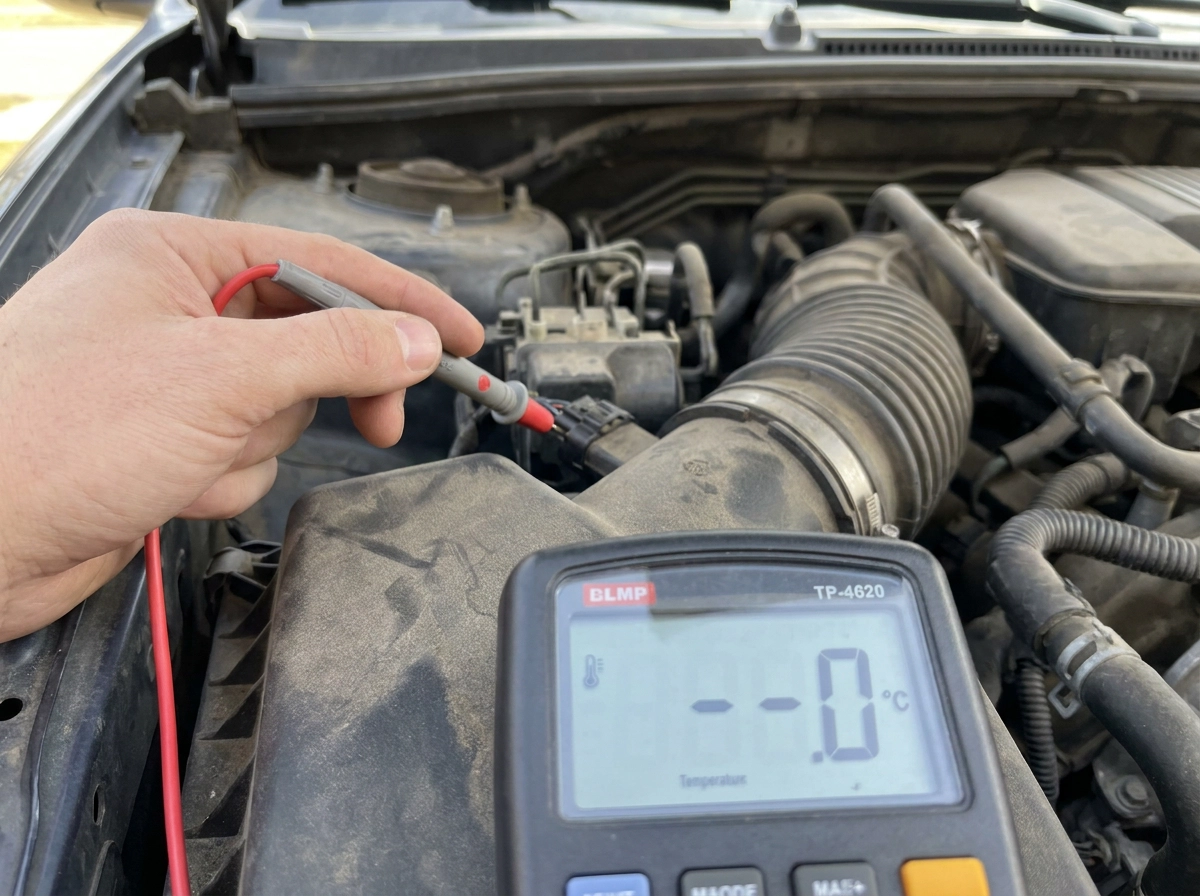
With the sensor’s location established, the log becomes the evidence. Stuck or flatlined values are the clearest failure sign: if intake air temperature barely moves from a stone-cold start to a fully warm run, suspect an open or short circuit, a dead thermistor or a severed wire, not heat soak. Implausible values usually mean the ECU has substituted a default it no longer trusts. Expect P0112 (low input), P0113 (high input) and P0111 (range/performance); readings around minus 40 °C or above 130 °C are substitution values, not measurements. A slow or biased sensor is harder: it may read roughly correctly at idle but lag a rapidly rising or falling temperature, a response fault that often passes a static code check with no warning lamp, unlike obvious alerts such as the engine oil light. Wiring mimics failure, so check chafed loom near exhaust manifolds or turbine housings, corroded pins and grounds before condemning the probe. Finally, cross-check intake air temperature against ambient, coolant and any post-intercooler reading, then confirm with a known-good probe. This compares the reading with an expected value, the same model-based idea used for coolant diagnosis in a 2017 Chalmers and Volvo thesis, though that work concerns coolant, not intake sensors. That triage separates circuit and sensor faults from genuine heat soak before you spend.
How to Log Intake Air Temperature: PID, Sample Rate and Ambient Reference
With the circuit cleared, build an interpretable log. Standard OBD-II intake air temperature is PID 0x0F in mode 01, defined under SAE J1979, but that standard leaves applicability to the user, and many UK performance platforms expose it only through manufacturer-specific identifiers. Confirm your adapter reads a live value by watching it move as the engine warms.
Match sample rate to the test: 1 to 2 Hz suits a soak test over minutes, while a 20 to 60 mph pull lasts seconds and a slow stream misses the transient. Use 5 to 10 Hz, or log ECU-side, to see inside a pull.
Log a reference alongside it: ambient air temperature from a separate PID or a shielded external probe. Intake-to-ambient delta is the meaningful number; absolute intake temperature alone is not.
Use paired runs, not snapshots: the same route or dyno session cold and fully heat soaked, plus static ignition-on and post-shutdown logs. The difference between controlled runs is evidence.
Record context: ambient temperature, wind, road speed, gear, coolant temperature, boost pressure, and whether fans or a dyno blower were running. Without metadata the log cannot be interpreted later. If it points to charge cooling, our front-mount intercooler guide explains when an FMIC makes sense.
Heat Soak After Shutdown vs Heat Soak Under Load
With PID and sample rate settled, separate two soak modes in your log. Post-shutdown soak is bay temperature rising after engine stop as coolant circulation and airflow cease. An SAE methodology paper on transient engine compartment air temperature after shutdown describes this temporary rise and reports cooling rate and time to equilibrium depend on ambient temperature and wind speed; it studies a military wheeled vehicle and has a conflicting metadata date, so treat it as context, not a UK car figure. Under-load soak builds while running but stationary: traffic idling, track-gate queuing and repeated standing starts raise intake air temperature because no ram airflow clears the bay. Use one protocol: 10 minutes steady 60 to 70 mph cruise, 10 minutes stationary idle, 15 to 30 minutes shutdown, restart and log. Recovery diagnoses: a reading falling quickly once moving is layout or airflow soak; one staying flat, stepping oddly or implausible points to sensor or circuit. Heat soak is studied: a 2024 Scientific Reports paper models engine-bay thermal soak, enough to confirm physics but not quote a precise figure. Tight modern bays and older layouts differ. If recovery is healthy but delta disappoints, read our guide to Stage 1, Stage 2 and Stage 3 tuning before assuming a part is faulty.
What a Realistic Intake-to-Ambient Delta Looks Like in a UK Summer
Having separated post-shutdown soak from under-load soak, the next step is a baseline. UK summer ambient usually sits in the high teens to late twenties Celsius, with heatwave days pushing higher, so an intake reading a few degrees above ambient is normal, not a fault. At a steady cruise with good airflow, treat roughly 5 to 15°C above ambient as a plausible healthy range for a naturally aspirated car on an OEM airbox, and roughly 10 to 25°C above for a turbocharged car, where compressor heating and intercooler recovery dominate the number. Stationary or slow traffic is where figures balloon: 30 to 50°C above ambient while idling in a queue on a hot day is ordinary heat-soaked behaviour, not evidence of a fault on its own. After a heat-soak shutdown, restart temperature can sit far above ambient and fall over several minutes of driving; how fast depends on ambient, wind and bay layout, so one reading right after a hot restart means very little. There is no published UK summer intake air temperature baseline for performance cars, so use these ranges as starting expectations and refine them with your own paired logs. Never treat a precise figure as a measured fact for another car. Apply the same discipline to any temperature-dependent choice, including engine oil viscosity grades: guidance is a starting point, not a substitute for your own data.
Three Verdicts Your Intake Air Temperature Log Can Give You
Your delta baseline now turns the log into a verdict.
Failed or slow sensor: flatlined, stepped, implausible, or lagging a real temperature change. Expect a fault code, substituted default, or no response to a cold-air blast or cold-soaked rag on the sensor body. Replace the sensor and check wiring; this is the one case where buying a part is right. Our electrical components range covers replacement sensors once the circuit is confirmed.
Genuine heat soak: temperature tracks load and airflow logically. It climbs when stationary, falls when moving, and settles at ambient plus a sensible delta at cruise. No codes; coolant, ambient and independent probe checks agree. Fix airflow, shielding, ducting or intercooling, not the sensor.
No advantage to lose: the sensor is healthy and the cold-run delta is fine, but the aftermarket intake shows no temperature benefit against the factory airbox at speed. Temperature alone never had power on the table, so read Does a cold air intake actually increase horsepower? and focus on tune, intercooling or boost work.
Compare on the same 20 to 60 mph pull or third-gear dyno sweep, cool then heat soaked, delta not absolute, repeat twice. A good cold-air feed may save a few degrees at speed; treat 20°C+ claims sceptically unless the old setup fed hot bay air straight in.
When an Intake Never Had a Power Advantage to Lose
If verdict three fits, the uncomfortable part is that the intake was sold on noise and throttle response, not on a temperature advantage at speed. Many aftermarket kits do exactly that: the OEM airbox was often already drawing air close to ambient once the car was moving, so a rolling comparison shows little difference. Temperature is also only one variable. Air density shifts by roughly 1% per 3°C at typical UK conditions, so a 10°C drop is small and easily buried in dyno repeatability. Real headroom exists mainly where the original layout was compromised: an unshielded filter in a hot engine-bay pocket, a charge pipe with no airflow and no intercooler recovery, or ducting that feeds hot radiator air into the intake. Do not confuse heat soak with altitude or pressure effects. A thesis on a small two-stroke engine recorded 4.1 kW near sea-level standard conditions, 3.5 kW at 1.5 km and 2.5 kW at 3 km, with pressure dominating temperature; that is a different mechanism, on a small engine, at altitude, not a UK car power-loss figure. Set expectations before spending: prioritise intercooling, heat shielding and ducting, then verify with the same paired logging method. Does a Cold Air Intake Increase Horsepower? is worth reading before buying a replacement intake, because a bolt-on alone will not recover losses that were never about intake temperature.
Conclusion: Diagnose With Data Before You Replace Anything
None of that changes the diagnostic method. Log first: record intake air temperature at 5 to 10 Hz through a pull, and at 1 to 2 Hz for soak tests, always with an ambient reference logged alongside it. Compare deltas, not absolutes, across paired cool and heat-soaked runs on the same route or dyno.
Then read the pattern. Flat, stepped or implausible values point to a sensor or wiring fault. Temperatures that climb when stationary and fall when moving point to heat soak and layout. A healthy sensor showing no aftermarket temperature benefit means there was never power to lose.
Expect a UK summer cruise to sit a modest margin above ambient, and expect stationary idle to run hot without that being a fault. Only replace a sensor once the circuit and cross-checks confirm it. If you need help identifying the right electrical component for your platform, contact us by email or WhatsApp.
Shop related performance parts

Explore related products



Always check the individual product listing for your vehicle and engine before ordering.